





I remember staring at my CSA pass notification for about ten minutes before it hit me that nobody had actually told me what to do next. The ServiceNow certification I’d just earned felt like a big deal the night before, and then it felt like the starting line the morning after. If you’re in that exact spot right now—badge earned, next move unclear—this is the post I wish someone had handed me instead of a dozen contradictory forum threads.
The honest answer is that there isn’t one universal “next exam” for everyone chasing a ServiceNow certification after CSA. There are three realistic directions, and which one is right for you depends on what you actually do at work, not on which path looks most impressive on LinkedIn.
I’m going to walk through all three, show you where ServiceNow’s own 2026 rule changes affect the decision, and give you a straight recommendation based on common situations rather than vague “it depends” hand-waving.
Why Was CSA Never Meant to Be the Finish Line?
CSA—Certified System Administrator—is ServiceNow’s entry point, and it’s deliberately broad. It tests tables, forms, ACLs, basic workflows, and import sets: the plumbing every other ServiceNow certification assumes you already understand.
That’s exactly why so many people treat it as the whole credential and then feel stuck. CSA proves you can navigate the platform and handle day-to-day system administration. It doesn’t prove you can build on it, implement a specific module, or own a platform strategy—and those are three genuinely different careers hiding inside the same ecosystem.
The exam itself is short by design—roughly 60 questions in 90 minutes, mixing multiple-choice and multiple-select items. That format is built to confirm general system administration competence quickly, not to probe depth in any one area, which is precisely why the next step matters so much more than the first one did.
According to the official ServiceNow Community training and certifications board, 2026 brought real structural changes to how every exam after CSA works—exams moved to Pearson VUE, vouchers were eliminated entirely, and eligibility now comes strictly from completing the required course on ServiceNow University first.
That last point matters more than people realize: you can no longer just book an exam on a whim. You need the course completion first, then you pay and schedule. Knowing this before you pick a direction saves you from planning around rules that no longer exist.
Your Options After CSA: The 3 Main Paths
Here’s the decision in its simplest form, broken down the way I’d explain it to a colleague over coffee rather than a glossy brochure:
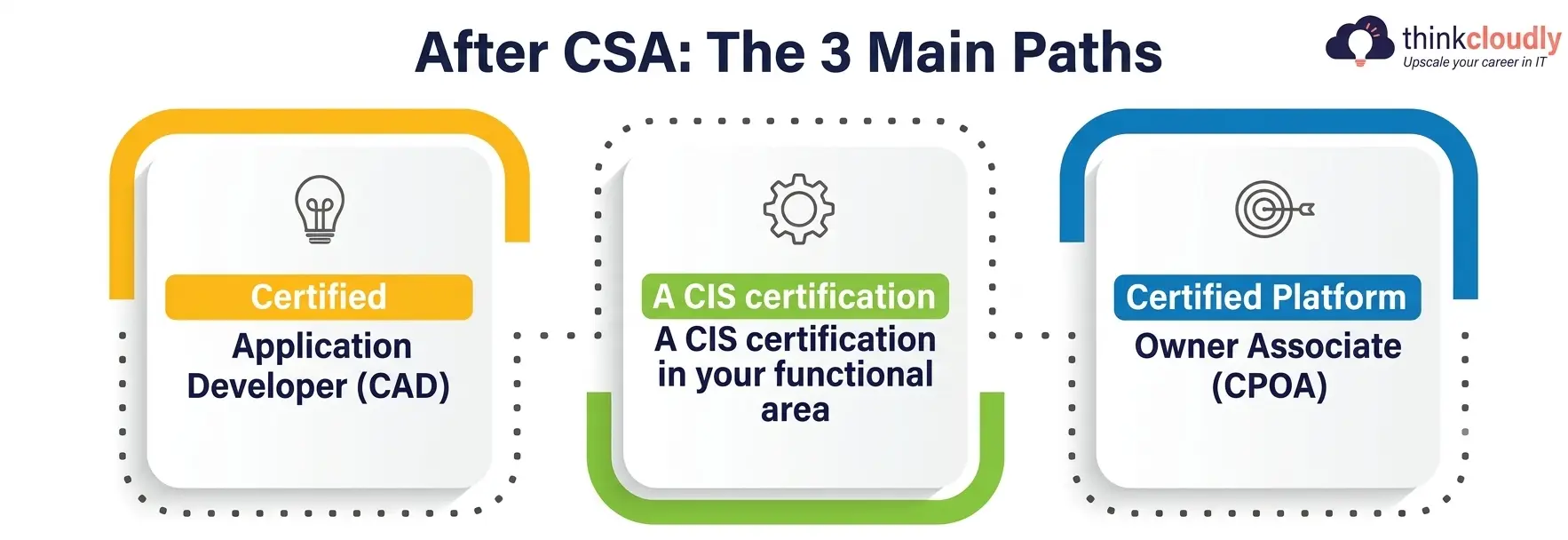
- Path 1—Certified Application Developer (CAD): The right move if your actual job involves writing JavaScript, building business rules, client scripts, script includes, or REST APIs inside the platform. This is pure application development territory.
- Path 2—A CIS certification in your functional area: The right move if you work inside a specific module—ITSM, CSM, HR Service Delivery, Discovery, or Security Incident Response—and want proof of deep implementation skill in that exact area.
- Path 3 — Certified Platform Owner Associate (CPOA): The right move if you’re drifting toward platform strategy, governance, and cross-team ownership rather than hands-on configuration. This sits closer to enterprise workflow management than to coding or module depth.
- A fourth, quieter option: Stop at CSA and go deep on system administration itself through hands-on project work instead of more exams if your role genuinely doesn’t require any of the above yet.
Most people reading this already know, in their gut, which of these four describes their actual day-to-day work. The exam choice should follow the job, not the other way around.
Path 1: Application Development (CAD) — For the Builders
If you spend more time in Script Includes than in the UI Builder, CAD is almost certainly your next ServiceNow certification. The exam blueprint splits roughly evenly across application design, UI construction, security, and automation—each weighted around 20%. That even split matters: you can’t lean entirely on scripting skills and skip the security and automation domains, because they carry equal weight.
A few things worth knowing before you commit to this path:
- CSA isn’t a hard prerequisite for CAD on paper, but every credible study-time estimate assumes you already have it, because CAD builds directly on CSA-level platform vocabulary.
- The exam costs $300 for a first attempt, with a $150 retake fee—identical pricing to CSA itself.
- CAD is rated noticeably harder than CSA by most prep resources, mainly because it tests applied scripting under scenario-based questions rather than straightforward recall.
- This path is the most direct route if your long-term goal is a developer or technical-lead role rather than an admin or functional-consultant track.
Application development inside ServiceNow isn’t like general web development—you’re working inside a platform with its own data model, its own scoped application rules, and its own security context. A ServiceNow certification in this track proves you understand those constraints, not just that you can write JavaScript.
Path 2: The CIS Track — For the Specialists
This is where most working ServiceNow professionals actually end up, because most jobs are tied to a specific module rather than general platform-wide system administration. A CIS certification (Certified Implementation Specialist) proves deep, hands-on skill in one functional area—ITSM, CSM, HR, Discovery, Security Incident Response, and more—and it assumes the baseline platform fundamentals from CSA are already solid.
Here’s the part that changed in January 2026 and trips people up constantly: ServiceNow introduced CIS-DF (Data Foundations) as a mandatory gate before seven specific CIS exams. Per SNReady’s full certifications guide, you cannot sit CIS-ITSM, CIS-Discovery, CIS-SM, CIS-HAM, CIS-SAM, CIS-SIR, or CIS-VR until you’ve passed CIS-DF first. Other CIS tracks—CIS-CSM, CIS-HR, CIS-FSM, CIS-RC, and several more—don’t require that gate.
A quick way to think about where you land:
|
If your module is… |
Do you need CIS-DF first? |
Typical focus |
|
ITSM, Discovery, Service Mapping |
Yes |
CMDB, IRE, data-driven service management |
|
Hardware or Software Asset Management |
Yes |
Asset lifecycle, data foundations |
|
Security Incident Response, Vulnerability Response |
Yes |
Security operations, shared data layer |
|
Customer Service Management, HR Service Delivery |
No |
Case management, functional configuration |
|
Field Service Management |
No |
Scheduling, dispatch, field workflows |
|
Strategic Portfolio Management |
No |
Portfolio and resource planning |
Every CIS exam runs $450 per attempt, with a $225 retake fee—noticeably steeper than CSA or CAD, which reflects how specialized each one is. This CIS certification path rewards people who already work daily inside one module, because the exam questions assume real implementation exposure, not textbook familiarity.
Path 3: CPOA — For the Strategists
CPOA leans away from configuration entirely and toward the question of how a platform gets governed across an organization. Its domains cover strategy, people, process, technology, data, and governance, with technology carrying the heaviest single weight at roughly 23%, based on SNReady’s certification path breakdown cited earlier.
If your work increasingly involves conversations about platform roadmap, cross-department adoption, or how workflow automation decisions get made rather than how one specific workflow gets built, this credential fits where you’re actually headed.
This track sits closest to enterprise workflow management as a discipline—it’s less about any single module and more about how an organization coordinates workflow automation decisions across every department using the platform.
People pursuing this ServiceNow certification are often already managing other admins or acting as the internal point of contact for platform strategy, even if their title hasn’t caught up yet. If that’s the itch you’re feeling, CPOA is effectively the credential that proves you can speak the language of enterprise workflow management to executives, not just explain a single workflow to fellow admins.
How to Choose the Right Path: 5 Questions to Ask Yourself
Before you register for anything, run through these honestly:
- Do I spend most of my week writing scripts, or configuring existing features? Scripts point toward CAD; configuration points toward a specialist CIS exam.
- Is my job tied to one specific module, or does it span the whole platform? One module strongly suggests CIS; broad platform work suggests CPOA or further system administration depth.
- Does my organization already run CIS-DF-gated modules like ITSM or Discovery? If yes, budget for CIS-DF as an unavoidable first step, not an optional extra.
- Am I being pulled toward strategy conversations instead of hands-on build work? That pull is usually a sign CPOA fits better than another technical exam.
- Can I realistically pass a 90-minute, scenario-heavy exam on applied scripting right now? If the honest answer is no, CAD prep time is better spent before booking than after failing once.
Answering these five questions usually makes the decision obvious within a few minutes, which is more than most people get from browsing forum threads for a week.
What Changed That Affects Every One of These Paths
A few platform-wide shifts apply no matter which direction you pick next:
- Exams now run through Pearson VUE instead of the older testing vendor, and you register and pay through ServiceNow University first.
- Exam vouchers were eliminated. Eligibility now comes exclusively from completing the required course—usually the Implementation or Advanced course, not just the Fundamentals version—before you can even purchase the exam.
- Retake rules loosened in one sense and tightened in another: there’s no cap on total retakes anymore, but you wait 3 days after a first miss, 30 days after a second, and 6 months after any attempt beyond that.
- CIS-DF had a temporary free-first-attempt promotion running into mid-2026, which is worth checking before you pay out of pocket for it.
None of this changes which path fits your job. It changes the logistics of actually getting into the exam room, and skipping this part is how people end up registering for a course they didn’t need or missing an eligibility window entirely.
Workflow Automation, Application Development, and Where the Real Demand Sits
If you’re choosing based purely on job-market demand rather than personal preference, here’s the honest picture: automation skills and scripting-heavy builder skills are both in strong demand, but they surface in different hiring conversations.
Builder-track roles tend to pay more per credential but require a steeper, more technical exam. Specialist implementation roles are more plentiful because nearly every enterprise running the platform needs people who understand their specific module deeply, not just generically.
Enterprise workflow management as a broader discipline — the CPOA end of the spectrum — is smaller in raw job count but growing as organizations mature their platform usage past the “we just automated one process” stage into genuinely coordinated, cross-department workflow automation. None of these three directions is objectively “better.” They’re answers to different questions about where you want your ServiceNow certification journey to go next.
A Personal Note
I’ll be honest about something most certification blogs won’t tell you: I picked my second ServiceNow certification for the wrong reason the first time. I went for CAD because it sounded more technical and, frankly, more impressive to say out loud in a meeting.
Six months later I realized my actual job was almost entirely CIS-shaped — deep inside one module, talking to the same stakeholders every week about the same workflow automation gaps.
I eventually circled back and earned the CIS credential that actually matched my work, and it was a far better use of my study hours than the first detour. If there’s one thing I’d tell you plainly: don’t pick your next exam to sound impressive. Pick it to match the Tuesday-afternoon version of your job, not the version you describe at a networking event.