





I’ve lost count of how many data engineers have messaged me some version of the same question this year: “I build pipelines all day. I already know Glue and Redshift cold—does an AWS machine learning certification actually change anything for my career, or am I just collecting badges?” It’s a fair question, and the honest answer is more nuanced than most certification marketing admits.
An AWS machine learning certification doesn’t turn a AWS data engineer into a machine learning engineer overnight. What it does is formalize a skill set you’ve probably already been building without realizing it, and it signals that to hiring managers who are scanning resumes for exactly that overlap.
That overlap is bigger than most people think. Data engineers already spend their days doing the unglamorous work that every machine learning model depends on—moving data, cleaning it, validating it, and shaping it into something a model can actually train on. An AWS machine learning certification simply puts a name and a scaled score on skills that were already half-built.
If you’re a data engineer weighing whether to add this credential to your resume, this guide walks through what the certification actually covers in 2027, how it connects to the AWS Glue ETL work you already do, and whether it genuinely moves your data engineering career path forward or just adds another line to a LinkedIn profile nobody reads closely.
It also helps you understand how an AWS Data Engineering Training can support your learning and career goals.
What Does “AWS Machine Learning Certification” Mean?
Here’s where a lot of confusion starts. There isn’t a certification literally titled “AWS machine learning certification for data “engineers”—that’s a description of intent, not an exam name. The credential most data engineers are actually asking about is the AWS Certified Machine Learning Engineer – Associate exam, and as of late September 2026, that exam is running a rebuilt version—MLA-C02—currently in beta. The earlier version, MLA-C01, retired for English-language testing on September 28, 2026, and anyone who already holds it keeps that certification valid through its original three-year window.
What matters for a data engineer specifically is who AWS says this exam is built for. The official candidate profile isn’t a research scientist or a PhD—it’s someone with roughly a year of hands-on experience with Amazon SageMaker AI and Amazon Bedrock, coming from a background that explicitly includes data engineering, alongside backend development or MLOps.
In other words, this AWS machine learning certification was designed with people like you in mind, not against you. If your day job already involves AWS Glue ETL jobs feeding a data lake, you’re closer to the target candidate than the word “machine learning” might make it sound.
It also helps to know this credential sits inside a wider family of AWS AI certification options, not as a standalone island. AWS offers a tiered path: a foundational AWS AI certification for people who want conceptual fluency without hands-on build work, and more technical associate-level exams—including this one—for people who actually build and operate pipelines. Understanding where the Machine Learning Engineer Associate exam sits in that lineup matters before you commit eight weeks of study time to it.
The 4 Exam Domains That Decide Your Study Plan
An AWS machine learning certification lives or dies on how well you understand its domain weighting, because that tells you exactly where your limited study hours should go. Here’s how the current exam breaks down:
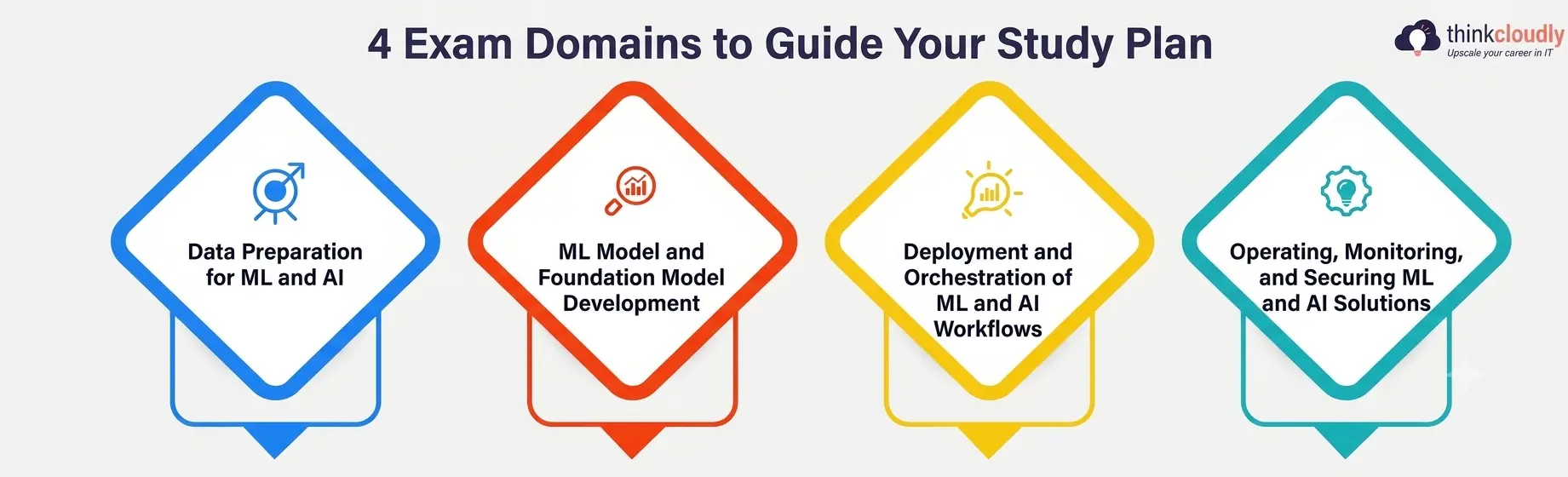
- Data Preparation for ML and AI—28%. This is the heaviest domain by a clear margin, and it’s also the one where a data engineer’s existing skills transfer almost directly. It covers ingesting, transforming, validating, and feature-engineering data using tools like AWS Glue ETL, Glue DataBrew, and the SageMaker Feature Store.
- ML Model and Foundation Model Development — 24%. This domain tests whether you can select and train traditional machine learning algorithms, then separately select, adapt, and fine-tune foundation models through Amazon Bedrock.
- Deployment and Orchestration of ML and AI Workflows — 24%. Here the exam checks whether you can build CI/CD pipelines for models and orchestrate multi-step workflows, often using Step Functions or Amazon Managed Workflows for Apache Airflow.
- Operating, Monitoring, and Securing ML and AI Solutions — 24%. This domain covers logging, drift detection, IAM policy design, and the audit trails that keep a model’s lifecycle compliant once it’s live.
Notice that data preparation is the only domain pulling ahead of the other three, and it’s also the domain where years of pipeline work already give data engineers a head start. That’s not a coincidence—it’s the clearest signal that this AWS machine learning certification rewards exactly the kind of work most data engineers have already been doing on AWS Glue ETL jobs for years.
How the Exam Format Actually Breaks Down?
Beyond the domains, the practical exam details matter for planning your timeline and budget. Here’s the current snapshot while the exam is in its MLA-C02 beta phase:
|
Detail |
Current Spec (MLA-C02 Beta) |
|
Exam code |
MLA-C02 |
|
Duration |
170 minutes |
|
Total questions |
85 (scored and unscored mixed) |
|
Question format |
Multiple choice and multiple response |
|
Passing score |
720 out of a scaled 100–1,000 |
|
Cost |
75 USD (temporary beta pricing) |
|
Validity period |
3 years |
|
Prerequisite experience |
~1 year hands-on with SageMaker AI and Bedrock |
Unanswered questions are scored the same as wrong ones, so there’s no strategic reason to leave anything blank. Once general availability replaces the beta period, expect the price to move back toward the standard Associate-level rate listed on AWS’s certification page and for additional exam languages to return.
5 Skills Data Engineers Already Bring to This Certification
A lot of data engineers underestimate how much ground they’ve already covered before opening a single study guide for an AWS machine learning certification. Here’s what usually transfers directly:
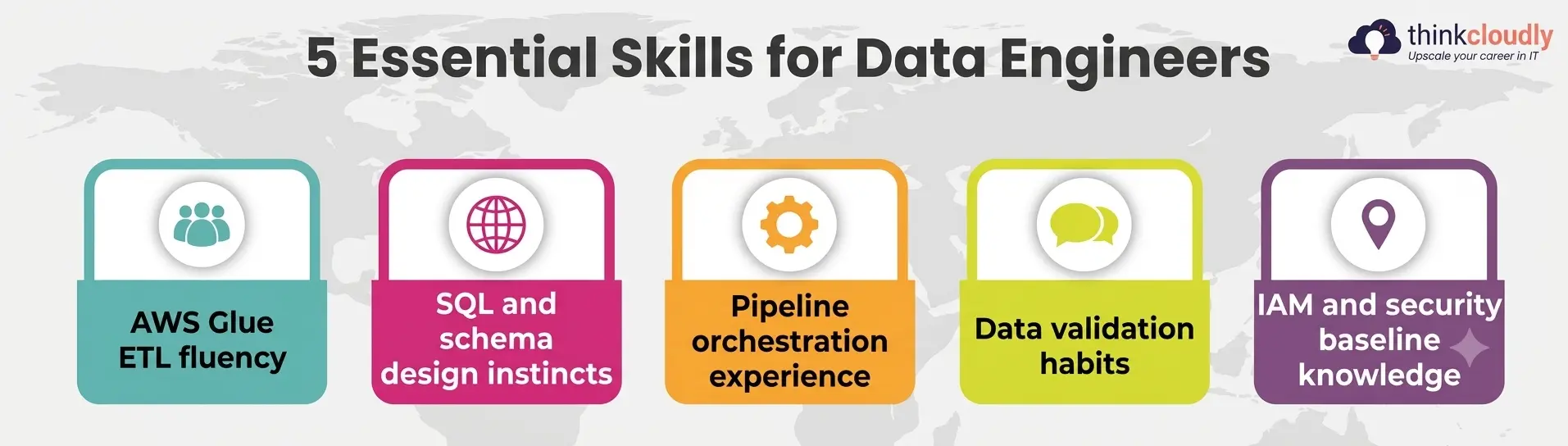
- AWS Glue ETL fluency. If you’ve built crawlers, managed the Glue Data Catalog, or scheduled Glue jobs, you already understand the backbone of Domain 1’s data preparation requirements.
- SQL and schema design instincts. Knowing how to structure clean, query-ready tables in Redshift or Athena translates almost directly into understanding feature readiness for machine learning algorithms.
- Pipeline orchestration experience. Anyone who has chained Step Functions or debugged a failing Airflow DAG already has a mental model for Domain 3’s deployment and orchestration content.
- Data validation habits. Data engineers who catch schema drift or bad records before they hit production are already doing an informal version of what Domain 4 tests formally.
- IAM and security baseline knowledge. If you’ve ever scoped a least-privilege policy for a Glue job or an S3 bucket, you’re not starting Domain 4’s security content from zero.
What data engineers typically still need to build is comfort with the model-side tools—training traditional machine learning algorithms inside SageMaker and understanding how foundation models get selected and fine-tuned through Bedrock. That gap is real, but it’s narrower than most people assume going in, and it’s exactly the kind of gap an AWS machine learning certification is designed to close.
It’s worth being specific about where the line actually sits, because “AWS Glue ETL experience” and “machine learning on AWS experience” aren’t the same muscle, even though they feel related. Glue gets data clean, structured, and cataloged—the AWS Glue documentation describes crawlers, the Data Catalog, and managed Spark jobs that do exactly that work at scale.
What Glue doesn’t do is train or evaluate a model; that’s SageMaker’s job, and it’s the part of the exam that genuinely requires new hours of practice rather than transferable instinct. Knowing which half of the pipeline you’re already strong in keeps you from either overstudying familiar territory or underestimating the model-side learning curve.
Where This Fits in a Data Engineering Career Path
This is the question that actually matters more than exam logistics: does this change your data engineering career path, or is it a resume line that quietly expires in three years?
The honest answer depends on direction. If you want to stay a data engineer and simply get better at supporting machine learning on AWS—building cleaner feature pipelines, understanding what a model actually needs from your data—this certification sharpens skills you’ll use immediately.
If you’re trying to pivot fully into a machine learning engineering role, it’s a meaningful signal, but it’s not a substitute for hands-on project work. Hiring managers weighing a data engineering career path pivot still want to see a real project: a model you trained, deployed, and monitored, not just a passing score.
There’s also a market signal worth naming honestly. Compensation data from 2027 shows AI and machine learning engineering titles commanding roughly a 26–29% premium over general mid-level data engineering roles in the US.
Broader labor-market research backs this up—job postings that list AI skills tend to pay noticeably more than those that don’t. That gap doesn’t close just because someone passes an exam, but it does explain why so many data engineers are treating an AWS machine learning certification as a deliberate step in their data engineering career path rather than an afterthought.
If your interest is broader than one certification, it’s worth knowing the alternative on the lighter end of the spectrum: the AWS Certified AI Practitioner is AWS’s foundational AWS AI certification, aimed at people who want conceptual fluency in generative AI and machine learning on AWS without the hands-on build requirement.
It’s a reasonable starting point if a year of SageMaker experience sounds out of reach right now and a sensible complement if you want a broader AWS AI certification sitting alongside the more technical Machine Learning Engineer Associate credential on your resume.
A Realistic Study Roadmap for Working Data Engineers
Here’s a rough eight-week plan for someone studying part-time around a full-time data engineering job:
- Weeks 1–2: Go deep on Domain 1 using tools you likely already touch — AWS Glue ETL jobs, Glue DataBrew, and Amazon Athena — then extend into SageMaker’s feature engineering tools, including the Feature Store.
- Weeks 3–4: Train a traditional model end to end in SageMaker, then separately explore foundation model selection and fine-tuning inside Bedrock, so you understand how machine learning algorithms differ from generative approaches in practice.
- Week 5: Build a small CI/CD pipeline for a model deployment using Step Functions, so Domain 3 isn’t theoretical.
- Week 6: Spend the week on monitoring and IAM security — CloudWatch dashboards, least-privilege roles, and audit logging for a model in production.
- Week 7: Take a full timed practice exam and trace every missed question back to a specific domain gap.
- Week 8: Close remaining gaps and do a final review of the official exam guide’s task statements.
The through-line across every week is the same: this isn’t a credential you cram for with flashcards. It rewards people who’ve actually touched the machine learning on AWS toolchain, not people who memorized definitions the night before.
A Personal Note
I’ll say something that most certification guides avoid saying plainly: I don’t think every data engineer needs this certification, and I think the ones who benefit most are the ones who were already curious about machine learning before they opened a study guide.
I’ve watched engineers chase an AWS machine learning certification purely because a job posting mentioned it, pass the exam, and then feel no different in their actual work six months later — because they never built anything beyond the practice questions.
I’ve also watched the opposite: engineers who trained one real model on real data, hit a wall, went and found the answer instead of guessing, and walked into the exam almost as a formality because the understanding was already there. If you’re going to spend eight weeks on this, spend most of it building something that breaks, not memorizing something that doesn’t.
The certificate is the artifact. The judgment you build getting there is the actual asset, and it’s the part nobody can test for directly but every good interviewer eventually finds.