




A recruiter at a London fintech told me something that stuck with me: she can fill a junior developer role in three weeks, but an AI engineering seat sits open for three months, not because candidates lack code, but because most of them freeze the moment a stakeholder asks “why should we trust this model’s output.”
That gap between writing a model and defending it in a room full of skeptical executives is exactly where the UK’s AI hiring market is stuck right now, and it’s why the debate over AI engineer skills has stopped being an academic one.
This isn’t a listicle of buzzwords to paste onto a CV. It’s a practical breakdown of what UK employers are actually testing for in 2026 AI interviews, which soft skills close the gap that pure coding ability can’t, and where the two genuinely overlap. If you’re a student, a career switcher, or an engineer wondering whether to specialize, this is the comparison you need before you pick a learning path.
Why This Skills Gap Became the UK’s Hottest Hiring Topic?
The numbers explain the urgency better than any opinion piece could. Specialist AI job postings in the UK rose 61% year on year, taking specialist AI roles from 1.3% to 2.2% of the entire job market, even as overall UK vacancies fell by 6.6%, according to PwC’s UK AI Jobs Barometer. That’s a market growing against the grain, and it tells you employers aren’t hiring broadly right now—they’re hiring narrowly and specifically for AI engineer skills they can’t find internally.
The wage data makes the stakes even clearer. The average wage premium for AI-related skills jumped to 34.2%, up from just 11% the year before, with some sectors like consumer markets paying a premium as high as 64%. That’s not a rounding error; that’s employers openly admitting they’ll pay a third more for someone who can actually deliver.
At the same time, the UK government’s own research warns that AI adoption could add up to £400 billion to the economy by 2030, but only if the current skills gap closes—a gap serious enough that major tech firms have committed to training materials for 7.5 million UK workers through 2030. Put plainly: the UK has the ambition and the budget, but not yet the people.
Technical AI Engineer Skills UK Employers Test For
Strip away the job-ad jargon, and most UK AI engineering interviews converge on the same handful of technical checkpoints. Here’s what actually gets tested, roughly in the order interviewers tend to probe it:
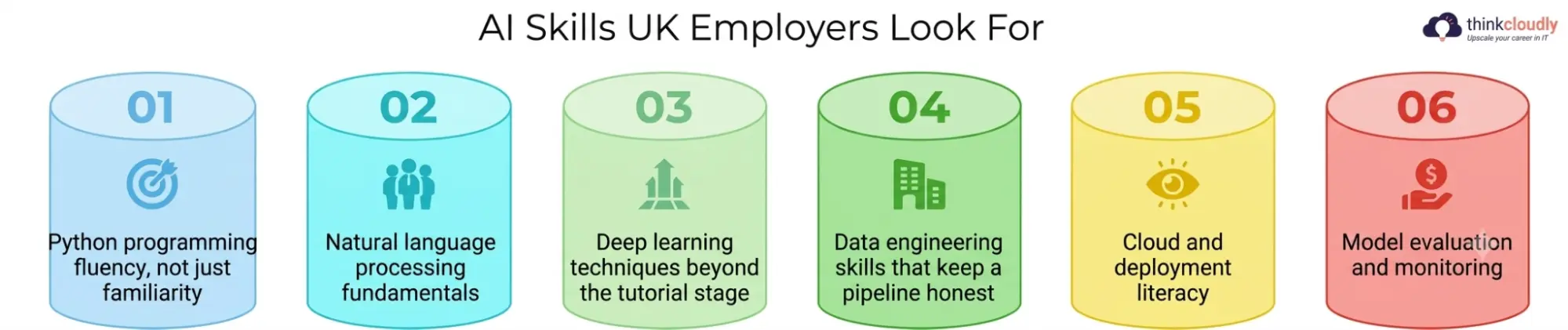
- Python programming fluency, not just familiarity. Nearly every AI job ad in the UK lists it as a baseline requirement, and interviewers now expect you to write clean, production-grade code under time pressure, not just complete a Jupyter notebook exercise at your own pace.
- Natural language processing fundamentals. With large language models dominating product roadmaps, this skill set has shifted from a specialist niche to a core expectation—tokenization, embeddings, and fine-tuning basics now come up in mid-level interviews, not just research roles.
- Deep learning techniques beyond the tutorial stage. Employers want to see that you understand why a model overfits, how regularization and transfer learning actually solve that, and that you can explain a training curve without reading from a script.
- Data engineering skills that keep a pipeline honest. A model is only as reliable as the data feeding it, so this discipline—schema validation, handling missing values, versioning datasets—now sits alongside modelling ability as a core requirement rather than an afterthought.
- Cloud and deployment literacy. Recent UK job-ad analysis shows Azure appearing in 46% of AI developer postings and Python in 44%, with AWS, GCP, and frameworks like LangChain close behind, confirming that cloud platform experience is now treated as inseparable from core technical ability.
- Model evaluation and monitoring. Being able to say a model is “accurate” isn’t enough anymore; teams want engineers who can define the right metric for the problem and catch drift before a customer does.
Here’s the part most self-taught learners miss: none of these skills exist in isolation. Clean inputs feed the models trained on them, and language-model work is worthless without code solid enough to put into production. UK hiring managers aren’t looking for six separate boxes ticked—they’re looking for someone who can move fluidly between all of them on the same project.
The Soft Skills Gap: Why Human Skills Now Outweigh Code
Here’s the part that catches a lot of technically strong candidates off guard. LinkedIn’s most recent skills research found that while demand for technical ability is still climbing, the skills actually closing job-offer gaps lean human: leadership and people management, stakeholder communication, and risk and compliance thinking all showed strong growth alongside the technical list, and the report stated plainly that technical expertise alone won’t close the UK’s AI skills gap.
PwC’s barometer backs this up from a different angle, noting the market is shifting toward “qualities that are harder to automate, such as judgement, creativity, and adaptability”—the exact qualities a model can’t yet replicate in itself.
So which soft skills actually move the needle for engineers in practice?
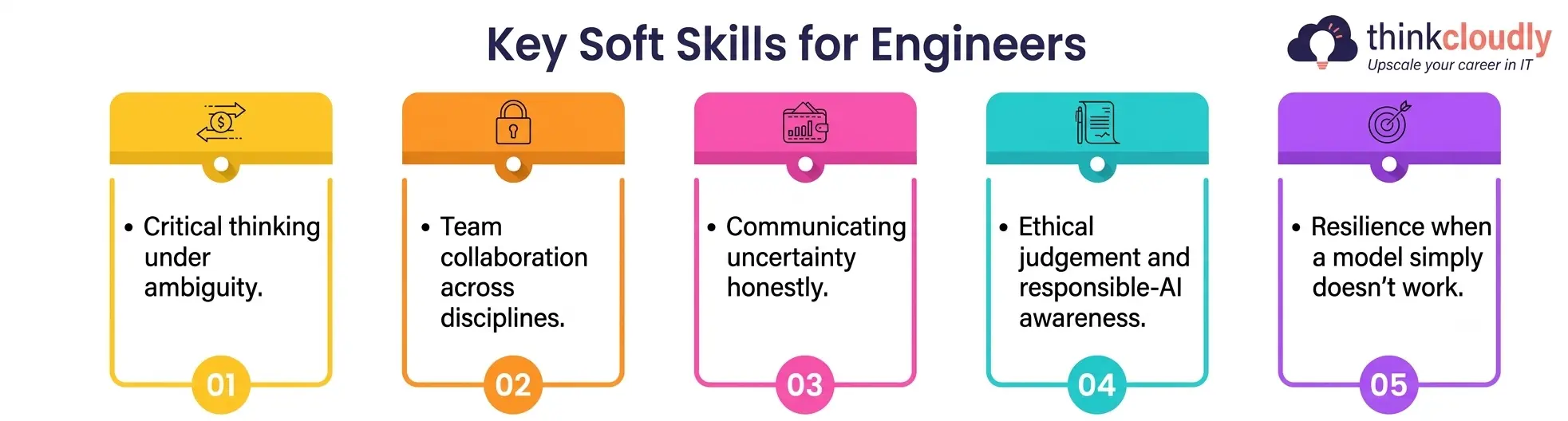
- Critical thinking under ambiguity. Training data is messy, requirements change mid-sprint, and a model that looked great in a notebook can quietly fail in production. This is what separates an engineer who panics at that moment from one who isolates the actual cause calmly, and UK interviewers now build case-study questions specifically to surface it.
- Team collaboration across disciplines. An AI engineer rarely works alone; working well with data scientists, product managers, and compliance teams decides whether a model actually ships. Employers increasingly ask behavioral questions aimed squarely at this history, not just a candidate’s solo project portfolio.
- Communicating uncertainty honestly. Telling a non-technical stakeholder “it’s 87% accurate, and here’s what that misses” without either oversimplifying or drowning them in jargon is a skill most bootcamps never teach, yet it’s often the deciding factor in whether a project survives its first review.
- Ethical judgement and responsible-AI awareness. With the UK’s AI Skills Framework explicitly covering responsible and non-technical skills alongside technical ones, employers expect engineers to flag bias or privacy risk themselves, rather than waiting for a compliance team to catch it after launch.
- Resilience when a model simply doesn’t work. Most prototypes fail before they succeed. Calm, methodical troubleshooting paired with the patience to iterate, rather than abandon the approach after one failed experiment, is what UK teams repeatedly say they struggle to find.
None of this means code stops mattering. It means AI engineer skills in 2027 are judged on a wider scoreboard than they were even two years ago, and candidates who ignore the human half of that scoreboard are the ones losing offers to less technically flashy competitors.
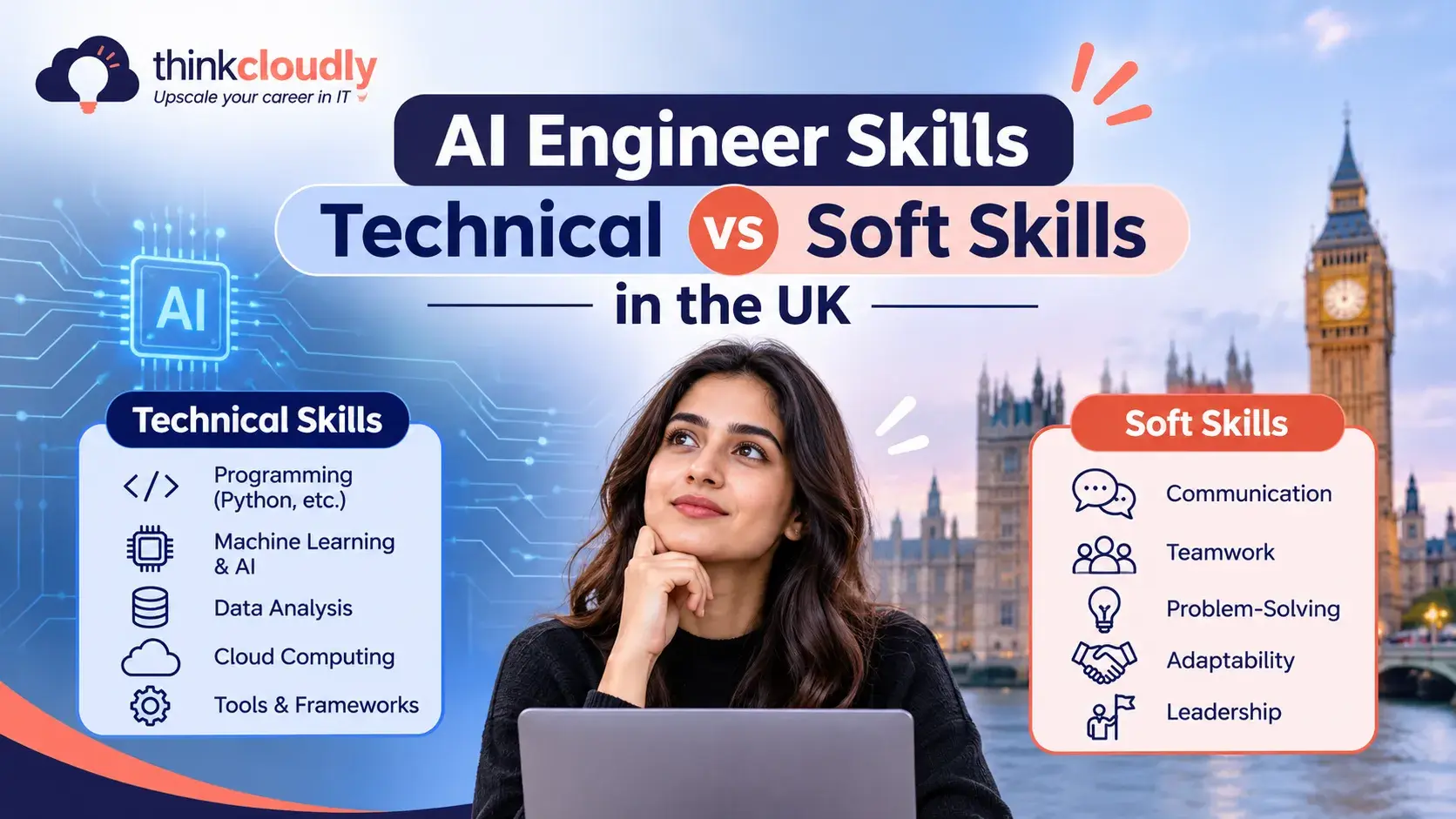
Technical vs Soft Skills: A Side-by-Side Comparison
|
Dimension |
Technical Skills |
Soft Skills |
|
Core examples |
Python programming, Natural language processing, deep learning techniques, Data engineering skills |
Critical thinking, team collaboration, communication, ethical judgement |
|
How it’s tested |
Live coding, system-design walkthroughs, take-home model tasks |
Behavioural interviews, case studies, stakeholder role-play |
|
Where it breaks down |
Overfitting, pipeline failures, poor deployment hygiene |
Siloed work, unclear risk communication, resistance to feedback |
|
UK hiring signal |
Required baseline for shortlisting |
Often the deciding factor between two shortlisted candidates |
|
How fast it can be learned |
Months, with structured practice |
Built over projects and real team exposure, slower to fake |
UK Salary Reality Check: What AI Engineer Skills Are Worth in 2027
Money talks, so here’s where the current data lands. Median UK salary for AI developer roles sits at roughly £80,000, rising to around £95,000 in London and reaching as high as £125,000 for fully remote positions, based on job-ad data covering the second half of 2026. The spread is wide—the 25th to 75th percentile runs from roughly £65,750 to £104,375—which tells you experience level and specialization matter enormously here, not just the job title on your contract.
What’s notable is which skills correlate with the top end of that range. Cloud platforms, large language model experience, and frameworks for building AI applications dominate the highest-paying postings, while generic “AI familiarity” without real coding depth or a solid data foundation tends to land candidates at the lower end of the band.
Looking toward 2027, the trajectory from PwC’s wage-premium data suggests this gap will widen rather than close, as employers keep paying more for people who combine technical depth with the judgement to apply it responsibly.
How to Build a Strong AI Skill Set If You’re Starting From Zero
If you’re mapping out where to start, sequence matters more than volume. Trying to learn everything simultaneously is how most self-taught learners stall out around month two.
- Get genuinely comfortable with Python programming first—not tutorial-following, but writing functions, debugging your own errors, and reading someone else’s code without panicking.
- Layer in foundational statistics and the math behind deep learning techniques before jumping into frameworks; understanding why gradient descent works saves you weeks of confused debugging later.
- Build two or three small end-to-end projects that force you to practice Data engineering skills—cleaning a messy public dataset is more instructive than any polished course dataset will ever be.
- Pick one specialization to go deep on, whether that’s natural language processing, computer vision, or recommendation systems, rather than staying a generalist with no depth anywhere.
- Join a study group, open-source project, or cohort-based course specifically to practise Team collaboration and Critical thinking in a low-stakes setting before you need those skills in a real job.
- Practice explaining your projects to a non-technical friend. If they can follow your explanation, you’ve genuinely understood the work; if you lean on jargon, you haven’t yet.
Common Mistakes UK Job Seekers Make Building Their AI Career
A few patterns show up again and again in CVs and interviews that otherwise look promising:
- Listing frameworks and libraries without being able to explain a single design decision behind using them.
- Treating specialised AI techniques as a certificate to collect rather than a skill to demonstrate on a real, messy dataset.
- Skipping Data engineering skills entirely because data cleaning feels unglamorous, then struggling the moment an interview task hands over imperfect data.
- Preparing only for technical rounds and getting blindsided by a behavioural interview built around cross-functional teamwork and conflict scenarios.
- Assuming clear-headed reasoning under pressure is something you either have or don’t, rather than something you can visibly demonstrate by narrating your thought process out loud during a live problem.
Fixing even two or three of these before your next application round will put you ahead of a surprising number of otherwise well-qualified competitors.
A Personal Note
I’ve watched a lot of smart people over-invest in the flashiest parts of this field — the latest model architecture, the newest framework release — while quietly under-investing in the unglamorous half: writing Python programming that someone else can maintain, explaining a failed experiment honestly instead of hiding it, or simply asking a teammate for a second opinion before shipping something uncertain.
The engineers who are thriving in the UK market right now aren’t necessarily the ones who learned the most frameworks fastest. They’re the ones who got comfortable saying “I don’t know yet, but here’s how I’ll find out” in front of a room that expected confidence. If there’s one thing I’d tell anyone starting this path today, it’s that your AI engineer skills will only take you as far as your willingness to be honestly wrong in public while you’re still learning. That discomfort doesn’t go away with seniority — it just gets easier to sit with.