





I’ve spent the last few years watching security teams try to keep pace with attackers who now move faster than any human analyst can manually track. That gap is exactly why threat detection training has shifted from a “nice to have” line on a resume to the baseline expectation for anyone serious about a cybersecurity career in the United States.
Employers aren’t just asking whether you understand firewalls and logs anymore. They want to know whether you can work alongside AI threat detection systems, interpret what the models are flagging, and make a sound call when the automation itself gets it wrong.
This piece is my attempt to lay out, plainly and without the usual recruiting-page fluff, what this discipline actually looks like once AI and automation are built into it, why it matters heading into 2027, and how a student or career-switcher in the USA can approach it without wasting a year on the wrong program.
Why Threat Detection Training Matters More Heading Into 2027?
The threat landscape didn’t get friendlier this year, and there’s no real reason to expect it will next year either. Attackers are using generative tools to write more convincing phishing emails, generate working malware variants faster, and probe defenses at a scale no manual SOC team can match.
According to IBM’s Cost of a Data Breach Report, the average breach now costs organizations $4.99 million globally, and AI-driven attacks have climbed 56% over the past year, with deepfake impersonation and AI-enabled malware leading that rise.
What’s changed the calculus for anyone picking a learning path is this: organizations that lean heavily on AI and automation in their security operations save an average of $1.93 million per breach compared to those that don’t, per the same IBM research. That’s not a marginal improvement.
It’s the difference between a contained incident and a front-page headline. For someone starting out, that single statistic should tell you everything about why a learning path built around AI and automation, rather than legacy manual methods alone, is the version worth your time and tuition money.
Cyber threat analysis used to mean reading through SIEM alerts one at a time. It still involves that, but the volume of alerts has grown so much that analysts now spend more time deciding which AI-flagged anomalies deserve escalation than they spend hunting manually. That shift is the entire reason training providers have rebuilt their curriculums around automation rather than treating it as an add-on module.
What AI Threat Detection Actually Changes About Cyber Threat Analysis?
AI threat detection isn’t magic, and good training programs are honest about that upfront. What it does well is pattern recognition at a scale humans can’t match: scanning millions of log entries, flagging behavioral deviations, and correlating signals across endpoints, network traffic, and identity systems in near real time. What it still struggles with is context—knowing whether an unusual login at 2 a.m. is a breach or just an employee working a late shift in a different time zone.
That’s precisely where this kind of human judgment still matters, and it’s why training that only teaches “how to use the AI dashboard” falls short. The SANS Institute’s 2026 AI survey found that 63% of security practitioners now report significant shortcomings in AI’s threat detection and response performance, up sharply from 45% just a year earlier, even as active AI use in security operations jumped from 50% to 78% in the same period. Read that twice. Adoption is accelerating faster than trust in the tooling, which means the humans running cyber threat analysis on top of the AI output are more valuable, not less.
Machine learning in cybersecurity works best as a force multiplier for a trained analyst, not a replacement for one. A model can surface the needle in the haystack. It still takes a person who understands these models well enough to know when the confidence score is misleading, or when an adversary has learned to blend in just below the detection threshold. That’s a skill set, and it has to be taught deliberately rather than picked up by accident on the job.
Core Skills You’ll Build in a Strong Threat Detection Training Program
Good programs in the USA tend to cover a consistent core, even when the branding or vendor differs. Here’s what to actually expect, laid out point by point:
- Log analysis and SIEM platform navigation (Splunk, Microsoft Sentinel, or similar)
- Behavioral analytics and anomaly-detection fundamentals
- Reading and tuning AI-generated alerts to cut down false positives
- MITRE ATT&CK framework mapping for real-world attack patterns
- Incident triage, escalation, and documentation under time pressure
- Basic scripting (Python or PowerShell) for automating repetitive detection tasks
- Network traffic analysis and packet-level investigation
- Cloud-native detection across AWS, Azure, and GCP environments
- Threat intelligence research and indicator-of-compromise (IOC) correlation
- Communicating findings to non-technical stakeholders clearly
A program that skips the scripting and cloud pieces is teaching yesterday’s job. Threat detection training that still only covers on-premises firewalls and manual log review is training you for a role that’s shrinking, not growing.
How Machine Learning in Cybersecurity Strengthens Security Risk Analysis?
Security risk analysis has always been about prioritization: which vulnerability gets patched first, which alert gets a human’s attention, which system matters most if it goes down. Machine learning in cybersecurity changes the inputs to that prioritization, not the underlying logic. Instead of a static risk matrix updated quarterly, models now adjust risk scores continuously as new threat intelligence and behavioral data come in.
This matters for anyone doing this kind of prioritization as part of their job, because it means the work is less about memorizing a checklist and more about judging whether a dynamically generated risk score makes sense given everything else you know about the environment. That’s a harder skill to teach than running a scanner, and it’s exactly where a strong training program earns its cost.
The practical upside is real. ISC2’s study found that AI is now the single most in-demand skill in the field for the second year running, cited as critical by 41% of the roughly 16,000 professionals surveyed, ahead of cloud security at 36%.
Nearly half of respondents said they’re building generalized AI knowledge largely on their own, through self-study, because formal training hasn’t caught up yet. That’s an opening for anyone willing to get structured instruction now rather than piecing it together later under deadline pressure.
Cyber attack prevention, in this context, stops being purely reactive. When a risk-scoring model flags a pattern consistent with early-stage reconnaissance—unusual scanning behavior, credential-stuffing attempts, lateral movement probes—a trained analyst can act on preventive measures before the attacker gets anywhere near sensitive data, rather than cleaning up after the fact.
Traditional vs. AI-Driven Threat Detection: A Side-by-Side Look
|
Aspect |
Traditional Threat Detection |
AI-Driven Threat Detection |
|
Alert volume handled |
Limited by analyst headcount |
Scales to millions of events per day |
|
Detection speed |
Hours to days for pattern recognition |
Near real-time anomaly flagging |
|
False positive rate |
High without tuning; manual review-heavy |
Lower when properly trained, but needs human oversight |
|
Skill focus |
Manual log review, signature matching |
Model interpretation, behavioral analysis, tuning |
|
Cyber attack prevention approach |
Largely reactive, post-incident |
Increasingly proactive, pattern-based intervention |
|
Training emphasis |
Tools and procedures |
Tools, procedures, and statistical and behavioral literacy |
The table isn’t meant to suggest traditional methods are obsolete. Signature-based detection still catches plenty of known threats efficiently. The point is that modern coursework in this field has to prepare you for both columns, not just one.
Cyber Attack Prevention Strategies Now Built Into Training Curriculums
Prevention-focused content has moved earlier in most training timelines, rather than being tacked on at the end as an afterthought. Current prevention-focused modules typically walk through zero-trust architecture principles, least-privilege access design, continuous authentication, and automated patch management—all areas where AI-assisted tooling has measurably sped up response times.
Good training programs also now teach adversarial thinking deliberately: understanding how attackers probe AI defenses themselves, since threat actors are increasingly testing detection models to find blind spots before launching a full campaign.
Training that treats prevention as a static checklist, rather than an evolving contest between attacker and defender tooling, leaves graduates underprepared for what they’ll actually face in a SOC.
This is also where this kind of program earns its value for career-switchers specifically. You don’t need five years of IT experience to understand zero-trust logic or how a patch management pipeline works. You need a program that teaches the concepts clearly and lets you practice in realistic, simulated environments before you’re doing it with production systems on the line.
Steps to Start a Career Through Threat Detection Training in the USA
If you’re mapping out how to actually get from “interested” to “employable,” here’s a realistic sequence:
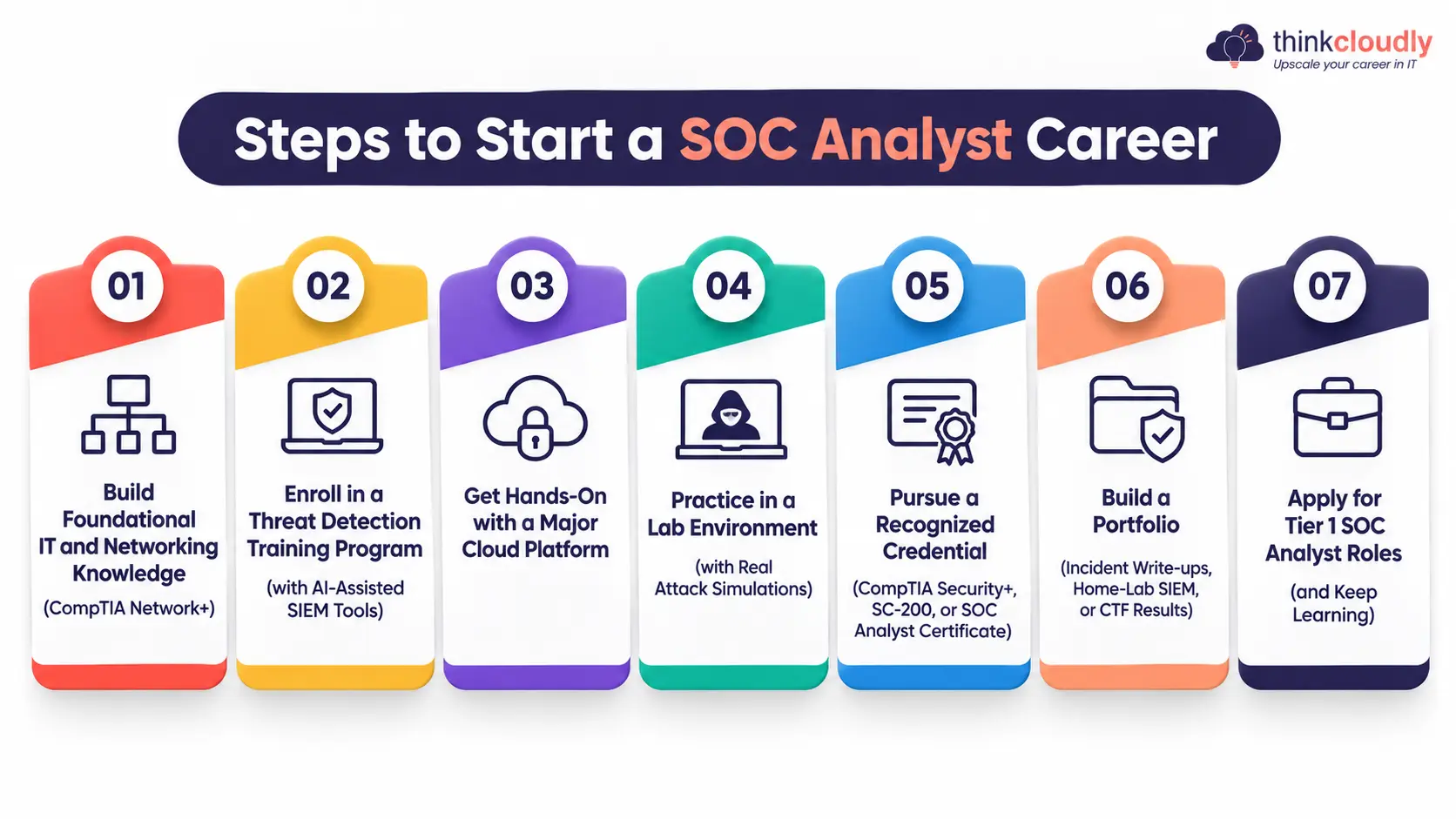
- Build foundational IT and networking knowledge (the CompTIA Network+ level is a reasonable baseline)
- Enroll in a threat detection training program that explicitly covers AI-assisted SIEM tools, not just legacy log review
- Get hands-on with at least one major cloud platform’s native security tooling
- Practice in a lab environment using real (anonymized) attack simulations, not just slide decks
- Pursue a recognized credential such as CompTIA Security+, SC-200, or a SOC analyst certificate tied to your training
- Build a small portfolio: documented incident write-ups, a home-lab SIEM setup, or a CTF (capture-the-flag) result
- Apply for Tier 1 SOC analyst or junior detection engineer roles and treat the first job as further training, not the finish line
A program that includes a lab component consistently outperforms purely theoretical courses when it comes to actual job readiness. Employers notice the difference in interviews almost immediately.
Career Outlook and Pay for Threat Detection Roles
The numbers back up the time investment. The U.S. Bureau of Labor Statistics projects information security analyst roles — the category most threat detection and SOC positions fall under — to grow 21% between 2025 and 2035, far faster than the average occupation, with roughly 14,100 openings projected per year over the decade. Median pay sits at $129,180 annually as of May 2025.
That growth rate isn’t evenly distributed, though. Candidates who can demonstrate security risk analysis skills alongside AI-tool fluency are the ones landing offers above the median, while candidates relying purely on entry-level certifications without any automation exposure are increasingly competing for a shrinking pool of manual-review roles. Choosing a program that reflects where the job market is actually heading, rather than where it used to be, is the difference between those two outcomes.
Choosing the Right Threat Detection Training Program
A few practical filters help separate serious programs from marketing pages dressed up as curriculums:
- Does it include a live or simulated SOC lab, not just video lectures?
- Are AI threat detection tools (not just traditional SIEM) part of the actual coursework?
- Does it teach enough machine learning in cybersecurity fundamentals that you understand model limitations, not just the interface?
- Is there a path to a recognized certification exam at the end?
- Do instructors have real SOC or incident-response experience, or are they purely academic?
Coursework without a hands-on lab is, frankly, closer to a documentary than a course. You can watch someone else do the work, but that’s not the same as building the muscle memory you need when an actual alert fires at 3 a.m. and someone’s waiting on your call.
A Personal Note
I’ll be honest about something most training providers won’t say out loud: no certificate or course alone makes you job-ready. I’ve mentored people who finished excellent programs and still struggled in their first SOC role because nothing fully replicates the pressure of a live incident with real stakeholders asking real questions. What good threat detection training does is shorten that adjustment period and give you the vocabulary and instincts to not freeze when it counts.
If you’re genuinely considering this field, don’t just chase the credential. Build the lab habit, ask uncomfortable questions about how the analysis actually works in every course you take, and stay a little skeptical of any tool — AI-powered or not — that promises to make the hard judgment calls for you. That skepticism, more than any single certification, is what employers are actually paying for.