




A former colleague, now running automation strategy for a logistics firm in Ohio, called me last month genuinely confused. Her team had rolled out two “AI tools” in one quarter—one wrote customer emails, the other rebooked shipments on its own when a port got delayed—and leadership called both of them simply “the AI.”
She wanted to know what to actually tell the board. That conversation is why this piece exists. The honest answer to agentic ai vs generative ai isn’t a trivia-night distinction; it decides what a tool is allowed to do without a human watching, and getting it wrong is how a “helpful assistant” ends up rerouting a shipment nobody approved.
This guide walks through agentic ai vs generative AI in plain terms, with a side-by-side table, real-world use cases, and a look at where this split matters most in security operations. If you remember one line by the end, make it this: one of these technologies answers, and the other one acts.
What Is Generative AI?
Generative AI is the technology most people already know, even without using that exact term. It’s the engine behind tools that write a paragraph, draft an image, or generate working code from a plain-English request.
Underneath nearly every mainstream generative AI product sit large language models (LLMs)—systems trained on enormous volumes of text to predict, token by token, what a coherent response looks like. Ask it a question, and it answers. Ask it to rewrite an email in a friendlier tone, and it rewrites it. What it doesn’t do, on its own, is decide to send that email or follow up three days later if nothing happens.
That single-response pattern is the entire personality of generative AI. It’s reactive by design: a person, or another piece of software, has to initiate every exchange and decide what happens next. That’s not an oversight—a tool that only responds when asked is easier to predict, audit, and control. For a huge share of business tasks, that constraint is a feature, not a flaw.
Agentic AI vs Generative AI: Where the Split Actually Happens
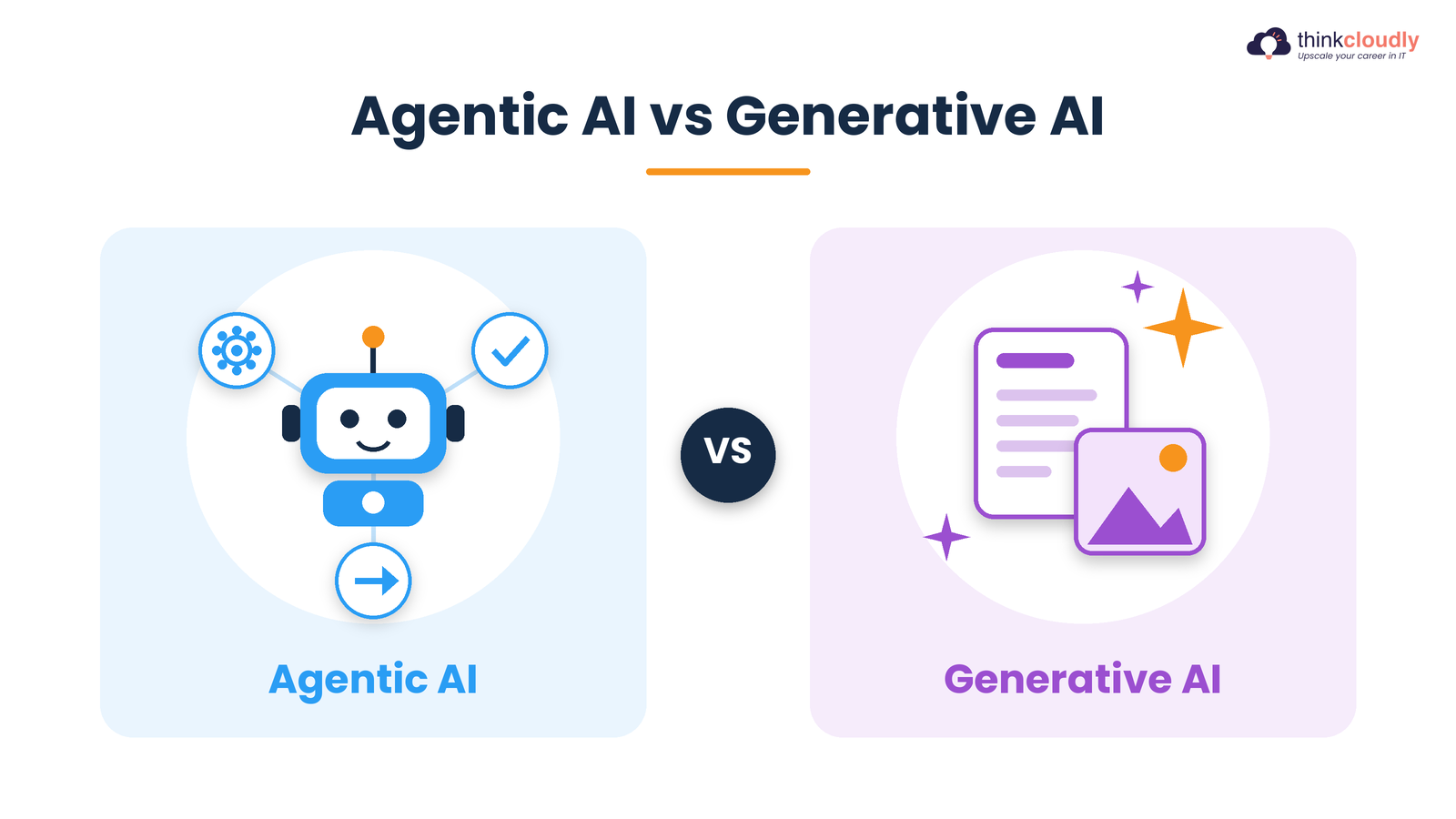
Here’s where the comparison stops being academic. Agentic AI takes the same underlying models — often the very same LLMs — and wraps them in a loop: perceive, decide, act, observe, and decide again.
It doesn’t wait for a fresh prompt at every stage. Given a goal like “keep this shipment on schedule,” an agentic system can check a tracking API, notice a delay, book an alternate carrier, and notify the relevant team—all from one initial instruction.
That difference is why agentic ai vs generative AI keeps coming up in boardrooms now rather than staying a developer-forum debate. According to Deloitte’s research on scaling AI agents, 74% of leaders surveyed across 24 countries expect their organizations to be using AI agents at least moderately by 2027, with 5% expecting agents to become a fully integrated, core part of operations. That’s a different ambition than “we use a chatbot for FAQs.” Autonomy, planning, and tool access are the real dividing line, not marketing copy.
Agentic AI vs Generative AI vs AI Agents: Untangling Three Overlapping Terms
Vendors throw around “AI agent,” “agentic AI,” and “generative AI” almost interchangeably, which is exactly why agentic ai vs generative AI vs. AI agents deserves its own section. These aren’t synonyms, and treating them that way is how teams buy the wrong tool. Here’s the breakdown, written so it drops cleanly into a slide or infographic:
-
Generative AI is the underlying capability—creating new text, images, or code from a prompt, built on LLMs trained to predict the next plausible output.
-
An AI agent is one specific system built to pursue a goal—the actual product or script running in your stack right now.
-
Agentic AI is the broader category of approach—systems designed around autonomy, planning, memory, and tool use, of which any AI agent is one instance.
-
The practical distinction: generative AI produces an output for a human to act on; an AI agent is a deployed instance of agentic AI; and agentic AI is the design philosophy enabling autonomous, multi-step action.
-
Why the confusion persists: software labeled “AI agent” is often a generative feature with a new name—what some analysts call “agent washing”—so asking what a tool can do unsupervised tells the two apart.
Keeping agentic ai vs generative AI vs. AI agents straight is less about vocabulary purity and more about one practical question before you sign a contract: is this thing answering me or acting on its own?
Agentic AI vs Generative AI vs Machine Learning: Where Each One Sits in the Stack
It’s worth zooming out one more level, because agentic ai vs generative ai vs machine learning is a question I get almost as often as the narrower comparison. Machine learning is the broad discipline of algorithms that learn patterns from data instead of hardcoded rules.
Generative AI is a branch of machine learning focused on producing new content rather than just classifying or predicting a number. Agentic AI, in turn, is a way of architecting systems on top of either—usually on top of generative models—so they plan and act rather than output a single response.
Thinking about agentic ai vs generative ai vs machine learning this way makes the hierarchy click: not every machine learning model is generative, and not every generative model is agentic, but every agentic system still depends on machine learning underneath to make decisions at each step.
A spam filter is machine learning without being generative or agentic; a chatbot drafting a reply is generative but not agentic; a system that drafts the reply, sends it, and checks for a response before deciding its next move is agentic—and still, underneath it all, machine learning doing the pattern recognition.
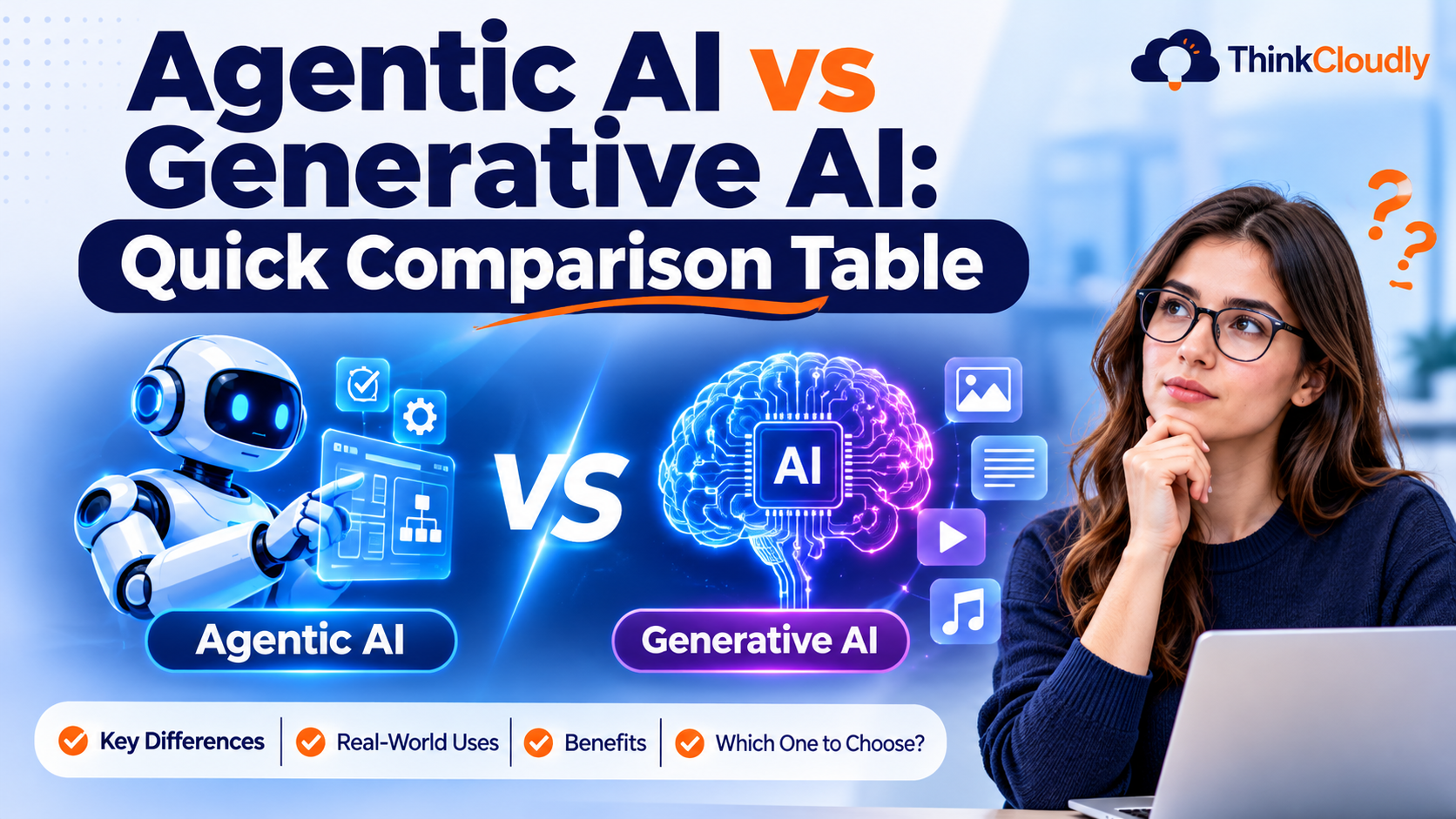
Agentic AI vs Generative AI: Quick Comparison Table
Sometimes the fastest way to settle this debate is to see it side by side rather than read another paragraph about it.
|
Factor |
Generative AI |
Agentic AI |
|
Core behavior |
Responds to a single prompt |
Pursues a multi-step goal |
|
Human involvement |
Needed at every step |
Needed to set the goal, then check in |
|
Decision-making |
None—it outputs, you decide. |
Plans, chooses actions, adjusts |
|
Tool and system access |
Typically none built in | Calls APIs, databases, other software |
|
Memory across steps |
Usually session-only |
Persists across the full task |
| Best suited for | Drafting, summarizing, brainstorming |
Monitoring, routing, multi-step workflows |
|
Risk profile |
Lower—output needs review before use |
Higher—actions can happen without review. |
|
Built on |
Large language models, diffusion models |
Often the same LLMs, orchestrated differently |
Read it as a spectrum, not a rivalry. Most organizations run both at once, frequently on the same underlying models, pointed at different kinds of problems.
Agentic AI Use Cases Across Industries in 2027
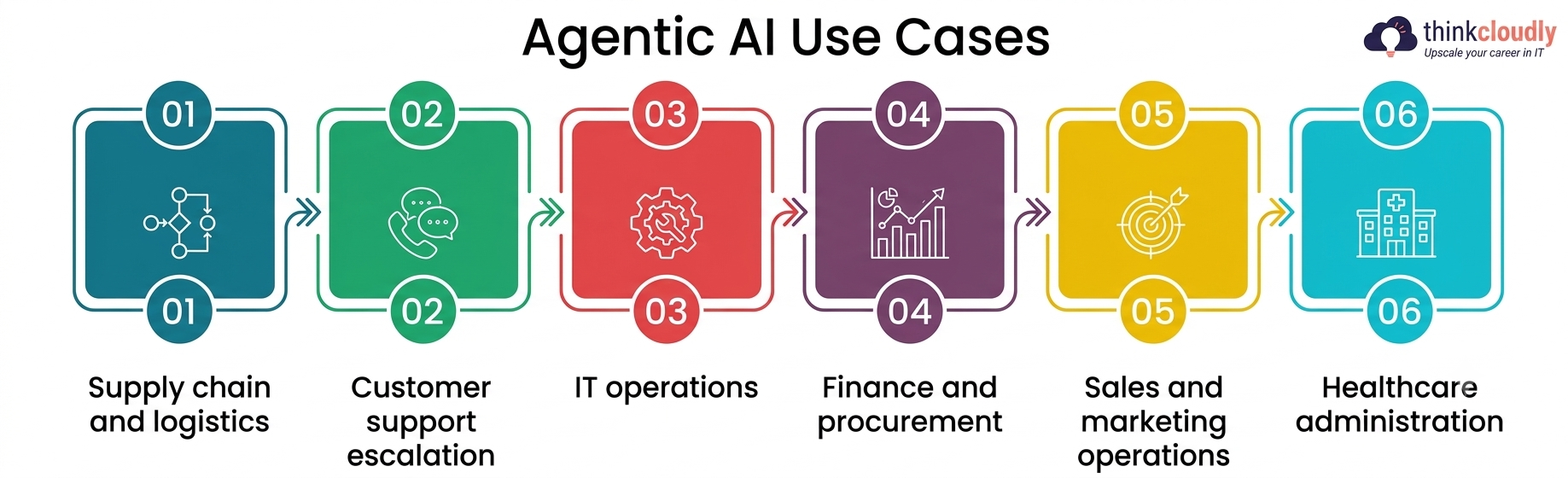
The theory only matters once you can picture it running somewhere. These agentic ai use cases are drawn from patterns showing up across real deployments now, laid out so the list drops straight into a one-page visual:
-
Supply chain and logistics—rerouting shipments and flagging disruptions before a human notices, the exact scenario that opened this piece.
-
Customer support escalation—triating a ticket, pulling account history, and looping in a person only when confidence drops below a threshold.
-
IT operations—detecting a failing server, restarting the right service, and opening a ticket only if the fix doesn’t hold.
-
Finance and procurement—reconciling invoices against purchase orders and routing exceptions to the right approver automatically.
-
Sales and marketing operations—qualifying inbound leads against a scoring model and adjusting outreach timing based on engagement.
-
Healthcare administration—checking insurance eligibility and scheduling follow-up appointments without a staff member touching each step.
If agentic ai vs generative AI vs. AI agents still feels like three overlapping circles rather than a clean hierarchy, revisit the terminology breakdown above before mapping a use case to a tool. What ties these agentic AI use cases together is one pattern: a goal gets set once, and the system handles the steps in between without a fresh instruction at each stage.
The firm expects more than 40% of current agentic AI projects scrapped by the end of 2027 over unclear returns and weak risk management, even as it projects agentic systems will handle 15% of routine business decisions by 2028. The lesson for anyone evaluating agentic ai use cases isn’t to avoid the technology; it’s to pick one narrow, well-bounded workflow first.
Agentic AI in Cybersecurity: Where the Stakes Get Real
No discussion of agentic ai vs generative AI is complete without a hard look at security, because this is where autonomy actually bites. Generative AI in a security operations center mostly helps an analyst write a clearer incident summary faster.
Agentic ai in cybersecurity is a different animal: a system that can investigate an alert, correlate it against other signals, and, in some deployments, isolate a compromised device or revoke a credential without waiting for a person to click “approve.”
That shift raises the stakes on both sides of the fight. Research from Arkose Labs, covered by Help Net Security, found defensive teams already leaning on autonomous systems for faster response, while cautioning that most organizations haven’t built the controls needed to tell legitimate autonomous activity apart from a hostile one impersonating it.
Attackers, the same research notes, are testing their own automation and switching tactics the moment a defense works—meaning agentic AI in cybersecurity isn’t a one-sided advantage by default; it has to be built and governed deliberately.
Practically, any team deploying agentic AI in cybersecurity needs stronger guardrails than a typical generative AI rollout: clear limits on unsupervised action, logging detailed enough to reconstruct every decision afterward, and a kill switch that works under pressure.
The data makes a similar point for enterprise deployments generally — the same autonomy that makes these systems useful is what makes oversight non-negotiable.
Large Language Models: The Shared Engine Behind Both Approaches
It’s easy to assume agentic AI and generative AI run on completely different technology, but that’s rarely true. Large language models sit underneath most of both; the difference isn’t the engine, it’s what gets built around it. A generative AI product hands an LLM a prompt and returns whatever it produces.
An agentic system wraps that same model in a loop that lets it call tools, check results, and decide on a next step — often using several LLMs in combination, one for planning, another for executing, another for reviewing the output before anything is acted on.
This matters because the leap from one to the other isn’t a technology swap — it’s an architecture decision. A team with LLMs already in a writing tool doesn’t start from zero to build something agentic; they need orchestration, tool access, and far more testing before anything runs unsupervised.
Understanding that the underlying models are a shared foundation, not a dividing line, is often the moment agentic ai vs generative ai finally clicks for people hearing the distinction for the first time.
Which One Should You Actually Use First?
If you’re deciding where to start, rather than which is theoretically superior, the answer is fairly simple. Start with generative AI for anything where a human is comfortable reviewing output before it goes anywhere — drafting, summarizing, first-pass analysis.
Move toward agentic AI only once you have a well-defined workflow with clear boundaries, a way to monitor what the system does, and a real cost to the manual process that justifies the added complexity.
Most teams burned by agentic AI didn’t fail because the technology was immature — they handed an agent too much scope before building guardrails to match. If agentic ai vs generative ai vs machine learning still feels like three overlapping circles rather than a clean hierarchy, revisit that breakdown before signing anything with “autonomous” in the pitch. Start narrow, and expand autonomy only after it earns trust over real runs, not a demo.
A Personal Note
I used to think the agentic ai vs generative ai debate was mostly semantic — a distinction consultants invent to justify a new slide. Watching what happened after my colleague’s shipment-rerouting agent quietly fixed three disruptions in its first week, without anyone escalating a single one, changed my mind.
The difference stops being academic the moment a system makes decisions nobody directly approved in real time. If you’re evaluating either technology this year, don’t start by asking which one is smarter. Ask who’s accountable when it’s wrong, and whether you’d explain its last ten decisions to someone who wasn’t in the room when it made them. That question, more than any benchmark score, tells you whether you’re ready for the one that acts on its own.