
Here’s a question worth sitting with for a second: would anyone trust a pilot who had only read about flying? Probably not, yet for years that is exactly how many people learned to become Scrum Masters: sitting through slide decks and memorizing definitions with no messy, real team to practice on.
That approach is fading fast. The global market for agile transformation services is projected to grow to roughly $57.78 billion in 2026, according to the 2026 market report, and that kind of growth pulls employers toward candidates who can prove they’ve actually run a sprint, not just describe one.
This is exactly why Scrum Master training built around real-world projects, rather than static theory, has become the format employers respect most this year.
Why Scrum Master Training Needs Real Projects, Not Just Slides?
Reading about a daily stand-up and actually running one for a team that has a real deadline, real disagreements, and a real product owner who keeps changing their mind are two completely different skills. Traditional courses often stop at definitions: what a sprint is, what a backlog is, what a burndown chart shows.
Good agile scrum training goes further, placing learners inside a simulated project where they have to facilitate a retrospective that actually surfaces an uncomfortable truth or mediate a disagreement between two developers about scope.
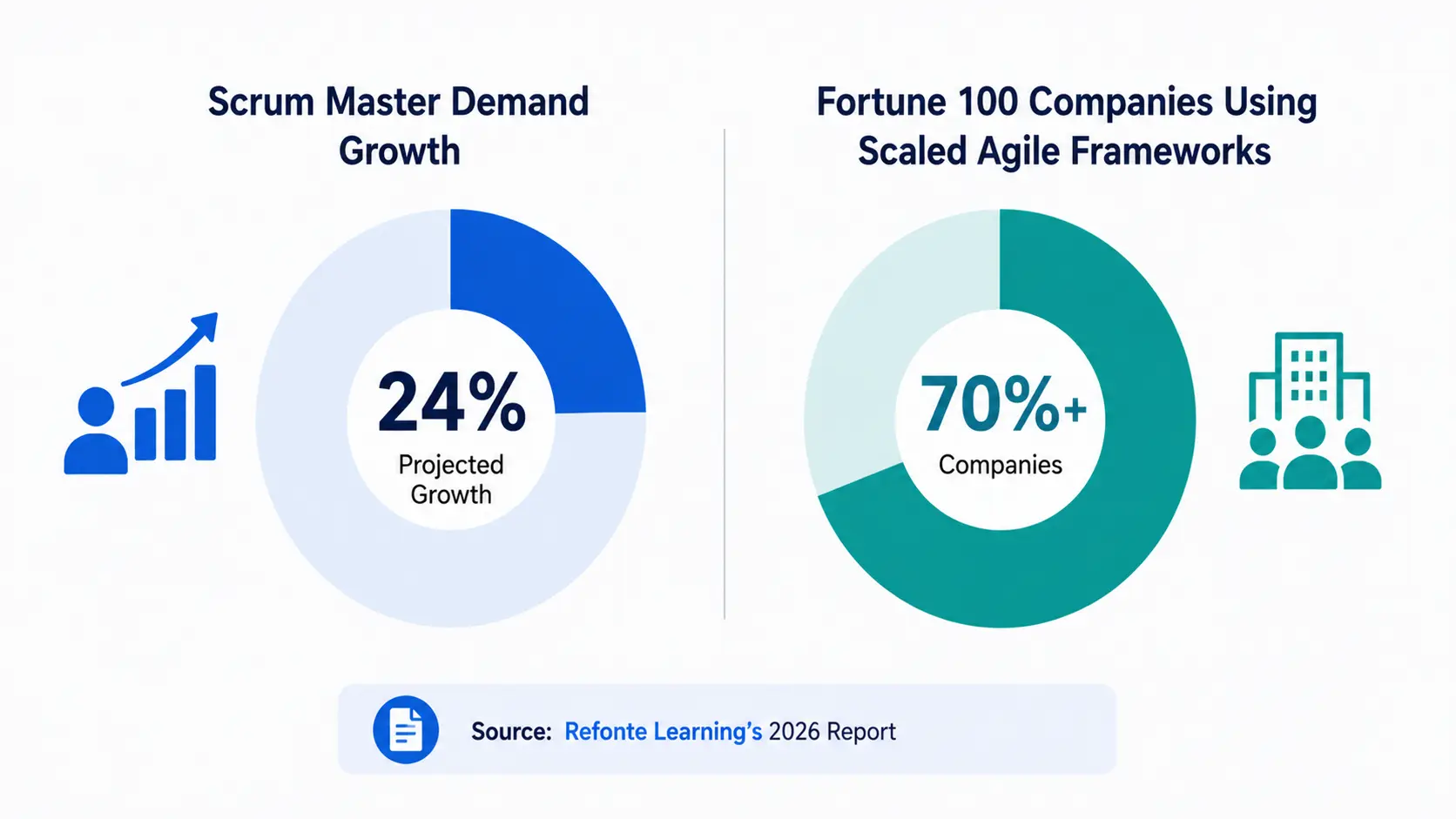
According to Refonte Learning’s 2026 report, demand for Scrum Masters is projected to grow by roughly 24 percent, and more than 70 percent of Fortune 100 companies now use scaled Agile frameworks to coordinate multiple teams. Training that never touches a multi-team scenario simply doesn’t prepare someone for that reality.
What Does Hands-On Scrum Master Training Actually Look Like?
Picture a cohort split into small teams, each one handed a fictional but realistic product brief: a mobile banking app redesign or a logistics platform that needs a new tracking feature. Over several weeks, learners run actual sprints against that brief.
They write user stories, groom a backlog, plan capacity, hold daily check-ins, and close each sprint with a genuine review and retrospective. Scrum Master Specialization describes this kind of applied learning directly, noting that participants build a portfolio of real project work, from timelines to issue tracking to communication plans, that they can later show an employer instead of just a certificate. That portfolio is often the difference between a resume that gets a callback and one that doesn’t.
|
Training Element |
Theory-Only Classroom |
Project-Based Scrum Master Training |
|
Learning format |
Lectures, slides, quizzes |
Live sprints on a simulated real project |
|
Team roles practiced |
Discussed in the abstract |
Rotated through in person: Product Owner, Developer, Scrum Master |
|
Conflict handling |
Rarely covered in depth |
Practiced through realistic team disagreements |
|
Certification readiness |
Focused on exam recall |
Focused on applied scenarios plus exam prep |
|
Portfolio at the end |
Usually none |
A shareable body of sprint artifacts and case work |
|
Confidence on day one of the job |
Often shaky |
Noticeably stronger, per learner feedback on Coursera |
Scrum Roles, Scrum Methodology, and the Agile Framework in Practice
No serious program can skip the fundamentals, but the way those fundamentals are taught matters enormously. Understanding the three Scrum roles, the Product Owner, the Developers, and the Scrum Master, means very little until a learner has actually stood in each one and felt the different pressures each role carries.
The same goes for the Scrum methodology itself: reading that a sprint is time-boxed is not the same as watching a sprint run out of time and having to make a real call about what gets cut. A strong program also situates Scrum inside the wider agile framework, showing how it relates to Kanban, Lean, and scaled approaches like SAFe, so graduates aren’t caught off guard when a future employer mixes methodologies.
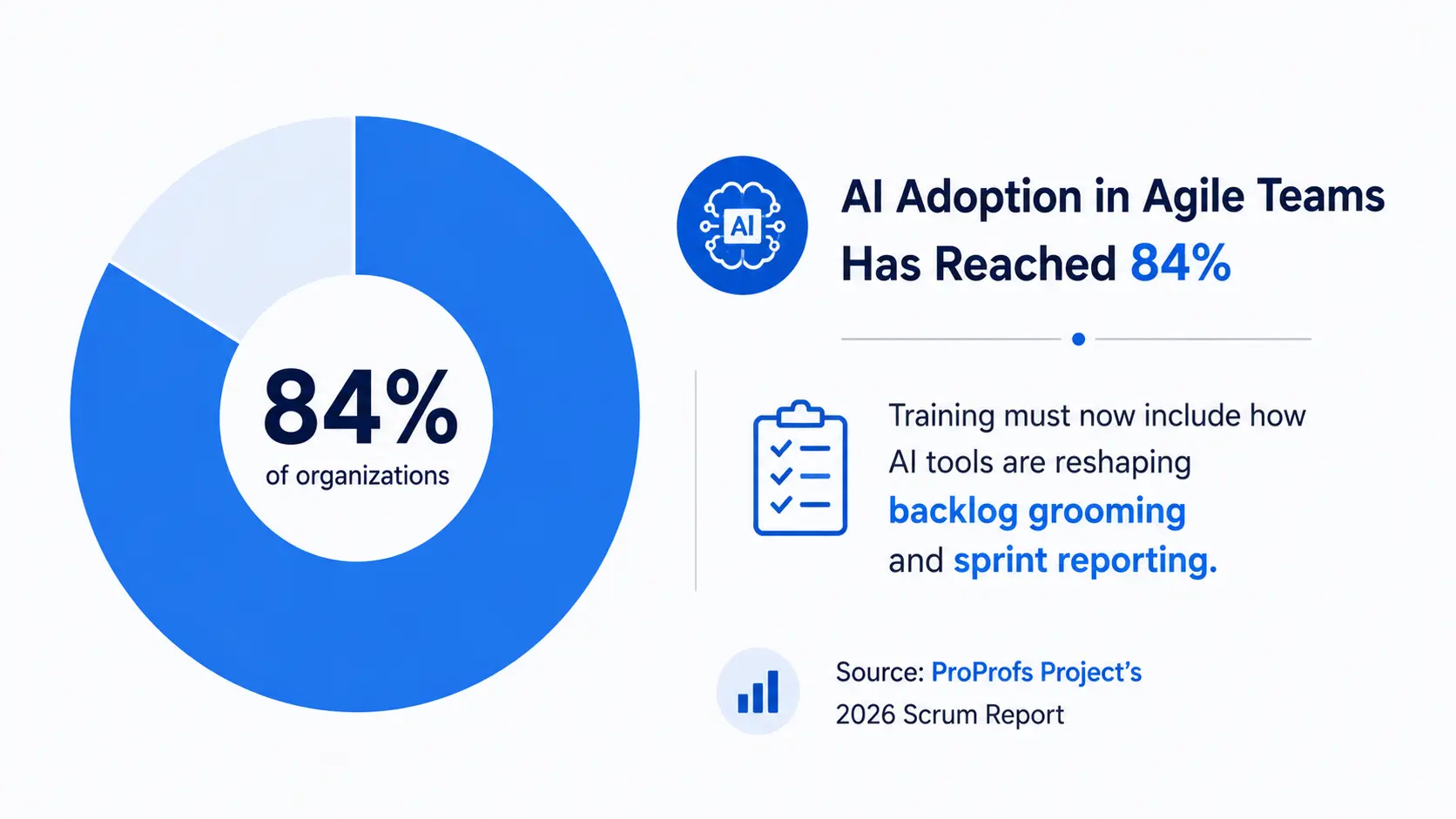
ProProfs Project’s 2026 Scrum report notes that AI adoption inside Agile teams has climbed to 84 percent of organizations, which means today’s training also has to touch on how AI tools are reshaping backlog grooming and sprint reporting, not just the classic Scrum mechanics from a decade ago.
How Agile Coaching Fits Into Scrum Master Training
A Scrum Master is not a project manager with a different title; the role leans heavily on facilitation and coaching, and that is exactly where many self-taught learners fall short. Good agile coaching teaches someone how to ask a question instead of handing out an answer, how to let a team struggle just long enough to learn something, and how to read the room when a retrospective has gone quiet for the wrong reasons.
Programs that pair learners with a mentor who has actually coached real teams give this skill room to grow in a way that reading a coaching framework never can. It is also one of the hardest things to fake in an interview, which is exactly why interviewers probe for it and exactly why this kind of coaching deserves real class time rather than a single afternoon session.
Choosing the Right Scrum Certification Training Program
Not every scrum certification training program is built the same way, and it is worth checking a few things before enrolling. Look for a curriculum that names specific project simulations rather than vague promises of “real-world experience.” Ask whether mentors have actually worked as practicing Scrum Masters or Agile coaches, not just as trainers.
Check whether the program prepares learners for a recognized credential, such as the Certified ScrumMaster path from Scrum Alliance or the Professional Scrum Master track from Scrum.org, alongside the hands-on work rather than instead of it.
Class Central’s 2026 directory of Scrum courses lists hundreds of options across providers, and the strongest listings consistently combine certification prep with real project delivery scenarios rather than treating them as separate tracks.
Why Does This Matter for Pay and Career Growth?
None of this is just about passing an exam. According to 2026 salary data, Scrum Masters in the United States now earn a median total pay of roughly $126,000 a year, and candidates who can point to real project work during an interview are consistently the ones who negotiate from a position of strength.
Employers are not just checking a box for a certificate; they want proof that someone can walk into a messy, real team on day one and add value immediately.
Conclusion
The case for Scrum Master training built around real-world projects is simple: teams don’t hire someone to recite the Scrum methodology from memory; they hire someone who can run a sprint, coach a struggling team member, and keep a backlog honest under pressure.
Programs that combine hands-on certification prep with genuine project simulations consistently produce graduates who walk into their first role with more confidence and a portfolio to prove their skills. Anyone comparing options this year should ask hard questions about how much of the course is actually hands-on before enrolling.
A Personal Note
I’ve sat through both kinds of training, the slide-heavy kind and the kind that threw me into a messy simulated sprint in week two, and the difference in how prepared I felt afterward was night and day. The theory-only course left me able to define terms; the project-based one left me able to actually run a retrospective when a team member was clearly frustrated and not saying why.
That contrast is really the whole case for agile scrum training built around real projects, summed up in one sentence. If there’s one piece of advice I’d pass on, it’s this: before signing up for any program, ask exactly how many real sprints you’ll run before you graduate.
That single question tells you almost everything about whether the training will actually prepare you for the job.