
Here’s a number that surprised me when I first calculated it: a single Scrum Master certification can range anywhere from $200 to nearly $2,500, and yet two people who spent wildly different amounts often end up in the exact same job, earning the exact same salary. So why does the price tag swing so much, and does spending more actually get you more?
I’ve trained agile teams for years, sat through several certification courses myself, and paid for exams out of my own pocket before an employer ever reimbursed me. This guide breaks down the real Scrum Master certification cost in 2026, what you’re actually paying for, and whether the return is worth it.
What Actually Drives Scrum Master Certification Cost in 2026?
Before comparing individual programs, it helps to understand why prices vary so much in the first place. Unlike a standardized university degree, Scrum certifications are issued by different organizations, each with its own pricing model, trainer network, and renewal rules.
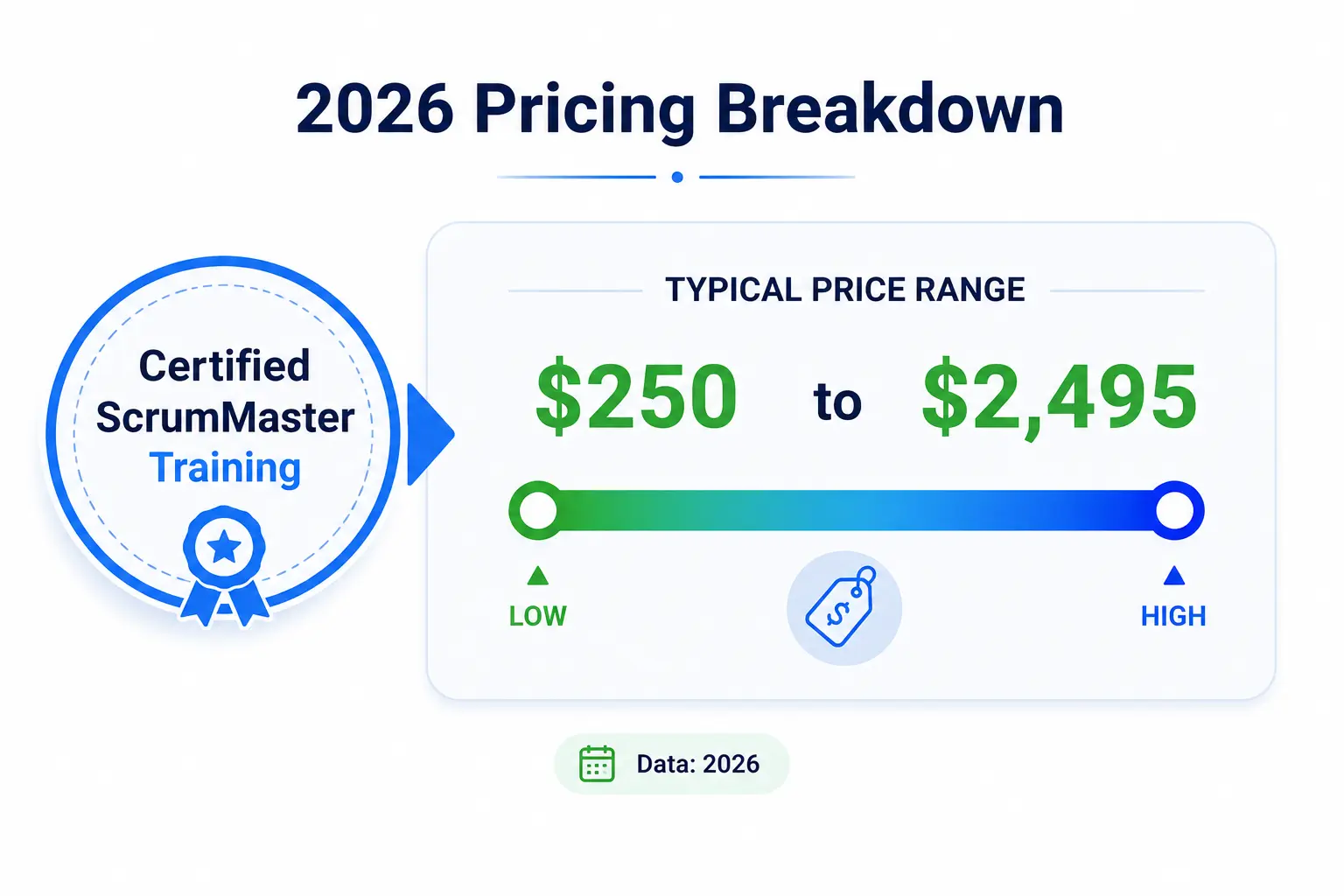
According to a 2026 pricing breakdown, Certified ScrumMaster training typically falls between $250 and $2,495, depending on the trainer’s reputation, class format, and region. That’s a massive range for what is, on paper, the same credential.
A few factors consistently move the needle: whether the course is instructor-led or self-paced, whether the trainer is based in a high cost-of-living city, whether the price bundles exam retakes and membership, and how many years of renewal fees you’ll be locked into.
This is the piece most first-time candidates miss when they’re only looking at the sticker price of the Scrum Master Certification Cost advertised on a training provider’s homepage—the advertised figure is often just the starting point once retakes and renewal cycles are added in.
Whether you eventually pursue a professional scrum master credential through Scrum.org or a CSM through Scrum Alliance, the underlying cost drivers — trainer quality, location, and bundled extras — stay remarkably similar across providers.
CSM Certification Cost vs Other Certification Paths
The Certified ScrumMaster (CSM) from Scrum Alliance remains the most recognized entry point, but it’s rarely the cheapest. Because Scrum Alliance requires a mandatory 16-hour, instructor-led workshop, the CSM certification cost is baked into the training fee rather than charged as a separate exam.
A successful CSM course graduate has the exam fee covered by their Certified Scrum Trainer, and the credential can support salaries placed around $128,000 for the role in the US, with senior titles like “agile coach” reaching higher.
That single difference — no biennial renewal — is why so many budget-conscious professionals treat PSM I as the lowest-friction way into the field, even though a professional scrum master credential from Scrum.org carries slightly less brand recognition among traditional US recruiters compared to CSM.
Here’s a side-by-side snapshot to make the comparison easier:
|
Certification |
Typical 2026 Cost | Renewal |
Mandatory Training |
|
CSM (Certified ScrumMaster) |
$500 – $2,000 | $100 + 20 SEUs / 2 yrs |
Yes, 16 hrs |
|
PSM I (Professional Scrum Master) |
$200 | None, lifetime |
No |
|
CSPO (Certified Scrum Product Owner) |
$445 – $1,200 | $100 / 2 yrs |
Yes, 16 hrs |
|
SAFe Scrum Master (SSM) |
$995 – $1,295 | $100 / yr |
Yes, 2 days |
|
A-CSM (Advanced CSM) |
$800 – $1,200 | $175 + 30 SEUs / 2 yrs |
Yes |
It also helps to remember that the CSM certification cost you see advertised almost always excludes the mandatory renewal cycle, so factor that recurring $100-plus-SEUs commitment into your real total before you compare it against a lifetime-valid alternative.
Even within this table, the Scrum Master certification cost you personally pay depends heavily on whether your employer sponsors the course, whether you catch an early-bird discount, and which trainer’s calendar you book.
CSPO Certification, SAFe Training, and Other Paths Worth Knowing
Not everyone stays a Scrum Master forever. Many professionals eventually branch toward product ownership or enterprise-scale agile work, and the pricing landscape there looks a little different.
A CSPO certification teaches the product owner side of Scrum — backlog management, stakeholder alignment, and value prioritization — rather than team facilitation. Because there’s no exam requirement, the entire cost sits in the two-day workshop itself, which typically runs between $445 and $900.
A second CSPO certification track exists under the SAFe umbrella (SAFe POPM), aimed specifically at product people working inside large, multi-team enterprises. If your organization runs on the Scaled Agile Framework rather than plain Scrum, you’ll likely need SAFe training instead of, or in addition to, a Scrum Alliance credential.
SAFe training for the Scrum Master track costs noticeably more upfront — $995 to $1,295 for the course itself — because it requires a full two-day session led by a licensed SAFe instructor and comes with an annual (not biennial) renewal fee.
I generally recommend it only when your company has explicitly adopted SAFe, since the framework-specific vocabulary doesn’t transfer cleanly to a plain Scrum team.
Is the Investment Worth It? Real ROI Numbers for 2026
This is the part that actually matters more than the price tag: what does certification return on that spend?
A 2026 salary analysis from staffing firm KORE1 found that certified Scrum Master titles earned $143,262, compared with $126,892 for the broader Scrum Master category—roughly a 13% premium, though the report shows almost no measurable gap using its own methodology.
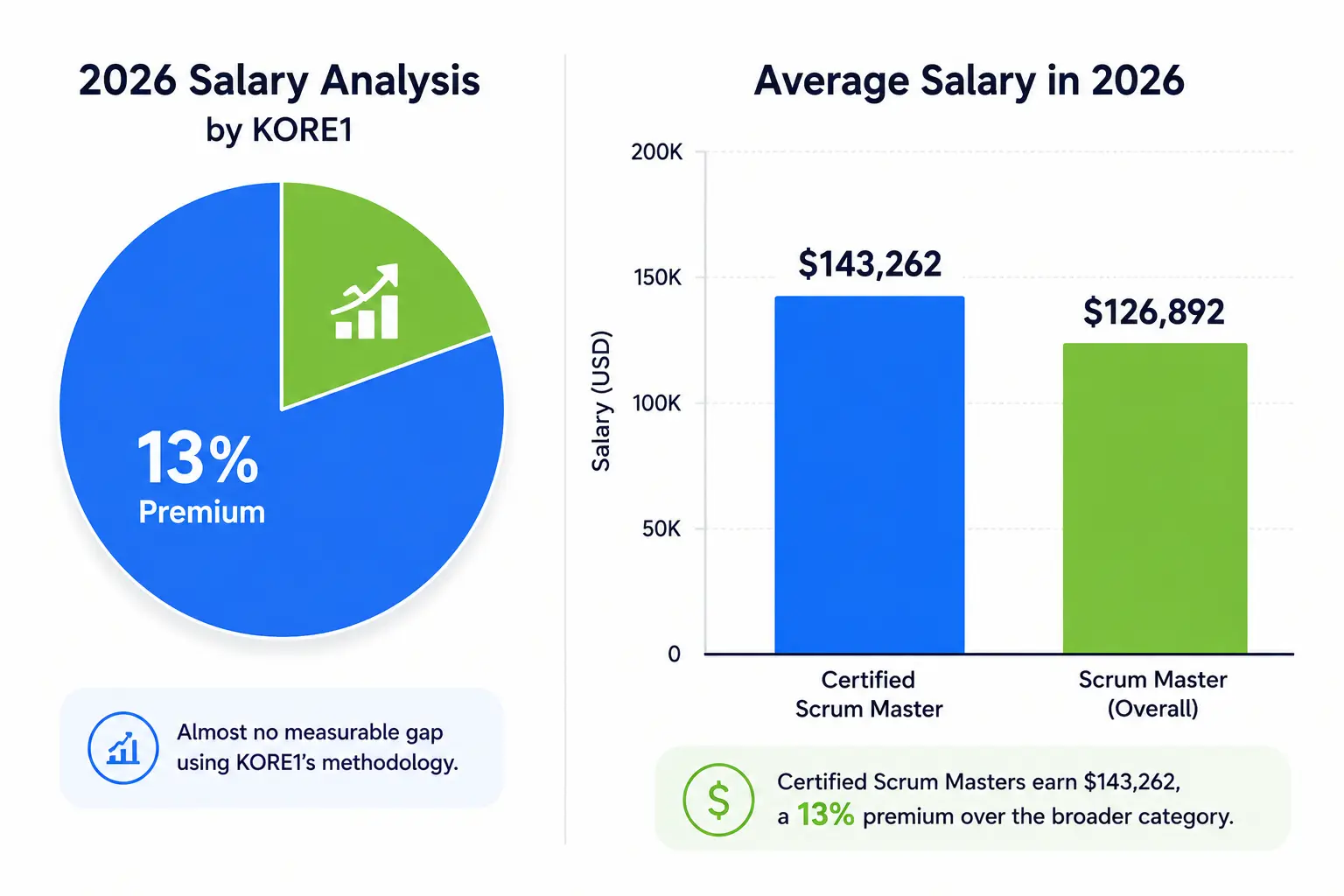
That inconsistency across salary databases is worth sitting with before you assume certification alone guarantees a raise. A separate 2026 report puts it more conservatively, estimating that certified Scrum professionals earn roughly 20–24% more than uncertified peers, while cautioning that the gap likely reflects experience as much as the paper credential itself.
The same analysis calculates a simple return: a $200 PSM I exam fee against a conservative $5,000–$12,000 annual salary uplift is one of the strongest cost-to-benefit ratios in the agile certification space.
Separately, data aggregated from various sources shows PSM I holders earning in the $90K–$120K range, reinforcing that even the cheapest path carries genuine hiring weight. These numbers help answer the real question behind Scrum Master certification cost decisions: does the money spent translate into measurable career return?
When professionals ask whether the CSM certification cost is justified over a cheaper alternative, the honest answer is only if your target employer explicitly values the Scrum Alliance brand or requires it in the job posting.
What none of these numbers capture is the softer ROI: certification often shortens the interview process because it signals baseline competence to a recruiter scanning hundreds of resumes. It won’t replace real facilitation experience, but it does get your application past the first filter more consistently.
My Personal Experience With Certification Costs
When I first budgeted for my own Scrum Master path, I underestimated how many hidden line items would show up after the “headline” course price. A few lessons from going through it myself, organized by the mistakes I actually made:
1. The renewal fee ambush
I paid for my CSM course and mentally closed the topic—then two years later got an email about SEUs and a $100 renewal fee I hadn’t budgeted for. Always calculate certification as a recurring cost, not a one-time purchase.
2. Choosing a trainer based on price alone
My first course was the cheapest option I could find, and it showed—thin case studies, no real facilitation practice. My second certification, at a higher price point, included live simulations that I still use in retrospectives today. Price and quality aren’t always correlated, but rock-bottom pricing is rarely a coincidence.
3. Underestimating exam retake fees
I passed on my first attempt, but a colleague of mine didn’t, and the extra $25–$200 (depending on the certifying body) caught them off guard mid-job search.
4. Assuming one certification would be enough
I eventually added a CSPO certification on top of my original Scrum Master credential, mainly because job postings kept asking for both. That second course paid for itself within four months once I was eligible for hybrid Scrum Master/Product Owner roles.
5. Not asking my employer to pay
In hindsight, I should have asked HR about training reimbursement before self-funding my first course — many companies budget for this and simply never advertise it. Looking back, I’d still pay the CSM certification cost again given how the credential opened doors early in my career, but I’d negotiate reimbursement first and shop around trainers instead of booking the first course I found.
How to Choose the Right Certification for Your Career?
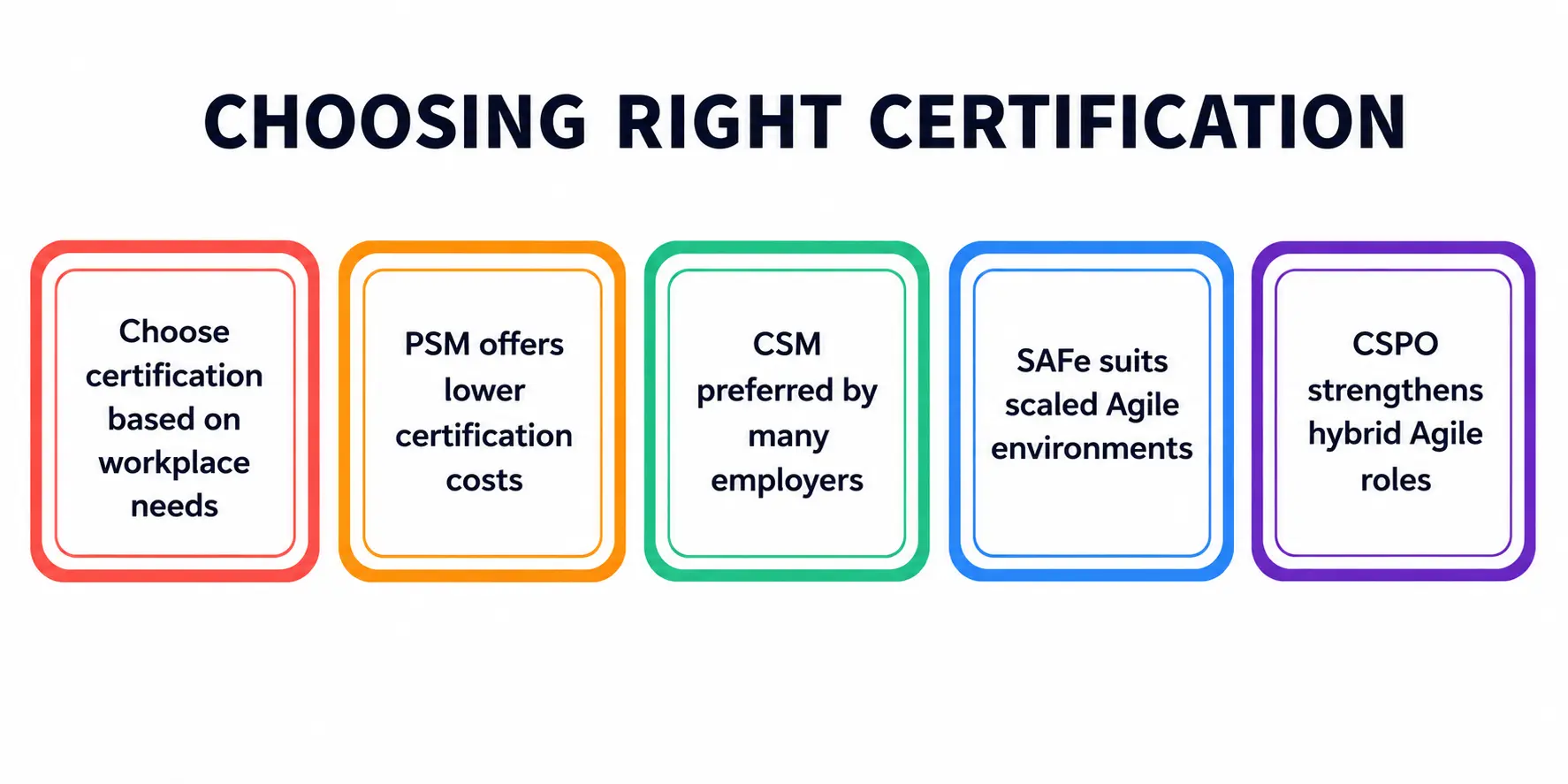
If you’re weighing options, match the certification to your actual working environment rather than to whichever one shows up first in search results. A professional Scrum master credential from Scrum.org makes sense if you want the lowest upfront Scrum master certification cost and don’t need Scrum Alliance’s networking ecosystem.
CSM makes sense if your target employers explicitly list it in job descriptions, which many still do, particularly in the US and UK markets. And if your workplace has already adopted the Scaled Agile Framework, SAFe training stops being optional and becomes close to mandatory, regardless of price.
If your role increasingly touches backlog ownership rather than pure facilitation, adding a CSPO certification on top of your existing Scrum Master credential can round out your profile for hybrid job postings.
Conclusion
There’s no universal “best” answer here—the right Scrum Master certification cost for you depends on your budget, your target employer, and whether you’re optimizing for the cheapest credible entry point or the most widely recognized brand name.
What the 2026 data makes clear is that the certification itself rarely determines your ceiling; how you apply it in real team settings does. Whichever path you choose — CSM, PSM, CSPO, or SAFe — treat the fee as an investment with a renewal clock attached, not a one-time purchase, and budget accordingly.
If you’re comparing options, ThinkCloudly runs live Scrum Master and Product Owner training with certified trainers, and beyond the certification itself, students get access to real project simulations, retrospective templates, and post-course mentorship to help apply what they’ve learned on an actual team.