






A cloud engineer’s job used to be fairly predictable: provision the infrastructure, keep it secure, keep it running, and move on to the next ticket. That job description barely survives contact with 2027. Workloads now carry models that need serving, retraining, and monitoring, and the person closest to the infrastructure is usually the one asked to make that happen.
This is exactly why AI skills for cloud engineers have stopped being a nice-to-have and started showing up as a line item in job descriptions that, two years ago, only mentioned networking and storage.
The shift isn’t a prediction anymore—it’s already measurable. Gartner’s research found that through 2027, 80% of the engineering workforce will need to upskill to work alongside generative AI, and a separate Gartner survey of 300 engineering leaders found that 56% of them already rank AI/ML engineer as the single most in-demand role on their teams.
Cloud engineers sit in an unusually good position to absorb that demand, because much of the plumbing AI workloads need—compute scaling, storage tiers, networking, identity—is plumbing they already own. What’s changed is that owning the plumbing is no longer enough on its own.
This piece walks through why that shift is happening now, what AI skills for cloud engineers actually look like in practice, and how to build them without starting a second career from scratch.
Why Cloud Computing Skills Alone No Longer Cut It in 2027?
Traditional cloud computing skills—provisioning, scaling, securing, and monitoring infrastructure—are still the foundation of the role. Nobody is arguing that a cloud engineer should stop knowing how a VPC works. But job postings are stacking a second layer on top of that foundation, and the data shows it clearly:
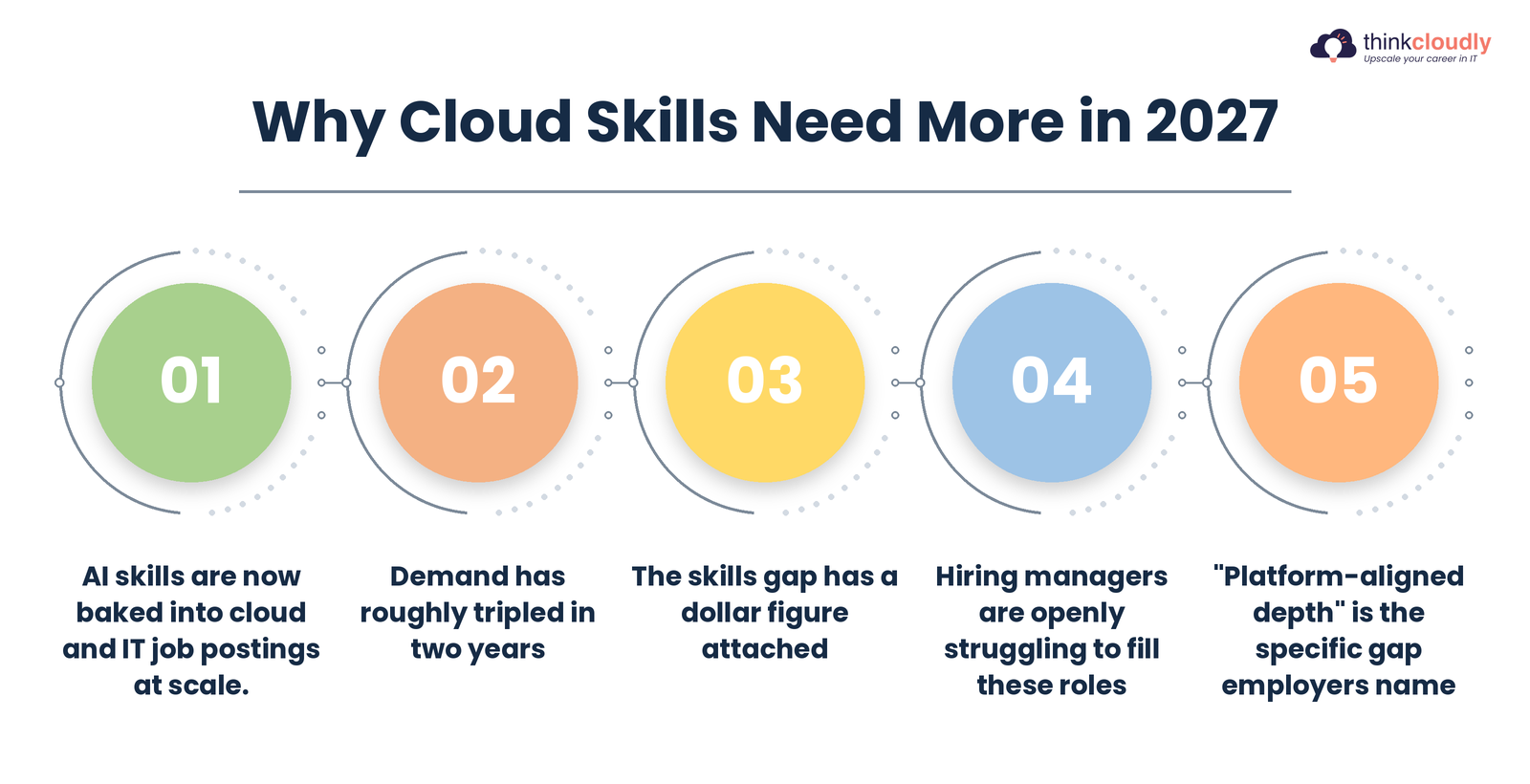
- AI skills are now baked into cloud and IT job postings at scale. An ICT jobs report cited by Fierce Network found that 78% of the 50 ICT roles it examined now require some form of AI skill, with employers also expecting more years of experience attached to those skills than in other industries.
- Demand has roughly tripled in two years. Employers now seek AI expertise in about three times as many job postings as they did two years earlier, with generative AI openings climbing from almost nothing in 2021 to thousands today.
- The skills gap has a dollar figure attached. IDC estimates that AI-related skills shortages could cost the global economy up to $5.5 trillion, a number that keeps upskilling budgets from getting cut even when other line items do.
- Hiring managers are openly struggling to fill these roles. A 2026 ManpowerGroup survey found 72% of employers report difficulty filling open technical positions, and Robert Half’s research separately placed AI and machine learning at the top of its list of hardest-to-find skills, just ahead of cloud architecture itself.
- “Platform-aligned depth” is the specific gap employers name. IDC Group VP Dr. Amy Loomis described the shortage not as a lack of generalists but as a lack of professionals with deep, hyperscaler-specific expertise—precisely the lane cloud engineers already occupy.
Put plainly: cloud computing skills get a candidate through the door, but they rarely get a candidate the whole offer anymore. Employers are now screening for the layer above infrastructure—the part where a cloud engineer understands what’s running on top of what they built. That doesn’t mean cloud computing skills matter less; it means they’re no longer the finish line.
In 2027, AI skills are becoming essential for cloud engineers as organizations increasingly rely on intelligent automation, predictive analytics, and AI-powered security solutions. Learning AI helps professionals improve cloud infrastructure management, optimize performance, and identify potential security threats. Enrolling in a Cloud Security training program can help aspiring professionals develop practical cloud security skills, understand AI-driven threat detection, and prepare for emerging career opportunities in cloud computing and cybersecurity.
The Data Behind the Demand for AI Skills for Cloud Engineers
It helps to look at which specific titles and competencies are growing fastest, rather than treating “AI skills” as one vague category. The same ICT jobs report broke this out by title and skill, and a few results stand out directly for anyone working in infrastructure:
- AI infrastructure engineer roles grew 124% year over year, making it one of the fastest-growing job titles the report tracked, right alongside AI/ML engineer (up 145%) and NLP engineer (up 186%).
- Multi-agent systems knowledge grew 245%, reflecting how fast production AI has moved from single models to coordinated systems that need real infrastructure behind them.
- Responsible AI implementation grew 256%, and AI governance grew 150%, both of which increasingly fall on whoever manages the environment the models run in, not just the data science team.
- LinkedIn’s 2026 Skills on the Rise report put AI engineering at the very top of its fastest-growing skills list, ahead of operational efficiency and AI business strategy, and found that job postings requiring AI literacy had grown more than 70% year over year.
- The talent pipeline hasn’t kept pace. The same ICT report flagged a “critical” gap across 14 in-demand skill areas, where current talent supply meets only about 30% of employer demand.
This is the clearest evidence yet that AI skills for cloud engineers aren’t a side specialization — they’re becoming one of the fastest-growing requirements inside the infrastructure role itself. A cloud engineer who can explain autoscaling but not how it behaves differently under GPU-bound inference traffic is increasingly the candidate who gets passed over, even with a strong resume otherwise.
AWS Machine Learning Services vs Azure and Google Cloud AI Tools
Most cloud engineers already have a home platform, and the good news is that AI skills for cloud engineers don’t require abandoning it—each major provider has built AI tooling directly into the infrastructure layer engineers already manage. Here’s how the three leading ecosystems currently compare:
|
Platform |
Core AI/ML Offering |
What It Means for a Cloud Engineer |
|
AWS |
AWS machine learning services such as SageMaker, Bedrock, and the newer AI-focused certification tracks |
Direct integration with the compute, storage, and IAM layers engineers already manage; AWS now offers five dedicated AI certifications, including a 2026 Business Strategist track. |
|
Microsoft Azure |
Azure AI Foundry and Cognitive Services |
Strong fit for engineers already managing enterprise identity, security, and governance inside Microsoft-stack environments |
|
Google Cloud |
Vertex AI and Gemini-based tooling |
Favors engineers working in data-heavy, analytics-first environments with large-scale pipeline needs |
AWS machine learning services deserve particular attention because of how directly they tie into infrastructure a cloud engineer already touches daily. SageMaker, for instance, isn’t a separate data science sandbox anymore—it depends on the same networking, autoscaling groups, and storage classes engineers configure for every other workload.
According to AWS’s own announcement, professionals holding an AWS AI certification earn salaries up to 47% higher across technical roles, and the company now offers more than 330 free and subscription-based AI learning resources through AWS Skill Builder.
One AWS partner quoted in that announcement put the gap bluntly: “We are seeing a lack of expertise to help deploy, maintain, and monitor “models”—which is a cloud engineering problem as much as it is a data science one.
The practical takeaway isn’t that engineers need to master all three ecosystems. It’s that whichever platform an engineer already runs, there is now a direct, learnable path from “I manage this infrastructure” to “I can also support AI in cloud computing environments running on top of it.”
MLOps Tools Every Cloud Engineer Should Know in 2027
If AI skills for cloud engineers have a center of gravity, it’s MLOps — the discipline of taking a model from a notebook to a production environment that behaves reliably under real traffic. This is where cloud engineering and machine learning overlap almost completely, because deploying a model well requires exactly the skills engineers already have: versioning, monitoring, rollback, and scaling.
A few categories worth knowing:
- Pipeline orchestration tools, which automate the steps between a trained model and a deployed endpoint, so retraining doesn’t require manual intervention every time.
- Model monitoring and observability tools, which track drift, latency, and accuracy decay, the same way infrastructure monitoring tracks CPU and memory—except the failure mode here is a model quietly giving worse answers, not a server going down.
- Feature stores and versioned data pipelines, which solve the problem of a model behaving differently in production than it did in testing because the underlying data shifted.
- Container and orchestration layers, since most production ML deployments today run on Kubernetes-based infrastructure that cloud engineers are already fluent in.
- Cost and resource governance tools, because GPU-bound inference workloads can quietly multiply a cloud bill in a way traditional compute rarely do.
None of this requires a cloud engineer to become a data scientist. MLOps tools are built specifically to let infrastructure specialists own the deployment and reliability side of machine learning without needing to design the model itself.
That division of labor is exactly why employers are hunting for engineers who already understand infrastructure and are willing to learn a handful of new tools, rather than training a data scientist to learn infrastructure from zero.
Becoming an AI Infrastructure Engineer: What Changes Role to Role
“AI infrastructure engineer” has become one of the fastest-growing titles in the market for a reason—it describes almost exactly what a strong cloud engineer already does, with AI workloads added to the scope. The shift from a general cloud role to this one tends to follow a consistent pattern:
- Compute planning changes in shape. Instead of planning for steady-state web traffic, the role now plans for GPU availability, batch inference spikes, and training jobs that can run for hours or days.
- Monitoring expands beyond uptime. Watching for model drift and output quality now sits alongside the usual latency and error-rate dashboards.
- Security scope widens. Protecting a model endpoint, its training data, and its prompt inputs introduces attack surfaces that didn’t exist in a traditional web application.
- Cost conversations get more technical. GPU pricing, spot capacity, and inference-per-request economics become part of the job, not a separate finance concern.
- Collaboration shifts toward data science and ML teams, rather than only toward application developers, which changes how technical trade-offs get communicated day to day.
None of this demands a computer science PhD. It demands the same instincts a good cloud engineer already has, pointed at a new category of workload — which is really the whole story behind why AI skills for cloud engineers are spreading so fast through job descriptions right now.
How to Build AI in Cloud Computing Expertise Without Starting Over?
The most common mistake engineers make when they decide to build AI in cloud computing expertise is treating it like an entirely new career path. It isn’t. A few starting points carry disproportionate value:
First, pick the platform certification that matches the job postings an engineer is actually targeting, whether that means AWS machine learning services, Azure AI Foundry, or Google’s Vertex AI track, rather than chasing whichever one has the most marketing buzz that month.
Second, build one small, real project rather than collecting certificates. Deploying a single model behind an API, monitoring it, and documenting what broke the first time teaches more about AI in cloud computing than a stack of unused exam vouchers ever will.
Third, get comfortable with at least one or two MLOps tools well enough to explain, in an interview, what happens when a model silently degrades in production — because that scenario comes up far more often in hiring conversations than exam-style trivia does.
Fourth, treat governance and responsible AI practice as part of the technical skill set, not a compliance afterthought. With responsible AI implementation growing 256% as a job requirement, interviewers are increasingly testing for this directly.
Fifth, revisit the certification every year or two. Providers are revising AI-focused exam content almost as fast as the underlying services change, and a two-year-old credential can undersell what an engineer actually knows today.
A Personal Note
I’ve noticed the same pattern over and over when I talk to cloud engineers weighing whether to invest time in this shift: the ones who hesitate are usually waiting to feel “ready” before they start, as if AI skills for cloud engineers arrive as a finished package rather than something built one deployed model at a time.
Nobody I’ve spoken to who made this transition well started by mastering the theory first. They started by breaking something small — a model endpoint that fell over under load, a pipeline that silently fed stale data for a week — and learning from the fix.
If you’re a cloud engineer reading this in 2027 wondering whether it’s worth the time, it is, but not because a certificate will say so. It’s worth it because the infrastructure you already know how to run is quietly becoming the infrastructure AI depends on, and the engineers who notice that first are the ones who stop competing for roles and start being asked to fill them.