

Here’s a number that stopped me mid-scroll while researching this piece: Professionals holding an Agile-recognized credential are now earning between 16% and 22% more than their uncertified peers on similar projects. That’s not a marketing number from a training company trying to sell a course.
It’s the kind of gap that makes a person stop and actually think about whether an agile project management certification is worth the time, the fee, and the study weekends it demands. I’ve spent years around project teams, certified and uncertified, and I’ve watched this decision play out both ways.
This piece walks through the honest pros, the real cons nobody puts on the sales page, and a realistic look at the payoff, built on 2026 numbers, so the decision is based on facts rather than a glossy landing page.
What Does an Agile Project Management Certification Actually Cover?
Before weighing pros and cons, it helps to know what’s actually being tested. An agile project management certification, whether it’s the PMI Agile Certified Practitioner (PMI-ACP), a Certified ScrumMaster, or a SAFe credential, generally validates a working knowledge of agile principles, iterative delivery, backlog management, and team facilitation.
The official PMI-ACP certification page describes it as an agnostic, experience-based credential that spans Scrum, Lean, and Kanban rather than locking a candidate into a single methodology. That breadth is exactly why it differs from a standard PMP certification path, which leans more heavily on traditional, predictive project management, even though the 2026 PMP exam now folds in more hybrid and agile content than it used to.
The Pros of Earning an Agile Certification
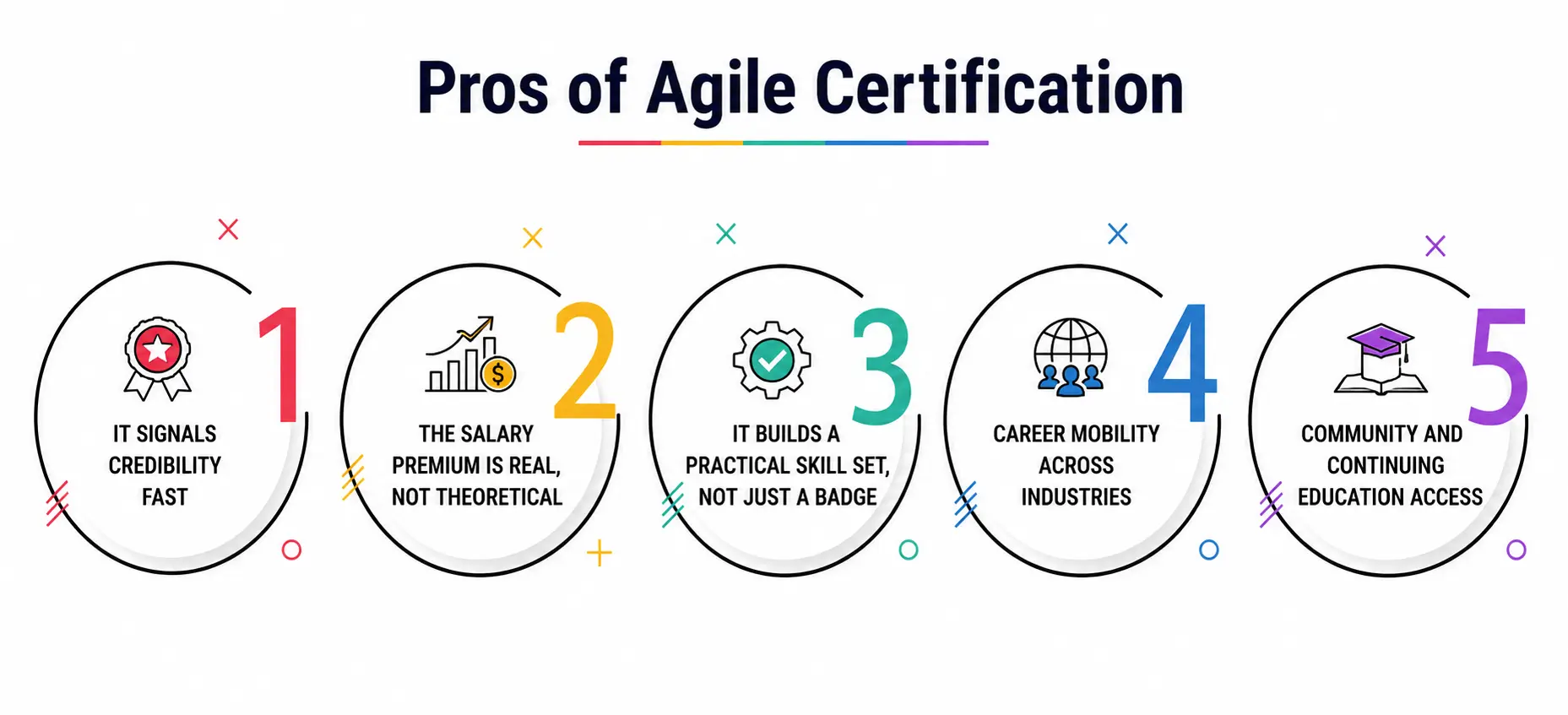
1. It Signals Credibility Fast
Recruiters and hiring managers skim resumes in seconds. A recognized Agile project management certification acts as a filter that gets a resume past automated screening systems, which matters more than most candidates realize in a crowded job market.
2. The Salary Premium Is Real, Not Theoretical
This is where the numbers get interesting. According to the 2026 PMP cost and ROI breakdown, certified professionals in the US report a median salary of $150,000 compared to $100,000 for non-certified peers, a 24% premium, with three-quarters of certified professionals receiving a raise within the past year.
3. It Builds a Practical Skill Set, Not Just a Badge
Agile training tied to these certifications usually covers real facilitation techniques, sprint planning, and stakeholder communication, not just theory memorized for an exam. That hands-on grounding tends to show up quickly in day-to-day project management work.
4. Career Mobility Across Industries
Digital transformation isn’t limited to tech anymore. Healthcare, finance, telecom, and government agencies are all hiring agile-literate project leads, which widens the pool of roles a certified professional can move into.
5. Community and Continuing Education Access
Most credentialing bodies, including PMI, bundle in access to templates, research, discounted events, and a professional network, which quietly adds ongoing value well beyond the exam date.
The Cons of Earning an Agile Certification
Certification marketing rarely mentions the friction points, so here they are plainly.
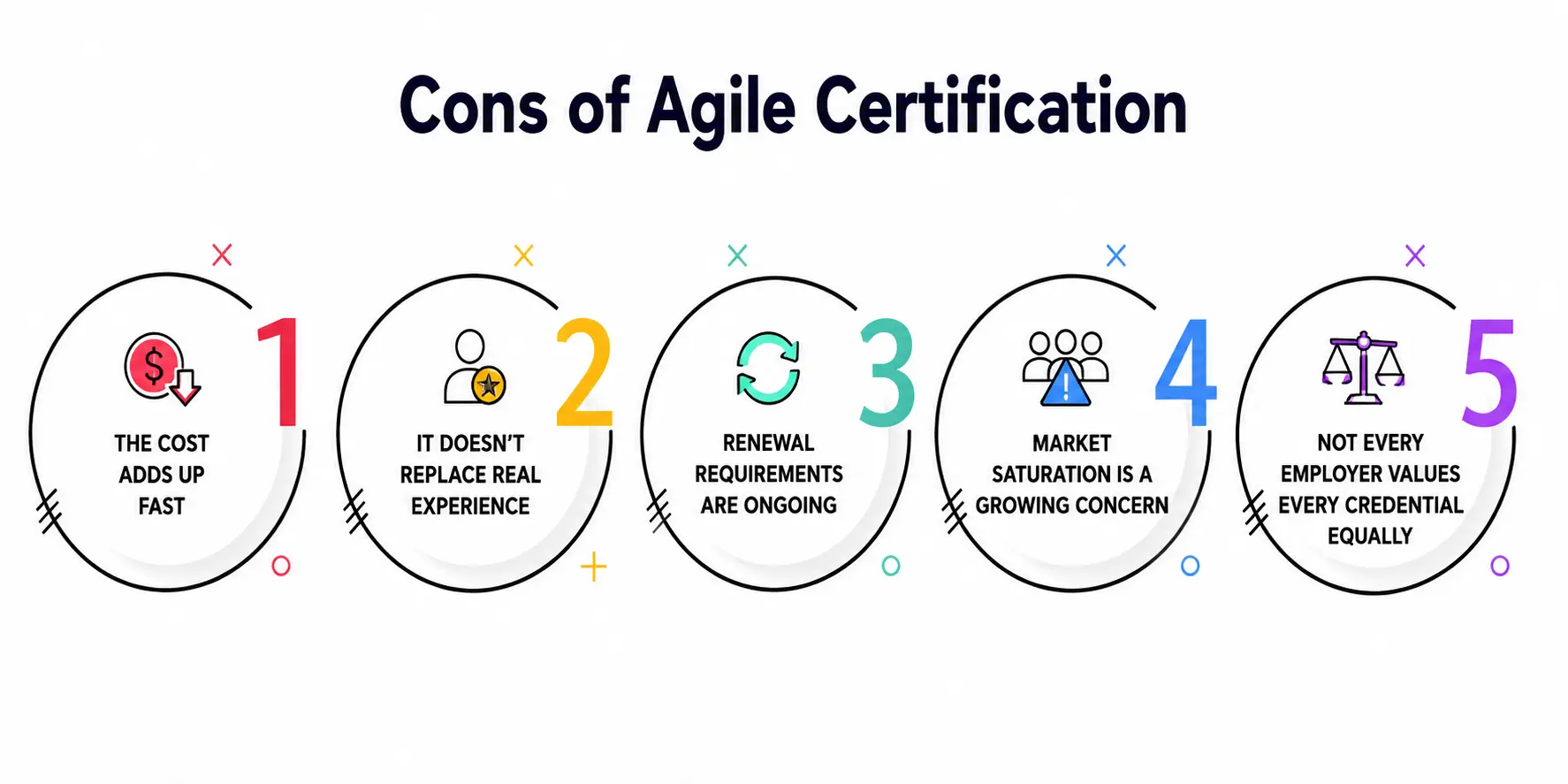
1. The cost adds up fast
Between the exam fee, required training hours, study materials, and possible PMI certification membership, total spend for something like the PMI-ACP typically lands between $700 and $2,500, according to PMTI’s 2026.
2. It doesn’t replace real experience
A certification proves knowledge of agile concepts on paper, but hiring managers still weigh actual delivery experience heavily, especially for senior roles.
3. Renewal requirements are ongoing
Most agile credentials expire every one to three years and require continuing education units, so the investment isn’t a one-time event.
4. Market saturation is a growing concern
As more professionals get certified, the credential alone carries less differentiation than it did five years ago, which is why pairing it with demonstrated project outcomes matters more now.
5. Not every employer values every credential equally
A Scrum-specific badge may carry little weight at a company running SAFe at scale, and vice versa, so picking the right certification for the target role matters as much as getting one.
ROI Analysis: Is the Certification Worth the Money?
Doing a proper ROI analysis means comparing what goes out against what tends to come back. On the cost side, a PMI-ACP-style credential runs roughly $700 to $2,500 all-in, factoring in exam prep, the exam itself, and any PMI certification membership fees.
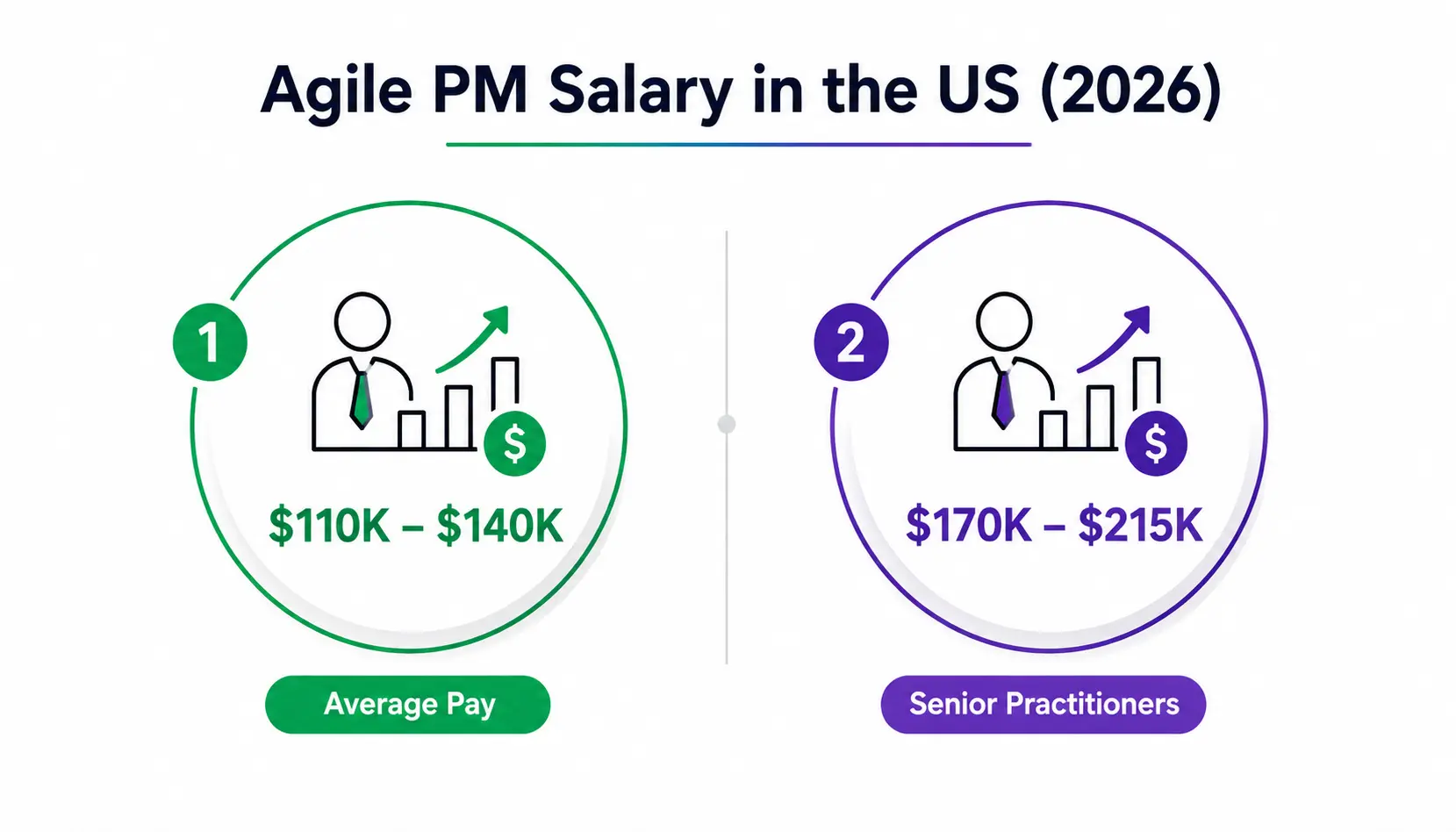
On the return side, Invensis Learning’s 2026 Agile PM data puts realistic average pay for a certified Agile project manager in the US between $110,000 and $140,000, with senior practitioners reaching $170,000 to $215,000. Even a conservative reading of that gap means the certification cost is typically recovered within the first few weeks of a new, higher-paying role, and the compounding effect over a multi-year career becomes substantial.
That said, the payoff isn’t purely financial; time invested in study, exam prep, and renewal cycles is a real cost too, and it should be weighed against a person’s actual career trajectory rather than assumed automatically.
Popular Agile Certifications Compared
|
Certification |
Typical Cost (USD) | Training Requirement |
Average US Salary (2026) |
|
PMI-ACP |
$700 – $2,500 | 21 hours of agile training |
~$123,000 |
|
Certified ScrumMaster (CSM) |
$1,000 – $1,500 | 2-day live course |
$105,000 – $137,500 |
|
SAFe Scrum Master |
$1,000 – $1,800 | 2-day live course |
$120,000 – $160,000 |
|
PMP (with agile/hybrid content) |
$700 – $1,300 | 35 hours of formal education | $150,000 median |
Agile Certification vs. a Traditional PMP Course
A common point of confusion is whether to pursue an agile-specific credential or a broader PMP course. The 2026 PMP exam blueprint has shifted to include more hybrid and agile scenarios than earlier versions, though it still leans more traditional and predictive overall.
Someone working almost entirely in agile teams, sprints, backlogs, and retrospectives tends to get more direct, applicable value from an Agile Project Management Certification. Someone managing large, cross-functional programs with heavy governance and compliance needs may still find the broader credential, or a hybrid of both, the stronger long-term investment for their career.
Where Is Agile Heading Beyond Software Teams?
Agile didn’t start out as something HR departments or marketing teams would ever touch. It began in 2001 as a reaction against rigid, document-heavy software development, built around short cycles, constant feedback, and the belief that working software mattered more than a thick project plan nobody read.
That origin still shapes how the framework operates today: fixed-length sprints, a prioritized backlog, and regular retrospectives designed to catch problems early rather than at the very end of a long project. What’s changed is where those ideas now show up. Marketing teams run campaign sprints instead of software sprints.
HR departments use backlogs to sequence hiring initiatives. Even legal and finance functions inside large enterprises have started borrowing Agile ceremonies to manage recurring, high-volume work with tighter feedback loops. This spread isn’t accidental. Leadership teams have noticed that Agile’s core habit, breaking big, uncertain work into small, testable pieces, holds up in almost any environment where requirements shift mid-project.
Artificial intelligence tooling is accelerating that shift further, since AI-assisted reporting and estimation now let non-technical teams run lightweight retrospectives and burndown tracking without needing a dedicated Scrum Master watching every metric. None of this means Agile has become one-size-fits-all; a team building physical hardware still has constraints software teams never face.
But the underlying mindset, adapting in small steps rather than planning everything upfront, keeps finding new departments willing to try it, which is exactly why understanding Agile properly has become useful well outside its original home in software engineering.
Conclusion
An agile project management certification isn’t a magic ticket to a bigger paycheck, but the 2026 data makes a fairly strong case that it’s not just marketing hype either. The pros, credibility, salary premiums, practical skill-building, and industry mobility, are backed by real numbers, and the cons, cost, renewal cycles, and market saturation, are manageable for most candidates who go in with clear eyes.
Running the numbers honestly before committing, rather than chasing a badge for its own sake, is what actually separates a smart investment from an expensive certificate sitting in a drawer.
A personal note
I’ll be honest, I went back and forth on my own certification for almost a year before committing to it, mostly because the fees felt steep against an uncertain payoff. Looking back, the certification itself wasn’t what changed things for me; it was the discipline of the coursework that came with it, the habit of actually applying agile principles in messy, real projects instead of just reading about them.
If you’re on the fence, my honest advice is to pick the credential that matches the work you actually want to do next, not the one with the flashiest logo.