

Here is a fact that surprises most people new to Agile. The entire Scrum framework is governed by just three Scrum roles, five events, and three artifacts. That is it. Thirteen components, working together in a repeatable cycle, is what powers some of the most productive and adaptive teams in the world across software, marketing, healthcare, finance, and beyond.
If you have heard terms like Sprint Retrospective, Sprint Backlog, or Product Increment thrown around in meetings and never quite known what they meant or how they connected, you are not alone. Understanding Scrum Roles, Scrum Events, and Scrum Artifacts is deceptively simple on the surface and surprisingly deep once you start applying it. This guide walks through every component clearly, explains how they interact, and gives you the practical understanding needed to work inside a Scrum team or evaluate whether the Agile Scrum framework is right for your organization in 2026.
Scrum Roles: The Three People Who Make It Work
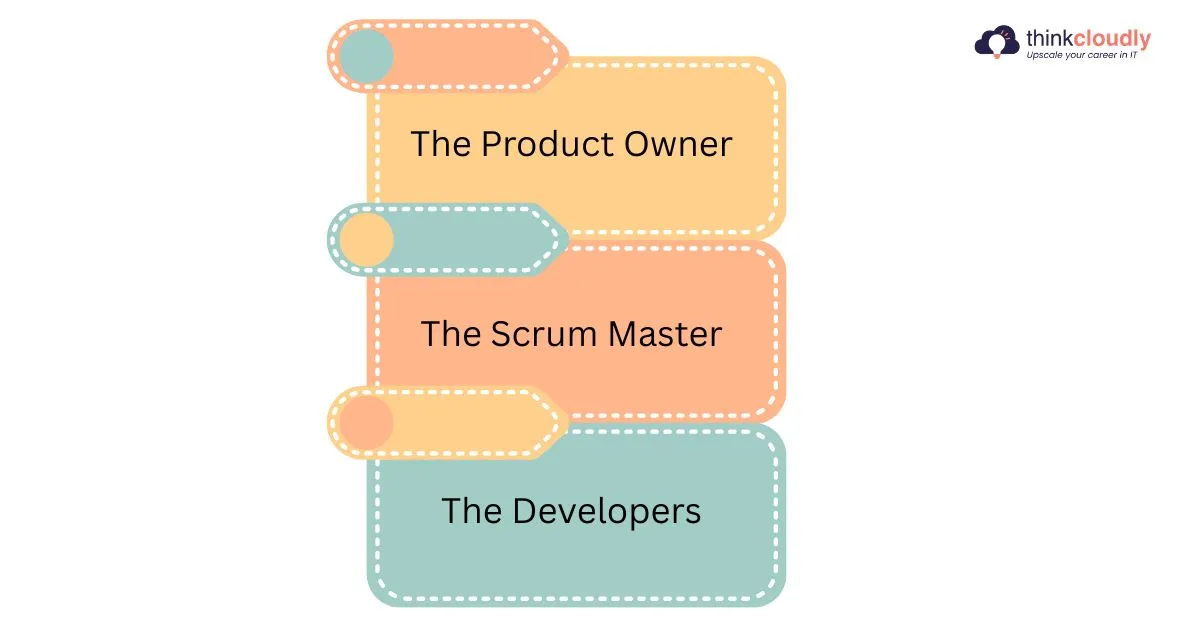
The Agile Scrum framework defines exactly three roles within a Scrum team. Not five, not ten. Three. Each one has a distinct purpose, a clear set of responsibilities, and a specific relationship to both the work and the other people on the team. There is no hierarchy in the traditional sense, no one role sitting above another. Each carries equal importance, and if any one of them is missing or poorly understood, the team will feel it quickly.
The Product Owner
The Product Owner is the person who decides what the team builds and in what order. They own and maintain the product backlog, which is the ordered list of everything that might be needed in the product, and they are accountable for making sure that list is clear, genuinely prioritized, and reflects what the customer and business actually need right now, not six months ago.
That sounds manageable on paper. In reality, it is one of the most demanding positions among all the Scrum roles. Every sprint, the Product Owner is balancing stakeholder expectations, market signals, technical constraints, and business value simultaneously. A strong product owner keeps the team working on things that genuinely matter. A weak one, or an absent one, creates the kind of confusion that leads to rework, missed goals, and a team that quietly stops trusting the process.
According to the 2025 State of Agile Report by Digital.ai, poor product ownership was cited as one of the top five obstacles to Agile success globally, appearing in 34% of respondents’ answers. That figure tells you everything about how often this role gets underinvested or handed to someone without the time or authority to do it properly.
The Scrum Master
The Scrum Master is a servant leader. That phrase gets used a lot and means less than it should in many organizations. What it actually means in practice is this: the Scrum Master is not a manager, does not assign work, does not own the delivery timeline, and has no positional authority over anyone on the team. What they do have is deep knowledge of how Scrum works and a genuine commitment to making the team’s environment better.
Day to day, that means removing the obstacles that slow the team down, protecting the team from unnecessary external interruptions during a sprint, and coaching everyone involved to understand and apply Scrum correctly rather than just going through the motions.
The organizational coaching dimension of this Scrum role tends to get overlooked, particularly in organizations new to Scrum. A Scrum Master working at full effectiveness is not just serving their immediate team. They are quietly influencing the broader organization to create conditions where Agile ways of working can take root genuinely rather than existing only on a process diagram somewhere.
LinkedIn Talent Insights 2025 data shows that senior Scrum Master job postings list organizational coaching and stakeholder management as the most frequently required competencies, appearing more often than any specific technical skills. That data point reflects where the real value of this role sits at the senior level.
The Developers
In Scrum, “developers” means everyone on the team who is directly responsible for delivering a usable increment of the product each sprint. The label can mislead people who are new to the framework. It does not mean software engineers exclusively. It means designers, analysts, writers, testers, and any other practitioner whose hands are on the actual work being delivered.
What makes this role genuinely distinctive among the Scrum roles is the self-organizing principle. Developers decide how to accomplish the work, not just what work to do. That is a meaningful shift from how most traditional teams operate, where work gets assigned from above and the people doing it follow instructions rather than making decisions. In Scrum, the people closest to the work are the ones determining how it gets done each day. That is what gives Scrum teams their speed and adaptability, and it only works when the Developers are genuinely empowered to make those calls rather than constantly seeking approval.
The Five Scrum Events: Structure That Creates Rhythm
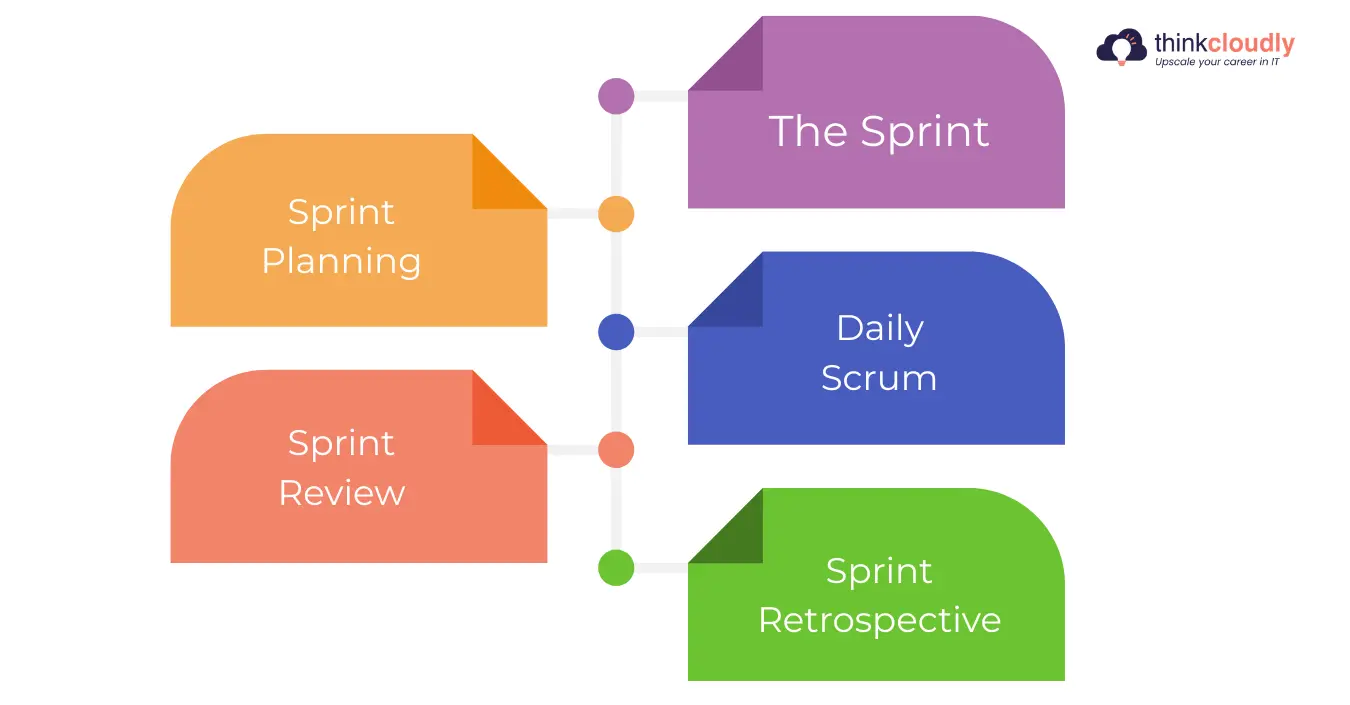
One of the most common misconceptions about Scrum is that the events are just meetings. They are not. Each one is a structured opportunity for the team to pause, look honestly at where things stand, and make a deliberate decision about what to do next. Remove one and you do not just save time. If you remove a feedback loop, the team needs to stay on track.
The Sprint
Everything in Scrum happens inside a sprint. It is a fixed-length cycle, most commonly two weeks, during which the team works toward a single defined sprint goal and produces a usable product increment before the clock runs out. Think of it as the unit of delivery in Scrum. Everything else, the planning, the daily coordination, the reviews, the reflection—all of it fits inside this container.
One thing that catches teams off guard when they first adopt Scrum is how seriously the Sprint boundary is meant to be respected. Once a sprint goal is set and the sprint begins, stakeholders cannot add new work to it. The team gets to finish what they committed to without the goalposts moving. That protection is not a technicality. It is what makes consistent, trustworthy delivery possible.
Sprint Planning
Sprint Planning is the event that kicks off every sprint. The whole Scrum team sits down together; the product owner brings the highest-priority items from the product backlog, and the developers assess honestly what they can deliver within the sprint window. Out of that conversation comes the sprint goal, the shared commitment that will guide every decision the team makes over the next two weeks.
For a two-week sprint, sprint planning is time-boxed at eight hours maximum. When it goes well, the team leaves the room feeling clear, aligned, and genuinely confident about what they signed up for. When it goes badly, it becomes a tense negotiation that ends with vague commitments and a team that is already uncertain before the work even begins.
Daily Scrum
The Daily Scrum is 15 minutes. Same time, same place, every working day of the sprint. Its purpose is not to update a manager or report progress upward. It belongs entirely to the developers, and its job is to help them inspect where they stand against the Sprint Goal and adjust their plan for the next 24 hours based on what they learned yesterday.
This distinction matters more than most organizations realize when they first introduce Scrum. The moment the Daily Scrum turns into a status meeting where people report to a Scrum Master or manager, it stops serving the team and starts serving the hierarchy. The value drains out of it quickly, and people start showing up because they have to rather than because it helps them.
Sprint Review
The Sprint Review happens at the end of every sprint. The Scrum team brings the completed product increment to stakeholders and has a real conversation about what was built, whether it achieved the sprint goal, and what that means for what comes next. It is collaborative and working-session in nature, not a polished presentation designed to impress anyone.
The feedback that comes out of a good sprint review directly shapes the product backlog and influences the direction of the next sprint. This is how Scrum teams stay honest about whether what they are building is actually what the customer needs, rather than dutifully executing a plan that stopped reflecting reality three months ago.
Sprint Retrospective
The Sprint Retrospective closes out every sprint. It is an honest internal conversation between the Scrum team members about how they worked together, what helped, what got in the way, and what they are going to do differently in the next sprint as a result.
It is also the event that gets sacrificed most often when teams feel pressure. A sprint runs long, the review takes more time than expected, and the sprint retrospective gets cut to a five-minute conversation at the end of a tired afternoon. Teams that do this consistently find themselves having the same problems sprint after sprint with no mechanism to address them. The Sprint Retrospective is the engine of continuous improvement in Scrum, and skipping it is one of the clearest ways to guarantee a team that never gets better.
The Three Scrum Artifacts: Making Work Visible
Scrum artifacts are what keep the work honest. They represent what needs to be done, what the team has committed to right now, and what has actually been delivered. Without these Scrum artifacts, Scrum becomes a set of meetings with nothing concrete to inspect or adapt. The artifacts are what give the events their purpose and give stakeholders a reliable window into real progress rather than reported progress.
The Product Backlog
The Product Backlog is the ordered, evolving list of everything that might ever be needed in the product. Owned by the Product Owner, it sits at the center of how priorities get decided and how the team understands what matters most right now versus what can wait. A healthy product backlog is detailed enough near the top to support upcoming sprints and intentionally vaguer further down, since priorities will shift before those items become relevant. Without consistent attention, the product backlog becomes either an overwhelming dumping ground or a stale list disconnected from current reality.
The Sprint Backlog
The sprint backlog is the subset of product backlog items selected for the current sprint, combined with the developers’ plan for delivering them. Unlike the Product Backlog, which belongs to the Product Owner, the Sprint Backlog belongs entirely to the Developers and can be adjusted throughout the sprint as they learn more about the work. It functions as a real-time picture of what the team committed to and how that commitment is progressing, updated daily as tasks move forward or new information emerges.
The Product Increment
The product increment is the usable output produced by the end of each sprint, and it must meet the team’s definition of done before it counts. This is not a draft or a work in progress sitting in a separate environment. It is a tangible step toward the overall product goal, something that could theoretically be released even if the team chooses not to release it immediately. The product increment is what makes Sprint Review conversations meaningful, because stakeholders are responding to something real rather than a description of planned work.
Scrum Components at a Glance
|
Component |
Type | Owner | Purpose |
Time-Box |
|
Product Owner |
Role | Individual | Maximizes product value, owns backlog |
Ongoing |
|
Scrum Master |
Role | Individual | Serves the team and coaches the organization. | Ongoing |
| Developers | Role | Team | Delivers usable increment each sprint |
Ongoing |
|
Sprint |
Event | Scrum Team | Container for all work and events |
1 to 4 weeks |
|
Sprint Planning |
Event | Scrum Team | Defines sprint goals and sprint work |
Max 8 hours |
|
Daily Scrum |
Event | Developers | Daily inspection and adaptation |
15 minutes |
|
Sprint Review |
Event | Scrum Team | Reviews increase with stakeholders |
Max 4 hours |
|
Sprint Retrospective |
Event | Scrum Team | Inspects team process, commits to improvements |
Max 3 hours |
|
Product Backlog |
Artifact | Product Owner | Ordered list of all product needs |
Evolving |
|
Sprint Backlog |
Artifact | Developers | Sprint items plus delivery plan | Sprint duration |
|
Product Increment |
Artifact | Developers | Usable output meeting Definition of Done | End of each sprint |
How the Scrum Process Flow Connects Everything
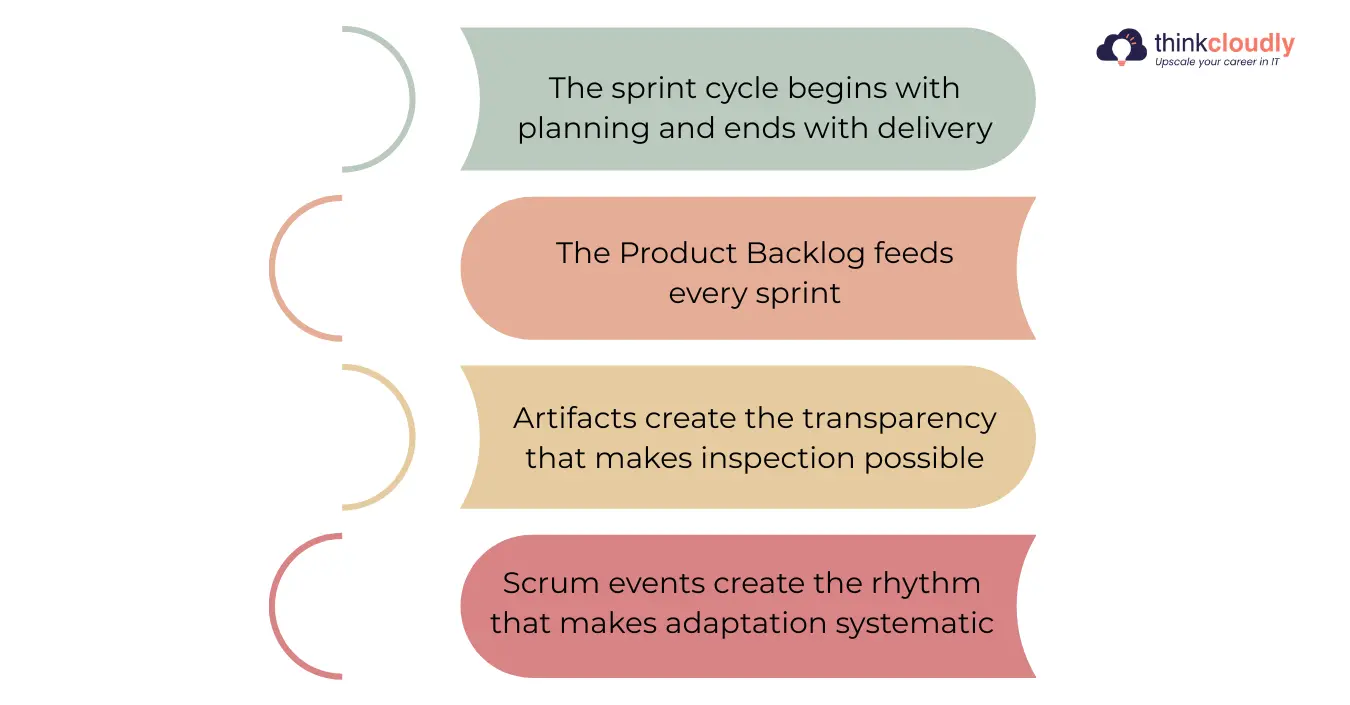
Understanding each component individually is useful. Understanding how they connect in the Scrum process flow is what allows you to actually use the framework effectively.
The sprint cycle begins with planning and ends with delivery
Sprint Planning opens the sprint with a shared commitment to a sprint goal. The developers work through the sprint backlog daily, using the daily scrum to stay coordinated and adapt their plan. The sprint closes with the sprint review presenting the product increment to stakeholders and the sprint retrospective identifying improvements for the next cycle.
The Product Backlog feeds every sprint
The Product Owner continuously refines and prioritizes the Product Backlog between sprints through backlog refinement sessions. The backlog is the single source of truth for what the team will work on. When it is well-maintained, sprint planning becomes efficient and focused. When it is neglected, sprint planning becomes a chaotic negotiation.
Artifacts create the transparency that makes inspection possible
The Scrum artifacts in Agile, the Product Backlog, Sprint Backlog, and Product Increment, create the visibility that allows the team and stakeholders to inspect what is happening and adapt accordingly. Without them, Scrum collapses into a set of meetings with no shared reference point for what was planned, what was built, and what still needs to be done.
Scrum events create the rhythm that makes adaptation systematic
The five events are not just meetings. They are the structured moments at which the team pauses to inspect what it knows and adjust what it is doing. Sprint Planning adapts the plan before work begins. The Daily Scrum adapts it each day. The Sprint Review adapts the product direction. The Sprint Retrospective adapts the team process. Together, they create an organization that learns and improves continuously rather than discovering problems only at the end of a long project cycle.
Conclusion
Thirteen components. Three Scrum roles, five events, and three artifacts. On paper, that is genuinely the entire Agile Scrum framework. What makes it powerful is not the number of moving parts but how deliberately each one is designed and how much each one depends on the others to function properly.
The Product Owner, Scrum Master, and Developers each carry a distinct accountability that the team cannot afford to blur or combine carelessly. The Sprint, Sprint Planning, Daily Scrum, Sprint Review, and Sprint Retrospective give the team a structured rhythm that makes inspection and adaptation a natural part of how they work rather than an occasional exercise. The Product Backlog, Sprint Backlog, and Product Increment turn abstract plans into visible, measurable, honest representations of progress.
What holds all of it together is a simple but demanding philosophy. Look at what is actually happening, not what you hoped would happen. Adjust based on reality. Deliver something real at the end of every sprint. The Sprint Retrospective keeps the team improving. The product increment keeps delivery honest. Backlog refinement keeps the work connected to what genuinely matters to the customer rather than drifting toward what was convenient to plan months ago.
Scrum remains the most widely adopted framework within Agile delivery in 2026 because it works when teams apply it with genuine understanding rather than surface-level compliance. The thirteen components covering Scrum roles, Scrum events, and Scrum artifacts are not overhead. They are the minimum viable structure that allows a team to stay focused, stay transparent, and keep getting better. Get comfortable with each one individually. Understand how they connect. That foundation will serve you well regardless of what comes next in your Agile career.
Sources and References
- Digital.ai. 17th Annual State of Agile Report 2025: Agile Adoption, Roles, and Framework Usage.
- Scrum Alliance. State of Scrum Report 2025: How Scrum Teams Operate and Improve.
- Scrum.org. The Official Scrum Guide: Roles, Events, and Artifacts Reference.
- LinkedIn Talent Insights. Scrum Master Competency Data and Senior Role Requirements 2025.
- Atlassian. Agile Coach: Scrum Roles, Ceremonies, and Artifacts Explained.
- Harvard Business Review. Why Agile Teams Succeed and Where They Still Fail in 2025.
- Coursera. Global Skills Report 2025: Agile and Scrum Learning Trends and Enrollment.