

Did You Know That 84% of Organizations Now Use AI in Their Agile Workflows?
That’s not a guess. That’s the reality of 2026. Just three years ago, running a Scrum standup meant sticky notes on a whiteboard, gut-feeling estimates, and a Product Owner spending half their week grooming a backlog manually. Today, AI copilots handle a big chunk of that grunt work — and the numbers are hard to argue with.
Agile teams around the world are no longer just adopting AI as a side experiment. They’re weaving it directly into their daily Scrum rituals—sprint planning, retrospectives, backlog refinement, and everything in between. The question in 2026 isn’t whether AI belongs in Agile. The question is how fast your team can get good at using it before your competitors do.
This blog breaks down what’s actually changing, what the data says, and what it means for anyone working inside the Scrum framework today.
Why the Scrum Framework Needed an AI Upgrade
The Scrum framework was built for speed and flexibility. Work gets broken into short cycles called sprints—usually two weeks—and teams continuously deliver, review, and adapt. It’s a brilliant system. But it was designed for humans doing human things at human speed.
That’s where friction started creeping in.
Sprint planning sessions could drag on for hours. Backlog refinement was a repetitive, time-consuming task that left Product Owners exhausted. Velocity estimates were often guesswork dressed up as data. And retrospectives, while valuable, rarely produced insights that were actually tracked over time.
AI doesn’t just speed these things up. It fundamentally changes the quality of decision-making inside the Scrum framework. Teams are now entering sprint planning with historical data surfaced automatically, dependencies flagged before the meeting starts, and user stories that are already half-written by the time the Scrum Master opens the room.
What Do the 2025–2026 Numbers Actually Tell Us?
Here’s where things get interesting. The data coming out of the last 12 months tells a clear story:
84% of organizations now report AI adoption inside their agile methodology, up significantly from 2023—signalling that AI has stopped being a pilot and started being standard practice. Gartner reported a 1,445% surge in multi-agent system inquiries between Q1 2024 and Q2 2025, a staggering signal that organizations aren’t thinking about single AI tools anymore—they want coordinated AI systems working inside their agile workflow. Pull request turnaround time — one of the clearest signals of team velocity — dropped from 9.6 days to 2.4 days for teams using AI coding tools. That’s a 75% reduction in a metric that directly impacts how many iterations a team can ship per sprint.
AI copilots are slashing backlog refinement time by up to 70% for product owners, according to industry data from 2026. That’s not a marginal gain. That’s the difference between a product owner being a strategic leader versus a glorified ticket writer. And Gartner predicts that by the end of 2026, 40% of enterprise applications will be integrated with task-specific AI agents — up from less than 5% at the start of 2025. The agile workflow is being automated, one ceremony at a time.
How Is AI Changing Each Part of the Scrum Cycle?
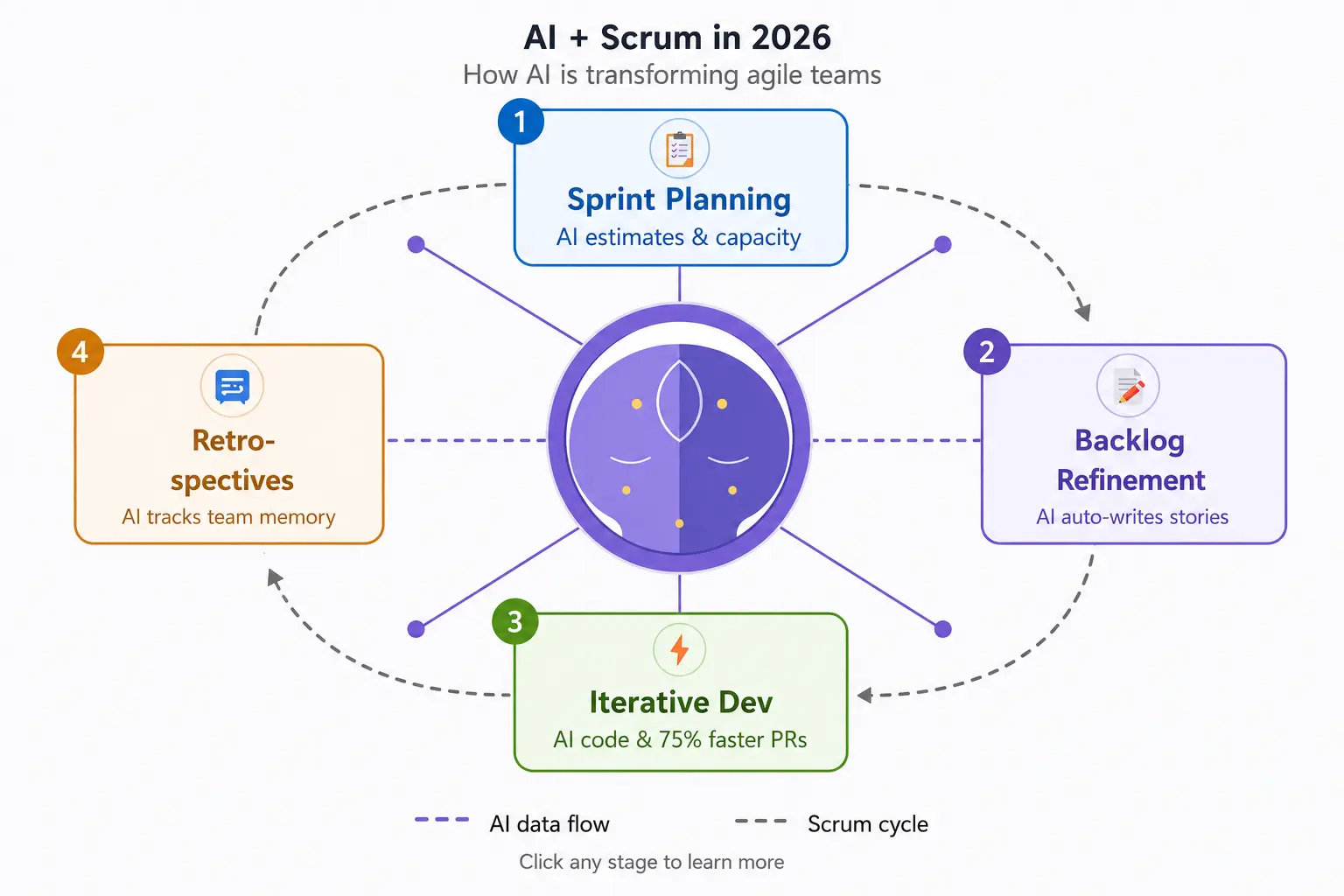
1. Sprint Planning Gets Smarter, Faster, and More Honest
Traditional sprint planning has always had one dirty secret: estimates are wrong. Not because teams are bad at their jobs, but because human memory is unreliable, and pulling historical data manually before a planning session is painful enough that most teams don’t do it thoroughly.
AI copilots change this equation by analyzing dozens of past sprints in seconds. They surface patterns—which story types tend to blow past estimates, which team members are overloaded, and what dependencies are lurking—before the planning session even begins. Gartner research found that organizations implementing AI-assisted Agile methodology tools report up to 40% faster release cycles and a 35% reduction in planning overhead. That time doesn’t disappear. It gets reinvested in the conversations that actually matter: priorities, risks, and what the team is really committing to.
2. Backlog Refinement Becomes a Strategic Activity
Here’s something most non-technical people don’t realize: backlog refinement can eat 20% or more of a product owner’s working week. Reviewing tickets, rewriting vague user stories, aligning items with business goals, removing duplicates, adding acceptance criteria — it’s necessary, but it scales badly as a product grows.
In 2026, AI copilots take the first pass. Tools integrated with platforms like Jira or Linear can auto-generate user stories from a few lines of input, suggest prioritization based on customer feedback and business value signals, and flag when a story is too vague to be sprint-ready. Atlassian Intelligence alone has helped teams cut story preparation time by 30–40%, with the most advanced implementations reducing overall backlog refinement effort by up to 70%.
The Product Owner’s job doesn’t disappear. It shifts. Instead of writing and sorting tickets, they’re reviewing AI-generated output, making judgment calls on priorities, and focusing on stakeholder conversations that no machine can replicate.
3. Iterative Development Gets Shorter Loops
The whole philosophy of iterative development is learning fast and adjusting. The shorter the loop, the faster the learning. AI compresses those loops dramatically.
Pull request review cycles that used to take nearly 10 days now take under 3. Automated test generation means bugs are caught before they reach the review stage. AI tools can generate boilerplate code, write unit tests, and flag security issues mid-sprint—all of which used to slow down iterative development significantly. GitHub and Accenture’s joint research across 4,800 developers found teams completing tasks 55% faster when using AI tools. For agile teams trying to ship more value per sprint, that’s a genuine competitive advantage.
4. Retrospectives Finally Have Memory
One of the least-discussed failures of traditional Scrum is the retrospective that produces great insights on a Friday and gets completely forgotten by Monday. Without a system tracking what was decided and whether it stuck, the ceremony becomes therapeutic but not transformative.
Key Challenges Agile Teams Must Navigate
The shift isn’t without friction. Here are four real challenges that agile teams face when bringing AI into the Scrum framework — and what to do about them:
1. AI Estimates Without Context Are Still Bad Estimates
AI tools trained only on generic data — not your team’s specific history — can produce sprint capacity plans that look precise but are built on shaky foundations. The fix is straightforward but often overlooked: feed your tools with your actual data. Past velocity, team size changes, and recurring blockers—context is what makes AI-generated estimates reliable.
2. The Definition of Ready Needs Rewriting
In an AI-assisted agile workflow, a ticket isn’t “ready” just because a human says so. If an AI agent is picking up development tasks, prompts need to be precise, complete, and technically sound—otherwise the agent will hallucinate or go off-track. Teams adopting AI agents in their Scrum framework are discovering they need to evolve what “ready” even means.
3. Developer Trust in AI Has Dropped Sharply
This is a real and underreported problem. Developer sentiment towards AI tools went from over 70% positive in 2023 to just 29% positive in 2025, according to Stack Overflow’s year-over-year data. The enthusiasm of early adoption has given way to skepticism after too many experiences with plausible-looking but wrong code. Agile teams that invest in AI training and create clear review protocols are getting better outcomes than those who hand the keys to the AI and walk away.
4. Security Risks Are Real
AI-generated code contains 2.74 times more security vulnerabilities than human-written code, according to recent analysis. For agile teams shipping fast, this is a genuine risk. The answer isn’t to stop using AI—it’s to build security review checkpoints into the Agile workflow itself, not treat them as an afterthought.
What This Means for Scrum Roles in 2026?
The Scrum Master, Product Owner, and development team members aren’t disappearing.
But their roles are evolving:
- Scrum Masters are becoming AI orchestrators—choosing which tools to use, interpreting data surfaced by those tools, and coaching teams on how to work alongside AI effectively.
- Product Owners are shifting from content creators (writing user stories) to content reviewers (approving and refining AI-drafted output) and strategic decision-makers.
- Developers are acting less like solo code writers and more like quality controllers and architects — directing AI agents, reviewing output, and focusing on the high-ambiguity problems machines can’t yet solve.
The Agile methodology hasn’t been replaced. It’s been augmented. The core values—individuals and interactions, working software, customer collaboration, and responding to change—remain as relevant as ever. AI just removes the low-value friction that was slowing teams down from living those values fully.
AI + Scrum: A Quick Comparison Table (2024 vs 2026)
|
Scrum Activity |
2024 (Without AI) | 2026 (With AI) |
Key Improvement |
|
Sprint Planning duration |
3–4 hours average | 1.5–2 hours average |
40–50% time saved |
|
Backlog Refinement effort |
15–20% of PO’s week | 5–8% of PO’s week |
Up to 70% effort reduction |
|
PR / Code Review Turnaround |
~9.6 days | ~2.4 days |
75% faster |
|
User Story generation |
Fully manual | AI-drafted, human-reviewed |
30–40% faster prep |
|
Risk identification |
Post-sprint detection | Pre-sprint flagging |
Earlier by 1–2 sprints |
|
Retrospective insights |
Discussed, rarely tracked | AI-tracked across sprints |
Systemic improvement |
|
Release cycle speed |
Baseline | Up to 40% faster |
Gartner-verified gain |
|
AI adoption in Agile |
~60% (estimated) | 84% of organisations | Mainstream, not optional |
Sources
- ProProfsproject — Scrum Statistics 2026 (January 2026)
- Staragile — State of Agile Report 2026
- Nextagile — AI Tools for Sprint Planning (May 2026)
- Restratconsulting — AI as a Co-Pilot for Agility (April 2026)
- Modall — AI in Software Development Statistics (April 2026)
- Arxiv — AI and Agile Software Development: XP2025 Workshop Research
- Electroiq — Agile Statistics and Facts 2025
- First Line Software — AI Software Development: What Changes 2026–2035 (May 2026)