
You’ve probably Googled “AWS certification path” a dozen times and still feel stuck. I did the same thing three years ago — spent almost two months just deciding which cert to start with before I finally committed to Cloud Practitioner. My own path went Cloud Practitioner → Developer Associate → SAA-C03, and looking back, that order made each next exam easier than the last. Which cert first? Which track fits your career? How long will it actually take? The confusion is real — and it’s costing people 12–18 months of wasted effort.
Here’s the honest truth: the AWS certification path you choose in the next 30 days will shape your salary, your job title, and your career trajectory for the next five years. Cloud professionals who follow a structured path consistently out-earn peers with the same experience but no credentials. According to the 2025 Jefferson Frank AWS Careers & Hiring Guide, 93% of hiring managers consider AWS certification an active factor in hiring decisions.
This guide gives you the complete AWS certification path 2026 roadmap — clear, honest, and built for action. Whether you’re mapping out your first move or deciding which specialty to target next, this is the only AWS certification path resource you’ll need.
The AWS Certification Path at a Glance
Before diving deep, here’s the framework:
- Step 1 → Start with Cloud Practitioner (universal entry point)
- Step 2 → Pick your Associate track based on your goal
- Step 3 → Advance to Professional or Specialty level
|
Your Goal |
Your Next Certification |
|
Cloud Architecture |
Solutions Architect – Associate |
|
Application Development |
Developer – Associate |
|
Cloud Operations |
SysOps Administrator – Associate |
|
Data Engineering |
Data Engineer – Associate |
|
ML / AI |
ML Engineer – Associate |
|
Cloud Security / GRC |
Security – Specialty |
Why the AWS Certification Path Still Pays Off in 2026
For someone earning $90,000, a 20% post-certification salary bump means $18,000 more per year — often from a single exam. Cloud spend continues to accelerate, and cloud security has moved from an IT concern to a board-level priority.
For professionals in risk, audit, and compliance, understanding cloud architecture and security frameworks—FedRAMP, HIPAA, SOC 2, and PCI DSS—is increasingly non-negotiable. AWS certifications directly demonstrate that knowledge. The cloud security track in particular has seen significant growth in hiring demand.
64% of organizations report cloud skill gaps (Pluralsight). That’s your career opportunity.
Full AWS Certification Structure: 2026 Edition
|
Level |
Certification | Cost |
Duration |
|
Foundational |
Cloud Practitioner | $100 |
90 min |
|
Foundational |
AI Practitioner (New 2024) | $100 |
90 min |
|
Associate |
Solutions Architect – Associate | $150 | 130 min |
| Associate | Developer – Associate | $150 |
130 min |
|
Associate |
SysOps Administrator – Associate | $150 |
130 min |
|
Associate |
Data Engineer – Associate (New 2024) | $150 |
130 min |
|
Associate |
ML Engineer – Associate (New 2024) | $150 |
130 min |
|
Professional |
Solutions Architect – Professional | $300 |
180 min |
|
Professional |
DevOps Engineer – Professional | $300 |
180 min |
|
Professional |
Generative AI Developer – Professional (Beta) | $300 |
180 min |
|
Specialty |
Security – Specialty | $300 |
170 min |
|
Specialty |
Advanced Networking – Specialty | $300 |
170 min |
|
Specialty |
Machine Learning – Specialty | $300 |
180 min |
|
Specialty |
Data Analytics – Specialty | $300 |
180 min |
All certifications expire after three years. AWS automatically provides a 50% recertification discount voucher after each passed exam.
The AWS Certification Path by Role: Full Visual Roadmap
Use this roadmap to identify your path before committing to a study plan:
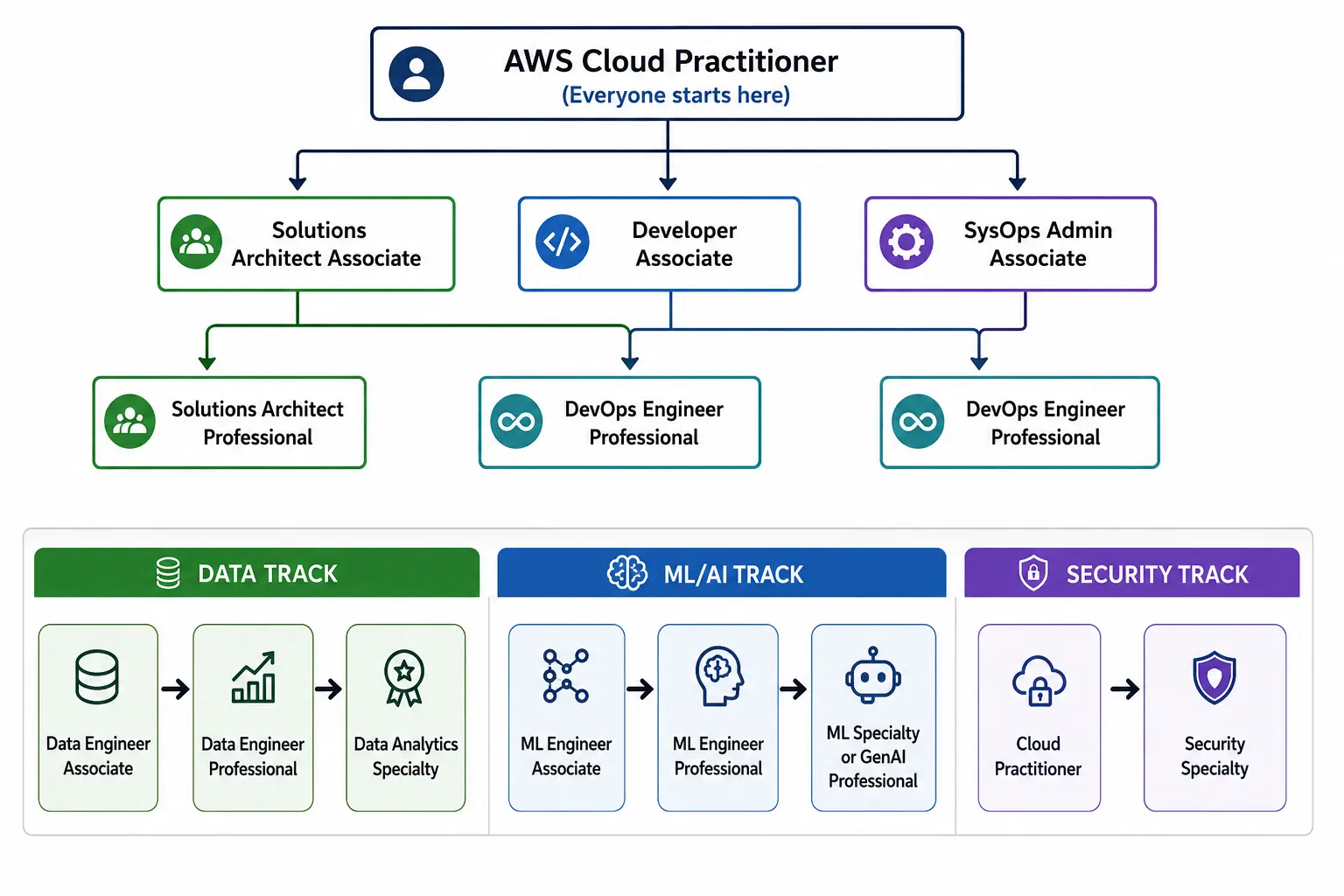
Text version for quick reference:
- Cloud Architects → Cloud Practitioner → Solutions Architect Associate → Solutions Architect Professional
- Developers → Cloud Practitioner → Developer Associate → DevOps Engineer Professional
- Operations / SysAdmins → Cloud Practitioner → SysOps Administrator → DevOps Engineer Professional
- Data Engineers → Cloud Practitioner → Data Engineer Associate → Data Analytics Specialty
- ML / AI Engineers → Cloud Practitioner → ML Engineer Associate → ML Specialty or GenAI Professional
- Security / GRC / Auditors → Cloud Practitioner → Security Specialty
Honest Difficulty Rankings (No Sugarcoating)
|
Certification |
Pass Rate | Difficulty |
Hardest Part |
|
Cloud Practitioner |
~85% | 3/10 |
Breadth of service knowledge |
|
AI Practitioner |
~80% | 3/10 |
AI/ML concepts without coding |
|
Solutions Architect – Associate |
~65% | 6/10 |
Multi-service design scenarios |
|
Developer – Associate |
~68% | 5/10 |
SDK, IAM, Lambda edge cases |
|
SysOps Administrator – Associate |
~55% | 8/10 |
Live hands-on lab component |
|
Data Engineer – Associate |
~60% | 6/10 |
Glue, Kinesis, Lake Formation |
|
ML Engineer – Associate |
~58% | 7/10 |
SageMaker pipeline depth |
|
Solutions Architect – Professional |
~45% | 9/10 |
Multi-account design at scale |
|
DevOps Engineer – Professional |
~48% | 8/10 |
CI/CD and Infrastructure as Code depth |
|
Security – Specialty |
~50% | 8/10 |
IAM policy nuance, incident response |
|
Advanced Networking – Specialty |
~42% | 9/10 |
Transit Gateway, BGP, hybrid routing |
|
Machine Learning – Specialty |
~46% | 9/10 |
Math-heavy model tuning |
Key callout: The SysOps Administrator is harder than most people expect—harder than some professional exams—purely because of its live lab component. When I sat for mine, the lab portion threw me off because I’d only practiced in a sandbox account—the real exam console had slightly different navigation, and I lost almost 10 minutes just orienting myself. Budget an extra 3–4 weeks of hands-on cloud operations console practice specifically for that exam.
Level 1: AWS Certification for Beginners — Cloud Practitioner
Best for: Career changers, students, IT auditors, GRC professionals, business stakeholders.
AWS certification for beginners starts here — no prerequisites, no prior AWS experience required. It’s the most widely recommended starting point in any AWS certification for beginners’ guide, and for good reason.
The Cloud Practitioner covers:
- AWS global infrastructure and core services
- The security shared responsibility model
- Cloud pricing models and cost management
- Compliance basics (critical for cloud security and GRC roles)
Most people underestimate this exam. That’s exactly why passing it gives you a credibility edge. For non-technical professionals—risk analysts, compliance officers, and IT auditors—it delivers real leverage in governance conversations.
Also worth knowing: The new AWS Certified AI Practitioner pairs powerfully with the Cloud Practitioner if your organization is embedding AI into products or workflows.
- Prep time: 4–8 weeks
- Pass rate: ~85% with structured study
- Bonus: Passing unlocks a 50% discount on your next exam
In my case, I studied for 5 weeks doing about an hour a day and passed comfortably on my first attempt.
Ready to start? AWS Skill Builder offers free official learning paths mapped to every certification. It’s the best first stop for AWS certification for beginners — no paid subscription needed to begin.
Level 2: Associate Certifications — Where Real Cloud Careers Take Root
The associate tier is where most cloud careers truly take shape. In 2026, there are five distinct associate paths. Choosing the right one matters far more than most guides admit.
AWS Solutions Architect – Associate (SAA-C03)
Best for: Cloud architects, IT generalists, developers moving into architecture roles.
This is the most popular AWS certification in the world—appearing in roughly 80% of cloud engineering job postings. The SAA-C03 proves you can design, not just operate. It covers compute, storage, networking, databases, and cloud security across four key domains:
- Resilient architecture design
- High-performing architectures
- Secure applications and infrastructure (including cloud security controls)
- Cost-optimized architectures
The pass rate sits around 65%. The most common failure reason: underestimating scenario-based questions where multiple services interact together. I almost fell into this trap myself—on my first practice exam, I kept choosing the “technically correct” answer instead of the “most cost-effective” one, which cost me almost 15 questions before I caught the pattern.
Prep time: 6–12 weeks | Experience recommended: 1 year hands-on AWS
AWS Certified SysOps Administrator – Associate
Best for: System administrators, cloud operations engineers, DevOps practitioners.
Here’s what most guides leave out: the SysOps Administrator is the hardest associate exam—not just for content, but because it includes live, hands-on lab components. During the exam, you perform actual tasks in a live AWS console: configuring CloudWatch, Auto Scaling, and VPC settings. You don’t just answer questions about them.
This exam rewards people who treat cloud operations as a daily practice, not a subject to memorize. Pass rate: ~55%.
Key domains: Monitoring and logging, reliability, deployment and provisioning, cloud operations cost optimization, and compliance.
AWS Certified Developer – Associate
Best for: Software developers, application engineers, and backend developers building cloud-native applications.
Goes deep on Lambda — the backbone of serverless architecture — plus API Gateway, DynamoDB, and the AWS SDKs. Many candidates use this as a stepping stone before the SAA-C03, pairing development expertise with architecture fundamentals. I followed this same order and found that the Lambda/API Gateway knowledge from the Developer exam made the SAA-C03 architecture scenarios noticeably easier to reason through.
Serverless architecture adoption is accelerating. Lambda-based applications now handle production workloads across industries, and developers who understand event-driven patterns built on serverless architecture are among the most sought-after cloud professionals in 2026. If your team is moving toward microservices or function-based deployments, serverless architecture fluency isn’t optional anymore — it’s the job.
AWS Certified Data Engineer – Associate (New 2024)
Best for: Data engineers and analytics engineers working on AWS data pipelines.
Covers AWS Glue, Amazon Kinesis, Amazon Redshift, and AWS Lake Formation. Rapidly gaining traction in job descriptions as data infrastructure moves to the cloud.
AWS Certified ML Engineer – Associate (New 2024)
Best for: ML engineers and applied AI practitioners building, training, and deploying ML models on AWS.
Focuses on practical ML engineering with SageMaker. One of the highest-momentum certifications in the 2026 landscape.
Level 3: Professional Certifications — Advanced Cloud Mastery
This is where you stop proving you can use AWS and start proving you can architect, automate, and govern it at scale. Professional certs are harder and rarer and pay accordingly.
AWS Solutions Architect – Professional
Tests complex, multi-account AWS designs at scale: advanced networking, migration strategies, and infrastructure as code governance across large organizations. Infrastructure as Code is now table stakes at this level—understanding CloudFormation deeply is nonnegotiable.
Salary range: $145,000–$175,000 in U.S. markets. Pass rate: ~45%.
AWS DevOps Engineer – Professional
Validates expertise in automating continuous delivery systems. Goes deep on Infrastructure as Code using AWS CloudFormation, configuration management, automated testing pipelines, and monitoring at scale. If your organization has adopted Infrastructure as Code practices, this credential makes you the person who can enforce and scale them.
The combination of cloud operations expertise and Infrastructure as Code mastery is what separates DevOps engineers at the $130K–$160K level from those stuck at $90K.
Pro tip: A Cloud Guru and Tutorials Dojo are two of the most trusted platforms for professional-level prep. Both provide hands-on labs specifically built around infrastructure as code and cloud operations scenarios.
AWS Generative AI Developer – Professional
Validates expertise in building GenAI solutions using Amazon Bedrock. If you’re on a developer or ML path, this is now a live exam (code: AIP-C01, 75 questions, available at testing centers)—organizations are moving from AI experiments to production deployments fast.
Level 4: Specialty Certifications — Deep Domain Expertise
Specialty certs aren’t about breadth — they’re about depth in one domain: security, networking, ML, or data. Pick the one that matches where you already spend your time.
AWS Certified Security – Specialty
Best for: Cybersecurity professionals, cloud security engineers, GRC practitioners, and IT auditors.
This is the most strategically valuable certification for anyone whose work intersects with cloud security, compliance, or risk management. High-profile breaches and regulatory pressure have made security a board-level conversation. The security specialty validates the following:
- IAM policy design and cross-account access control
- Encryption strategies for data at rest and in transit
- CloudTrail, GuardDuty, Security Hub, and AWS Config for security monitoring
- Automated security response workflows
High-profile breaches and regulatory pressure have made cloud security a board-level conversation. This certification proves you can contribute to it meaningfully, not just nod along.
Salary range: $140,000–$170,000. Pass rate: ~50%.
For cloud security deep dives: AWS Security documentation is the authoritative reference—bookmark it before you begin studying.
AWS Certified Advanced Networking – Specialty
For network engineers dealing with complex hybrid environments—VPNs, Direct Connect, Transit Gateway, and multi-region architectures. Pass rate: ~42%, making it the most technically demanding in the catalogue.
AWS Certified Machine Learning – Specialty
For data scientists and ML engineers using SageMaker. Pairs naturally with the ML Engineer Associate for a complete ML credentials stack.
AWS Certified Data Analytics – Specialty
For data engineers and analysts working with Redshift, Kinesis, Glue, and Athena. Relevant for anyone building large-scale data pipelines in AWS-native environments.
AWS Certification Path by Career Goal
|
Career Goal |
Recommended Path |
|
Cloud Architect |
Cloud Practitioner → SA Associate → SA Professional |
|
DevOps / Cloud Engineer |
Cloud Practitioner → SysOps → DevOps Professional |
|
Application Developer |
Cloud Practitioner → Developer Associate → DevOps Professional |
|
Cloud Security / GRC |
Cloud Practitioner → SA Associate → Security Specialty |
|
IT Auditor / Compliance |
Cloud Practitioner → Security Specialty |
|
Data / Analytics Engineer |
Cloud Practitioner → Data Engineer Associate → Data Analytics Specialty |
|
ML / AI Engineer |
Cloud Practitioner → ML Engineer Associate → ML Specialty |
|
GenAI / Bedrock Specialist |
Cloud Practitioner → Developer Associate → GenAI Developer Professional |
|
DevSecOps |
SA Associate → DevOps Professional + Security Specialty |
2026 AWS Certification Salaries
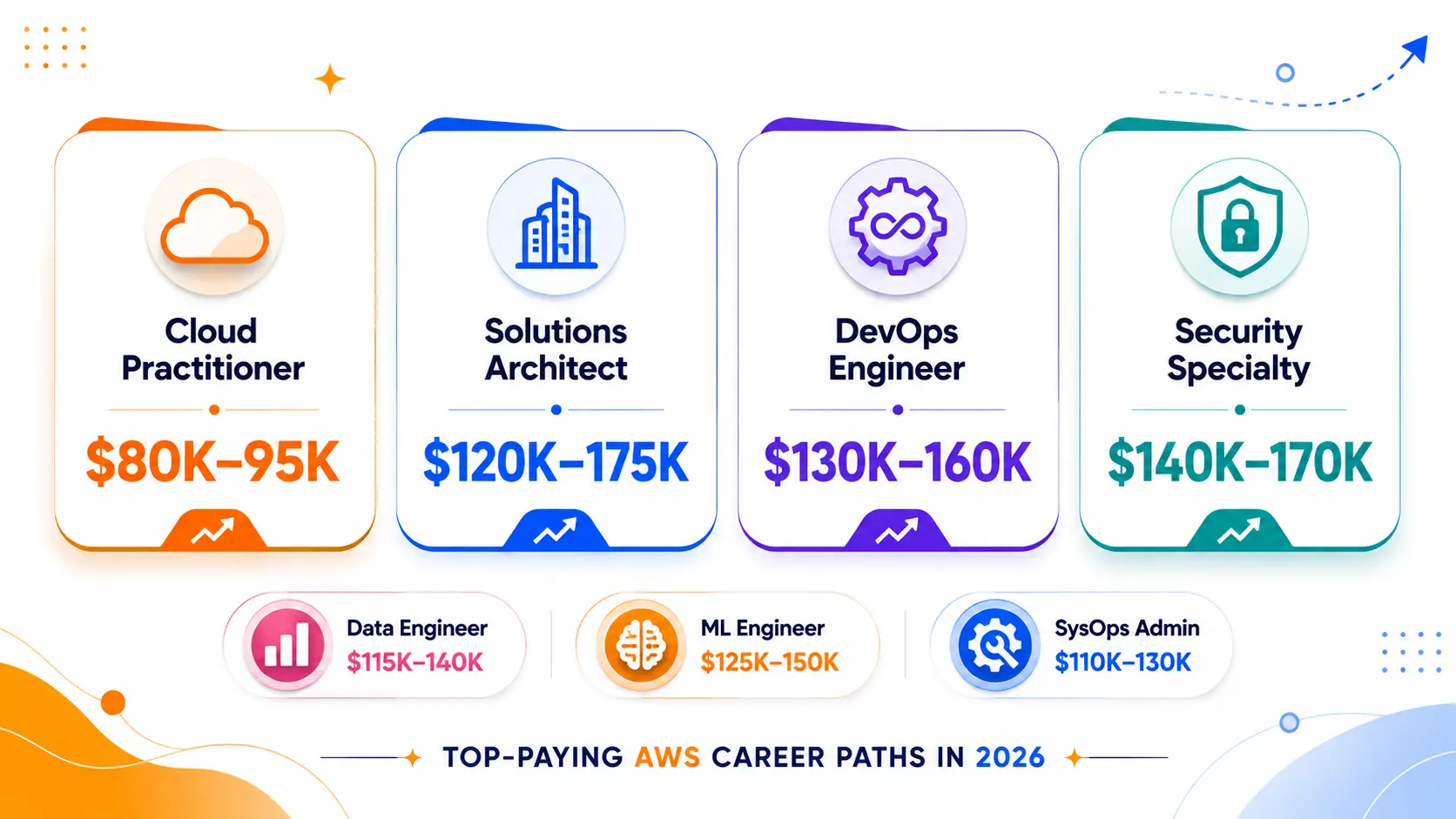
|
Role |
Average Annual Salary (U.S.) |
|
Cloud Practitioner (entry) |
$80,000–$95,000 |
|
Solutions Architect – Associate |
$120,000–$145,000 |
|
SysOps Administrator – Associate |
$110,000–$130,000 |
|
Data Engineer – Associate |
$115,000–$140,000 |
|
ML Engineer – Associate |
$125,000–$150,000 |
|
Solutions Architect – Professional |
$145,000–$175,000 |
|
DevOps Engineer – Professional |
$130,000–$160,000 |
|
Security Specialty |
$140,000–$170,000 |
Source: ZipRecruiter, Indeed, LinkedIn Salary — 2025–2026 averages.
2026 Market Trends Shaping the AWS Certification Path
Infrastructure as Code is now table stakes. Organizations have moved well beyond manual deployments. Proficiency with CloudFormation and Terraform is expected in cloud engineering and DevOps roles. Infrastructure as Code skills show up in the SysOps Administrator, DevOps Professional, and SA Professional exams—so you’ll build these skills naturally as you progress. In fact, any AWS certification path that leads to a DevOps or architecture role will require you to get comfortable with Infrastructure as Code practices before you hit the Professional tier.
Serverless architecture adoption is accelerating. Lambda-based serverless architecture handles production workloads across industries. The Developer Associate covers serverless architecture in depth, and event-driven design patterns built on serverless architecture now appear in architecture discussions at every level of the certification path. Organizations that have embraced serverless architecture at scale need engineers who can debug, optimize, and secure it — skills that command a premium.
Cloud security is a board-level concern. High-profile breaches and regulatory pressure have pushed cloud security from IT’s problem to everyone’s priority. The Security Specialty has seen increased demand from both technical practitioners and governance professionals.
Cloud operations complexity is growing. Large enterprises rarely run on a single cloud. Professionals who understand hybrid cloud operations, multi-account management, and automated remediation — core skills in the SysOps and DevOps Professional exams — are in a consistently strong position.
How Long Does It Actually Take?
|
Starting Point |
Target Cert |
Realistic Study Time |
|
No prior cloud experience |
Cloud Practitioner |
6–10 weeks |
|
Cloud Practitioner in hand |
Associate level |
8–14 weeks |
|
Associate certified |
Professional level |
3–6 months |
|
Any cert |
Specialty |
6–12 months domain experience |
The biggest variable isn’t aptitude — it’s consistency. 1–2 hours of focused study daily beats weekend cramming every time. That’s exactly what worked for me—I tried cramming on weekends for SAA-C03 prep and burned out by week three. Switching to a fixed 45-minutes-every-morning routine after that is what actually got me across the finish line.
AWS Certification for Beginners: A 4-Step Start
If you’re new to cloud and the AWS certification path feels overwhelming, here’s the practical truth: you don’t need to map the entire journey before taking your first step.
- Spend 2–4 weeks exploring AWS. Learn what the console looks like, what problems cloud solves, and what the main service categories are.
- Pursue the Cloud Practitioner exam. It’s the best starting point on the AWS certification path—no prerequisites, ~85% pass rate with structured prep, and it earns you a 50% discount on your next exam.
- Choose your specialization. Once you’ve passed, you’ll have a clearer picture of whether architecture, development, cloud operations, data, or cloud security fits best.
- Invest in structured learning. Guided courses accelerate preparation at the associate and professional levels, where scenario-based questions require understanding how multiple services interact—not just knowing each one in isolation.
Start today: AWS Skill Builder has hundreds of free courses. It’s the right first move for anyone beginning the AWS certification path — especially for AWS certification for beginners who want official content, not third-party guesses.
Start Your AWS Certification Path Today
The AWS certification path isn’t a destination — it’s a framework for building and validating cloud expertise that compounds over time. Every step opens new doors: better salaries, stronger recruiter interest, greater confidence in technical conversations.
The talent gap is real. Cloud skill shortages aren’t shrinking. The professionals who invest now will be the ones organizations compete to hire over the next three years.
Whether you’re just beginning with AWS certification for beginners content or ready to push into professional-level credentials—the next step is simpler than it feels. Pick your track, open AWS Skill Builder, and start.
Salary data sourced from ZipRecruiter, Indeed, and LinkedIn Salary (2025–2026 averages). Certification details current as of June 2026.