
Did you know that Microsoft rebuilt the AZ-400 exam blueprint for 2026, pushing pipeline design and security scanning to more than half of the entire test? If you have been putting off the AZ-400 Certification because the old study guides felt outdated, that single fact should change your mind. The exam you sit for today is not the exam your colleague passed two years ago.
It now leans heavily on real pipeline logic, secretless authentication, and compliance automation rather than simple memorization. I have watched candidates walk in prepared for trivia and walk out confused by scenario-based questions. This guide breaks down what actually changed, what to study, and how to avoid the same mistakes.
Why Does the AZ-400 Certification Still Matter in 2026?
Cloud hiring has shifted. Companies are no longer hiring generalists who “know a bit of everything.” They want engineers who can prove they understand end-to-end software delivery. That is exactly what this credential validates.
According to Microsoft’s own certification page, the English-language version of the exam was refreshed in mid-2026, with build and release pipelines now carrying 50 to 55 percent of the total weight, source control strategy and process design each holding roughly 10 to 15 percent, and the remainder split across security, compliance, and instrumentation. This is a meaningful shift from earlier versions, and it tells you exactly where to put your energy.
This expert-level DevOps certification sits at the top of Microsoft’s developer track. According to Windows News, 2026 notes that the developer path now runs from AZ-204 to AZ-400, replacing the older one-size-fits-all approach with role-specific progression. Professionals who already hold the credential were told they can keep their certification without retesting, but new candidates face a blueprint built around real DevOps transformation rather than scattered trivia.
DevOps adoption is no longer a “nice to have” add-on for engineering teams; it is the operating model. Spacelift’s blog found that 83 percent of IT decision-makers adopt DevOps practices specifically to generate greater business value, and that 99 percent of organizations surveyed report a positive effect on their business after adoption.
When almost every company is measuring DevOps adoption as a success metric, holding a credential that proves you can design and implement that transformation carries real weight with hiring managers.
What Designing and Implementing DevOps Solutions Actually Covers?
The exam’s full name, Designing and Implementing Microsoft DevOps Solutions, is not just a formality. It tells you the two verbs you are being tested on: design and implement. It is not enough to know that a blue-green deployment exists; you need to know when to design one, how to implement it in YAML, and how to troubleshoot it when it breaks in production.
Based on the current Microsoft study guide, the skills measured for designing and implementing DevOps solutions fall into five broad groups:
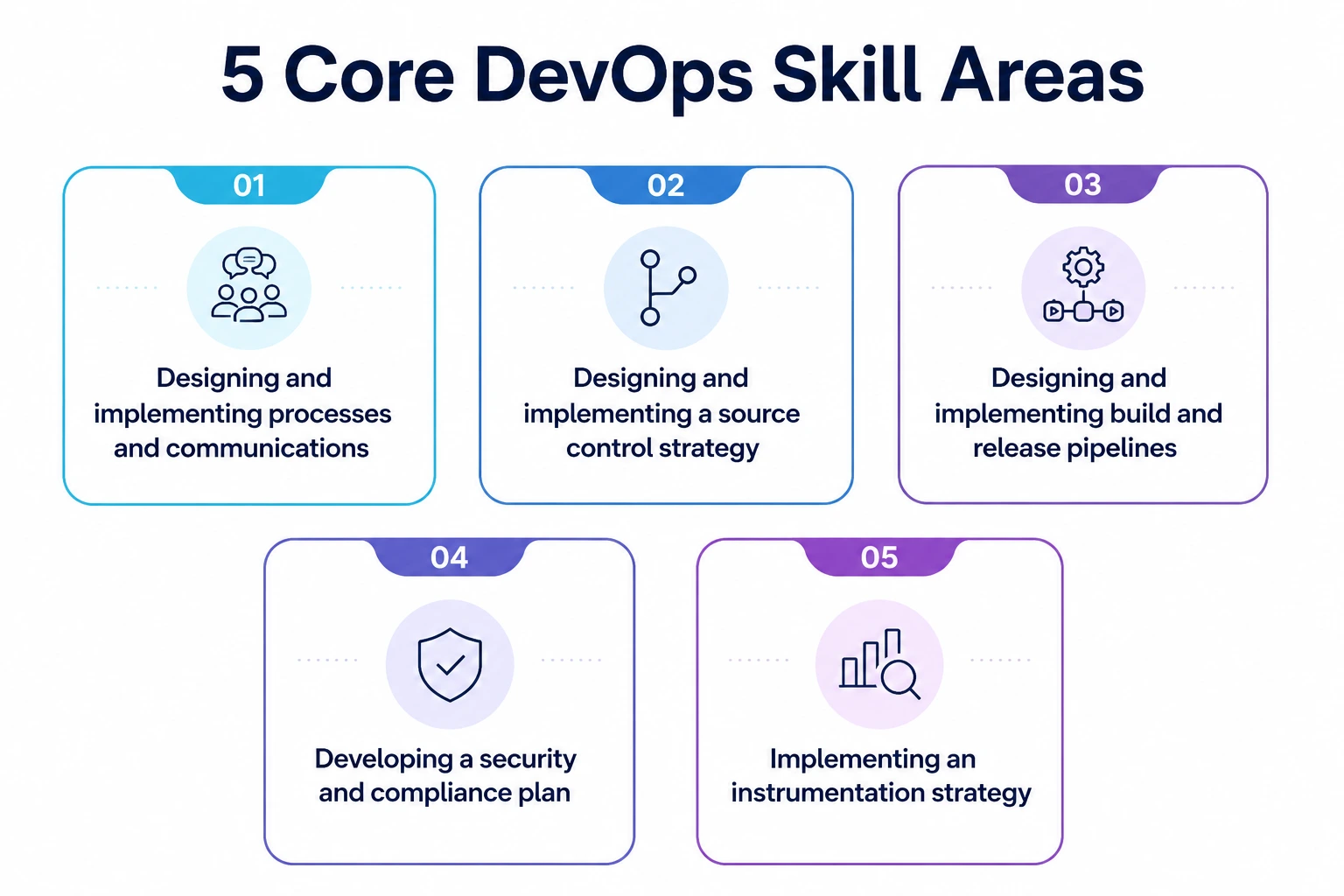
- Designing and implementing processes and communications — including stakeholder access levels in Azure DevOps and outside collaborator access in GitHub.
- Designing and implementing a source control strategy—covering branching models and scaling Git for enterprise teams.
- Designing and implementing build and release pipelines—which now includes YAML-based environments, checks, approvals, and progressive deployment patterns such as canary and ring deployments.
- Developing a security and compliance plan — including secretless authentication methods like workload identity federation and OpenID Connect.
- Implementing an instrumentation strategy—including distributed tracing through Azure Monitor Application Insights and basic Kusto Query Language searches.
Microsoft’s own study guide confirms this pipeline-heavy shift, noting that candidates must now design and implement a strategy for job execution order, including parallelism and multi-stage pipelines, alongside newer requirements to implement and manage secrets and secretless authentication in GitHub Actions and Azure Pipelines.
If your study plan from last year does not mention secretless authentication or GitHub Advanced Security, it is already out of date.
The AZ-400 Exam Structure You Should Expect
The AZ-400 exam is not a simple multiple-choice quiz anymore. Recent coverage of the 2026 update describes a format that now blends case studies with practical, scenario-driven tasks, and the exam commonly includes pipeline configuration tasks in simulated Azure DevOps environments rather than relying purely on multiple-choice questions.
A study resource estimates the exam runs to roughly 40 to 60 questions, mixing multiple choice, case studies, and hands-on-style tasks, with a required passing score of 700 out of 1000 according to Microsoft’s official listing.
Here is a quick snapshot of the current exam structure, gathered from Microsoft’s own study guide and independent exam-prep coverage published in 2026.
|
Exam Area |
Approximate Weight |
What It Tests |
|
Processes and communications |
10–15% |
Stakeholder access, collaboration models, GitHub/Azure DevOps permissions |
|
Source control strategy |
10–15% |
Branching strategy, Git scaling, dependency management |
|
Build and release pipelines |
50–55% |
YAML pipelines, deployment patterns, approvals, runners/agents |
|
Security and compliance plan |
Included in overall weighting |
Secretless auth, GitHub Advanced Security, Defender for Cloud DevOps |
|
Instrumentation strategy |
Included in overall weighting |
Application Insights tracing, KQL log queries |
Notice how pipelines alone make up over half the exam. That single number should reshape how you allocate your study hours. Spending equal time on every topic instead of following the actual weighting is the single biggest reason candidates walk out disappointed.
How a DevOps Certification Pays Off in the Current Job Market
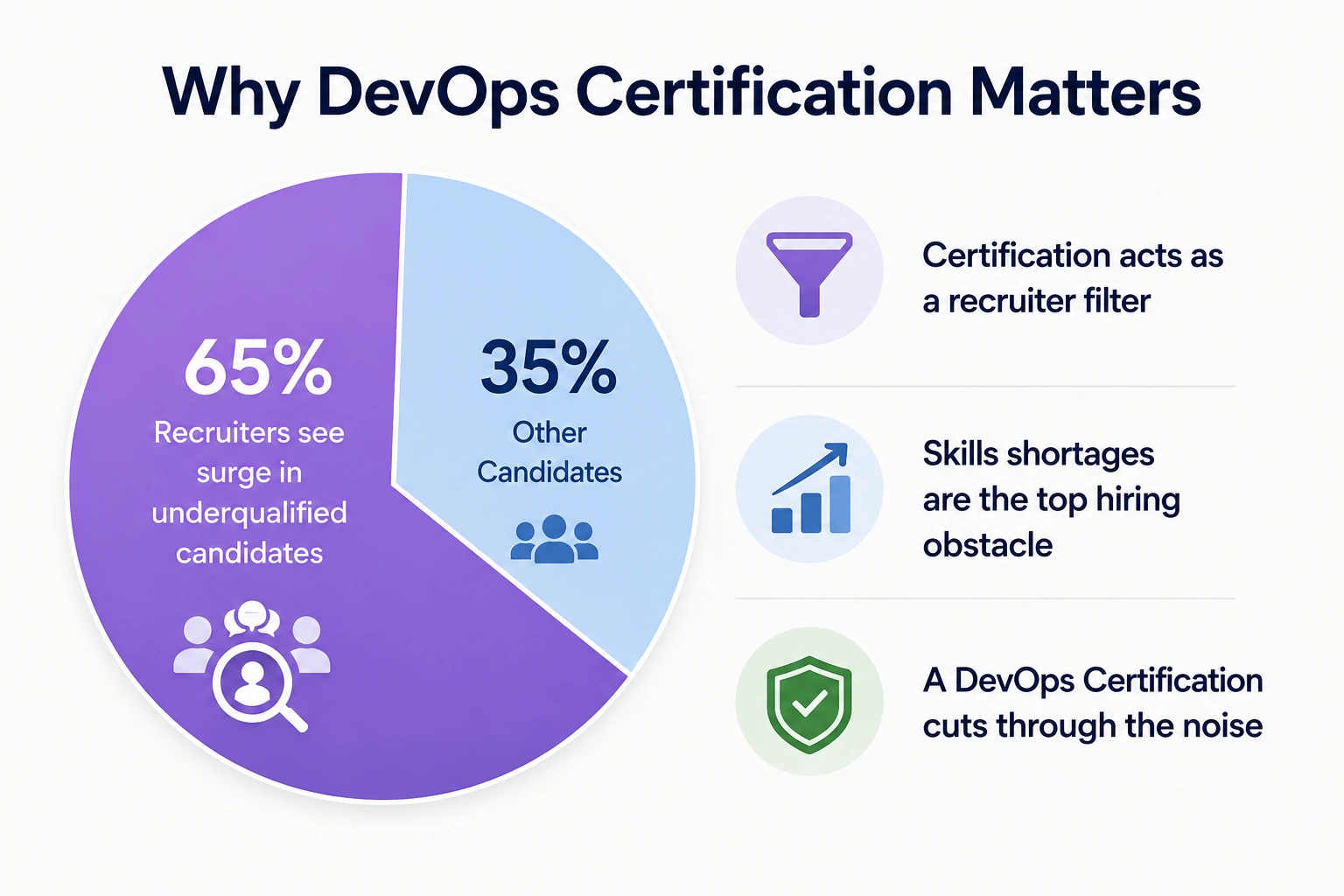
A DevOps certification is not just a line on a resume; it is a filter that recruiters use before they even schedule an interview. Market research 2026 survey data found that skills shortages remain the top hiring obstacle, and one recruitment survey cited in that report found that 65 percent of recruiters reported a surge in underqualified candidates applying for specialized roles such as DevOps engineering. A verified DevOps certification cuts through that noise instantly.
Pay data backs this up too. That same 2026 salary research shows DevOps engineers earning strong averages across major markets, with one U.S. survey placing the highest-paying city at an average annual salary of 174,390 dollars in San Francisco, followed closely by fully remote roles. Whether or not you live near a major tech hub, remote-friendly DevOps roles mean this earning potential is more accessible than ever in 2026.
Beyond salary, a DevOps certification signals something recruiters cannot easily verify through a resume alone: that you can actually operate the tools, not just describe them. That distinction matters more as companies raise their hiring bar, and it is one more reason the AZ-400 Certification is worth the effort this year.
Personal Lessons From My Own AZ-400 Certification Journey
I will be honest about something most study guides will not tell you. When I first attempted this certification, I treated it like any other multiple-choice exam and leaned on flashcards for two weeks. I failed by a narrow margin, and the score report told me exactly why: I had underestimated the pipeline section. I had memorized definitions of blue-green and canary deployments without ever building one myself in a real YAML pipeline during my first AZ-400 exam attempt.
On my second attempt, I changed my approach completely. I spent three weekends building an actual multi-stage pipeline in a free Azure DevOps organization, deliberately breaking it, and fixing it under time pressure. I also stopped avoiding the security section, which I had originally treated as an afterthought.
That single change, from reading about pipelines to actually building and breaking them, was the difference between a narrow fail and a comfortable pass. If there is one thing I want you to take from my experience, it is this: hands-on repetition beats passive reading every single time on this exam.
Practical Steps to Prepare and Pass on Attempt One
Getting ready requires a study plan that mirrors how the test is actually weighted, not a generic checklist copied from an old blog post. Building strong DevOps practices into your daily workflow now will make every one of these steps easier later.
- Start with Microsoft’s official study guide and compare it against the previous version so you know exactly what changed for 2026.
- Build at least one real multi-stage YAML pipeline from scratch, including approvals and environment checks, instead of only reading about them.
- Practice implementing secretless authentication methods like workload identity federation, since this is now a named requirement in the security section.
- Use Microsoft’s free official practice assessments rather than static question dumps, since dumps go stale as soon as the exam blueprint shifts.
- Review Kusto Query Language basics and Application Insights tracing, since instrumentation questions are often skipped in casual prep.
Following strong DevOps practices in your daily work, even informally, is one of the best ways to internalize this material. If your current job does not expose you to release pipelines, consider spinning up a personal project specifically to practice these DevOps practices before exam day.
Where is DevOps adoption heading, and why does it matter for you?
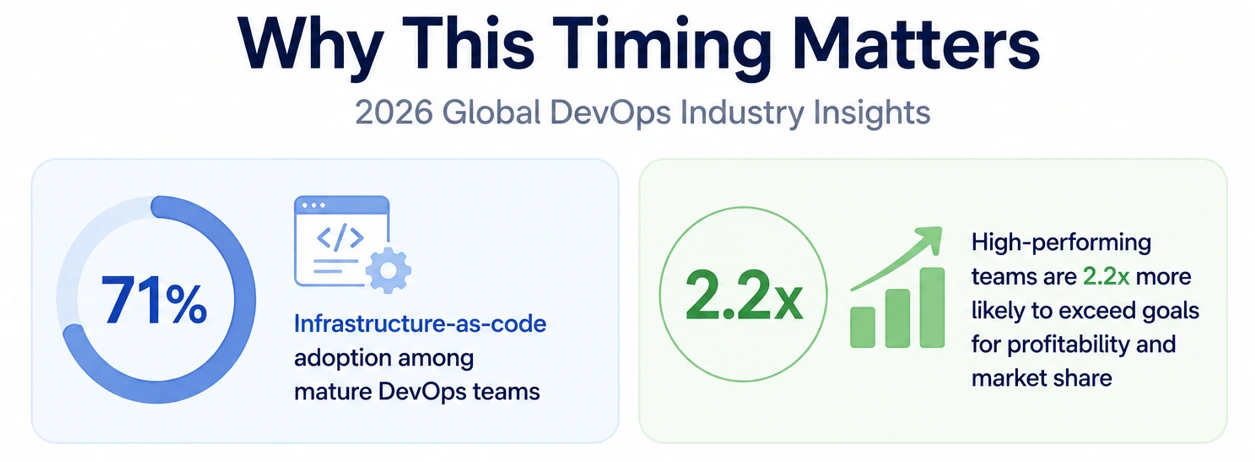
Broader industry data reinforces why this timing matters. A 2026 statistics roundup covering global DevOps adoption found that infrastructure-as-code adoption has reached 71 percent among mature DevOps teams, and that high-performing teams following strong DevOps practices are 2.2 times more likely to exceed their goals for profitability and market share.
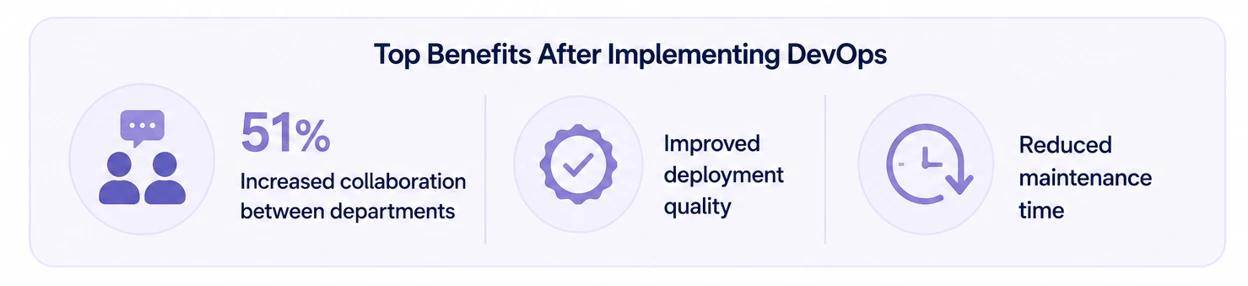
Also found that the top benefits companies report after implementing DevOps include increased collaboration between departments, cited by 51 percent of organizations, alongside improved deployment quality and reduced maintenance time.
Rising DevOps adoption also means rising expectations. As more companies mature past basic CI/CD into full DevSecOps practices, certifications like the AZ-400 Certification become the shorthand employers use to confirm you can operate at that level without months of on-the-job ramp-up. That is precisely why timing your DevOps Certification now, while the market still rewards early movers on the refreshed blueprint, works in your favor.
Conclusion: Is the AZ-400 Certification Worth It in 2026
The short answer is yes, provided you prepare for the exam it actually is today, not the exam it used to be. This credential now rewards candidates who can design pipelines, secure them, and monitor them end to end, rather than those who memorized a glossary of DevOps terms.
Pair Microsoft’s official study guide with genuine hands-on pipeline practice, keep building real DevOps practices as you go, respect the heavy weighting on build and release pipelines, and treat the security section as a first-class citizen rather than an afterthought. Do that, and your first attempt at the AZ-400 Certification has a real shot at being your last, especially as DevOps adoption keeps climbing across every industry.