
Here is a fact that surprises most people the first time they hear it: Microsoft has confirmed that its current Azure security certification, the AZ-500 exam, will retire on August 31, 2026. If you are already studying or thinking about starting, that single date changes almost everything about how you should plan the next few months.
So the real question is not “should I get certified” but “how do I actually pass before the clock runs out, and does it still make sense for my career?”
I have sat this exam myself, watched the exam blueprint shift twice in a year, and helped a small study group get through it, so this guide is built from that lived experience rather than recycled exam-dump advice. We will walk through what changed, what to study, how to structure your weeks, and what happens to your credential after retirement.
Understanding the Azure Security Certification Path in 2026
Cloud security work has quietly become one of the most stable corners of the tech job market. According to Microsoft’s own credential documentation, the exam behind the current Azure security certification, known as AZ-500 (Microsoft Azure Security Technologies), tests your ability to manage identity, protect infrastructure, secure data, and respond to threats across Azure, hybrid, and multi-cloud environments.
Passing it earns you the Microsoft Certified: Azure Security Engineer Associate title, a credential still recognized by hiring managers everywhere from Toronto to Berlin. The catch in 2026 is timing. Microsoft is retiring AZ-500 on August 31, 2026, and replacing it with a broader exam called SC-500, which folds in AI workload protection alongside traditional cloud defense.
If your work is centered on classic Azure infrastructure, sitting the current exam before it disappears is usually the smarter, faster route. If you are only starting out and will not be ready in time, it is worth planning around the newer path instead. Either way, an azure security certification remains one of the clearest signals to employers that you can actually secure a cloud environment, not just talk about it.
What Does the Exam Actually Cover?
The exam is built around four broad domains, and understanding how they are weighted tells you where to spend your study hours. Identity and access management questions test your command of conditional access, privileged roles, and everyday permission decisions. Platform protection covers network security, Azure firewall configuration, and workload isolation. Security operations lean heavily on security monitoring through Microsoft Defender for Cloud and Sentinel. Data and applications security covers encryption, key management, and data governance across storage and databases.
|
Exam Domain |
What It Covers |
Approximate Weight |
|
Identity & Access Management |
Entra ID, Conditional Access, access management, PIM |
25–30% |
|
Platform Protection |
Network security, azure firewall, VM, and container security |
25–30% |
|
Security Operations |
Security monitoring, Defender for Cloud, Sentinel, vulnerability management |
25–30% |
|
Data & Application Security |
Encryption, Key Vault, data governance, app protection |
20–25% |
These weights shift with each update, so cross-check the live skills outline before finalizing your study plan.
My Own Path to Certification
I will be honest about how my own attempt went. I came into this exam already comfortable with general Azure administration, but I underestimated the security operations domain badly. My first practice score sat around 55 percent, mostly because I had read about security monitoring instead of actually building alert rules and investigating simulated incidents inside a real subscription.
What turned things around was treating every topic as a lab exercise rather than a reading assignment. I built a small hub-and-spoke network, deployed an azure firewall policy, deliberately misconfigured a storage account, and then used Defender for Cloud to find and fix my own mistakes. That hands-on loop is what finally pushed my scores above 85 percent on practice tests, and it is the same advice I now give anyone chasing an Azure security certification of their own, whether they stop there or keep going toward an Azure architect role down the line.
A Study Plan That Actually Works
Random YouTube videos will not get you exam-ready, and generic Azure training alone rarely closes the gap either. Structure matters more than volume. Here is the plan I recommend, broken into five focused stages.
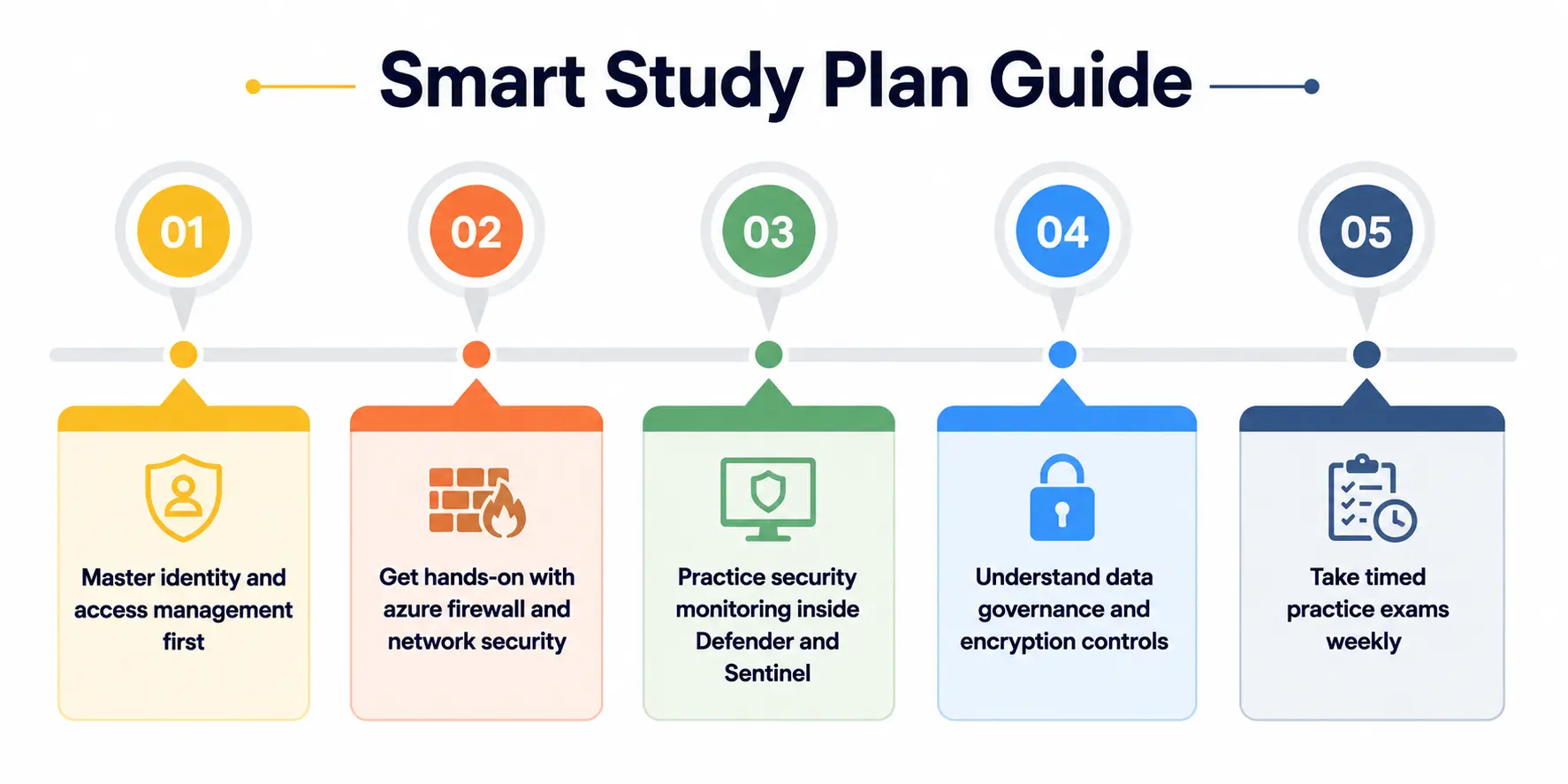
1. Master identity and access management first
Build conditional access policies, configure privileged identity management, and practice access management scenarios involving guest users and service principals.
2. Get hands-on with azure firewall and network security
Deploy an Azure firewall, set up firewall policies, configure Azure Bastion, and test network security groups against real traffic rules.
3. Practice security monitoring inside Defender and Sentinel
Enable Defender plans, review the secure score, write basic KQL queries, and walk through vulnerability management workflows from detection to remediation.
4. Understand data governance and encryption controls
Work through Key Vault, disk encryption, and data governance policies for storage accounts, including soft delete and immutable storage.
5. Take timed practice exams weekly
Track your weak domains, revisit only those topics, and repeat until you consistently score above 85 percent under exam conditions.
Anyone aiming for the associate-level Azure security certification should also consider whether they eventually want to move toward the Azure architect track, since this exam builds directly into that higher-level design role.
Common Mistakes That Cost People the Exam
Most failed attempts share the same root causes, and none of them are really about intelligence or effort.
Skipping hands-on labs is the biggest one. AZ-500 questions frequently hinge on portal details and configuration screens that reading alone cannot teach you. Underestimating security monitoring is another common trap, since candidates often study Defender for Cloud in theory but never actually investigate a simulated incident.
Ignoring the retirement timeline is a newer mistake in 2026 specifically; some candidates build a six-month study plan without checking whether the exam will still exist when they are ready. Treating vulnerability management as a one-time checklist rather than an ongoing process also trips people up, since the exam expects you to describe continuous remediation, not a single scan.
Finally, treating generic Azure training courses as a substitute for practice labs tends to backfire, because passive video-watching does not build the muscle memory the exam actually tests.
Why Does Effort Pay Off?
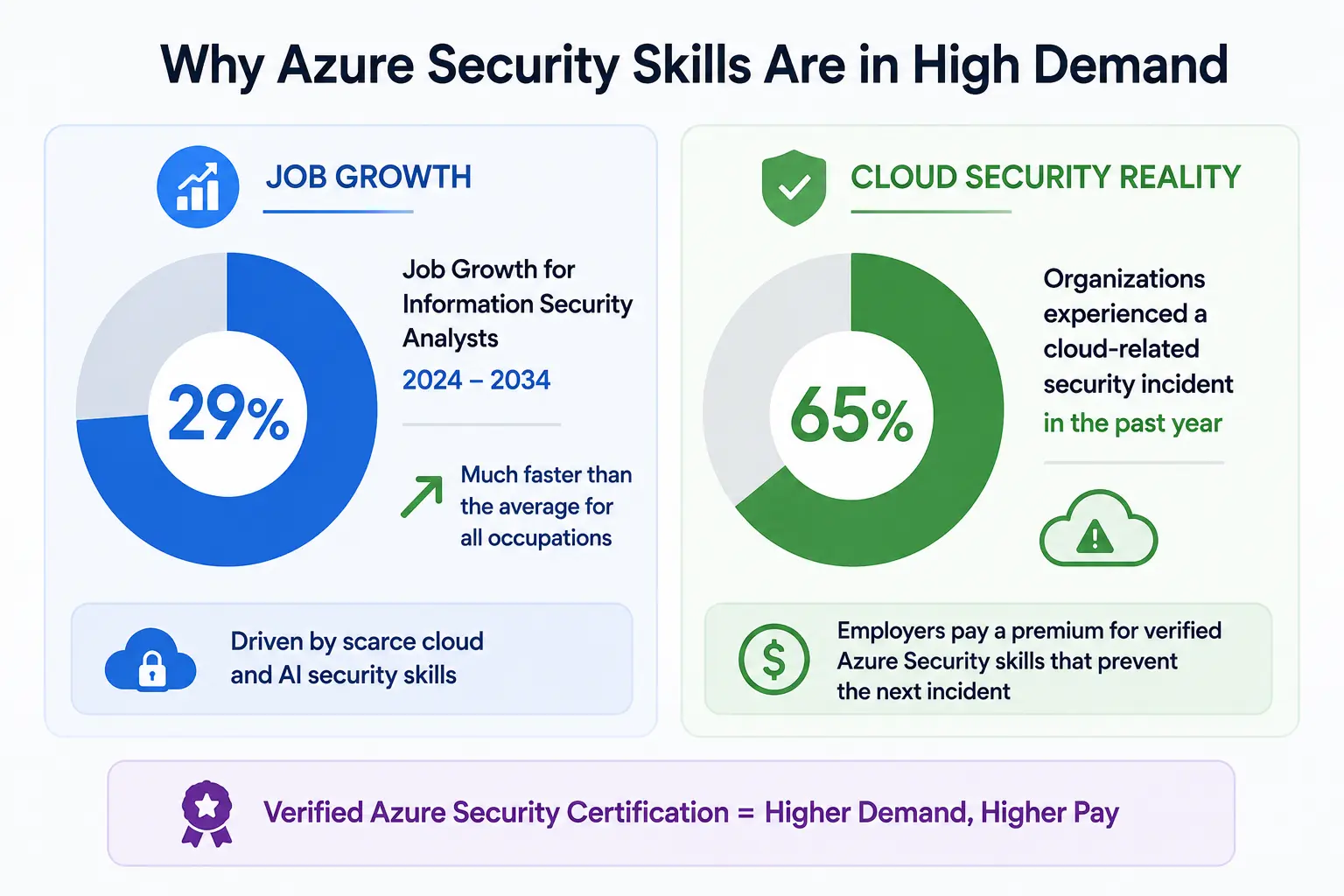
The market backs up the effort. Azure security hiring has stayed resilient even as parts of the broader tech sector cooled. Real-time compensation data puts the average cloud security engineer salary in the United States at roughly $152,773 as of mid-2026, with top earners crossing $205,000. Also, 2026 figures show a similar pattern, with 90th-percentile earners reporting pay above $264,000.
The 29 percent job growth for information security analysts between 2024 and 2034, far outpacing the average for all occupations, largely because cloud and AI security skills remain genuinely scarce. Separately, Check Point’s 2026 Cloud Security Report found that 65 percent of organizations experienced a cloud-related security incident in the prior year, which is exactly why employers keep paying a premium for people who hold a verified Azure security certification and can prove they know how to prevent the next one.
Where Does This Lead Next?
Many candidates treat this credential as a finish line, but it really works better as a checkpoint. Once certified, most engineers spend their first year deepening skills in vulnerability management, since new services and misconfigurations show up constantly and automated scanning tools alone will not catch everything.
Others move into broader data governance work, taking ownership of how sensitive information is classified, retained, and protected across an entire organization rather than a single subscription. If you are aiming higher, the natural next step is the Azure architect path, which builds on the same identity, network, and platform-security foundations but adds design-level decisions across multi-region and multi-cloud estates.
I have watched colleagues move from a first Azure security role into an Azure architect position within two or three years, almost always by continuing structured Azure training alongside real project work instead of stopping at the certification badge. Employers increasingly expect this trajectory, because a static skill set in Azure security ages quickly given how fast vulnerability management tooling and threat patterns change each quarter.
Ongoing Azure training, whether through Microsoft Learn paths or instructor-led programs, is what keeps a credential valuable long after the exam code itself is retired.
Conclusion
Passing an azure security certification in 2026 is less about memorizing terminology and more about proving you can secure a live environment under pressure. Focus your energy on access management, network security, Azure firewall configuration, security monitoring, data governance, and vulnerability management, and build every concept as a lab rather than a flashcard.
Whether you are racing the August 2026 retirement date or planning ahead toward the Azure architect track through structured Azure training, the fundamentals you build for this exam will outlast the exam code itself. Start with the official skills outline, build small, break things on purpose, and fix them yourself. That is genuinely the fastest way through.