
Here’s a number that stopped me mid-scroll this year: more than 90% of organizations worldwide are expected to feel a genuine digital skills shortage by the end of 2026, with the price tag estimated at $5.5 trillion globally. I thought about my own inbox, quietly full of recruiter messages asking one question: Do you hold an Azure certification? If you have ever typed “how do I even start” into a search bar at midnight, you are exactly who this guide is for. I have walked the Azure certification path myself, failed one exam, and passed four others, and I’m going to tell you honestly what it costs, how long it takes, and which certificate actually moved the needle on my career in 2026.
What Is the Azure Certification Path in 2026?
It is Microsoft’s structured set of exams that prove you can design, build, secure, and run workloads on the Azure cloud platform. It is a layered system, and understanding the layers is the first real step in building your cloud certification roadmap. Microsoft organizes its Azure credentials into four tiers: Fundamentals, Associate, Expert, and Specialty, spanning 24 exams across roles like administrator, developer, security engineer, and solutions architect.
For someone new to cloud computing, this can feel overwhelming. I remember staring at the Microsoft Learn catalog and genuinely not knowing where to click first. That confusion is common, and it is exactly why a clear Azure learning path matters more than raw ambition. You don’t need to collect every badge. You need the two or three certifications that match the job you actually want.
Why Cloud Skills Matter More Than Ever
Cloud adoption is no longer a future trend; it is the current operating reality, sitting at the center of nearly every enterprise cloud transformation initiative running right now. Over 94% of enterprises now use cloud services in some form, and organizations already direct roughly 45% of their total IT budget toward cloud infrastructure. The same report found that 76% of organizations struggle to find enough skilled cloud professionals. That gap is your opportunity.
Employers are not just hiring for enthusiasm anymore. They want proof of cloud skills that can be verified on a resume within seconds, and a Microsoft credential does exactly that. When I added my first Azure badge to LinkedIn, two recruiters reached out within a week, something my degree alone never achieved. Certifications compress years of scattered experience into one document a hiring manager can trust instantly, which is precisely why the Azure Certification Path shows up so often in cloud job postings.
The Four Levels of the Azure Learning Path
Every well-planned Azure learning path moves through the same broad structure, even though the exact exam codes shift year to year.
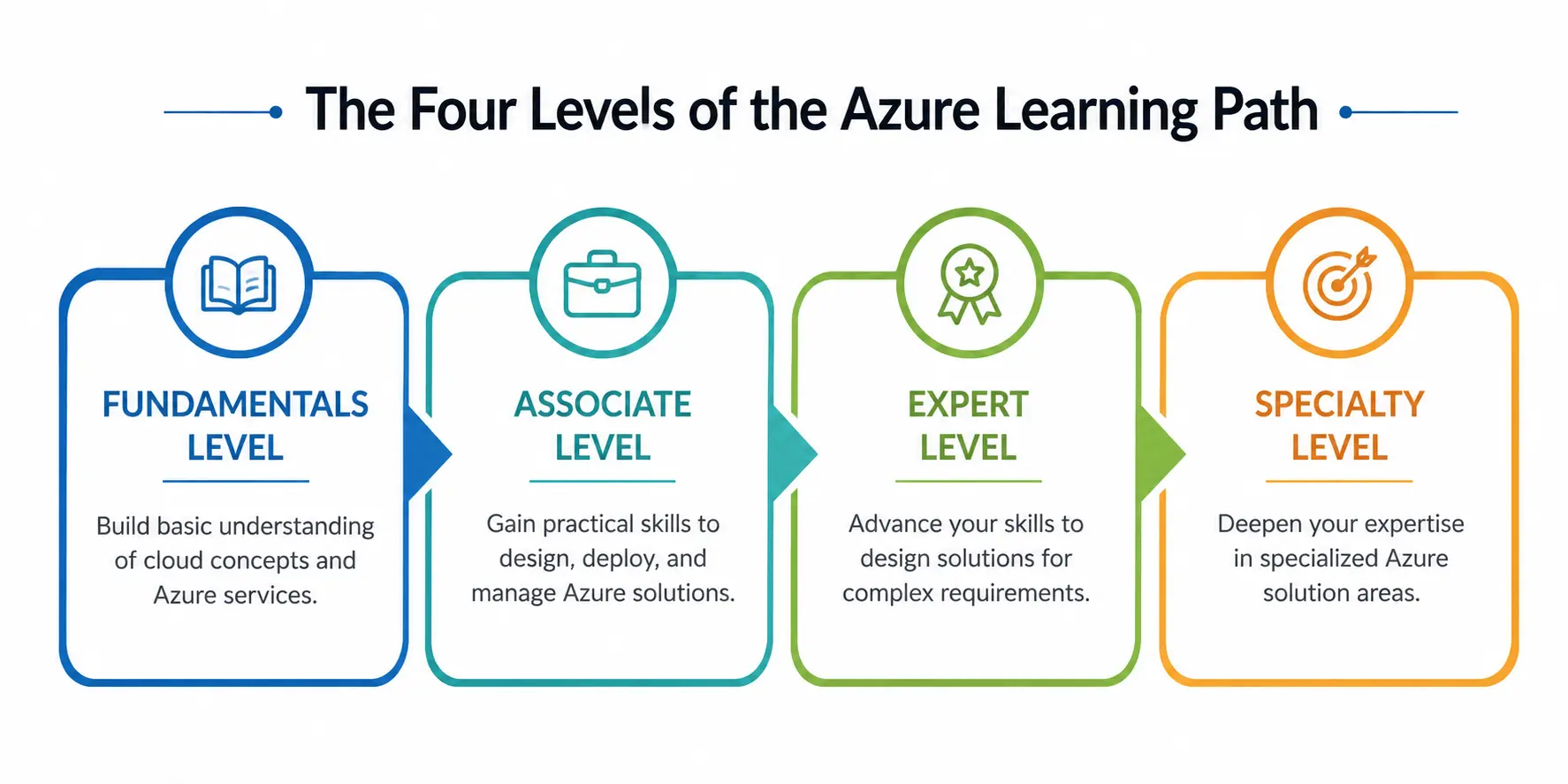
- Fundamentals level—This is where almost everyone should begin, technical background or not. The AZ-900 exam covers core cloud concepts, pricing, and governance, and unlike higher-tier certifications, it never expires.
- Associate level – Role-based exams such as AZ-104 (Administrator) and AZ-204 (Developer) sit here. They assume hands-on experience and test practical, day-to-day skills rather than theory alone.
- Expert level – Architecture-focused exams that expect you to already hold an associate certification and can design complete, secure, cost-aware solutions across an organization.
- Specialty level – Narrow, deep exams covering areas like IoT, data engineering with Microsoft Fabric, or security, aimed at professionals who already know their niche.
Each level builds on the one before it, so skipping straight to Expert without Associate-level exposure rarely works. I tried shortcutting this once and failed an expert-level practice test badly enough that I went straight back to basics.
Building Your Cloud Certification Roadmap Step by Step
A cloud certification roadmap only works when it is tied to a real job outcome, not a collection of shiny badges. Here is roughly how I sequenced mine and how I would advise a friend starting the Azure Certification Path from zero in 2026.
First, take AZ-900 to confirm cloud concepts genuinely interest you before spending real money, since this stage is really about testing your appetite for building real cloud skills. Second, pick a lane, administration, development, data, or security, based on what you enjoy doing daily, not what pays the most on paper. Third, commit to one associate exam and give yourself 6 to 10 weeks of consistent study using Microsoft Learn’s free modules plus hands-on labs in a real Azure subscription. Fourth, once employed or freelancing in that lane, layer in an expert or specialty credential tied to your actual project work, such as cloud migration projects or infrastructure security assessments. This sequencing matters because employers increasingly evaluate applied skill over exam count, which is the core idea behind a smart cloud certification roadmap, and your certifications gradually become the technical foundation of whatever cloud transformation strategy your employer is already running.
Azure Certification Costs in 2026: What You’ll Actually Pay
Cost is usually the first real question people ask, so here is a transparent breakdown based on current 2026 Microsoft pricing.
|
Certification Level |
Example Exam | Exam Fee (USD) | Typical Prep Time |
Validity |
|
Fundamentals |
AZ-900 | $99 | 2–4 weeks |
Does not expire |
|
Associate |
AZ-104 (Administrator) | $165 | 6–10 weeks |
12 months, free renewal |
|
Associate |
AZ-204 (Developer) | $165 | 8–10 weeks |
12 months, free renewal |
|
Expert |
AZ-305 (Architect) | $165 | 10–14 weeks |
12 months, free renewal |
|
Specialty |
Security/Data specialty exams | $165 | 8–12 weeks |
12 months, free renewal |
Figures are compiled from Microsoft’s official exam pricing model, where Fundamentals exams are set at $99 and Associate, Expert, and Specialty exams are priced at $165 globally. Add $50 to $500 for supplementary video courses, plus roughly $20 a month for an active Azure subscription while you practice hands-on labs.
The good news is that the return tends to justify the spend quickly. Certified professionals often earn more than uncertified peers in comparable roles, and many employers reimburse the exam fee once you commit to sitting the test, so treat the sticker price as a starting point, not the final number.
Certifications Built for Cloud Migration and Infrastructure Security
Two themes dominate Azure hiring conversations in 2026, and both deserve a spot on your cloud certification roadmap because they directly reflect the cloud skills employers now expect on day one.
Cloud migration remains the backbone of enterprise IT projects, as companies keep shrinking their on-premises footprint in favor of scalable, pay-as-you-go infrastructure. The AZ-104 and AZ-305 exams both test migration scenarios directly, from lift-and-shift workloads to full re-architecture. If your goal is consulting or systems integrator work, expect cloud migration questions to show up repeatedly across your study material.
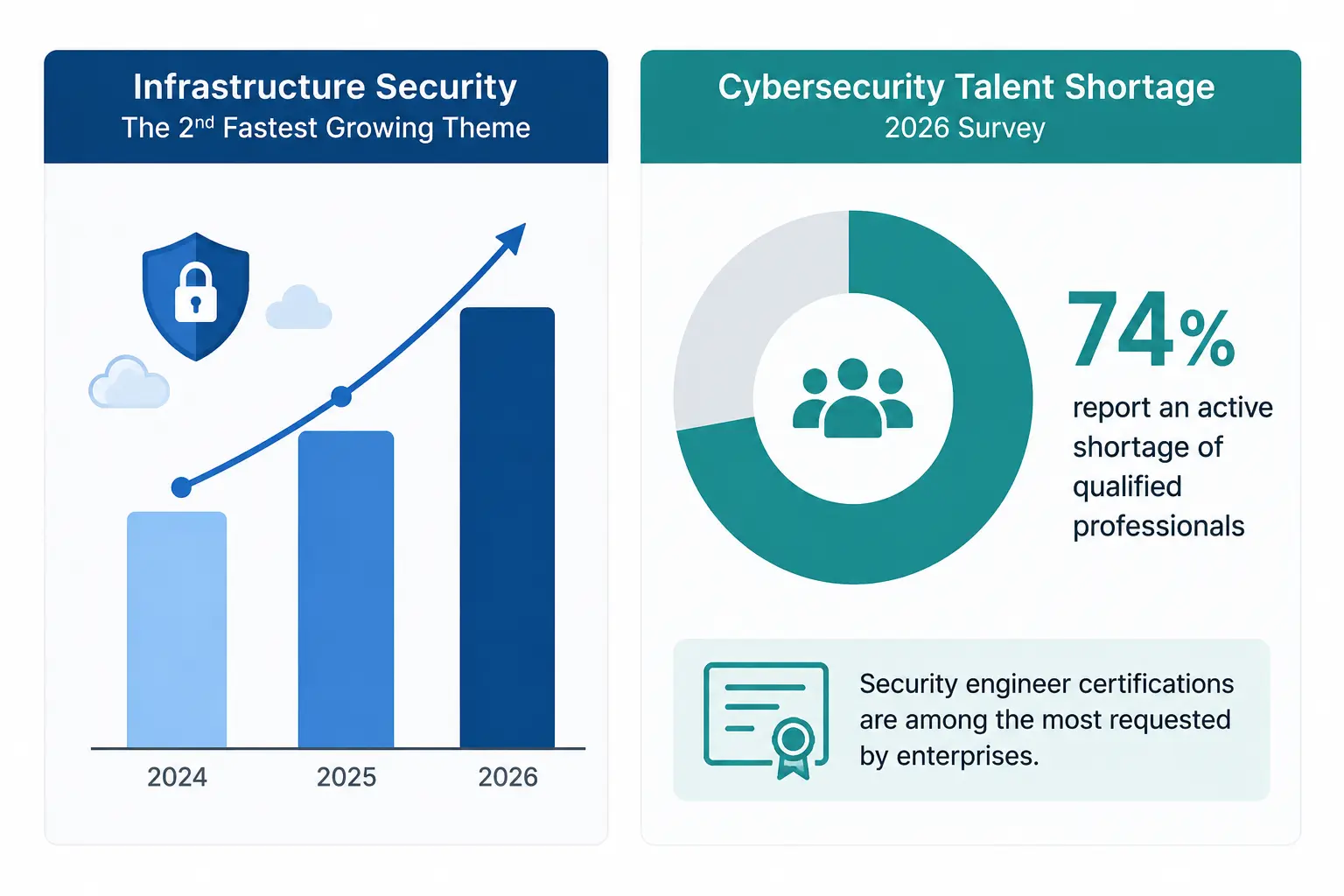
Infrastructure security is the second theme, growing faster than almost any other category. Nearly 74% of cybersecurity leaders surveyed in 2026 report an active shortage of qualified professionals, even as cloud environments grow more complex and harder to defend in real time. Certifications tied to this space, including the security engineer track, are quickly becoming some of the most requested credentials among enterprises rebuilding their defenses.
Zero Trust Architecture and Why Security Certifications Are Booming
If there is one concept reshaping the entire Azure Learning Path in 2026, it is zero trust architecture. Roughly 81% of organizations now plan to implement this approach this year, moving away from outdated perimeter-based defenses toward continuous verification of every user and device. Organizations that have already deployed Zero Trust Architecture principles report meaningfully lower breach costs compared with peers who have not, according to breach cost research cited across recent industry analysis.
This matters to your certification choices. Microsoft has woven Zero Trust Architecture concepts, including identity verification, least-privilege access, and continuous monitoring, into its security-focused exam content, framing Zero Trust as an adoption framework layered on top of its existing cloud adoption structure. Anyone pursuing the Azure Certification Path with a security lean in 2026 will encounter these concepts repeatedly, which are worth studying independently of any single exam.
My Personal Experience Walking the Azure Certification Path
I want to be candid here because most guides gloss over the messy middle. I started my own certification journey two years ago as a career-changer with zero formal IT background. AZ-900 took three weekends. AZ-104 took closer to nine weeks, and I failed my first attempt by 40 points because I underestimated networking. I retook it a month later and passed comfortably once I built actual virtual networks instead of just reading about them.
What surprised me most was how much the Azure Learning Path changed how I approached my day job, even before I switched roles. Concepts like cloud migration planning and infrastructure security basics stopped being abstract textbook ideas and became things I could actually discuss in meetings. That shift, from theoretical to practical, is the real value of walking this road, far beyond the certificate image you get to post online, because it mirrors exactly what a genuine cloud transformation project demands of you on the job.
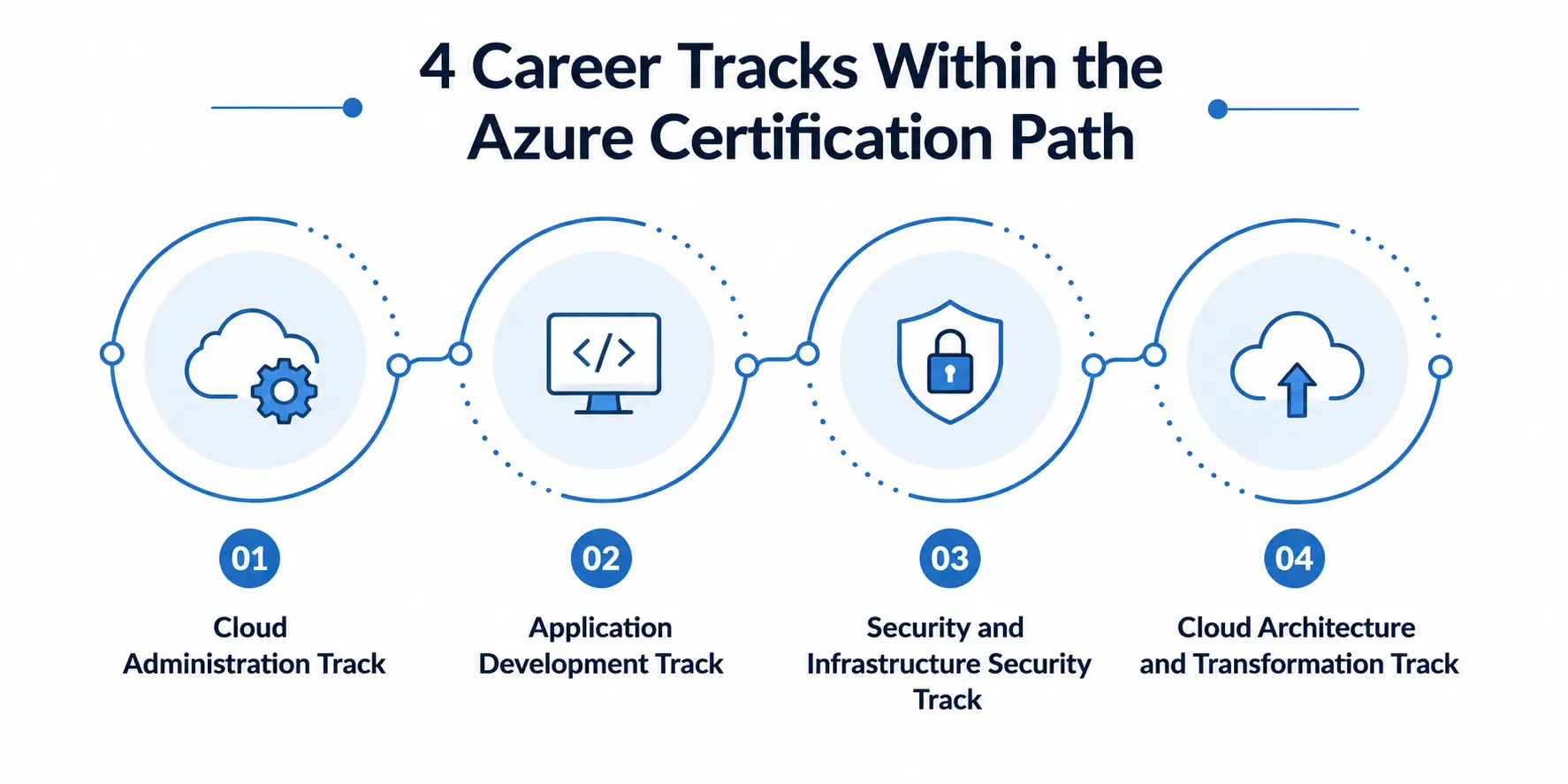
4 Career Tracks Within the Azure Certification Path
Choosing a lane early saves months of wasted study time. Here are the four broad tracks I would point a beginner toward, based on the data and my own trial and error.
1. Cloud Administration Track
Best for people who enjoy hands-on infrastructure work: virtual machines, storage, networking, and identity management. AZ-104 is the anchor exam, and it consistently ranks among the highest-demand associate-level Azure credentials.
2. Application Development Track
Suited to programmers who want to build and deploy apps natively on Azure. AZ-204 focuses on Azure Functions, APIs, and storage integration and pairs well with existing coding experience.
3. Security and Infrastructure Security Track
For those drawn to defense-focused roles. This track leans heavily on Zero Trust Architecture principles, identity protection, and governance and is currently one of the fastest-growing tracks tied to broader cloud transformation initiatives across enterprises.
4. Cloud Architecture and Transformation Track
The natural next step after gaining associate-level experience. Architect-track certifications validate your ability to design full solutions and guide enterprise-wide cloud transformation efforts, connecting technical decisions to business outcomes.
Conclusion
The Azure Certification Path is not a shortcut, and nobody should promise you a six-figure job overnight for passing one exam. But as someone who walked this road with real failed attempts and real late nights, I can say the structure works if you follow it deliberately: start with fundamentals, choose a lane, commit to one associate exam, and let real project work, whether that’s cloud migration, infrastructure security, or broader cloud transformation, shape your next certificate rather than chasing every badge available. Cloud skills are only becoming more valuable as enterprises keep investing in zero trust architecture and modern infrastructure, and a well-planned Azure learning path remains one of the most reliable ways to prove you belong in that conversation. Start with one exam. The rest of the roadmap will make a lot more sense once you’re standing inside it rather than reading about it from the outside.
Sources
-
Microsoft Learn – Azure Fundamentals Certification
-
Microsoft Learn – Azure Administrator Associate Certification
-
Microsoft Learn – Azure Developer Associate Certification
-
Microsoft Learn – Zero Trust Adoption Framework
-
CertMage – Azure Certification Cost 2026
-
TechTarget – Is There Still a Cloud Skills Gap in 2025/2026
-
Fortinet – 2026 Cloud Security Report Data Reveals “Complexity Gap”