

Did you know AWS still controls roughly 30% of global cloud infrastructure spending in early 2026, more than any other provider, and that share keeps holding even as Microsoft Azure and Google Cloud chase it?
That one fact explains why so many career changers, students, and non-technical professionals keep asking me the same question: is an AWS Cloud Practitioner course online actually worth your time and money this year, or has the AWS Cloud Practitioner certification become just another badge collecting dust on a LinkedIn profile? I sat the CLF-C02 exam myself a few months ago, and I want to walk you through what I found, using 2026 numbers instead of recycled advice from three years back.
I’ll be honest about something upfront. I am not a computer science graduate. I came into cloud computing from a marketing background, curious about why every client meeting suddenly involved words like “provisioning” and “scalability.” So when I talk about whether this credential makes sense for a non-technical audience, I’m speaking from lived experience rather than a textbook.
What Is the AWS Cloud Practitioner Course, Really?
The AWS Cloud Practitioner course prepares you for a single exam, officially coded CLF-C02, which Amazon Web Services designed for people with little or no background in IT. It is not a coding test. There is no lab component, no command-line challenge, nothing that requires you to write a single line of code. Instead, it checks whether you understand how the cloud works at a conceptual level: pricing models, security responsibilities, and the general shape of AWS services like storage, databases, and compute.
CLF-C02 exam format and passing score
The exam runs 90 minutes and includes 65 questions, only 50 of which are scored. The AWS Cloud Practitioner passing score is 700 out of 1,000. AWS doesn’t publish official pass rates, but the exam is designed to confirm baseline fluency, not to weed people out.
AWS Cloud Practitioner syllabus (exam domains)
|
Domain |
Weight |
|---|---|
|
Cloud Concepts |
24% |
|
Security and Compliance |
30% |
|
Cloud Technology and Services |
34% |
|
Billing, Pricing, and Support |
12% |
Why Cloud Adoption in 2027 Makes This Course Relevant Again
Here’s where the timing actually matters. Cloud adoption has quietly become close to universal. Roughly 94 percent of enterprises now use cloud services in some form, and average organizations run about half of their workloads in public cloud environments, up sharply from just a few years ago. In the European Union, the share of enterprises paying for cloud services rose past 52 percent in 2025, a jump of over seven percentage points in two years, according to Eurostat figures reported by industry analysts.
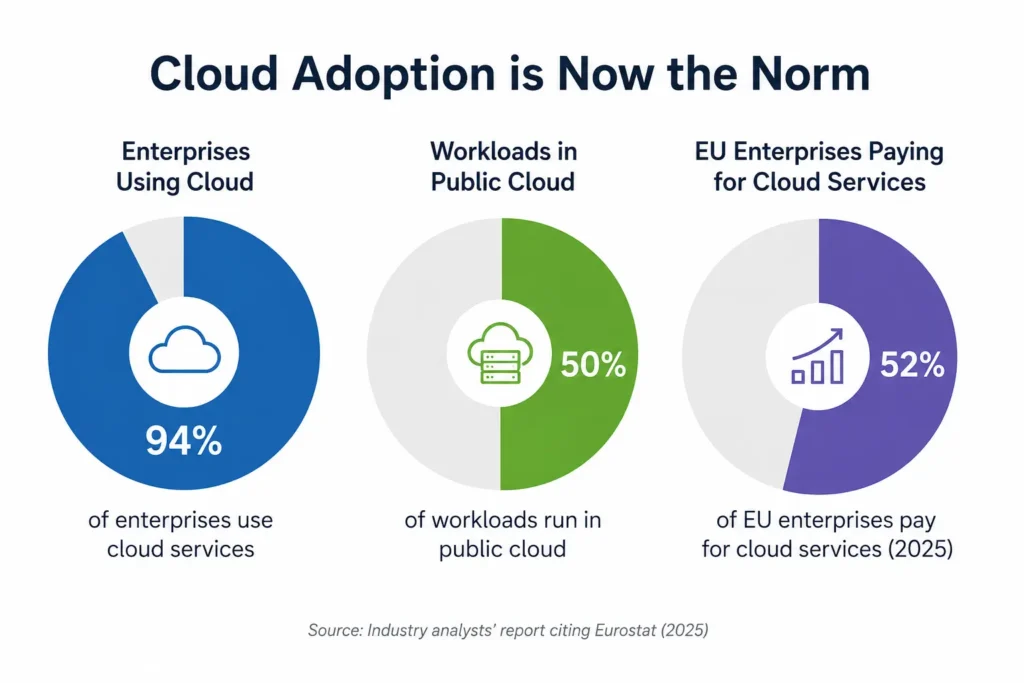
What that means in plain English: the cloud is no longer a niche skill you learn to stand out. It has become baseline workplace literacy, the way basic spreadsheet skills became non-negotiable in the 2000s. Cloud adoption at this scale means every department, not just engineering, now touches cloud tools, from finance teams reviewing billing dashboards to sales teams positioning cloud-based products to clients.
AWS Skill Builder and the Free AWS Cloud Practitioner Course
I did almost all of my preparation on AWS Skill Builder, Amazon’s own training hub. It hosts more than 900 free self-paced courses, including AWS Cloud Practitioner Essentials, the official free AWS Cloud Practitioner course. If you follow the official AWS Learning Path for Cloud Practitioner, you get a free practice question set, a free pretest, and domain-review videos at no cost at all. That alone surprised me. I expected to pay for everything.
What I did pay for was the $29-a-month Skill Builder subscription, which unlocked AWS Cloud Quest, a genuinely fun, game-style way to practice services like Amazon EC2, S3, and IAM inside a real sandbox account rather than a simulation. I kept that subscription for about six weeks. In May 2026, AWS also rolled out a new tool called Lab Maker, which generates instant, personalized hands-on labs for popular AWS services on demand. It didn’t exist when I started studying a year earlier.
How to Prepare for AWS Cloud Practitioner: My 4-Week Study Plan
My honest study routine was forty minutes most weekday mornings before work, working through the official AWS Learning Path modules. Weekend afternoons went to a free AWS account: launching an Amazon EC2 instance just to watch it boot, then terminating it before it could eat into my credits. (New AWS accounts now get a 6-month free plan with up to $200 in credits, rather than the old 12-month free tier.) That hands-on repetition mattered more than any single video.
- Week 1: Cloud Concepts. AWS Cloud Practitioner Essentials modules 1–3, plus the free pretest to find your weak spots.
- Week 2: Security and Compliance. The shared responsibility model and IAM, plus hands-on IAM users and roles in your free account.
- Week 3: Cloud Technology and Services. EC2, S3, RDS, Lambda, and the global infrastructure.
- Week 4: Billing, Pricing, and Support. Pricing models, Cost Explorer and support plans, then full-length practice tests until you score 80% or higher consistently.
AWS Cloud Practitioner Exam Cost: Fees, Subscriptions, and Hidden Extras
The AWS Cloud Practitioner course itself is free if you stick to official materials. What isn’t free is the exam registration and, for most people, at least one paid practice resource. AWS confirms the exam fee is a flat $100 USD globally, with associate-level exams priced at $150 and professional-level exams at $300.
|
Item |
Typical Cost (USD) |
Notes |
|---|---|---|
|
CLF-C02 exam fee |
$100 |
Flat global rate; local taxes may apply |
|
AWS Skill Builder free tier |
$0 |
900+ courses, incl. Cloud Practitioner Essentials and a practice question set |
|
AWS Skill Builder subscription |
$29/month |
Unlocks Cloud Quest and the official practice exam |
|
Third-party practice tests |
$15–$20 |
Optional; useful for exam-day pacing |
|
Retake fee (if needed) |
$100 |
14-day waiting period between attempts |
|
Realistic total budget |
$130–$250 |
Assuming one month of subscription and one attempt |
Retakes cost the full $100 again, and AWS requires a 14-day gap between attempts, so there’s a real financial incentive to prepare properly the first time. The upside of passing: AWS gives you a 50% discount voucher for your next exam, which brings an associate exam such as Solutions Architect down to $75.
AWS Cloud Practitioner exam cost in India
In India, the $100 fee is converted to rupees at checkout and 18% GST is added, which works out to roughly ₹10,400. With one month of Skill Builder and a practice test, a realistic total is about ₹13,000–₹15,000.
AWS Cloud Practitioner Salary and Career Impact: What 2026 Data Shows
This is the part people care about most, so let’s not dance around it. Entry-level professionals holding this credential earn an average of $85,866 a year in the United States, according to ZipRecruiter’s 2026 salary data. That figure climbs meaningfully with even a couple of years of relevant experience, and many holders report the certificate came before a raise, not just a new job title.
I want to be careful here, though, because I don’t think the certificate itself pays anyone’s bills. What it does is get your resume past automated filters and give you a shared vocabulary in interviews. In my own case, the credential didn’t land me a cloud engineering job overnight. It helped me speak intelligently to product and delivery teams, which, in a marketing-adjacent role, mattered more than I expected.
Who Should (and Shouldn’t) Take the AWS Cloud Practitioner Course in 2026
Not everyone benefits equally from this credential. Here’s how I’d break it down based on what I’ve seen among people I studied alongside.
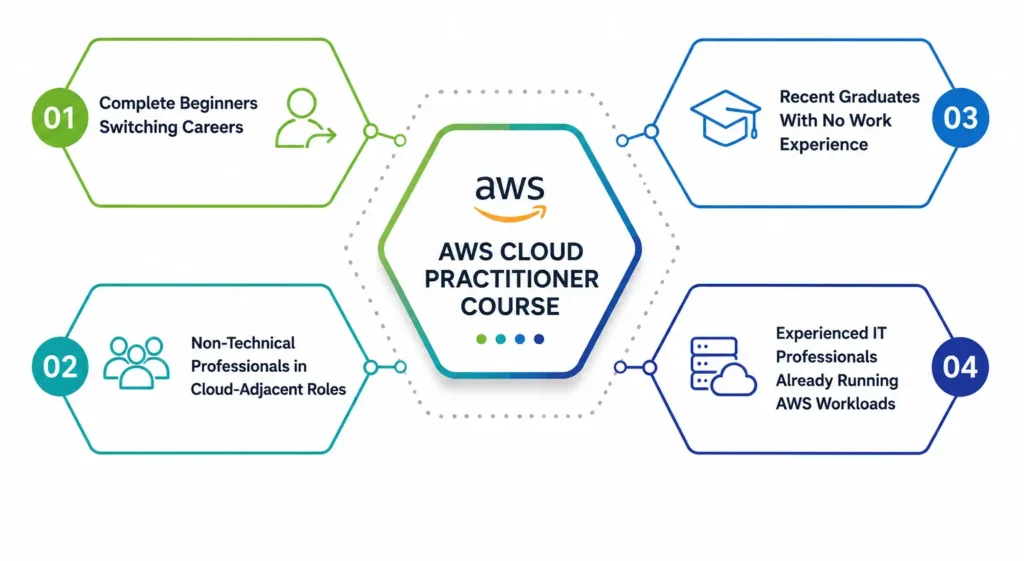
1. Complete beginners switching careers
If you have zero background in tech and want a low-risk entry point, this is exactly who AWS built the course for. You don’t need prior IT exposure, and the vocabulary you gain makes every later AWS course easier to follow.
2. Non-technical professionals in cloud-adjacent roles
Sales engineers, project managers, and compliance analysts who sit in meetings with engineers benefit enormously. You don’t need to build anything, but understanding what Amazon EC2 or S3 actually does changes how credible you sound on a client call.
3. Recent graduates with no work experience
The certificate signals initiative to hiring managers screening for junior cloud support roles, even when a candidate has no professional history to point to yet.
4. Experienced IT professionals already running AWS workloads
This group already knows the core AWS services in practice, so they should generally skip straight to an associate-level certification. If you’re already deploying production workloads on Amazon EC2 or managing real infrastructure, the Cloud Practitioner exam won’t add much weight to your resume and may even look like a step backward.
Common Mistakes CLF-C02 Candidates Make
A few mistakes came up repeatedly among CLF-C02 candidates I met in study groups and online forums. First, treating the $100 exam fee as the entire budget, then getting blindsided by a failed attempt and a second $100 charge. Second, skipping hands-on practice and relying only on video lectures, which produces candidates who recognize terminology but freeze on scenario-based questions. Third, underestimating the billing, pricing, and support domain. It accounts for only 12 percent of the exam, but it trips up a surprising number of people who assumed it was a minor afterthought.
Conclusion: Is the AWS Cloud Practitioner Course Worth It?
After going through the AWS Cloud Practitioner course myself, sitting the CLF-C02 exam, and watching how cloud adoption has reshaped even non-technical job descriptions this year, my honest answer is that it remains worth it in 2026, provided you go in with realistic expectations. It won’t turn you into a cloud engineer overnight, and it isn’t meant to. What it does is hand you a vocabulary, a foundational understanding of AWS services, and a credential that quietly signals initiative to hiring managers. For $100 and a few weeks of consistent study through the official AWS Learning Path, that’s a reasonable trade.