
Compliance isn’t a back-office function anymore—it’s a boardroom priority. As data privacy laws multiply, federal frameworks tighten, and cyber incidents make front-page news, organizations urgently need professionals who can bridge the gap between technical security controls and business risk decisions.
That’s exactly the space the ISC2 CGRC certification was built for.
If you’re weighing your next career move in IT security, risk management, or governance, you’ve probably seen this governance, risk and compliance certification come up repeatedly in job postings. Regulatory obligations in 2026 are more layered than ever, and companies pay a premium for professionals who can manage that load. Strong cybersecurity governance has shifted from an IT concern into a C-suite imperative.
This guide covers what GRC certification is, the updated CGRC domains, CGRC exam cost and requirements, how to prepare, real career paths, CGRC salary data, and whether CGRC is worth it in 2026.
What Is CGRC Certification?
CGRC—short for Certified in Governance, Risk, and Compliance—is an advanced credential offered by ISC2, one of the world’s most respected cybersecurity membership organizations. Formerly known as the Certified Authorization Professional (CAP), it was renamed in February 2023 to reflect its broader scope across enterprise governance and compliance frameworks.
At its core, CGRC certification validates your ability to design, implement, and sustain GRC programs that align with both security requirements and business objectives. It’s recognized across government agencies, financial institutions, healthcare organizations, and technology companies—anywhere regulatory compliance carries real operational weight.
What makes CGRC stand out from other cybersecurity credentials is its focus on governance and risk integration rather than purely technical controls. Holders can translate complex frameworks—like NIST RMF, ISO 27001, and FISMA—into practical organizational programs. The certification is ISO/IEC 17024 accredited and DoD 8140 approved, which matters significantly for government and defense-sector roles.
CGRC vs CAP: What Changed? (NEW)
CGRC and CAP are the same certification under a new name. ISC2 renamed CAP to CGRC in February 2023, and existing CAP holders were moved to CGRC automatically—no re-exam and no extra fee.
The bigger change came later. On June 15, 2024, ISC2 refreshed the CGRC exam outline after its job task analysis. The update added privacy throughout every domain, named international frameworks such as ISO/IEC standards, GDPR, and PCI DSS alongside FISMA and FIPS, and renamed the last two domains to System Compliance and Compliance Maintenance. If your study material predates June 2024, check it against the current outline.
Why CGRC Certification Matters in 2026
A few connected shifts are driving demand—tightening regulations, board-level accountability, a growing risk-talent gap, and fast-expanding GRC teams.
Growing Regulatory Requirements
The regulatory landscape in 2026 has never been more complex. GDPR enforcement actions continue to climb across Europe. In the U.S., the SEC’s cybersecurity disclosure rules require public companies to report material cyber incidents within four business days, and a growing wave of state privacy laws is layering fresh obligations on top of HIPAA, FedRAMP, and CMMC.
Organizations can no longer treat compliance as an ad-hoc exercise. Structured programs, mapped controls, and auditable evidence have become baseline requirements, not best practices. Professionals who can build and run those programs are in high demand.
Rise of Cybersecurity Governance
Boards of directors are now legally accountable for cyber risk in many jurisdictions. That shift has turned cybersecurity governance from an IT task into a business discipline. The question is no longer just “are we secure?” but “how does our security strategy align with business risk tolerance, and who is accountable for that alignment?”
Strong governance requires policies, accountability structures, and executive oversight—all areas where CGRC-certified professionals excel. For organizations that need governance frameworks built and enforced, this credential is increasingly the benchmark they hire against.
Demand for Risk Specialists
ISC2’s Cybersecurity Workforce Study has repeatedly flagged a global shortage running into the millions of cybersecurity professionals, with GRC-related roles among the hardest to fill. A qualified cyber risk analyst doesn’t just read threat reports—they quantify risk, advise leadership, and support investment decisions.
Organizations have learned, often painfully, that hiring risk talent after an incident is too late. CGRC gives candidates a framework-based vocabulary that works across technical and business teams, and more job postings for risk roles now name CGRC as a preferred credential.
Expanding GRC Teams
GRC teams are growing faster than almost any other function in corporate IT. What was once a single compliance manager’s job is now a structured team covering policy management, vendor risk, audit readiness, and framework alignment. This expansion is opening a genuine GRC analyst career path at entry, mid, and senior levels.
For professionals pursuing a GRC analyst career, CGRC demonstrates commitment to the discipline that generalist IT certifications don’t match. Many hiring managers in regulated industries now filter for it—more on that in the recruiter section below.
Understanding NIST RMF and Its Role in CGRC Certification
The two are deeply intertwined: the CGRC domains follow the NIST RMF lifecycle in order, so understanding one helps explain the other.
What Is NIST RMF?
NIST RMF—the National Institute of Standards and Technology Risk Management Framework—is a structured process for integrating security, privacy, and risk management activities into information systems and organizations. Originally designed for federal agencies, it has been widely adopted by state governments, defense contractors, and private-sector organizations that handle federal data or work under federal contracts.
For anyone pursuing a serious GRC career, NIST RMF isn’t optional—it’s the underlying language through which most U.S. government security programs are designed, evaluated, and authorized.
The Seven Steps of NIST RMF
-
Prepare—Establish the context and priorities for managing security and privacy risk
-
Categorize—Classify information systems based on potential impact if compromised
-
Select—Choose appropriate controls from the NIST SP 800-53 catalog
-
Implement—Put the selected controls into practice across the organization
-
Assess—Evaluate whether controls are implemented correctly and operating as intended
-
Authorize—A senior official formally accepts the residual risk of operating the system
-
Monitor—Continuously track control effectiveness and respond to changes
Why NIST RMF Matters for Compliance Teams
NIST RMF gives compliance teams a defensible, auditable structure for security decisions. When an organization can show documented risk assessments, control selections tied to categorization, and evidence-based authorization packages, it is far better protected from regulatory scrutiny.
It also gives lawyers, auditors, CISOs, and engineers a shared reference point that reduces miscommunication and speeds up authorization.
How CGRC Certification Aligns With NIST RMF
The CGRC exam tracks the NIST RMF lifecycle from Prepare (Domain 1) through Monitor (Domain 7). It tests candidates on the associated NIST special publications—particularly SP 800-37, SP 800-53, and SP 800-137—and on the practical skills needed to support an Authorization to Operate (ATO). Earning CGRC certifies your ability to run NIST RMF in real environments, where systems are complex, stakeholders compete, and time pressure is constant.
Skills You Learn Through CGRC Certification
These skills build on each other, starting with how an assessment is planned and run.
Security Assessment Process
Running a rigorous security assessment is one of the most practical skills CGRC develops. Candidates learn to plan, coordinate, and execute assessments—developing assessment plans, choosing evidence collection methods, and communicating findings to authorizing officials.
A well-documented assessment process is the foundation of any defensible authorization package, and employers look for people who can own it end to end. Organizations under FedRAMP or FISMA rely on it to satisfy regulators and keep their authorization status. This skill maps to Domain 5, Assessment/Audit of Security and Privacy Controls.
Security Control Assessment
Security control assessment goes deeper than a checklist review. It tests whether controls are in place, correctly implemented, operating as intended, and producing the desired outcomes.
The work includes interviewing personnel, reviewing documentation, running technical tests, and recording results in structured formats—across control families from access management and configuration to incident response and contingency planning. A thorough control assessment is what lets an organization withstand external audit, and it connects Domain 3 (control selection) with Domain 5 (assessment).
Information System Controls
Understanding information system controls means knowing which safeguards apply to a given system, how they’re categorized, and how they interact. They span technical mechanisms (encryption, access control lists) and administrative measures (policy enforcement, role-based training).
CGRC-certified professionals assess controls holistically, spotting gaps, overlaps, and dependencies that aren’t visible when looking at one system in isolation—a skill set that maps onto Domain 2, Scope of the System.
Continuous Monitoring
Continuous monitoring is one of the most operationally significant skills in modern GRC. Rather than treating compliance as a point-in-time event, it tracks control effectiveness, detects changes, and responds to new threats on an ongoing basis.
CGRC prepares you to design monitoring programs aligned with NIST SP 800-137—covering metrics, reporting cadence, alert thresholds, and integration with security operations. It turns compliance from an annual audit exercise into a living capability, and it is the core of Domain 7, Compliance Maintenance.
Cybersecurity Governance
CGRC also builds your ability to create and sustain governance structures—the policies, roles, and accountability mechanisms that keep security decisions consistent with business risk tolerance. This governance lens separates CGRC from purely technical credentials and is why holders are often pulled into governance committees rather than left in execution roles.
CGRC Domains Explained (Updated Exam Outline)
The current CGRC exam outline, in effect since June 15, 2024, covers seven domains:
|
Domain |
Name |
Exam Weight |
|---|---|---|
|
1 |
Security and Privacy Governance, Risk Management, and Compliance Program |
16% |
|
2 |
Scope of the System | 10% |
|
3 |
Selection and Approval of Framework, Security, and Privacy Controls |
14% |
|
4 |
Implementation of Security and Privacy Controls |
17% |
|
5 |
Assessment/Audit of Security and Privacy Controls |
16% |
|
6 |
System Compliance |
14% |
|
7 |
Compliance Maintenance |
13% |
How to Prepare for the CGRC Exam (NEW)
Most candidates prepare in 8–12 weeks, depending on how much NIST RMF work they already do day to day.
-
Download the official exam outline from ISC2 and use it as your checklist.
-
Study the core NIST publications—SP 800-37, SP 800-53, SP 800-60, SP 800-137, and FIPS 199/200. They are free and form the backbone of the exam.
-
Study domains in order. Because the domains follow the RMF lifecycle, learning them out of sequence makes later domains harder.
-
Weight your time toward Domains 4, 1, and 5, which together make up nearly half the exam.
-
Take timed practice exams to build stamina for 125 questions in 3 hours.
How to Apply for CGRC After Passing (NEW)
After you pass, you must complete endorsement within nine months: submit your work experience and have it endorsed by an active ISC2 member (or ask ISC2 to endorse you). Once approved and your first AMF is paid, you’re certified.
What Recruiters Are Actually Screening For in 2026
Job postings have become more specific about what they expect from a CGRC holder.
A growing number of federal contractor postings now list “supports continuous monitoring of assigned information systems” as a core duty, reflecting the shift from periodic reauthorization toward ongoing authorization. Compliance and audit-support postings increasingly ask for hands-on experience writing a security control assessment report—recruiters want people who have actually sat across from a system owner during an assessment.
On the privacy side, postings tied to state privacy law compliance are asking candidates how they’d run a privacy impact assessment alongside a standard NIST RMF authorization. Since the 2024 update, privacy is woven into every CGRC domain rather than treated as a separate topic—mirroring how privacy and security risk work is merging into a single GRC career track.
If you’re preparing for interviews, be ready to walk through one real (or practice) security control assessment you contributed to, and how you’d structure a continuous monitoring plan for an unfamiliar system. Both scenarios come up repeatedly for GRC analyst, compliance specialist, and cyber risk analyst roles.
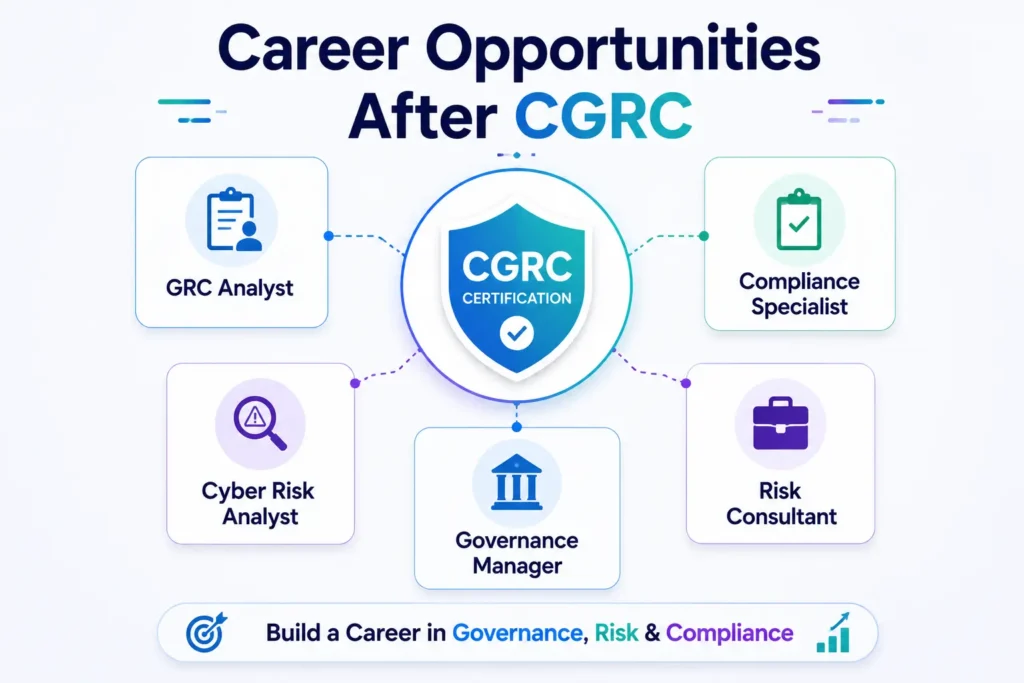
GRC Analyst
The most direct path from CGRC is a GRC analyst role. GRC analysts develop policies, maintain compliance documentation, support audits, and track risk management activities. Starting with a recognized credential gives candidates a measurable edge over uncertified peers.
Compliance Specialist
Compliance specialists focus on specific regulatory compliance frameworks—HIPAA, SOX, CMMC, and FedRAMP—and help organizations build programs to meet them. Many GRC careers start here before expanding into broader governance work.
Cyber Risk Analyst
A cyber risk analyst identifies and quantifies threats to organizational assets, develops risk treatment strategies, and advises leadership on risk acceptance. The role has become more senior as boards demand structured risk communication, and CGRC provides the framework fluency to work with both technical and executive audiences.
Governance Manager
Governance managers oversee the policies, procedures, and accountability frameworks guiding security decisions across the enterprise. They typically report to the CISO or CIO and work closely with legal, audit, and executive leadership.
Risk Consultant
Risk consultants work across multiple client organizations in advisory or professional services firms. Strong grounding in governance frameworks, compliance programs, and risk methodologies makes CGRC holders effective in this role.
CGRC Salary in 2026
ISC2 reports an average North America salary of about $134,522 for CGRC holders. The role ranges below are drawn from aggregated salary surveys (Payscale, Glassdoor, and ISC2 member data), so treat them as directional—pay varies by region, sector (federal vs. private), and seniority.
|
Role |
Average Annual Salary (US) |
|---|---|
|
GRC Analyst (entry–mid level) |
$85,000 – $105,000 |
|
Compliance Specialist |
$90,000 – $115,000 |
|
Cyber Risk Analyst |
$100,000 – $130,000 |
| Governance Manager |
$120,000 – $155,000 |
|
Senior GRC Consultant |
$130,000 – $170,000 |
| CGRC holders (ISC2 North America average) |
~$134,522 |
The premium tends to sit at the higher end for roles in federal contracting and financial services.
CGRC vs CISSP vs CISA vs CRISC
|
CGRC |
Security governance, risk, and regulatory compliance | ISC2 |
GRC professionals, federal IT, risk managers |
|
CISSP |
Broad security management across 8 domains | ISC2 |
Senior security managers, architects |
|
CISA |
IT audit, control, and assurance | ISACA |
Internal auditors, IT audit professionals |
|
CRISC |
IT risk and control design | ISACA |
Risk officers, IT risk managers |
CGRC is the strongest choice when your work centers on authorization, NIST RMF, and security governance—especially in government-adjacent environments. CISSP is broader but less specific to GRC workflow and costs more ($749 vs $599). CISA focuses on audit, while CRISC emphasizes IT risk design from a business perspective. Many experienced professionals pair CGRC with CISSP or CISM for maximum flexibility.
Benefits of CGRC Certification
-
Market recognition. CGRC is ISC2-backed, ISO/IEC 17024-accredited, and DoD 8140-approved—sought by employers in government, defense, healthcare, and financial services.
-
NIST RMF expertise. No other certification goes as deep into RMF implementation. That depth is indispensable in federal environments and transfers well to private-sector organizations that have adopted the framework.
-
Regulatory compliance credibility. Organizations managing FedRAMP, FISMA, or CMMC need people who understand compliance at a process level, not just policy awareness.
-
Career flexibility. Because CGRC sits at the intersection of governance, risk, and compliance, it supports lateral moves across roles and industries.
-
Community and CPE access. ISC2 membership provides professional development resources, local chapters, and networking events.
Is CGRC Worth It in 2026?
For the right professional, CGRC is one of the highest-ROI credentials in cybersecurity today.
If assessments are part of your daily work, CGRC formalizes skills you already practice and teaches you to document findings in a format that holds up to regulatory scrutiny. If you manage controls in complex environments, it gives you a common language with auditors, executives, and system owners. And if you’re building continuous monitoring programs, its framework-aligned method turns informal practices into a defensible capability.
One honest caveat: CGRC carries the most weight in U.S. federal and government-adjacent work. If your target employers are purely commercial and never touch NIST RMF, check local job postings before committing.
For anyone on a GRC career path who hasn’t formalized their credentials, 2026 is a strong year to close that gap. Ready to start? Explore the IT Auditing & GRC Job Seeker’s Package.