

In today’s world, Governance, Risk, and compliance (GRC) has become one of the most in-demand career paths. If you’re searching for entry level GRC certifications or wondering how to start a career in GRC, this guide will help you understand the best certifications for beginners in 2026. So, if you are planning to build a strong foundation in the GRC domain, earning a GRC certification is one of the best ways to start.
Certification not only validates your knowledge but helps your resume stand out to recruiters. Having a certification in a particular area is important because it provides proof of your skills, knowledge, and commitment in that subject area. These GRC certifications for beginners not only validate your skills but also help you build a strong GRC career roadmap.
In today’s competitive job market, many companies prefer only certified candidates because it allows them to trust your technical foundation without having to test every concept from scratch.
In this blog, we’ll explore the Top Entry -Level GRC Certifications that will help you begin your GRC career journey in 2026.
Why Start a Career in GRC?
GRC roles are in high demand because every organization, whether it’s a global enterprise or a tech startup faces cybersecurity threats, data privacy laws and ever-changing regulations.
What makes GRC truly appealing is its long-term stability and global demand. Your skills will always be useful, regardless of industry or geography, since every business needs professionals who can manage risk and compliance. Plus, with the right GRC certifications and experience, career growth and salary potential are both impressive.
Starting a career in this area provides:
- Job security: It gives you job security because compliance and risk management are needed in every industry.
- High salary growth: Professionals with GRC certifications and right GRC career roadmap can earn higher package as GRC analyst.
- Global Opportunities: GRC skills are recognized worldwide you can work in your country or out of country.
- Versatility: You can work in finance, IT, government, healthcare and more.
This is why many professionals are now choosing risk and compliance certifications and cybersecurity certifications for beginners to enter this high-demand field.
Top Entry-Level GRC Certifications for 2026
Below are the best GRC certifications 2026 that can help you start your journey, even if you have no prior experience.
Let’s look at the best entry-level GRC certifications that can help you launch your career in 2026-even if you are a fresher or non-IT student looking to switch from another field.
Certified in Risk and Information Systems Control (CRISC):
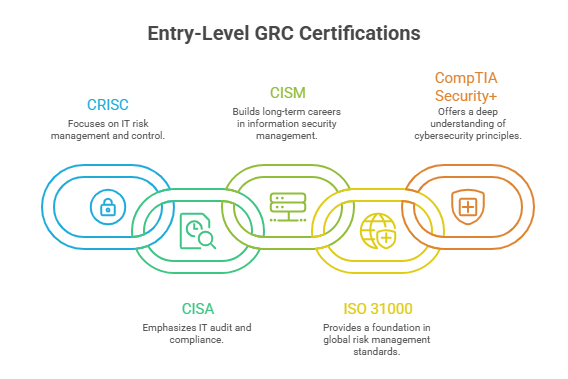
This Certification is best for who are interested in IT risk management and control. The CRISC certification is one of the most respected credentials for professionals who wish to understand IT risk and control framework, offered by ISACA. It teaches you how to identify, assess and manage IT risks in organizations.
CRISC is one of the most popular IT audit certifications and is highly valued in governance risk compliance jobs.
Core Concepts You will Learn In This Certification Include:
- Risk Identification and Assessment
- Risk and Control Monitoring
- Risk Response and Mitigation
- Information Systems Control Design
Certified Information Systems Auditor(CISA):
Another prestigious program offered by ISACA is CISA certification. Its main objectives are auditing, controlling and compliance assurance. Best for those who want to work in IT audit and compliance.
CISA is widely recognized as a top IT audit certification for professionals entering compliance and auditing roles.
Core Concepts You will Learn In This Certification Include:
- IT Governance and Management
- Information Systems Operations and Protection
- Information Systems Acquisition and Implementation
- IT Audit Process
Certified Information Security Manager(CISM):
While CISM certification is slightly advanced. It is good for those who want to build a long term career in information security management. By earning this certification, you can demonstrate your ability to design, implement and oversee an organization’s information security program, a skill set highly valued in today’s cybersecurity-driven world.
It focuses on the relationship between information security and business goals, helping you align technical and organizational priority.
Core Concepts You will Learn In This Certification Include:
- Information Security Governance
- Risk Management and Compliance
- Security Program Development
- Incident Response
ISO 31000 Risk Management Certification:
The ISO 31000 certification provides a strong foundation in global risk management standards. It’s ideal for anyone working in finance, IT, or operations who needs to understand structured risk management practices. It is based on International standards, provides practical knowledge of risk frameworks.
Core Concepts You will Learn In This Certification Include:
- ISO 31000 Risk Management Framework
- Risk Identification and Evaluation
- Risk Treatment Plans
- Monitoring and Improvement
CompTIA Security+
It is best for beginners entering the cybersecurity and compliance field. CompTIA Security+ is a globally recognized entry-level certification that provides a deep understanding of cybersecurity principles, regulatory compliance, and risk management. It is beginner-friendly and focuses on practical security and compliance concepts. It helps you to build a foundation for future GRC and cybersecurity roles.
It is also considered one of the best cybersecurity certifications for beginners starting their GRC journey.
Core Concepts You will Learn In This Certification Include:
- Network Security Basics
- Threats, Vulnerabilities, and Attacks
- Identity and Access Management
- Risk Management and Mitigation
Section 1: How to Choose the Right GRC Certification for Your Career Goals
Choosing the right GRC certification depends on your current knowledge, career goals, and professional experience. Instead of selecting a certification based only on its popularity, consider which skills you want to develop and whether you meet the eligibility requirements.
Here are a few factors to consider before making your decision.
1. Your Current Experience
If you are a fresher or transitioning from a non-IT background, begin by building foundational knowledge of governance, risk management, compliance, and cybersecurity. Consider beginner-friendly options such as the GRC Professional (GRCP) certification or ISC2 Certified in Cybersecurity (CC). Check the current eligibility requirements before registering.
2. Your Preferred Career Path
Your target role can help narrow your options. If you are interested in IT risk management, explore risk-focused certifications. If auditing and control assessments interest you, research IT audit credentials. For security governance and management, consider certifications that align with those responsibilities.
3. Certification Eligibility and Cost
Review the examination fee, experience requirements, renewal conditions, and continuing education obligations. Some well-known certifications, including CISA, CRISC, and CISM, have professional experience requirements for full certification, even when candidates can take the exam earlier under applicable rules.
4. Industry Recognition
Review job descriptions for the roles and locations you are targeting. Look for certifications employers mention frequently and compare their requirements with your existing skills.
The best GRC certification is not necessarily the most advanced one. Choose a credential that matches your current level, supports your immediate career goals, and gives you a clear path toward more specialized qualifications as you gain experience.
What Job Roles You Can Apply for After Certification
Once you earn an entry-level GRC certification, you can apply for roles like:
|
Job role |
Key Responsibilities |
|
GRC Analyst |
Supports the implementation of governance frameworks, identifies risks, and assists in compliance audits. Helps maintain documentation and ensure policies are followed |
|
Compliance Analyst |
Ensures that the organization complies with legal and regulatory requirements. Conducts compliance assessments and provides training to employees. |
|
Risk Analyst |
Analyses potential business risks, develops mitigation strategies, and monitors risk exposure. Works closely with management to maintain enterprise risk registers. |
|
Security analyst |
Ensures compliance with security standards like ISO 27001 or NIST. Works closely with IT and compliance teams to strengthen the company’s security posture. |
|
Governance Consultant |
Helps organizations establish clear policies, reporting structures, and accountability systems to maintain ethical and efficient operations. |
|
IT Auditor |
Identifies vulnerabilities, assesses risks, and provides actionable recommendations for improvement. |
With experience, you can grow into senior roles such as Chief Risk Officer (CRO), Chief Compliance Officer (CCO), or Information Security Manager.
Practical GRC Skills to Develop Alongside Your Certification
A GRC certification can help demonstrate your understanding of governance, risk, and compliance, but employers also need professionals who can apply these concepts to everyday business situations. Developing practical skills alongside certification preparation can help you understand how GRC teams assess risks, maintain evidence, and support audits.
Here are five useful skills to develop.
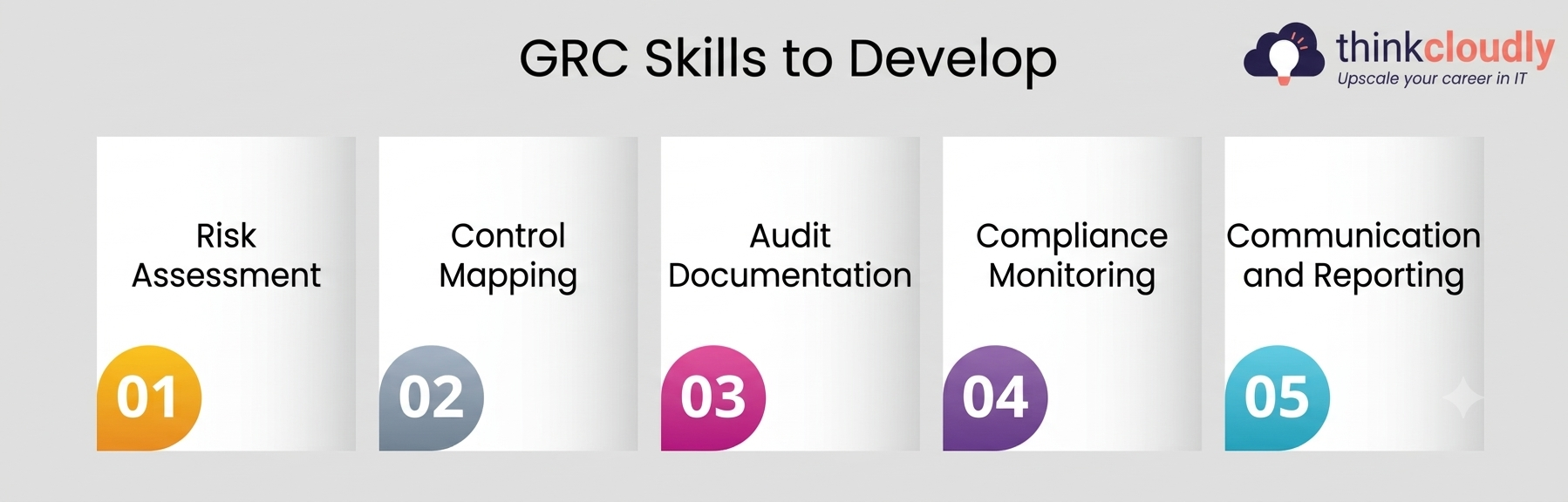
1. Risk Assessment
Learn to identify potential risks, evaluate their likelihood and impact, and recommend suitable mitigation measures. Practice creating a basic risk register that records risks, owners, existing controls, and planned actions.
2. Control Mapping
Understand how organizational policies and security controls support compliance requirements. Practice mapping selected controls to frameworks such as ISO 27001 or the NIST Cybersecurity Framework, using the relevant official documentation.
3. Audit Documentation
GRC professionals regularly work with policies, evidence, audit findings, and remediation plans. Practice organizing evidence, documenting observations, and writing clear summaries of control gaps.
4. Compliance Monitoring
Learn how organizations track compliance obligations, review control effectiveness, and follow up on outstanding issues. Understanding how to maintain compliance checklists and track corrective actions can help you prepare for entry-level responsibilities.
5. Communication and Reporting
GRC professionals must explain risks and compliance gaps to both technical and non-technical stakeholders. Practice writing concise risk summaries that describe the issue, its potential business impact, and recommended actions.
You can develop these skills through case studies, sample audit exercises, framework-mapping activities, and practical training. For example, take a hypothetical organization, identify three information security risks, map relevant controls, and prepare a short report with recommendations.
Combining certification knowledge with practical exercises helps you build a stronger foundation for GRC analyst, compliance analyst, and IT audit support roles.
Here’s What to Do Next
Whether you choose CRISC, CISA, CISM, or any other GRC certification, remember that your journey truly begins with consistent learning and practice. Focus on understanding the core concepts of governance, risk, and compliance, and build hands-on experience with real tools and frameworks. Strengthen your basics, stay updated, and connect with industry professionals through communities and networking. With the right GRC certifications, strong fundamentals, and a supportive network, you can confidently move toward your dream job in the GRC field.
Choosing the right entry-level GRC certifications can be your first step toward high-paying governance risk compliance jobs.