



I’ve reviewed enough resumes this year to notice a pattern: the candidates who get a callback aren’t the ones with the longest tool lists; they’re the ones who can actually sit down and write a query that answers a real business question. That’s exactly why SQL certifications keep showing up as the most-asked-about credential in every data analyst forum I follow.
A data analyst certification built around SQL doesn’t just look good on a resume—it proves, in a verifiable way, that you can pull, clean, and shape data without someone standing over your shoulder.
This guide walks through the credentials worth your time in 2027, how they differ, and how to pick one without wasting months on the wrong track. I’m not going to pretend every option here carries equal weight. Some are built for analysts, some are built for database administrators, and knowing the difference before you register for an exam will save you real money and real time.
We’ll also cover the core database fundamentals you need regardless of which certification path you choose, because no badge replaces actual understanding—a proctor can usually tell within the first ten questions whether you’ve only memorized flashcards or actually know how to reason through a schema.
Why SQL Certifications Still Matter for Data Analysts?
SQL isn’t glamorous. It doesn’t trend on social media the way generative AI tools do, but the numbers tell a different story. PostgreSQL is now used by 49.09% of professional developers, up more than two and a half points from the prior year, with MySQL and SQLite rounding out the top three databases. That’s not a niche skill fading into the background—that’s the backbone of how companies actually store and query information.
For data analysts specifically, SQL certifications act as a shortcut past the “can you really do this” skepticism that hiring managers bring to self-taught candidates. A hiring manager can’t watch you work in real time, but a recognized exam result tells them you’ve been tested on core database fundamentals—schema design, keys, and query logic—under timed, proctored conditions.
That matters more than it should, frankly, because plenty of strong analysts never bother certifying anything and get passed over simply because their resume doesn’t say so in black and white, even when their day-to-day work says otherwise.
The demand behind this shows up outside survey data too. Analyst job postings across the United States and the United Kingdom routinely list SQL as a required skill well above any single BI tool, and hiring-trend reports from major job boards have flagged data-literacy skills, SQL chief among them, as one of the fastest-growing requirements on entry-level analyst listings.
None of that disappears just because an AI assistant can now draft a passable query from a plain-English prompt—someone still has to check it joins on the right keys and isn’t quietly double-counting a column.
What a Strong SQL Certification Should Actually Teach You?
Not every exam covers the same ground, but the credentials worth pursuing in 2027 all test a consistent core. If you’re mapping this out for a study plan—or building an infographic to keep yourself on track—here’s what belongs on it:
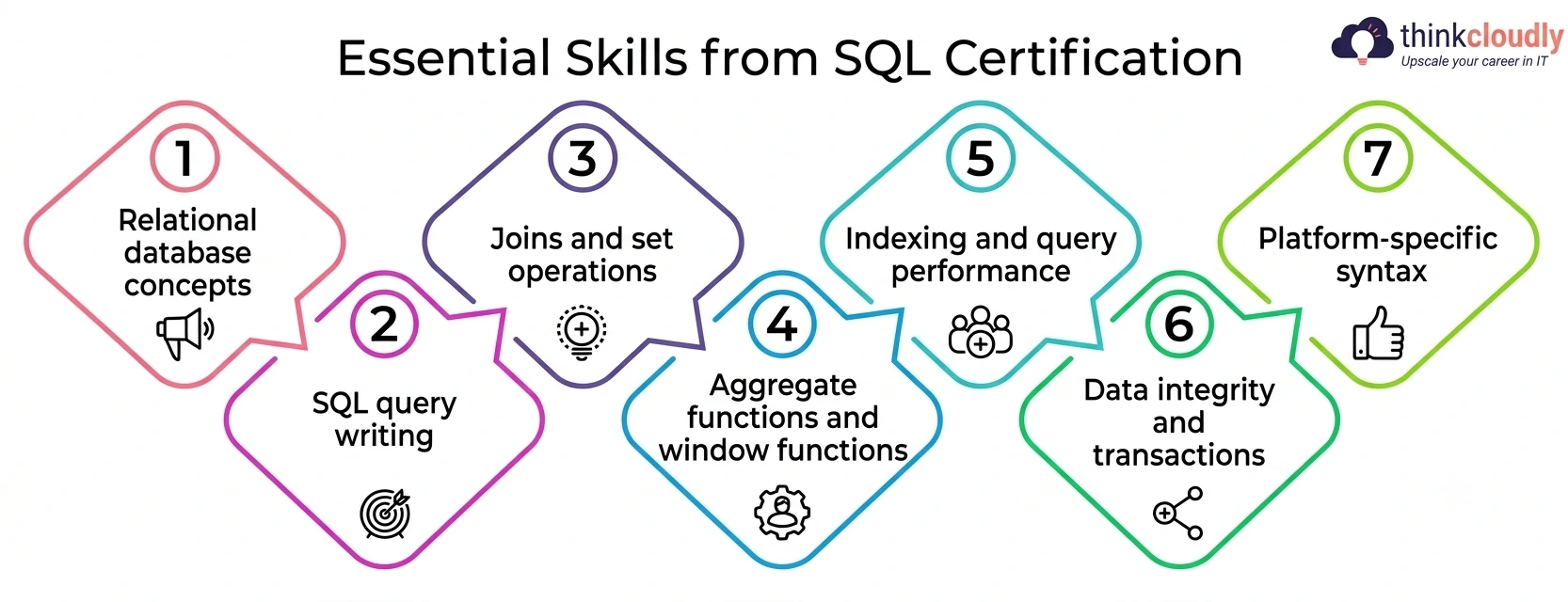
- Relational database concepts—tables, primary and foreign keys, normalization forms, and how schema design affects everything downstream
- SQL query writing—SELECT statements, WHERE clauses, GROUP BY and HAVING, subqueries, and common table expressions
- Joins and set operations—inner, outer, left, right joins, UNION, and INTERSECT, and when each one is the right tool
- Aggregate functions and window functions—running totals, ranking, and partitioned calculations analysts use daily
- Indexing and query performance—understanding why a query is slow and how an index actually fixes it
- Data integrity and transactions—constraints, ACID properties, and why a half-finished update can break a report
- Platform-specific syntax—the dialect quirks between PostgreSQL, Oracle, SQL Server, and cloud warehouses like Snowflake or BigQuery
If an exam skips straight to platform trivia without testing the fundamentals above, it’s testing memorization, not competence. That distinction is worth checking before you pay an exam fee.
Top SQL Certifications for Data Analysts
Here’s how the major options stack up against each other right now. I’ve kept this to credentials that are actually active and bookable in 2027, not retired or soon-to-be-replaced ones.
|
Certification |
Issuing Body | Best For |
Format |
|
EDB Essentials for PostgreSQL |
EnterpriseDB | Analysts working on open-source stacks |
Proctored exam, available for current PostgreSQL versions |
|
Oracle Database SQL Certified Associate (1Z0-071) |
Oracle | Analysts in enterprise, Oracle-heavy environments |
Multiple choice, timed, proctored |
|
Microsoft Certified: Azure Data Fundamentals (DP-900) |
Microsoft | Analysts moving toward cloud data platforms |
Multiple choice, beginner-friendly |
|
SnowPro Core Certification |
Snowflake | Analysts working in cloud data warehouses |
Proctored, scenario-based |
|
Google Data Analytics Professional Certificate |
Google / Coursera | Career changers wanting a broader analyst track with SQL included. |
Self-paced coursework plus assessments |
The EDB certification exams catalog is worth reading directly rather than through a reseller summary, since EDB periodically updates which PostgreSQL versions each exam covers. Likewise, Oracle’s database certification guide lays out exactly where 1Z0-071 sits relative to the rest of the Oracle certification ladder, which matters if you’re planning to stack credentials over a few years rather than stopping at one.
A data analyst certification from any of these paths gets you in the door, but they’re not interchangeable. The EDB and Oracle paths test deep, platform-specific SQL skills. Microsoft’s DP-900 and the Google program are broader and friendlier to someone earlier in their career. SnowPro sits somewhere in between, assuming you already know standard SQL and just need to prove cloud-warehouse fluency on top of it.
PostgreSQL Certification vs Oracle Database Certification: Which Should You Pick First?
This is the comparison I get asked about most often, so let’s be direct about it.
A PostgreSQL certification makes sense if your target companies run open-source infrastructure, which describes a growing share of startups and mid-size tech companies in 2027. PostgreSQL is free and actively developed, and the EDB credential tests you against real production scenarios rather than abstract theory. If you’re building a portfolio around modern analytics stacks—dbt, Airflow, cloud warehouses that speak Postgres-compatible SQL—this is the more future-aligned choice.
An Oracle database certification, on the other hand, still carries weight in banking, insurance, healthcare, government contracting, and other sectors where Oracle’s enterprise database has been embedded for decades, and migrating off it is neither cheap nor fast. If you’re targeting an analyst role at a large, established enterprise rather than a startup, knowing that the company almost certainly still runs Oracle somewhere in its stack makes this certification the more strategically relevant one.
Neither SQL certification is objectively “better.” The honest answer is that you should look at job postings in the specific industry and region you want to work in before committing exam fees to either path. If you see Oracle named repeatedly in postings you’d actually apply to, start there. If you’re seeing PostgreSQL, MySQL, or cloud-native warehouses instead, the open-source path is the better use of your study hours.
How to Choose the Right SQL Certification for Your Data Career?
Picking between competing SQL certifications gets easier once you stop treating it as a prestige contest and start treating it as a practical decision. Work through these in order:
- Check job postings first, not certification marketing pages. Search for analyst roles in your target city or remote-friendly companies and note which database systems show up repeatedly.
- Match the certification to your current skill level. DP-900 or the Google Data Analytics Professional Certificate make sense if you’re still building fundamentals; EDB or Oracle exams assume you already write queries comfortably.
- Consider cost against expected return. Proctored exams from EDB and Oracle typically run higher than beginner-level fundamentals exams, so weigh that against how directly the credential maps to roles you’re applying for.
- Factor in renewal and version churn. PostgreSQL and cloud-platform exams get updated as new versions ship, which keeps your knowledge current but also means older badges can look dated faster than a stable, long-standing credential.
- Remember AI tools shift the baseline, not the requirement. A query-generation tool can draft a SELECT statement, but every proctored exam still expects you to read, debug, and correct one by hand yourself.
- Don’t collect certifications for their own sake. One well-earned SQL certification backed by real project work outperforms three badges with nothing built behind them.
Strengthening SQL Query Writing and Relational Database Concepts Before You Test
No certification exam rewards memorized syntax over actual understanding, and the proctored ones especially will expose the gap fast. Before you schedule anything, make sure your SQL query writing is solid enough to handle multi-table joins, nested subqueries, and window functions without reaching for a cheat sheet.
The way to get there isn’t more reading—it’s building something. Pull a public dataset, load it into a free PostgreSQL instance, and write real queries against it: find trends, calculate running averages, rank results by category. Doing this repeatedly is what actually cements relational database concepts in a way flashcards never will, because you start to feel why a poorly normalized table causes problems three queries later instead of just being told that it does.
It also helps to deliberately break things. Write a query that’s slow on purpose, then use EXPLAIN or EXPLAIN ANALYZE to see why, and fix it with an index or a rewritten join. That single habit — diagnosing instead of just writing — is what separates candidates who pass an SQL certification exam comfortably from those who scrape by on their second attempt.
Career Paths That Open Up After a Data Analyst Certification
That credential isn’t a career on its own — it’s a lever that opens specific doors depending on which one you earn.
Analysts who earn a PostgreSQL certification often move toward analytics engineering or BI development roles, where deep SQL fluency and comfort with modern open-source tooling matter more than broad business context.
Those who earn an Oracle database certification tend to find faster traction in enterprise analyst roles, compliance-heavy reporting positions, or database-adjacent analyst work inside large organizations still running legacy systems.
More broadly, a solid data analyst certification — paired with real project work — tends to open paths toward business intelligence analyst, data quality analyst, and eventually analytics engineer or junior data engineer roles, since SQL fluency is the one skill every one of those jobs assumes you already have on day one. None of these SQL certifications guarantee a title bump by themselves, but they remove one common excuse hiring managers use to screen candidates out before an interview even happens.
The timeline for that payoff varies more than most guides admit. Some analysts land a new role within weeks of adding a credential to their profile; others spend a full quarter applying before anyone notices the line item. Pairing the credential with visible project work — a public query portfolio, a short case study, anything a recruiter can click into — tends to shorten that gap far more reliably than the certificate does alone.
A Personal Note
I used to think certifications were mostly theater — a way to make a resume look busier without proving much. That changed, and not for a flattering reason. I watched a friend who was genuinely sharp with data get passed over twice for analyst roles, not because she couldn’t do the work, but because nothing on paper backed up what she could actually do in an interview setting.
She finally sat a PostgreSQL certification exam, not because she needed to learn anything new, but because she needed a way to make her existing SQL query writing skill legible to someone skimming a stack of applications in under a minute. She got the next role she applied for. The lesson I took from that isn’t “certifications matter more than skill.”
It’s that an Oracle database certification, a PostgreSQL badge, or any other recognized credential is sometimes just a translation layer between what you know and what a stranger reading your resume is willing to believe. Don’t mistake the badge for the skill, but don’t dismiss it either — sometimes you need both.