

A friend messaged me in September asking the same question I get almost every month now: “Is it actually realistic to become a cloud engineer with no experience, or is that just something bootcamps say to sell seats?” Fair question. The honest answer is that it’s realistic, but not in the way most ads frame it. Nobody hires a stranger off the street to manage production infrastructure on day one.
What actually happens is that people build just enough proof of skill—through free-tier projects, a foundational certification, and a working knowledge of the tools real teams use—that a hiring manager is willing to take a chance on them for a junior or support-tier role. That’s the real path for anyone trying to become a cloud engineer with no experience in 2027, and it’s what this guide walks through step by step.
I’m not going to pretend this is a six-week sprint. It isn’t. But it’s also far more achievable than most people assume once they stop treating “cloud computing basics” as something you memorize from flashcards and start treating it as something you practice hands-on, badly at first, until it clicks.
Why Is This Still a Realistic Goal?
The honest demand picture is mixed, and I’d rather tell you that upfront than oversell it. According to the U.S. Bureau of Labor Statistics, computer network architect roles—the closest government-tracked category to modern cloud and infrastructure engineering—are projected to grow 8% between 2025 and 2035, well above the average for all occupations, with a median pay of $134,050 as of May 2025.
Meanwhile, more narrowly defined roles like traditional systems administration are flat or shrinking, which tells you something important: generic IT support is stagnant, but cloud-specific skills are where the growth actually sits.
Staffing firm Robert Half’s research backs this up from the employer side. In its most recent findings, 93% of technology leaders said their departments lack the staff and skills needed for this year’s priorities, and cloud architecture and operations were named among the biggest gaps.
Notably, 87% of tech leaders said they’re prepared to pay more for people with specialized skills, cloud computing among them. That’s the opening a person with no formal title can walk through, provided they show up with real, demonstrable skills rather than just a resume line.
None of this means a Cloud Security training with no experience walks straight into a six-figure architect role. It means the entry door—junior cloud support, a cloud-adjacent helpdesk role, or a cloud operations associate position—is propped open wider than most career-change guides admit.
The data says the gap exists; it doesn’t say the gap closes itself. Somebody still has to show up with proof of skill, and that’s the part this guide focuses on rather than repeating the same “cloud is booming” headline every other article leads with.
What a Cloud Engineer Actually Spends Their Day Doing?
Strip away the job-title inflation and the actual work is less mysterious than it sounds. A cloud engineer provisions and maintains the servers, storage, and networking that applications run on, but instead of racking physical hardware, they do it through a cloud provider’s console, command-line tools, or automation scripts.
Understanding cloud computing basics means knowing the difference between a virtual machine, a managed container service, and serverless compute and knowing when a team would reach for each one.
Day-to-day, that might mean troubleshooting why a deployment failed, adjusting access permissions so a teammate can reach the right storage bucket, writing a short script to clean up unused resources, or reading through monitoring dashboards to catch a cost spike before it becomes a budget problem. None of it requires genius-level math. It requires patience, curiosity about how systems fail, and a willingness to read documentation instead of guessing.
Skills You Actually Need Before You Apply
If you’re serious about becoming a cloud engineer with no experience, these are the five areas worth your actual time, not just your attention:
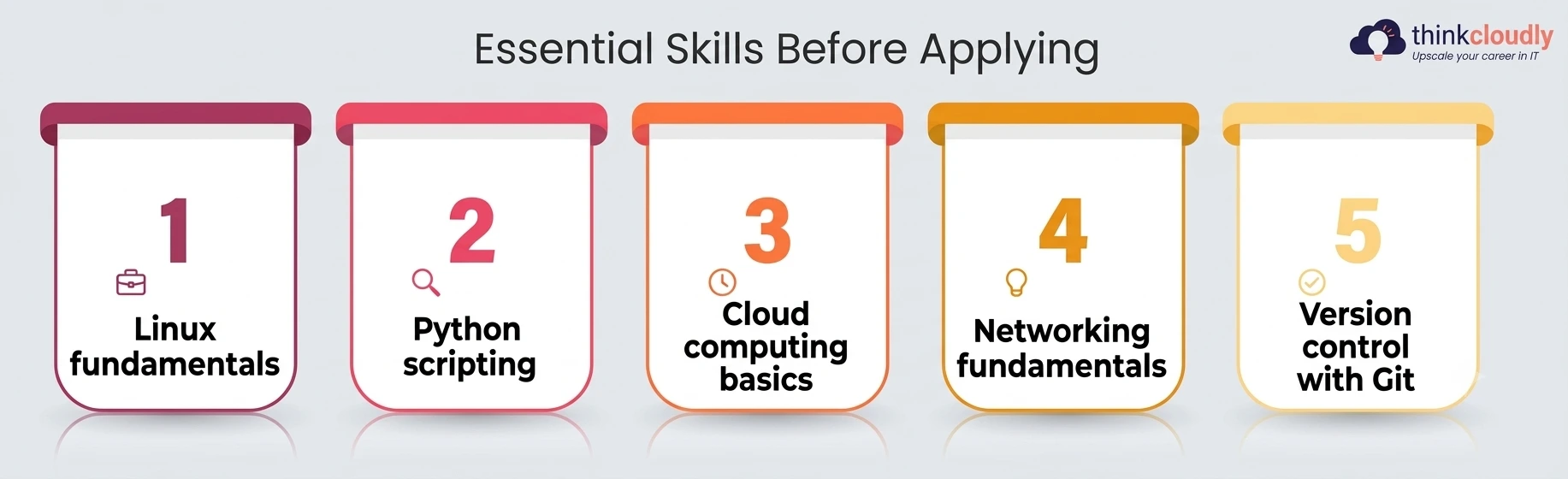
- Linux fundamentals—most cloud servers run Linux, so comfort with the command line, file permissions, and basic process management isn’t optional; it’s assumed from your first interview onward.
- Python scripting—you don’t need to be a software engineer, but Python scripting lets you automate repetitive tasks, parse logs, and interact with cloud provider APIs instead of clicking through a console by hand.
- Cloud computing basics—the shared responsibility model, the difference between IaaS, PaaS, and SaaS, and how billing actually works across the major providers.
- Networking fundamentals—subnets, DNS, load balancers, and firewalls, because almost every outage eventually traces back to one of these.
- Version control with Git—because infrastructure is increasingly written as code, and teams expect you to track changes the same way developers do.
Nobody expects mastery in all five on day one. Employers hiring someone with no formal background are looking for evidence you can learn the sixth and seventh skills on the job, because you’ve already proven you can learn the first five on your own.
Step-by-Step Roadmap to Get There
Here’s the order I’d actually follow, broken into stages rather than a rigid calendar, since everyone’s starting point differs:
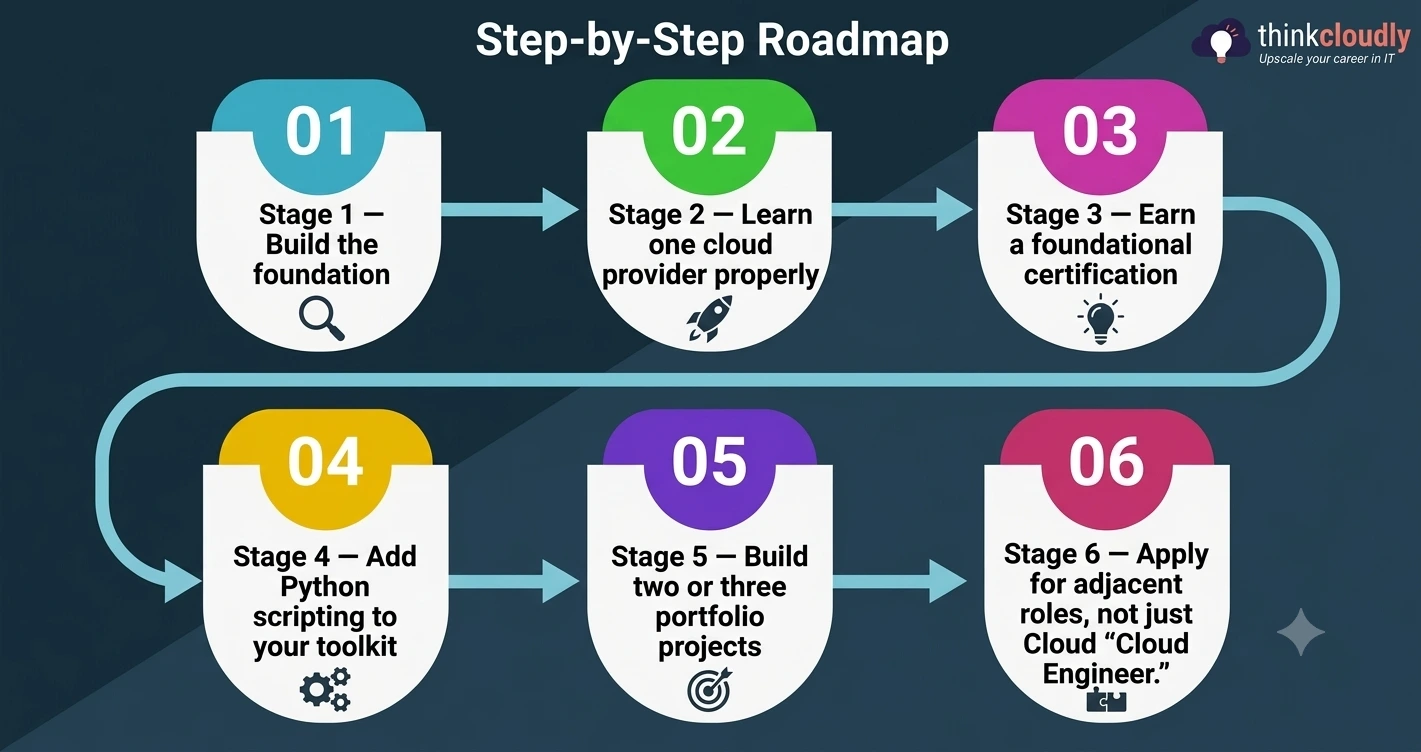
- Stage 1—Build the foundation. Spend three to four weeks on Linux fundamentals and basic networking. Use a free resource like the Linux Foundation’s Introduction to Linux course on edX, and practice in a free virtual machine rather than just watching videos.
- Stage 2—Learn one cloud provider properly. Pick AWS or Azure, not both at once. Set up a free-tier account, and work through official learning paths until cloud computing basics stop feeling abstract.
- Stage 3—Earn a foundational certification. AWS Certified Cloud Practitioner and Microsoft’s AZ-900 certification exams both validate real baseline knowledge and signal to recruiters that you’re serious, not just curious.
- Stage 4 — Add Python scripting to your toolkit. Automate something small and real—a script that tags untagged cloud resources, or one that emails you when a free-tier limit is close to being hit.
- Stage 5—Build two or three portfolio projects. Deploy a simple web app, set it up with monitoring and basic security, and document the whole process on GitHub so interviewers can see your thinking, not just your final result.
- Stage 6—Apply for adjacent roles, not just “Cloud Engineer.” Helpdesk-to-cloud, junior DevOps, cloud support associate, and IT operations roles with cloud exposure are realistic entry points for a cloud engineer with no experience.
Certification Comparison at a Glance
Since a foundational AWS or Microsoft certification is usually the first real milestone, here’s how the two beginner-level options compare for someone starting from zero:
|
Factor |
AWS Certified Cloud Practitioner |
Microsoft AZ-900 |
|
Best for |
Beginners targeting AWS-heavy job markets |
Beginners targeting Microsoft Shop employers |
|
Prior experience assumed |
None required, though some IT exposure helps. |
Some IT background is recommended, not required. |
|
Core topics |
Cloud concepts, billing, security, core AWS services |
Cloud concepts, Azure architecture, governance, and cost management |
|
Typical study time |
4–6 weeks part-time |
3–5 weeks part-time |
|
Passing score |
Scaled score of 700/1,000 |
Scaled score of 700/1,000 |
|
Good next step. |
AWS Solutions Architect – Associate |
Azure Administrator Associate (AZ-104) |
Neither certification alone gets anyone hired. They exist to prove you understand cloud computing basics well enough that a hiring manager isn’t starting from zero when they train you.
Why Do AWS Fundamentals and Azure Fundamentals Both Still Matter?
A question I get constantly: do you need both? Not right away, but understanding where AWS fundamentals and Azure fundamentals overlap, and where they diverge, pays off faster than people expect. The underlying concepts—regions and availability zones, identity and access management, pay-as-you-go billing—are nearly identical across providers once you strip away the branding. What differs is the console layout, the service names, and which certification a specific employer actually asks for in a job posting.
Most people starting from zero are better served picking one and going deep rather than splitting attention. If the job postings in your target market lean heavily toward AWS, start with AWS fundamentals and treat Azure as a second-certification goal six months later.
If local employers run on Microsoft infrastructure, Azure fundamentals are the more pragmatic first stop. Either path gives a cloud engineer with no experience a legitimate, verifiable starting credential, and neither choice locks you out of the other provider later—the core logic transfers far more than beginners assume it will.
Projects That Carry More Weight Than a Resume Line
A recruiter reading “aspiring cloud engineer” with no backing evidence skips to the next resume in under ten seconds. A recruiter seeing a GitHub link with three working, documented projects reads further.
Build something that uses the skills you actually claim: a deployed app behind a load balancer, an automation script written with Python scripting that provisions and tears down test environments on a schedule, or a small monitoring dashboard that alerts you when a resource misbehaves. Write a short README for each explaining what broke while you built it and how you fixed it—that story matters more to an interviewer than the polish of the final product.
Keep the scope small on purpose. A single deployed app with clean documentation, one automated teardown script, and a one-page architecture diagram beats five half-finished repositories every time. Interviewers skim; they don’t excavate.
Pin your best two or three projects at the top of your GitHub profile, write the README as if explaining it to a colleague who’s never seen the project before, and include the specific error messages you ran into along the way. That level of honesty signals someone who actually did the work, rather than someone who followed a tutorial and never deviated from the script.
Common Mistakes People Make at This Stage
- Collecting certifications instead of building anything. A stack of badges with zero deployed projects reads as theoretical knowledge, not practical skill.
- Trying to learn AWS, Azure, and Google Cloud simultaneously. Depth in one platform beats shallow familiarity with three.
- Skipping Linux fundamentals because the cloud console looks friendly. The console hides the complexity; interviews and real incidents don’t.
- Ignoring cost management. Running up a cloud bill during practice and panicking is a rite of passage, but not understanding billing alarms going into an interview is a real gap.
- Waiting to apply until “fully ready.” Nobody feels fully ready. Apply once you have one certification and one working project, then keep building while you interview.
How Long Does This Realistically Take?
Most people going from zero to job-ready land somewhere between four and nine months, depending on how many hours a week they can commit and whether they already have adjacent IT experience.
Someone transitioning from a helpdesk or sysadmin role usually moves faster, since networking fundamentals and Linux fundamentals often transfer directly. Someone starting from a completely unrelated field should expect the longer end of that range, and that’s not a failure — it’s just the actual size of the skill gap being closed.
A reasonable expectation for a cloud engineer with no experience working a full-time job on the side: two certifications and two solid projects within eight months, applying continuously from around month four or five rather than waiting until everything feels finished.
Timelines slip when people study passively — rewatching videos instead of building — far more often than they slip because the material itself is too hard. The material is learnable by almost anyone willing to put in consistent weekly hours; what varies is how long someone resists actually opening a terminal and breaking something on purpose.
A Personal Note
I’ll be honest about the part most guides skip: the hardest stretch isn’t learning the material, it’s the few weeks after you finish your first certification when you still don’t feel like a cloud engineer. I remember that exact feeling from watching people go through it — passing an exam and then staring at a job board full of listings that still feel out of reach.
The thing that actually moves people past that stretch isn’t another course. It’s picking one small, ugly, half-working project and finishing it anyway. Nobody becomes a cloud engineer with no experience by feeling ready first. They become one by building something real before they feel qualified to, and then letting the evidence of that work speak for them in the interview.
If you’re standing at the start of this right now, that discomfort you feel isn’t a sign you’re on the wrong path — it’s just what the early part of this path feels like for almost everyone who’s walked it.