

I read 500 cloud job postings so you don’t have to. Here’s what almost nobody tells you: the skills employers are actually hiring for in 2026 look nothing like what most certification courses are teaching.
There is a lot of noise around cloud careers. Bootcamps tell you to collect every badge. Forums say experience is all that matters. YouTube thumbnails promise a $150K job in 90 days. So I went through 500 real job postings — not summaries, not surveys, the actual listings — across the US, UK, Canada, Australia, and Germany. I tracked every skill, every cert preference, every experience level.
Here is what I found.
| Statistic | Insight |
|---|---|
| 500 | Job postings analyzed |
| 94% | Of enterprises will be using the cloud in 2026 |
| 317K | Cloud job openings per year in the US alone |
| 25% | Job growth rate — vs 4% average |
The cloud job market right now
Cloud is not just growing. It is accelerating. The global cloud computing market was valued at around $912 billion in 2025 and is projected to hit nearly $6 trillion by 2035, according to Electromech Cloud’s market analysis. That is not a niche sector. That is infrastructure for the entire modern economy.
The US Bureau of Labor Statistics projects cloud-related roles to grow 25–26% through 2034, compared to just 4% for the average job. That gap signals that demand is outpacing supply, which shows up in salaries and in how quickly good candidates get hired.
The talent shortage is real. Over 90% of organizations face IT skills shortages, according to industry data. Companies are not just “looking for the right person” — many are genuinely struggling to find qualified candidates at all.
What has changed recently is the type of cloud work employers need. It is no longer just “keep the servers running.” Cloud roles in 2026 sit at the intersection of infrastructure, security, AI, and software delivery. The job descriptions reflect this.
The skills that keep showing up
When I went through the 500 postings, I tracked every technical skill mentioned. Not just the headline bullet points — the full requirements sections. Here is what appeared most often.
| Platform / Statistic | Insight |
|---|---|
| AWS (Amazon Web Services) | 50,000 job listings globally |
| Microsoft Azure | 37,000 job listings globally |
| Google Cloud Platform (GCP) | 16,000 job listings globally |
| Multi-cloud | Using any two platforms is growing fast in enterprise roles |
AWS still dominates. But Azure is closing the gap fast, especially in enterprise environments, finance, healthcare, and government. GCP appears less often overall, but the roles that need it tend to pay more because the talent pool is smaller.
Tools that appeared in the majority of postings
|
Kubernetes |
16,000 Job listings |
|
Docker |
14,000 job listings |
|
Terraform (Infrastructure as code) |
9,000 job listings |
|
Cloud/DevOps Python roles |
67,000 job listings broadly |
Kubernetes and Docker were nearly everywhere in DevOps and platform engineering roles. Terraform has become a baseline expectation — it showed up in roles that were not even formally labeled “DevOps.” Python was listed so often it almost stopped feeling like a differentiator.
What AI skills employers are starting to ask for
This is where the market is shifting fastest. Machine learning mentions in job postings have roughly doubled in the past year. Employers are not asking for research scientists — they want engineers who can deploy and operate AI systems on cloud infrastructure.
Specific things that appeared in postings: experience with AWS SageMaker or Azure ML, familiarity with MLOps pipelines, and ability to work with large language model APIs. The AWS Certified Security – Specialty certification saw a 73% demand surge in just one year, largely because AI systems bring new attack surfaces that need to be secured.
Certifications employers actually list
Certifications are a real signal. Based on an analysis of more than 12 million tech job postings in early 2025, AWS certifications appear in over 51,000 job listings. They are not just resume decorations; hiring managers use them to filter applications.
That said, the data shows something important: certifications open doors, but they do not close deals. Employers consistently report that hands-on project experience matters more than badges alone. Use certifications as a structured way to learn, then back them up with actual work.
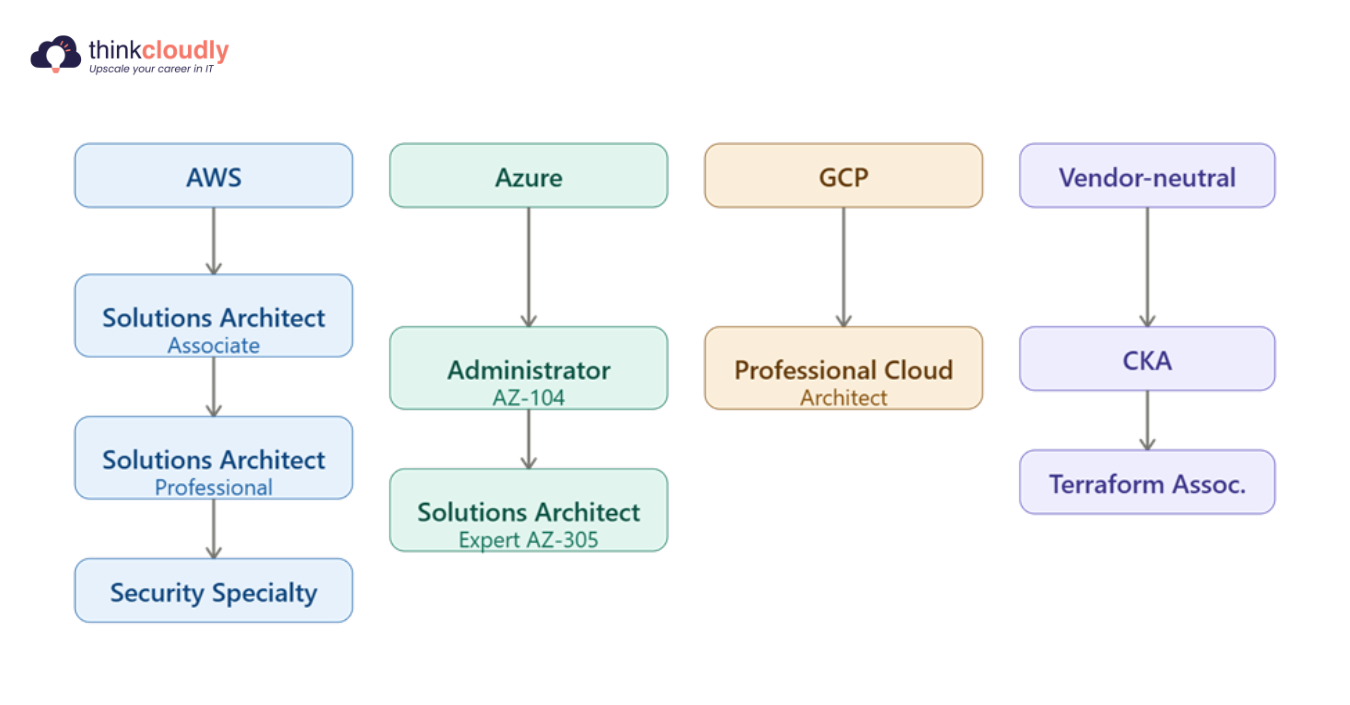
AWS Solutions Architect – Associate: Most commonly requested cert in cloud postings. Great starting point for infrastructure roles. Avg salary with this cert: $130K+
AWS Solutions Architect – Professional: The advanced version. Avg salary: $163K. Worth doing after 1–2 years of hands-on AWS work.
Azure Administrator Associate (AZ-104): High demand in enterprise and government. Strong in finance, healthcare, and Microsoft ecosystem shops.
Azure Solutions Architect Expert (AZ-305): Top Azure credential for senior roles. Avg salary $152K. Preferred in regulated industries.
Google Professional Cloud Architect: Fewer jobs but higher pay — has ranked as the top-paying IT cert in global salary surveys. Avg $143K.
AWS Certified Security – Specialty: Demand surged 73% in 2025. Essential for cloud security roles. Commands a significant salary premium.
CKA – Certified Kubernetes Administrator: Vendor-neutral, widely respected. Pairs well with any cloud platform. Strong in platform engineering roles.
HashiCorp Terraform Associate: As infrastructure-as-code becomes standard, this cert validates a skill that now appears in a huge share of postings.
Which cert should you start with? If you are in the US, start with AWS. In Europe or the Middle East, Azure often edges ahead. If your background is in data or machine learning, GCP gives you a smaller but higher-paying talent pool to compete in.
What the pay looks like
Cloud roles pay well. That is not hype — it shows up consistently across job boards and salary surveys. Here is what the market looks like for the most common roles in 2026.
|
Role |
Entry level |
Mid-level |
Senior |
|
Cloud Engineer |
$85K–$110K |
$120K–$145K |
$160K–$190K |
|
Cloud Architect |
N/A |
$145K–$165K |
$180K–$220K+ |
|
DevOps/platform engineer |
$90K–$115K |
$125K–$150K |
$160K–$195K |
|
Cloud security engineer |
$100K–$120K |
$130K–$155K |
$165K–$200K |
|
AI/ML Cloud Engineer |
$110K–$130K |
$145K–$175K |
$190K–$250K+ |
Note: “Cloud Architects typically require 5+ years of experience; entry-level roles are rare.”
Salary ranges based on data from Refonte Learning, Digital Cloud Training, and Glassdoor (2025–2026). US market figures.
The average cloud engineer salary in the US is around $130,802, with senior roles pushing past $175,000. Cloud security specialists and AI/ML engineers are at the top of the range because their skills are genuinely hard to find.
Case study: A junior software developer who pivoted into cloud security
A developer in Toronto, Canada, had three years of experience writing backend code for a mid-sized e-commerce company. She was not unhappy with her role, but she noticed that cloud security job postings were multiplying on LinkedIn and that the salaries were significantly higher than what she was earning.
She spent 8 months studying for the AWS Certified Security – Specialty certification while keeping her job. She also took on a side project where she helped audit the IAM configuration for a friend’s startup (unpaid, but documented). When she passed the exam and applied to cloud security roles, she received three offers within six weeks. She accepted a position as a cloud security engineer at $138,000 — a $42,000 increase from her previous salary. The hiring manager told her directly that the Security – Specialty cert was the reason she made it to the interview round: “Most applicants had the Cloud Practitioner or the Solutions Architect. You had the Security specialty, and that immediately told us something.”
What this shows: Specializing in a high-demand niche (security) with strong data behind it is one of the fastest ways to jump salary bands. The 73% demand surge in security cert requests was not abstract — it played out in real hiring decisions.
What most candidates get wrong
Four patterns came up repeatedly in hiring manager feedback:
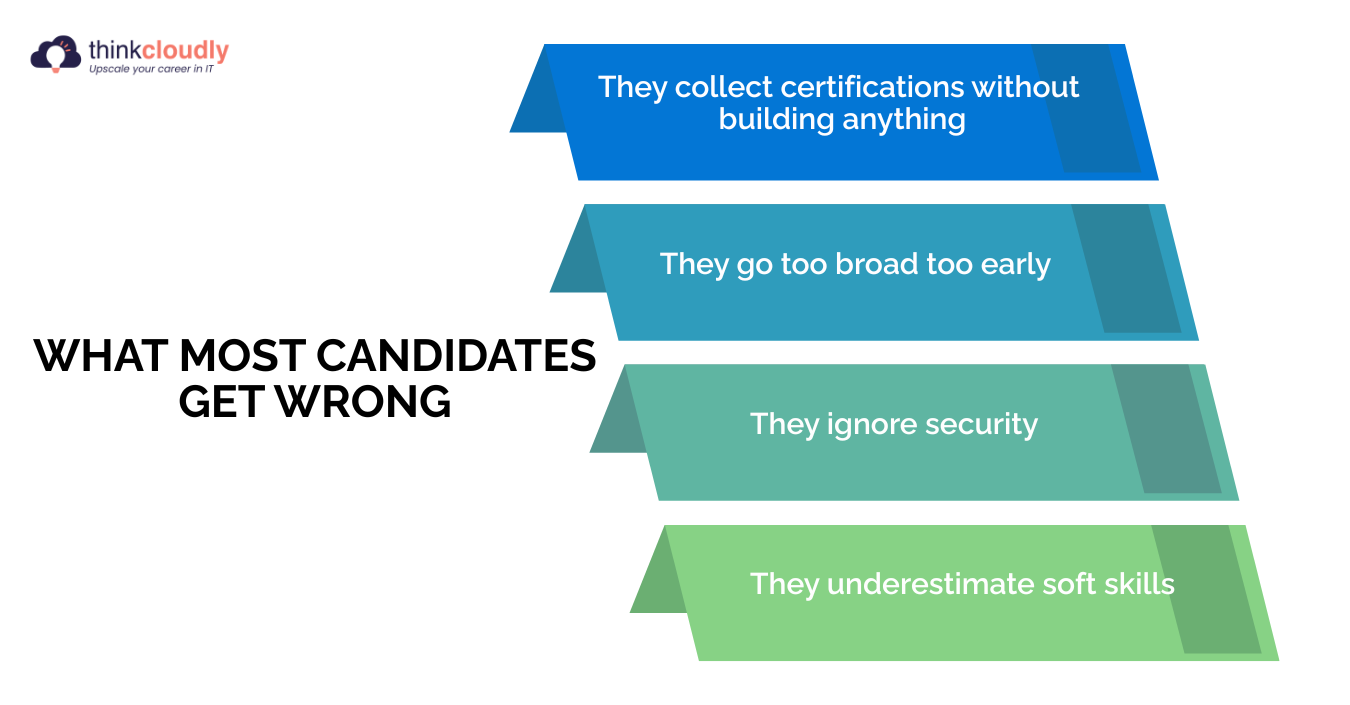
They collect certifications without building anything
This came up repeatedly in the posting language. Employers want to see hands-on experience. They want candidates who can talk through design decisions, explain why they chose one approach over another, and demo something that actually works. A wall of certifications with no projects behind them does not tell hiring managers anything about what you can do on day one.
They go too broad too early
Trying to learn AWS, Azure, GCP, Kubernetes, Terraform, and Python all at once is a recipe for knowing a little about everything and being good at nothing. The postings are clear: employers want depth. Pick one cloud platform, get genuinely good at it, and add complementary skills (like IaC or containerization) before jumping to a second platform.
They ignore security
Security skills appear in a large share of cloud postings — not just in dedicated security roles but in general cloud engineering and DevOps positions too. Understanding IAM, encryption, compliance frameworks like HIPAA and GDPR, and how to write secure infrastructure-as-code is increasingly a baseline expectation, not a specialty.
They underestimate soft skills
Over and over in the postings, employers used phrases like “can communicate clearly with non-technical stakeholders,” “able to work cross-functionally,” and “strong documentation habits.” Cloud engineers do not just write code — they advise product teams, explain infrastructure decisions to finance, and write runbooks that other people will actually use. Hiring managers notice this.
Conclusion
Cloud employers in 2026 are not just hiring for technical knowledge. They are hiring people who can build real things, secure them properly, explain their decisions clearly, and keep learning as the technology changes. The certifications matter. The hands-on work matters more. The combination of both is what gets offers. Start with the AWS Solutions Architect – Associate and build your first project before applying.
Sources and references
- US Bureau of Labor Statistics — Computer and IT Occupations Outlook 2023–2033
- Course Report — Trending Tech Skills & Certifications Report (12M+ job postings analyzed, 2025)
- LockedIn AI — Cloud Computing Skills Employers Are Hiring for in 2026
- Refonte Learning — Cloud Engineering Career Outlook 2026
- Glocomms — Tech Careers in 2026: AI, Cloud and Emerging Roles
- Digital Cloud Training — Top Paying Cloud & AI Job Roles in 2026
- KodeKloud — Top 5 Cloud Certifications for 2025 (salary & demand data)
- Research — Is Demand for Cloud Computing Degree Graduates Growing or Declining? (2026)
- Neal Davis (Medium) — Which Cloud Jobs Will Survive in 2026
- Electromech Cloud — Is Cloud Computing a Hot Skill in 2026? (market size and growth data)
- Synergy Research Group — Cloud Market Share Q4 2024 (via Ambacia recruitment data)
- 365 Data Science — Data Analyst Job Outlook 2026 (cloud skill demand in postings)