
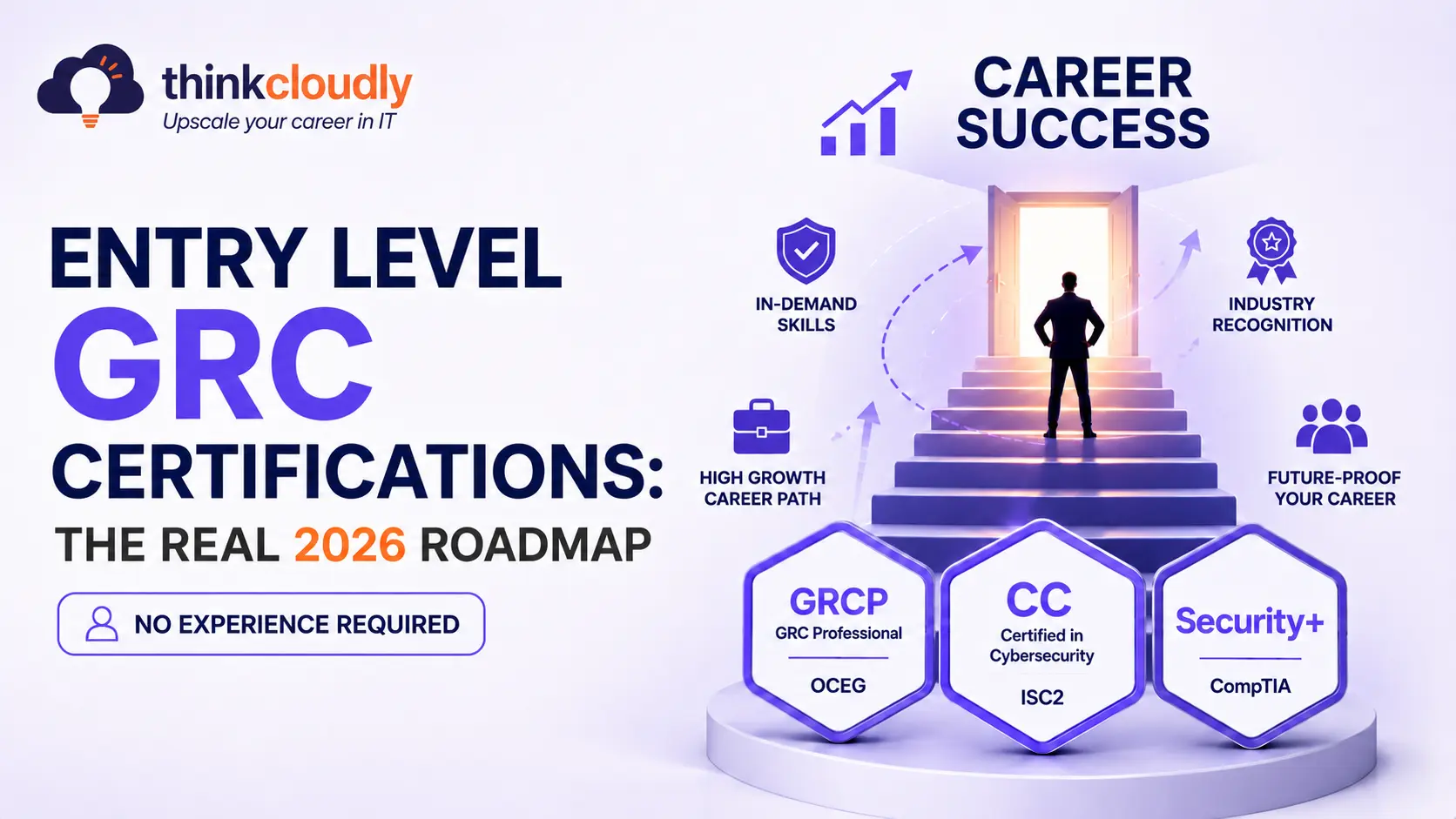
Short answer: If you’re starting from zero, the entry-level GRC certifications worth your time in 2026 are the GRC Professional (GRCP) from OCEG, the ISC2 Certified in Cybersecurity (CC), and CompTIA Security+. None require prior work experience. Everything else commonly labelled a “top GRC certification” online — CISSP, CISM, CRISC, CGEIT — requires three to five years of experience you don’t have yet, which is why most roundups leave beginners more confused than when they started.
I learned that the hard way. A few years ago, I mapped a certification path for someone who’d just finished our GRC & IT Audit Fundamentals course with zero professional GRC experience. I pulled up the most popular “best entry-level GRC certifications” articles, and nearly every one buried the fact that mattered most: almost none of the certifications on those lists would actually let her sit the exam yet. Her real worry wasn’t the syllabus — it was whether a two-hour, open-book exam would even be taken seriously by a hiring manager. She didn’t need a list of impressive acronyms. She needed to know which door was actually open.
That gap is what this guide fixes. Whether you call it a risk and compliance certification, a GRC credential, or just “that compliance cert everyone mentions in job postings,” the question is the same: Which entry-level GRC certifications can you actually qualify for right now?
What “Entry Level” Actually Means in GRC Certifications
Here’s something most GRC certifications content skips entirely: in this field, “entry level” doesn’t mean “easy.” It means “no professional experience gatekeeping the exam.” That distinction matters because GRC sits at the intersection of IT, security, audit, and law, and the heavyweight GRC certifications in this space were built for people who already have years in the trenches—not for someone hunting for genuine entry-level GRC certifications.
Take a look at how the experience requirements actually break down across the GRC certifications people search for under “entry level”:
|
Certification |
Issuing Body | Experience Required | Exam Cost (USD) |
Genuinely Entry Level? |
|
GRC Professional (GRCP) |
OCEG | None | ~$495–$499 (all-access) |
Yes |
|
ISC2 Certified in Cybersecurity (CC) |
ISC2 | None (basic IT knowledge recommended) | $199 |
Yes |
|
CompTIA Security+ |
CompTIA | None (CompTIA Network+ knowledge recommended) | $392 |
Yes |
|
CGRC (formerly CAP) |
ISC2 | 2 years in a relevant domain | $599 |
No—intermediate |
|
CRISC |
ISACA | 3 years in IT risk/control | $575–$760 |
No—intermediate/advanced |
|
CISA |
ISACA | 5 years in IS auditing | $575–$760 |
No—advanced |
|
CISM |
ISACA | 5 years in security management | $575–$760 |
No—advanced |
|
CISSP |
ISC2 | 5 years in cybersecurity | $749 | No—advanced |
Notice the pattern. The GRC certifications that show up most often on generic “top GRC certifications” roundups are mostly the advanced ones, because those are the credentials hiring managers recognize by name. That makes for an authoritative-sounding article. It does almost nothing for someone trying to land their first GRC analyst certification and break into the field.
If you only remember one thing from this article, remember this: find an entry-level GRC certification with no experience prerequisite, get certified, then use it to earn the experience that unlocks the bigger GRC professional certification names later. That’s the sequence that works, and it’s the order almost nobody writes about when they publish “top entry-level GRC certifications” content.
Why GRC Skills Are in Such High Demand Right Now
Before going further, it’s worth understanding why this field—and GRC certifications generally—are worth pursuing. Governance, risk, and compliance work used to live quietly inside audit departments. That’s no longer true. Regulatory complexity has expanded across data privacy, AI governance, third-party risk, and operational resilience, and most organizations are short-staffed for it. Compliance is now a board-level concern, not a back-office function, which is exactly why demand for risk and compliance certification holders keeps climbing year over year.
This is exactly why GRC professional certification programs have multiplied and why a single GRC professional certification can open doors that didn’t exist five years ago. Companies need people who can read a regulation, translate it into a control, and prove to an auditor the control works — a different skill from “knowing the rules.” It’s applied, procedural, and—encouragingly for beginners chasing their first GRC professional certification—teachable from the ground up.
There’s also a timing detail worth knowing if you’re considering the ISC2 route. ISC2 ran a “One Million Certified in Cybersecurity” initiative that gave away free exam vouchers for the entry-level CC certification. Heads up: ISC2 closed new enrollment in that free program on May 20, 2026. If you already grabbed a voucher before that date, you have until December 31, 2026, to sit the exam—but if you missed the window, the CC is back to its standard $199 fee, with a $50 annual maintenance fee after that. So if you’re reading this today, budget for the paid exam rather than counting on a free seat—but a $199 entry-level GRC certification is still one of the cheapest credible credentials on this list.
The Three Entry Level GRC Certifications Worth Starting With
Starting a career in Governance, Risk, and Compliance (GRC) can feel overwhelming, but choosing the right certification makes the journey much easier. These entry-level GRC certifications provide foundational knowledge, improve your job prospects, and help you build a strong career in cybersecurity and compliance.
1. GRC Professional (GRCP) — Best for Business-Minded Beginners
The GRCP, issued by OCEG, is the closest thing the industry has to a purpose-built starting point. There’s no required work experience and no required degree, and the exam itself is open-book—you’re allowed to use outside resources during the test because OCEG’s philosophy is that knowing how to apply the right framework matters more than memorizing it. You’ll need to score 70 out of 100 on a two-hour exam covering the GRC Capability Model: governance, risk, compliance, ethics, performance, and how they integrate.
What makes the GRCP genuinely useful as a first GRC analyst certification — and arguably the most well-rounded risk and compliance certification for someone with zero industry background — is its scope. Rather than narrowing in on one discipline like audit or cybersecurity, this GRC professional certification forces you to understand how governance, risk, and compliance functions talk to each other inside a real company, which is precisely the literacy most entry-level job postings test for. If you’re plotting a full GRC career roadmap rather than just your first credential, the GRCP tends to be the broadest possible foundation to build on next.
2. ISC2 Certified in Cybersecurity (CC) — Best for Security-Track Beginners
If your GRC career roadmap is angled more toward cybersecurity GRC—think IT risk, security controls, and audit readiness—the CC is the more direct entry point. ISC2 built it for people with no prior cybersecurity background, and it requires no work experience or degree. The $199 exam fee makes it one of the more accessible entry-level GRC certifications on the market, and passing it puts you on a path toward a full risk and compliance certification like CGRC and eventually CISSP once you’ve logged real experience and added more security certifications to your resume.
A small personal note here: when I’m advising someone who’s deciding between GRCP and CC for the start of their GRC career roadmap, the deciding factor is almost always which side of the house they want to work on first — policy and process (GRCP) or technical security controls (CC). Both are legitimate first moves; they just point toward slightly different first jobs.
3. CompTIA Security+ — Best for Maximum Employer Recognition
Security+ doesn’t have GRC in its name, but it’s one of the most recognized security certifications in entry-level compliance and IT audit postings because hiring managers have known it for over a decade. It’s broader and more technical than the GRCP, covering risk management, governance concepts, and security operations together—a strong addition if you’re stacking multiple credentials rather than relying on one alone. At $392, it costs more than the CC, but name recognition with non-specialist hiring managers can outweigh that for your first job search.
If you want to go deeper on how these frameworks compare before picking a path, our best GRC certifications guide walks through COBIT, NIST, and ISO 27001 side by side—useful context before you ever sit for an exam.
Building a Real GRC Career Roadmap: What Comes After Your First Certification
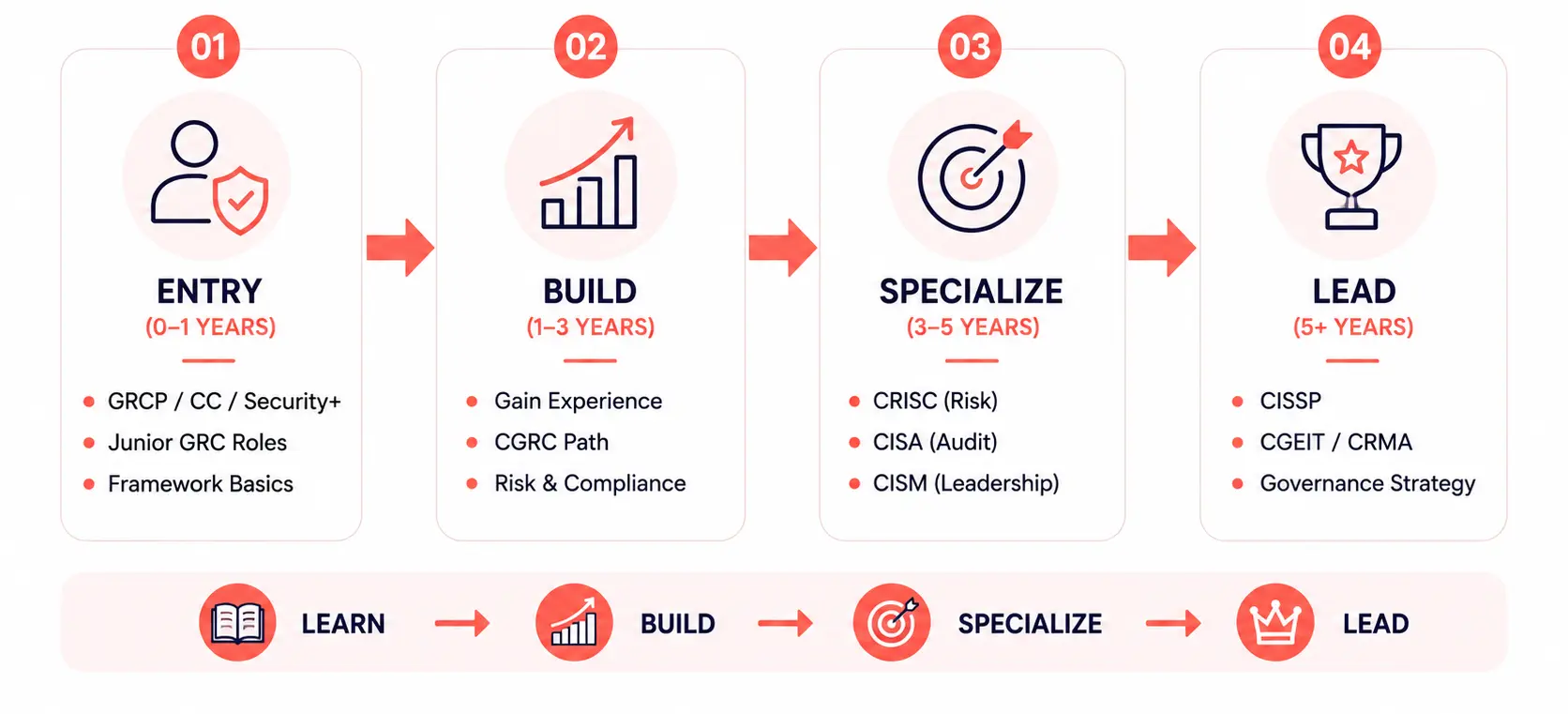
This is the part most competing guides skip entirely, and it’s the most useful section in this article. A single GRC analyst certification doesn’t make a career. Sequencing does, and that sequencing is the whole point of a real GRC career roadmap. Here’s a realistic four-stage GRC career roadmap based on how people actually progress in this field:
Stage 1 — Entry (0–1 years): Earn GRCP, CC, or Security+ as your first entry-level GRC certification. Take on a junior GRC analyst, compliance coordinator, or IT audit support role. Your job here is to learn how frameworks (NIST, ISO 27001, and SOC 2) map to real internal controls.
Stage 2 — Building (1–3 years): Start logging the experience that unlocks intermediate credentials and your next risk and compliance certification. This is when CGRC becomes realistic, since it only requires two years of relevant experience in any of seven domains — far more attainable than the five-year requirements further up the ladder.
Stage 3—Specializing (3–5 years): Choose a lane, CRISC, if you’re leaning into IT risk. CISA if you’re leaning into an audit. CISM if you’re leaning into security leadership. This is where a broader security certifications stack starts paying off in salary, not just job title—and where your GRC career roadmap branches, based on specialty.
Stage 4 — Senior/Leadership (5+ years): CISSP, CGEIT, or CRMA, depending on whether your path went technical, governance, or audit assurance. By this stage, you’re not chasing a GRC professional certification for credibility—you’re choosing one to formalize expertise you already have.
The mistake I see most often — almost weekly — is someone messaging me about CISSP or CRISC prep before checking whether they even meet the experience requirement. Skipping stages doesn’t just risk exam failure; often you don’t qualify to sit the exam yet.
What Entry-Level GRC Salaries Actually Look Like in 2026
Compensation data is one of the most distorted parts of GRC career content online, mostly because published “GRC analyst salary” figures blend entry-level and senior numbers into one misleading average. Based on 2026 compensation data, here’s a more honest breakdown for people pursuing entry-level GRC certifications:
|
Experience Level |
Typical Title |
Average Annual Salary (US) |
|
0–1 years |
Junior GRC Analyst / Compliance Coordinator |
$63,000–$80,000 |
|
1–3 years |
GRC Analyst |
$88,000–$98,000 |
|
3–5 years |
Senior GRC Analyst / IT GRC Analyst |
$98,000–$112,000 |
|
5+ years |
GRC Manager / Cybersecurity GRC Lead |
$112,000–$130,000+ |
Salary ranges reflect 2026 US compensation data aggregated from Glassdoor and ZipRecruiter.
A risk and compliance certification alone won’t move you up this table — experience does that. What any GRC analyst certification does is get your resume past the applicant tracking system and into a hiring manager’s hands. For a closer look at how specific credentials map to specific salary bands, our best GRC certifications guide breaks down ROI certification by certification. Treat any single risk and compliance certification as a key that opens the door, not a guarantee of what’s on the other side.
Common Mistakes Beginners Make Choosing a GRC Certification
A few patterns show up again and again with people just starting their search for entry-level GRC certifications:
- Chasing the most prestigious name first. CISSP is impressive, but if you don’t qualify to sit the exam, prestige is irrelevant. Start with genuine entry-level GRC certifications where you’re eligible.
- Assuming every GRC professional certification is interchangeable. The GRCP, CGRC, and CRISC tests fundamentally different things—integrated GRC literacy, system authorization, and IT risk control. Pick based on the work you want to do, not the acronym that sounds most familiar.
- Ignoring renewal requirements before enrolling. Every certification here, from entry-level GRC certifications through advanced security certifications, carries continuing education obligations. Factor that ongoing cost into your decision now, not after you’ve paid the exam fee.
- Studying frameworks in isolation. GRC is fundamentally about integration—governance feeding risk, feeding compliance, feeding audit. Study NIST and ISO 27001 as separate silos, and you’ll struggle on exams designed around how they overlap. Our best GRC certifications breakdown covers this integration thinking in more depth, useful once you’ve picked a direction for your GRC career roadmap.
- Treating security certifications and GRC certifications as the same thing. They overlap, but a GRC analyst certification emphasizes governance and process, while most security certifications emphasize technical defense. Know which one a given posting is actually asking for.
How to Actually Prepare Without Wasting Months
Self-study works, but it’s slow and easy to study the wrong things at the wrong depth—a real risk when open-book exams like the GRCP tempt you to under-prepare for what is still a serious GRC professional certification. The more efficient path is a structured course built around the actual exam blueprint for entry-level GRC certifications, rather than the full body of the underlying framework, which is broader than what gets tested.
If you’d rather not guess which 20% of NIST or ISO 27001 shows up on entry-level GRC certifications, ThinkCloudly’s GRC & IT Audit Fundamentals course is built to bridge that gap—practical control mapping, audit logic, and framework literacy, condensed for people who’ve never sat a GRC analyst certification exam before.
Sources: ISC2 CGRC certification details, ISC2 exam pricing, OCEG GRCP certification, ISACA CRISC certification.