
Here’s a fact that stopped me mid-scroll this year: the global cybersecurity workforce is still short by roughly 4.8 million people, according to ISC2, even as AI-driven attacks hit the majority of organizations. So who is quietly holding the line between “we got hacked” and “we caught it before it mattered”?
Increasingly, the answer is a GRC analyst. If you’ve seen this job title popping up on LinkedIn and wondered what it means or whether it’s worth building a career around cybersecurity compliance instead of hands-on hacking, you’re in the right place. I’ve spent the last few years working alongside security teams building out their governance programs, and I still remember my first audit meeting, completely lost, wondering why nobody mentioned firewalls.
This guide breaks down what a GRC analyst does, the skills and certifications you need, what the role pays in 2026, and how you can become one.
What Is GRC in Cybersecurity?
GRC stands for governance, risk, and compliance. In cybersecurity, it is the discipline that sets security policies (governance), identifies and prioritizes threats to the business (risk), and proves the organization meets laws and standards such as ISO 27001, SOC 2, HIPAA, PCI DSS, and GDPR (compliance). A GRC analyst is the person who runs this work day to day.
What Does a GRC Analyst Actually Do Every Day?
A GRC analyst sits at the intersection of three disciplines: governance, risk, and compliance. In plain English, this person makes sure a company’s security rules actually exist on paper, that the biggest risks are identified before they become disasters, and that the organization is meeting the legal and industry obligations it has signed up for.
Unlike a penetration tester or a SOC analyst who spends the day inside firewalls and logs, a GRC analyst spends more time inside spreadsheets, policy documents, and conversations with department heads. That doesn’t make the job easier; it makes it different, and arguably more strategic.
GRC Analyst Roles and Responsibilities
A typical GRC analyst job description includes:
- Writing and updating information security policies and standards
- Running risk assessments and maintaining the risk register
- Mapping controls to frameworks such as NIST CSF, ISO 27001, and SOC 2
- Preparing evidence for internal and external audits
- Reviewing vendor security questionnaires (third-party risk management)
- Tracking remediation of audit findings and compliance gaps
- Reporting risk and compliance status to leadership
On a typical day, a GRC analyst might review a vendor’s security questionnaire, update a risk register, prepare evidence for an external audit, or translate a dense regulation into a checklist that engineers can actually follow. A strong governance framework is the backbone of this work, because without documented policies, there’s nothing to measure compliance against.
The role also involves acting as a translator: turning legal and regulatory language into practical steps the IT team can implement and turning technical risk into language a board member can understand in five minutes. Good information security practice depends on this kind of translation working smoothly in both directions.
Why Is the GRC Analyst Role in Such High Demand in 2026?
Search interest in governance, risk, and compliance roles has grown sharply over the past five years, and 2026 is being described by industry analysts as the year compliance work stopped being a back-office function and became a boardroom priority. A few forces are driving this shift.
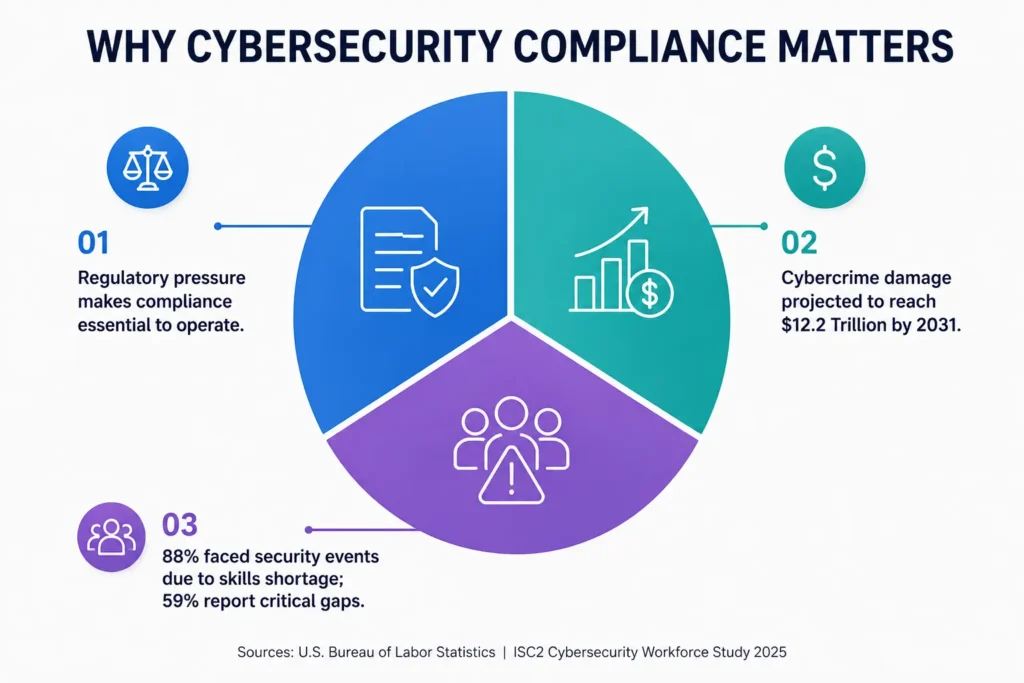
- First, regulatory pressure keeps stacking up. New privacy laws, financial regulations, and sector-specific rules mean that cybersecurity compliance is no longer optional paperwork; it is now directly tied to whether a company can legally operate in certain markets.
- Second, the cost of getting it wrong has become enormous, with industry projections putting global cybercrime damage above $12 trillion a year by 2031.
- Third, according to the 2025 ISC2 Cybersecurity Workforce Study, which surveyed more than 16,000 professionals worldwide, 88% of organizations experienced at least one significant security event tied to a skills shortage in the past year, and 59% reported critical or significant skills gaps, up sharply from the year before.
Organizations have realized that hiring one skilled GRC analyst can be far cheaper than cleaning up after a breach caused by an undocumented process. There’s also an AI angle nobody saw coming a few years back. As companies plug AI tools into daily operations, someone has to ask uncomfortable questions: Who approved this model? What data is it trained on? And who is accountable if it makes a harmful decision?
That accountability work sits squarely inside GRC teams, and it’s one reason recruiters describe the GRC analyst role as recession-resistant even while other tech hiring cools down.
GRC Analyst vs. Compliance Analyst, Risk Analyst, and SOC Analyst
People entering the field often get confused because so many titles overlap, and a compliance analyst, a risk analyst, and a security analyst can sound interchangeable even though each owns a different part of the security program.
Here’s a simple breakdown of how the most common related roles differ, based on how companies typically define them in 2026 job postings.
|
Job Title |
Main Focus | Typical Background |
Works Closely With |
|
GRC Analyst |
Governance, risk, and compliance across the whole security program | Business, IT, or audit |
Legal, IT, executives |
|
Compliance Analyst |
Meeting specific regulatory standards and day-to-day compliance obligations | Legal, audit, finance |
Compliance officer, legal team |
|
Risk Analyst |
Identifying, scoring, and tracking organizational risk | Finance, statistics, IT |
Risk manager, CISO |
|
Information Security Analyst |
Monitoring networks and responding to technical threats | Computer science, IT |
SOC team, incident responders |
|
Privacy Officer |
Data protection and privacy law compliance | Law, policy |
Legal, compliance analyst, IT |
As the table shows, a compliance analyst tends to specialize more narrowly in specific regulations, while a risk analyst focuses heavily on measuring and prioritizing threats using numbers and models.
A GRC analyst, by contrast, is expected to understand a bit of everything and connect the dots between them, which is exactly why compliance work increasingly reports up through one shared governance framework rather than three disconnected departments.
GRC Analyst Skills, Certifications, and Frameworks You’ll Need
Nobody starts this career already knowing everything, and that’s genuinely good news for people switching from finance, law, or general IT. That said, a few GRC analyst skills come up constantly in interviews and daily work:
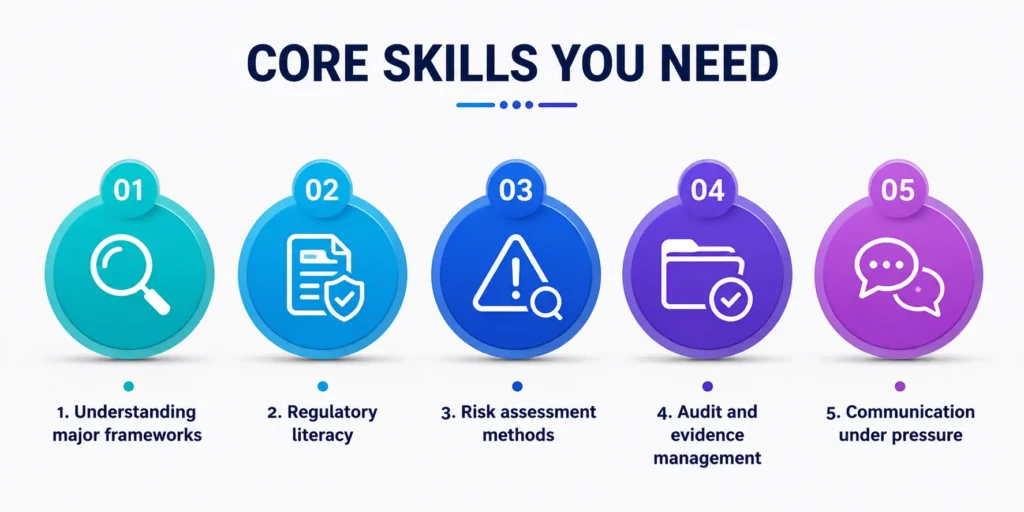
1. Understanding major frameworks
Professionals are expected to be comfortable working with a recognized governance framework such as NIST CSF, ISO 27001, or COSO, since these give structure to how information security controls are documented and tested.
2. Regulatory literacy
Knowing how privacy and data protection laws such as GDPR, HIPAA, and PCI DSS apply to your industry, and being able to translate legal text into an operational cybersecurity compliance checklist.
3. Risk assessment methods
Building and maintaining a risk register, scoring likelihood and impact the way a seasoned risk analyst would, and presenting findings clearly to non-technical stakeholders.
4. Audit, evidence management, and GRC tools
Collecting, organizing, and defending documentation during internal or external audits. Most teams do this inside dedicated GRC tools such as ServiceNow GRC, RSA Archer, OneTrust, Vanta, or Drata, so hands-on familiarity with at least one platform is a real advantage.
5. Communication under pressure
Explaining why a compliance gap matters to someone who has never heard of a firewall without sounding condescending or overly technical — exactly the kind of risk thinking employers say they can’t find enough of.
GRC Analyst Certifications That Help
Certifications such as CISA, CRISC, CompTIA Security+, and ISO 27001 Lead Implementer are commonly listed in GRC analyst job postings, but most current guidance agrees that hands-on exposure to real risk assessments matters just as much as a certificate on a resume. In my own experience mentoring people who moved from accounting and legal backgrounds into this field, the biggest hurdle was rarely technical knowledge. It was learning to sit in a room with engineers and hold their own without pretending to be one.
GRC Analyst Salary and Job Market in 2026
Numbers vary by source, but a consistent picture emerges from multiple 2026 salary trackers. The average GRC analyst salary in the United States sits around $112,000 to $125,000 annually, according to ZipRecruiter, with senior professionals commanding upward of $165,000.
The middle 50% of postings pay between roughly $80,000 and $142,000 depending on location and seniority, and entry-level GRC analyst roles usually start toward the lower end of that band. Career changers with a risk analyst background in finance or insurance often ramp up faster, since scoring and prioritizing threats is already a familiar exercise.
Beyond salary, the demand signal for GRC analyst jobs is loud. Governance-focused roles were named among the most in-demand cybersecurity positions of 2026 in multiple staffing reports, alongside cloud security and incident response.
Employment for compliance-related occupations is also projected to keep growing steadily through the next decade, as detailed in Research.com’s 2026 GRC careers report, and many organizations are quietly expanding GRC budgets even while general tech hiring cools. This isn’t a hype cycle; it reflects a structural shift where every company handling customer data now treats cybersecurity compliance as core infrastructure and needs someone accountable for proving its compliance posture is real, not just written down.
How to Become a GRC Analyst (Even Without a Technical Background)
You genuinely do not need a computer science degree or years of coding experience to become a GRC analyst, which is part of why this field attracts so many career changers.
-
Build foundational knowledge of one or two major governance frameworks and basic regulatory concepts relevant to your target industry, whether that’s healthcare, finance, or general data privacy.
-
Look for entry points through internal audit, compliance operations, or a junior risk analyst position rather than waiting for a job posting with the exact title you want.
-
Practice translating technical findings into plain business language, since this is the skill that separates people who get promoted from people who stay stuck at entry level.
-
Pursue a recognized certification once you have some practical exposure to cybersecurity compliance work, rather than collecting credentials before you’ve touched real work.
-
Volunteer for cross-functional projects at your current job, even outside security, that involve documentation, policy writing, or working closely with auditors.
-
Prepare for interviews with real scenario questions — our GRC control design interview questions are a good place to start.
If you want structured, hands-on preparation, the IT Auditing & GRC Job Seeker’s Package covers frameworks, audits, and interview prep in one track.
Final Thoughts
A GRC analyst is no longer the quiet person filing paperwork in the back office; this is one of the clearest paths into cybersecurity for people who think in terms of process, people, and accountability rather than code. Between a stubborn talent shortage, rising regulatory pressure, and companies finally treating risk as a board-level concern, 2026 has turned this from a niche title into one of the field’s steadiest career bets.
If you’re weighing whether to pursue this path, my honest advice after watching dozens of people make the switch is simple: start building the habit of documenting and questioning processes now, in whatever job you currently hold, because that instinct — more than any single credential — is what turns a solid compliance analyst into a genuinely trusted GRC analyst. For a deeper skills checklist, read skills every aspiring GRC analyst should learn.