

Short answer (read this first): GRC certification training teaches you to manage governance, risk, and compliance inside real organizations—and in 2026 it has quietly become one of the fastest, least code-heavy ways to break into cybersecurity. The strongest path pairs a recognized credential — CGRC, CRISC, or CISA — with hands-on, scenario-based learning that mirrors real audits, risk registers, and control testing. Budget 3–6 months of focused study, roughly $350–$760 in exam fees, and expect U.S. entry salaries between $65,000 and $90,000.
Now here’s the version no brochure will give you.
Why this guide is built differently
I’ve spent years coaching career changers, students, and overworked IT admins into governance, risk, and compliance roles. And I’ll be honest: most “top certification” lists read like product catalogs. They tell you what exists. They rarely tell you what actually works. After watching hundreds of learners move through GRC certification training—some who landed jobs in 90 days, some who stalled for a year—I learned one uncomfortable truth: the credential matters far less than how you train for it.
So this guide does something the others don’t. Alongside the roadmap, you’ll get a readiness scorecard, an original cost-to-salary table, and the exact mistakes I watch people repeat. Let’s get into it.
What “GRC” really means (and why 2026 changed the game)
Governance, risk, and compliance are the disciplines of making sure an organization makes good decisions (governance), understands what could go wrong (risk), and follows the rules that apply to it (compliance). For years it lived quietly in audit departments. Not anymore.
Three forces collided this year. First, AI moved from experiment to infrastructure—one 2026 benchmark found that 97% of compliance teams now use AI in their workflows (Hyperproof). Second, regulation got teeth: the EU’s Digital Operational Resilience Act (DORA) reached full enforcement, and U.S. agencies began offboarding contractors who couldn’t meet CMMC mandates. Third, boards stopped treating GRC as paperwork and started treating it as strategy.
The result? Demand for people who can translate messy regulations into practical controls is surging. That’s exactly what good risk and compliance training prepares you to do—and it’s why proper GRC certification training has become a genuine career accelerator rather than a checkbox.
Who this is for
You’re in the right place if you’re an aspiring cloud or cybersecurity professional, a student mapping your first move, an IT professional ready to step off the help-desk treadmill, or a career changer from finance, healthcare, or legal. Here’s the part most guides bury: a non-technical background is often an advantage in GRC. Finance pros already think in probability and impact. Healthcare workers have lived inside HIPAA audits. That lived experience is precisely what GRC Career Training helps you convert into a hireable skill set.
The 2026 certification landscape (an honest comparison)
There is no single “GRC certificate.” There’s an ecosystem, and each credential leans toward a different pillar. Below is the comparison I wish someone had handed me on day one — built from current exam outlines and pricing, not recycled marketing copy.
|
Certification |
Best for | Experience needed | Exam fee (2026) |
Focus |
|
CGRC (ISC2) |
First GRC-specific credential, government/defense | 2 years (associate path available) | ~$599 |
NIST RMF, authorization, continuous monitoring |
|
CRISC (ISACA) |
IT risk specialists, mid-career | 3 years (no waivers) | $575 / $760 |
Enterprise IT risk & controls |
|
CISA (ISACA) |
IT auditors, compliance analysts | 5 years (substitutions) | $575 / $760 | Audit process & assurance |
|
Security+ (CompTIA) |
Absolute beginners | None | ~$405 | Technical foundation |
Sources: ISC2 CGRC and published 2026 exam outlines.
A pattern I share with every learner: don’t chase logos; chase alignment. CRISC is risk. CISA is an audit. CGRC tries to cover the whole spectrum and shines in federal work. If you pick a credential misaligned with the job you actually want, you’ll burn months studying material you’ll never use. I’ve watched that happen too many times, and it’s always avoidable. (If you want a deeper side-by-side, our breakdown of the best GRC certifications walks through each one.)
This is also where structured GRC professional training earns its keep. Self-study can get you to an exam pass; it rarely gets you to job-ready. Employer-grade GRC certification training fills the gap between knowing a framework and running one.
What strong GRC training actually includes
Not every program is equal. The strongest GRC professional training is built in four layers. It starts with foundational risk and compliance training that teaches the language of frameworks and controls. It adds IT governance training that ties technology decisions to business accountability. It layers in GRC career training that turns knowledge into a portfolio and interview readiness. And it finishes with exam-aligned GRC certification training mapped to the credential you’re actually targeting. Skip a layer and you’ll feel the gap on day one — which is exactly what separates job-ready GRC certification training from the forgettable kind. Most providers nail one layer and quietly skip the rest.
The unique part: your GRC Readiness Scorecard
Before you spend a rupee or a dollar on an exam, score yourself honestly. Give yourself one point for each “yes.” I built this from the patterns that separate learners who get hired from those who don’t.
- Can I explain the difference between a risk and a control in one sentence?
- Have I ever built (or mocked up) a risk register?
- Can I name three frameworks (e.g., NIST, ISO 27001, SOC 2)?
- Do I understand what an audit evidence request looks like?
- Can I tie a security gap to a business consequence?
- Have I practiced explaining a finding to a non-technical manager?
0–2: Start with foundations and risk and compliance training before any exam. 3–4: You’re ready for targeted GRC certification training with hands-on labs. 5–6: You’re close to job-ready; focus on a credential and a portfolio.
No other roadmap hands you a go/no-go check before you spend money. That single habit—diagnosing readiness first—is the most underrated move in all of GRC Career Training and the cheapest insurance for your GRC certification training budget.
What it actually costs — and what it returns
Cost anxiety stops more people than difficulty does. So let’s be concrete. The table below pairs realistic 2026 U.S. salary bands with the training investment behind them. Figures are drawn from public workforce data and exam pricing; individual results vary by city, sector, and effort.
|
Stage |
Typical U.S. salary (2026) | Usual credential |
Realistic time to reach |
|
Entry GRC analyst |
$65,000 – $90,000 | Security+ → CGRC |
3–6 months of study |
|
Mid-level analyst |
$90,000 – $120,000 | CRISC or CISA |
2–3 years experience |
|
Senior / specialist |
$150,000+ | CRISC + CISA stack |
5+ years |
Salary ranges informed by CyberSeek workforce analytics. Two details worth knowing: certified professionals typically earn 10–20% more than uncertified peers at the same experience level, and financial services, healthcare, and government contracting pay a regulatory premium on top. Quality IT Governance Training and risk and compliance training are not an expense—they’re the cheapest leverage in this entire field.
If you’d rather skip the guesswork and learn the audit-and-controls workflow directly, our GRC & IT Audit Fundamentals course was built to take a complete beginner to job-ready with the exact labs hiring managers screen for.
The 2026 trends that should shape your training
Here’s where most GRC certification training quietly goes stale—it teaches the frameworks but ignores where the field is sprinting.
AI governance is the new frontier. As AI systems start making decisions, organizations need people who can govern them. New credentials in AI security and AI auditing were launched this year, and IT governance training that ignores AI oversight is already behind. You don’t need to be an AI expert; you need to understand how to put guardrails, ownership, and audit trails around AI use. Forward-looking IT governance training now bakes this in from the start, and the best GRC certification training treats AI oversight as a core skill, not an elective.
Outcomes replaced artifacts. Regulators in 2026 increasingly ask, “Show me how you’d recover,” not “Show me your policy binder.” Modern risk and compliance training, therefore, emphasizes continuous monitoring over once-a-year checklists (ISC2’s 2026 GRC survey captures this shift well).
Third-party risk is now a core risk. When a SaaS vendor goes down, the business goes down with it. Vendor risk management has moved from a side task to a headline skill—and strong GRC professional training now treats it as a first-class topic.
Choosing your path (by where you’re starting)
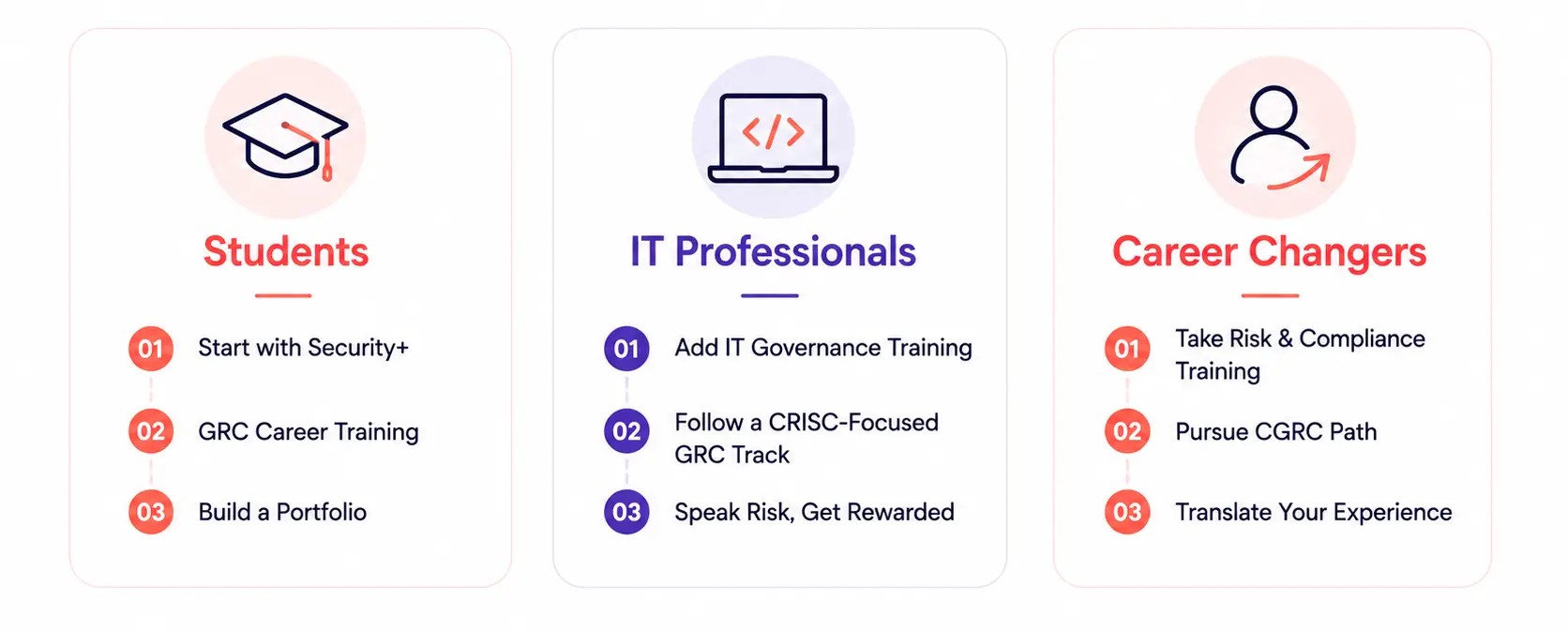
Your route depends on where you’re starting, and good GRC professional training meets you where you are rather than forcing one template on everyone. If you’re still weighing credentials, our guide to choosing the right GRC certification pairs well with this section.
Students: Begin with Security+ to build literacy, then layer GRC career training focused on a portfolio—a mock risk assessment beats an empty résumé every time.
IT professionals: You already understand systems. Add IT governance training and a CRISC-focused GRC professional training track to reframe your technical knowledge in risk language that executives reward.
Career changers: Lean on your domain. Pair foundational risk and compliance training with a CGRC path and translate your old job’s compliance instincts into GRC vocabulary. This is the lane where GRC certification training pays off fastest.
A realistic 90-day plan
This is the cadence I’ve seen work again and again, assuming 8–10 focused hours a week. Think of the next three months as a focused GRC career training sprint—short, daily risk and compliance training reps that compound.
- Days 1–30 — Foundations. Learn the vocabulary of governance, risk, and compliance. Build one mock risk register by hand. This is the backbone of any serious GRC professional training.
- Days 31–60 — Frameworks & labs. Map a small system to NIST or ISO 27001. Practice writing findings. Good GRC certification training lives or dies here, in the hands-on reps.
- Days 61–90 — Credential & portfolio. Sit your chosen exam, publish your portfolio, and start applying. You can be interviewing in three months. Individual results vary, but the structure doesn’t.
This 90-day spine is what separates effective GRC career training from passive video watching.
The mistakes I see most often
Experience teaches you what brochures won’t. The five I watch on repeat:
- Collecting certificates with no strategy. A stack of mismatched credentials impresses no one. Sequence them to your target role.
- Skipping the portfolio. Hiring managers want proof of thinking, not just a passing score. Even basic IT governance training should produce artifacts you can show.
- Ignoring business language. If you can’t tie a risk to dollars, you’ll stay an analyst forever.
- Memorizing instead of practicing. Real Risk and Compliance Training is reps, not recall.
- Waiting until you “feel ready.” You won’t. Start the GRC certification training, build in public, and let competence catch up to action.
Why ThinkCloudly for your GRC certification training
I’ll keep this honest, because trust is the whole point. Plenty of programs sell you slides. What changes careers is GRC certification training that drops you inside real workflows—building risk registers, mapping controls, and defending findings the way you will on the job. Ours is built exactly that way: our GRC certification training pairs every concept with a hands-on lab, the backbone of any real GRC professional training.
That’s the philosophy behind our GRC Professional Training: scenario-first, mentor-supported, and aligned to the credentials employers actually list. It pulls three threads—risk and compliance training, IT governance training, and GRC career training—into one coherent track instead of leaving you to stitch scattered modules together yourself. Whether you’re chasing your first analyst role or leveling up existing IT governance training, the goal is the same—walking into interviews able to do the work, not just describe it.
If you’re ready to begin, the GRC & IT Audit Fundamentals program is the most direct on-ramp we offer. And if you’re still comparing credentials, our guide to the top GRC certifications will help you choose before you commit.
The field is wide open in 2026. The right GRC certification training won’t just help you pass — it’ll help you perform. The people who win in this field aren’t the ones with the most certificates—they’re the ones who trained like the job was already theirs.