
Most people hear the words “cloud computing” and picture something impossibly technical, reserved for people with computer science degrees and years of experience staring at screens full of code. That image is outdated and more than a little misleading.
Cloud computing has quietly become one of the most in-demand, learnable, and accessible tech skills of our time. Whether someone’s a teacher, a small business owner, a nurse, or a marketing professional, understanding cloud computing at even a basic level can open doors you didn’t know existed.
The real question is not whether it is learnable. It is how long it actually takes. It depends on what you want to do with it, and we’re going to break that down clearly.
First, What Even Is Cloud Computing?
Before the timelines, it helps to establish what cloud computing actually means.
Cloud computing simply means using someone else’s computers, housed in massive data centers around the world, to store files, run software, or power websites and apps. When you back up your photos to iCloud, stream Netflix, or use Google Docs, you’re already using the cloud.
At a professional level, cloud computing means managing those systems, building on top of them, or helping organizations move their work into the cloud. Companies like Amazon (AWS), Microsoft (Azure), and Google (Google Cloud) rent out this infrastructure to businesses of all sizes.
That is the world a new cloud professional steps into.
It’s Not One Skill. It’s a spectrum.
This is where most people get confused. “Learning cloud computing” isn’t a single destination. Think of it more like learning to drive. There’s a big difference between knowing how to reverse out of a driveway and being a Formula 1 driver.
Here’s a practical breakdown
|
Level |
What You Can Do |
Realistic Time to Get There |
|
Beginner / Awareness |
Understand cloud concepts, terminology, and why it matters. |
2 to 4 weeks |
|
Foundational Certification |
Pass AWS Cloud Practitioner or Azure Fundamentals |
1 to 3 months |
|
Associate Level |
Deploy basic cloud infrastructure, manage storage, handle networking |
4 to 6 months |
|
Professional / Specialty |
Architect full solutions, pass advanced exams, job-ready |
9 to 18 months |
|
Expert Practitioner |
Deep specialization in security, ML, or DevOps on cloud |
2 to 3+ years |
These ranges are for people starting from zero and studying consistently, not full-time, but around 1 to 2 hours per day on average.
What Factors Speed Up or Slow Down Your Learning?
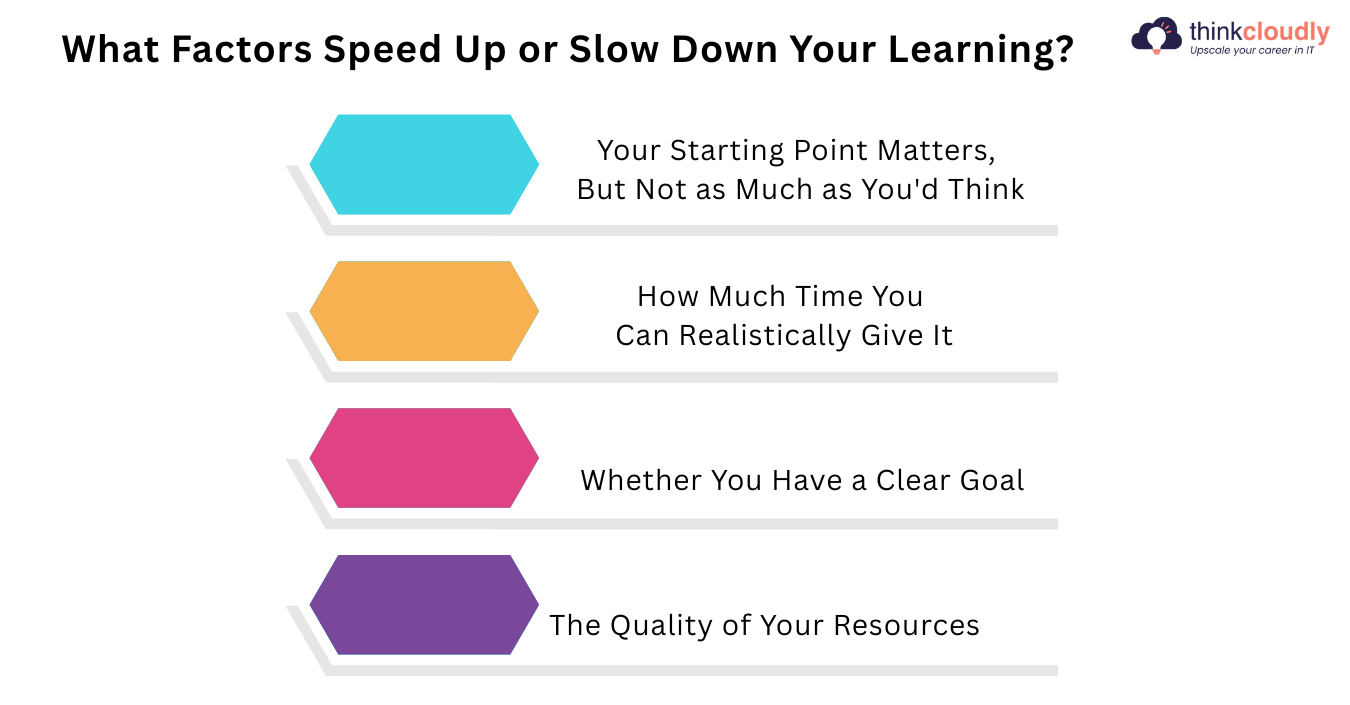
Your Starting Point Matters, But Not as Much as You’d Think
If you’ve never touched a command line in your life, your first few weeks will feel unfamiliar. That’s completely normal. Cloud platforms like AWS and Azure have invested billions into beginner-friendly interfaces and documentation precisely because they want more people using their services.
Having a general comfort with computers, spreadsheets, or even just browsing the internet puts you further ahead than you might expect.
How Much Time You Can Realistically Give It
Studying an hour a day, five days a week, is far more effective than cramming ten hours on a Sunday. Consistency beats intensity almost every time when it comes to learning something new.
Whether You Have a Clear Goal
People chasing a specific certification like the AWS Certified Cloud Practitioner tend to learn faster because they have a clear finish line. People learning “just to know more” often drift without structure. A goal gives your learning direction and momentum.
The Quality of Your Resources
There is no shortage of cloud learning content in 2026. But not all of it is good. Structured platforms with hands-on labs, where you actually log in to real cloud environments and practice, produce far better results than watching video lectures alone.
A Realistic Learning Path Without the Jargon
For someone starting from scratch today, here is what a sensible journey looks like.
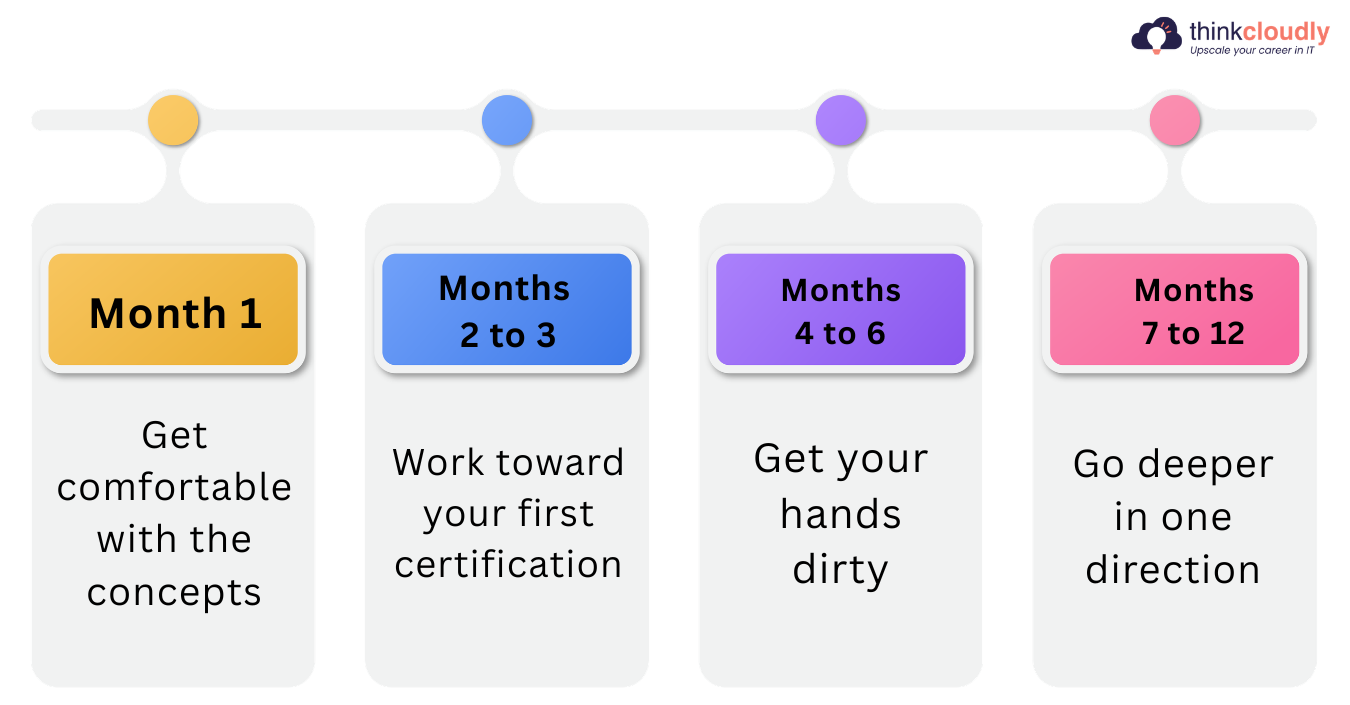
Month 1: Get comfortable with the concepts.
Start with free introductory courses. AWS, Microsoft, and Google all offer free beginner content on their websites. You’re not building anything yet. You’re just learning the language.
Months 2 to 3: Work toward your first certification.
The AWS Cloud Practitioner or Microsoft Azure Fundamentals (AZ-900) are widely recognized entry points. They don’t require any technical background and prove you understand the core concepts.
Months 4 to 6: Get your hands dirty.
Sign up for a free tier account on AWS or Azure and actually try things. Set up a simple website, store some files, and explore the dashboard. Doing beats watching, every single time.
Months 7 to 12: Go deeper in one direction.
At this point, you’ll start to see which area interests you most, whether that’s cloud security, data storage, infrastructure management, or cloud development. Pick one lane and go further.
What Are People Actually Learning Cloud For?
It’s worth knowing why people pursue cloud skills, because it shapes everything about how and how fast they learn.
Some are career changers who want to move into tech roles without going back to university. For them, certifications are currency. They signal competence to employers in a way that’s faster and cheaper than a degree.
Some are business owners who want to understand what their tech team is actually doing and make smarter decisions about their tools and infrastructure.
Some are professionals in adjacent fields such as project managers, finance analysts, and HR leaders who want to stay relevant as their industries digitize.
Each of these people needs a different depth of knowledge and therefore has a different timeline.
The Certification Landscape in 2026
Certifications remain the clearest signal of cloud knowledge, especially for those without a traditional tech background. Here’s a quick orientation.
Entry-level (no prerequisites): AWS Certified Cloud Practitioner, Microsoft AZ-900, Google Cloud Digital Leader
Intermediate (some hands-on experience helpful): AWS Solutions Architect Associate, Microsoft AZ-104, Google Associate Cloud Engineer
Advanced (for experienced practitioners): AWS Solutions Architect Professional, Microsoft Azure Expert certifications, Google Professional Cloud Architect
Entry-level exams cost roughly $100 to $150 to sit and can be taken online from home. Most people preparing on a consistent schedule are ready in four to eight weeks for the foundational tier.
The Bottom Line
Learning cloud computing is not a sprint, and it’s not a marathon. It’s more like training for a 10K. Completely achievable without being a professional athlete, but it does require showing up regularly.
For most people starting from scratch, a meaningful, employable level of cloud knowledge takes somewhere between six months and a year of consistent study. Your first certification could come in as little as four to eight weeks.
The best time to start was a few years ago. The second best time is right now.
Sources & Further Reading
The data and statistics in this article are drawn from the following sources:
- Amazon Web Services — AWS Training and Certification — Certification paths, exam structure, and official cloud learning resources
- Microsoft Learn — Azure Fundamentals Learning Path — Azure beginner curriculum, AZ-900 exam preparation, and free learning modules
- Google Cloud — Cloud Skills Boost — Google Cloud certification tracks and hands-on lab resources
- Coursera — Cloud Computing Specializations and Enrollment Data — Learner enrollment trends and structured cloud computing course offerings
- Linux Foundation — State of Tech Talent Report 2025 — Global tech talent demand, skills gap data, and cloud workforce trends
- CompTIA — IT Industry Outlook 2025 — Industry-wide hiring trends, certification value, and cloud skills demand analysis
- Lightcast (formerly Burning Glass) — Cloud Job Postings and Skills Demand Analysis — Real-time job market data tracking cloud computing role postings and required skills
- A Cloud Guru (Pluralsight) — Cloud Learning Platform and Certification Prep Resources — Hands-on cloud lab environments, learning timelines, and certification preparation data
- World Economic Forum — Future of Jobs Report 2025 — Global workforce transformation data and technology skills forecasting
- U.S. Bureau of Labor Statistics — Occupational Outlook Handbook: Cloud and Network Architects — Employment projections, salary benchmarks, and job growth statistics for cloud roles
- Forbes Technology Council — Cloud Computing Skills Gap Analysis 2025 — Expert insights on the global cloud talent shortage and employer expectations
- IDC Research — Worldwide Cloud Services and Infrastructure Forecast 2025 to 2026 — Market size projections, cloud adoption rates, and infrastructure spending forecasts
All data and statistics referenced in this article reflect global cloud computing market conditions and workforce trends as reported for 2025 and 2026.