
Most IT professionals think the only way to earn more or move up is to find a new job. It feels like the logical move—new company, fresh start, bigger title. But in 2026, that assumption is costing a lot of people time and money they didn’t need to spend.
Staying put and growing from within is often the smarter play. You already know how things work. You know the people, the systems, the politics. That’s not a small thing—companies spend a lot to replace someone who leaves, and they know it. Internal hires get up to speed faster, fit the culture better, and tend to stay longer. That gives you more leverage than most people realize.
A 2026 report found that employees who can see a clear path forward at their current company are 27% more likely to stay, and companies are now actively building internal mobility programs because of it. At the same time, global IT spending is on track to grow over 9% in 2026. More IT roles, more budgets, more room to move up. The window is open.
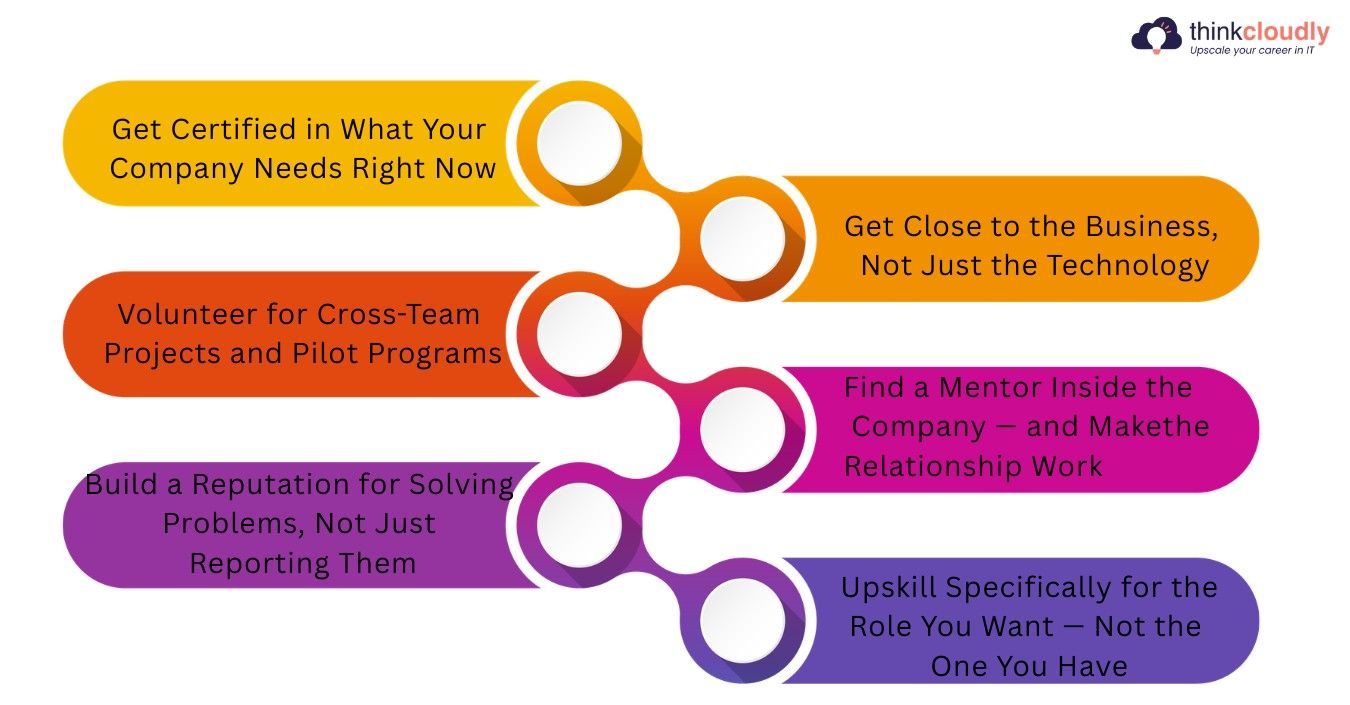
1. Get Certified in What Your Company Needs Right Now
If you only act on one thing from this entire article, make it this one. If your current certifications don’t touch any of these, you’re easy to overlook—even by people who already know your work.
Here’s what’s actually moving the needle right now:
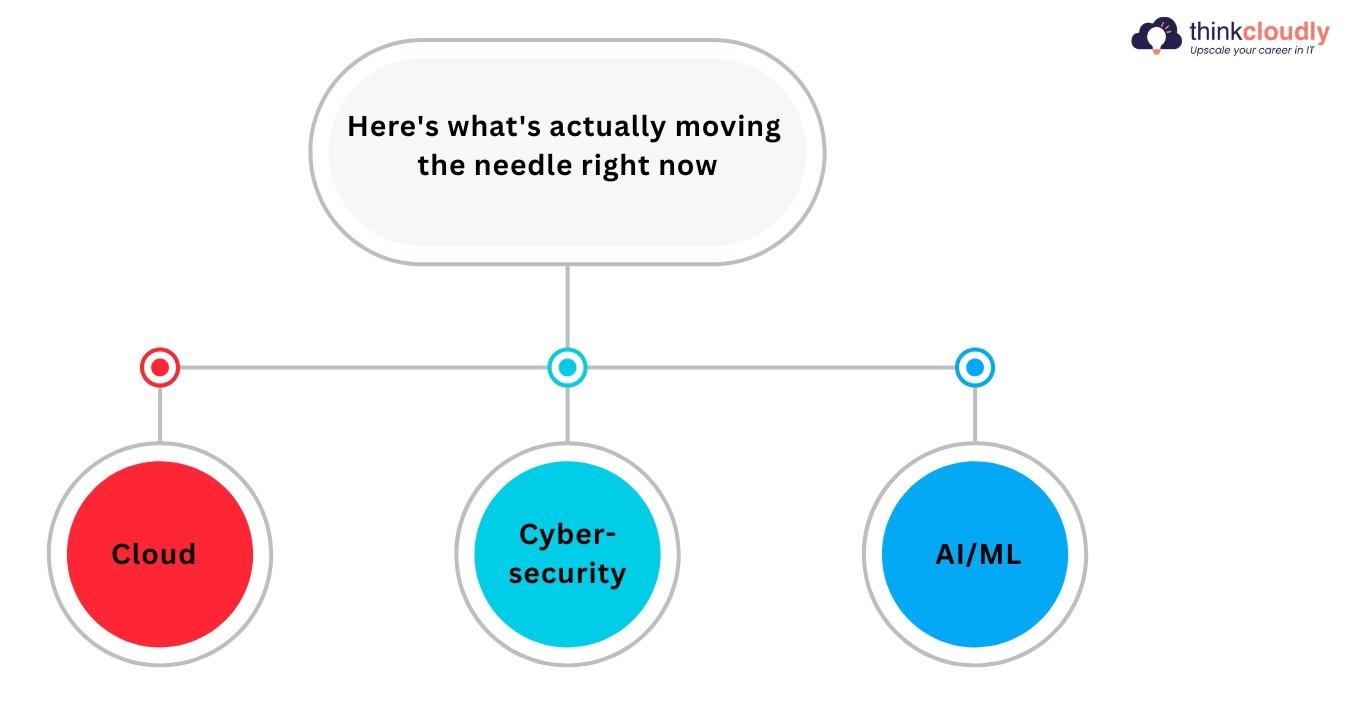
- Cloud: AWS Solutions Architect, Microsoft Azure Administrator, Google Cloud Professional—cloud certifications directly correlate with faster promotions in 2026. Employers are prioritizing certified professionals to lead their digital transformation efforts.
- Cybersecurity: CompTIA Security+ is widely requested by employers as a baseline. For senior roles, CISSP remains the gold standard.
- AI/ML: Microsoft’s Azure AI Engineer certification is relevant not just for developers but also for project managers and analysts. AI-skilled professionals are among the fastest-growing earners right now.
Here’s what most people miss: a certification without proof of application doesn’t carry much weight. But if you earn that cert and then use it on something real at work—writing a script that saves your team an hour each week, tightening up a monitoring setup, cleaning up a messy deployment process—you’ve already separated yourself from everyone else who just studied for the exam.
2. Understand the Business, Not Just the Tech
This one piece of advice has quietly launched more IT careers than any certification ever has. The professionals who move up fastest in IT are not always the most technically brilliant. They know what the business is actually trying to solve—and they use that understanding to make better technical calls.
If you’re a network admin, learn how the departments you support actually make money. If you’re in IT support, start understanding which systems are most critical to the business and why. When you can walk into a meeting and connect a technical decision to a business outcome, you stop being seen as support staff. You start being seen as a strategic asset.
This shift in how people see you is often what separates a senior engineer from a lead or manager.
3. Volunteer for Cross-Team Projects and Pilot Programs
Most companies in 2026 are running pilot programs around AI adoption, cloud migration, or security upgrades. These projects always need people. And because they’re new, the company doesn’t always know who to assign them to—which creates a rare opening for you.
Raise your hand. Volunteer. Even if the project is partly outside your current job description.
Here’s why this works: When you work on a cross-functional project, you interact with people across the company who would never otherwise notice you. People two levels above you start recognizing your name on work that matters.
Other department heads start knowing who you are. That visibility is extremely hard to build through your day-to-day work alone—but it happens quickly when you’re contributing to something new and visible.
4. Find a Mentor Inside the Company—and Make the Relationship Work
A mentor inside your company is worth more than any course. They can tell you things no training will ever teach you: which projects actually matter, how promotions really get decided, which skills your leadership team is currently prioritizing, and who you should be building relationships with.
Many companies have formal mentorship programs. If yours does, sign up. If it doesn’t, it’s still entirely acceptable to approach a senior colleague or manager and say, “I’m working toward growing in this company—would you be open to occasional conversations where I can learn from your experience?” In most cases, people say yes when you approach them with sincerity and a clear ask.
The goal isn’t to be someone’s project. It’s to have a trusted advisor who helps you make better decisions about your own career from the inside.
5. Build a Reputation for Solving Problems, Not Just Reporting Them
In many IT teams, the default mode is to identify the issue, report it up, and wait for direction. The people who get promoted are the ones who do something different—they come with a problem and a suggested solution.
Nobody expects you to walk in with a perfect solution every time. All it takes is showing up with some thinking already done. Do that regularly, and people will start to notice—faster than you’d expect.
The IT professionals getting promoted in 2026 are not always the most technically sharp people on the team. What sets them apart is how they think about problems. They don’t just flag issues—they come in with context and a suggested path forward. Leadership notices that fast. Now companies need people who can look at a technical decision and explain what it means for the business. If you can do that, you stop being seen as support. You start being seen as someone worth investing in.
6. Upskill Specifically for the Role You Want — Not the One You Have
Many professionals fall into this trap without realizing it—they upskill to get better at their current job, which helps day-to-day, but it doesn’t open doors to the next level. To move up, you need to start demonstrating skills that belong to that next role entirely.
Pull up the job posting for the role you’re aiming for inside your company. What tools do they use? What decisions do they make? What do they need to know? Then start filling those gaps now. When you can walk into a review conversation and say, “I’ve already been developing the skills for this role—here’s what I’ve done,” the conversation changes completely.
IT professionals with strategic specialization in high-demand areas like cloud, security, and AI consistently grow faster than those with general skills. Salaries also reflect this: IT professionals see 15–25% increases every two to three years through promotions when they pair skill development with smart visibility inside their organizations.
Strategies That Get You Promoted Faster
|
Strategy |
Time to See Results |
Effort Level |
Impact |
|
Get a high-value certification (cloud/AI/security) |
3–6 months |
Medium |
Very High |
|
Volunteer for cross-team projects |
Immediate visibility |
Low |
High |
|
Build business understanding |
3–6 months |
Medium |
Very High |
|
Find an internal mentor |
1–2 months to start |
Low |
High |
|
Bring answers, not just problems |
Immediate |
Low |
High |
|
Upskill for the next role, not the current one |
6–12 months |
High |
Very High |
The One Mindset Shift That Changes Everything
Here’s something nobody talks about enough: most IT professionals wait to be noticed. They work hard, do their job well, and hope someone in leadership eventually sees it.
That’s not how promotions actually happen.
You have to make your growth visible. Share what you’re learning with your team. Put together a brief internal update on something you finished and the lessons that came out of it.
Most people never bring this up with their manager—and that’s exactly why doing it puts you ahead. A direct, calm conversation about what growth looks like for you in the next six months is one of the most underused career moves in IT. It shows maturity, it gives your manager something to act on, and it puts your name on the right radar.
Companies in 2026 are building internal promotion processes specifically to retain good people. Only 4% of employees get promoted in a given year on average—but the ones who do are rarely the ones who stay quiet. They spoke up, showed their work, and made it easy for leadership to say yes.
Start Documenting Your Work—Your Career Depends on It
Most IT professionals have no record of what they’ve actually achieved. They fix problems, complete projects, improve systems—and then move on to the next task. Six months later, when a performance review comes around, they struggle to remember specifics. This is a silent career killer.
Start keeping a simple running document—a private log where you note what you worked on, what problem it solved, and what the outcome was. It doesn’t need to be long. A few lines per week is enough. Over time, this becomes your personal evidence file: concrete, specific proof of your contributions that you can bring to any review, promotion conversation, or internal application.
Here’s what to track: projects you contributed to, problems you solved, new skills you picked up, certifications you earned, times you helped a teammate or another team, and any feedback you received from managers or stakeholders. When promotion time comes, you won’t be trying to remember—you’ll be presenting. That shift alone puts you ahead of most people competing for the same opportunity.
Conclusion
You don’t need to leave your company to grow. You need to grow inside it—visibly, deliberately, and with skills that match where things are heading.
The IT market in 2026 is expanding fast. New roles are opening up in cloud, AI, and security inside companies that already exist. The people stepping into those roles aren’t necessarily the most experienced people in the room—they’re the ones who prepared, raised their hand, and made sure leadership knew their name.
Start with one thing from this article. Get one certification. Volunteer for one project. Have one honest conversation with your manager. Your next role might already be inside the building.
Sources & Further Reading
The data and statistics in this article are drawn from the following sources:
- Ravio — 2026 Compensation Trends Report — Average promotion rate of 4.0% and salary growth patterns for IT professionals
- Teamflect—HR’s Guide to Building an Internal Promotion Process 2026—Internal mobility statistics and employee retention data
- Mercer — The Evolving Workforce: Key Hiring and Promotion Trends in European Technology — Global IT spending growth projection for 2026
- Sunset Learning Institute—Cloud Certifications That Can Transform Your Career in 2026—Cloud certification impact on promotions, salary, and job flexibility
- Final Round AI—Top 18 IT Career Paths (Skills Required & Salary in 2026)—Changing nature of IT roles and business alignment expectations in 2026
- IT Support Group — IT Career Outlook 2026 — Salary growth timelines and specialization data for IT professionals
- Computerworld — How to Put Your IT Career on the Fast Track — Business alignment as a career acceleration strategy in IT
All data points referenced in this article are sourced from global industry reports and publications. Statistics reflect findings from 2025–2026 research unless otherwise noted.