
Picture this. A year ago, you were confident. You knew your tools, you understood your stack, your manager trusted you, and you felt solid in your role. You decided to coast for a bit. No new certifications, no side projects, no keeping up with industry news. Just doing the job, collecting the paycheck, and enjoying some breathing room.
Fast forward twelve months. A junior colleague is talking about tools you have never heard of. A job listing for a role you would have been perfect for last year now has three new requirements you cannot tick. A round of layoffs hits your company, and somehow the people who survived were the ones who had been upskilling quietly in the background.
This is not a scare story. This is a pattern playing out across the IT industry right now, and it is happening faster than most people realize.
The IT Industry Does Not Wait for Anyone
Most industries evolve slowly enough that taking a year off from learning is uncomfortable but survivable. IT is not one of those industries.
The pace of change in technology is genuinely unlike anything else in the professional world. Cloud platforms release major updates quarterly. AI tools that did not exist eighteen months ago are now listed as job requirements. Programming languages rise and fall in popularity within a few years. Security threats evolve constantly, and the defences against them have to evolve just as fast.
The World Economic Forum has identified that 44% of workers’ core skills will be disrupted within the next five years, and technology roles sit right at the centre of that disruption. In IT, that disruption is not something that happens gradually in the background. It shows up in job descriptions, in project requirements, and in the conversations your colleagues are having around you.
When you stop learning in this environment, you do not stay still. You fall behind. And twelve months is long enough for that gap to become genuinely difficult to close.
What Actually Changes in 12 Months of IT
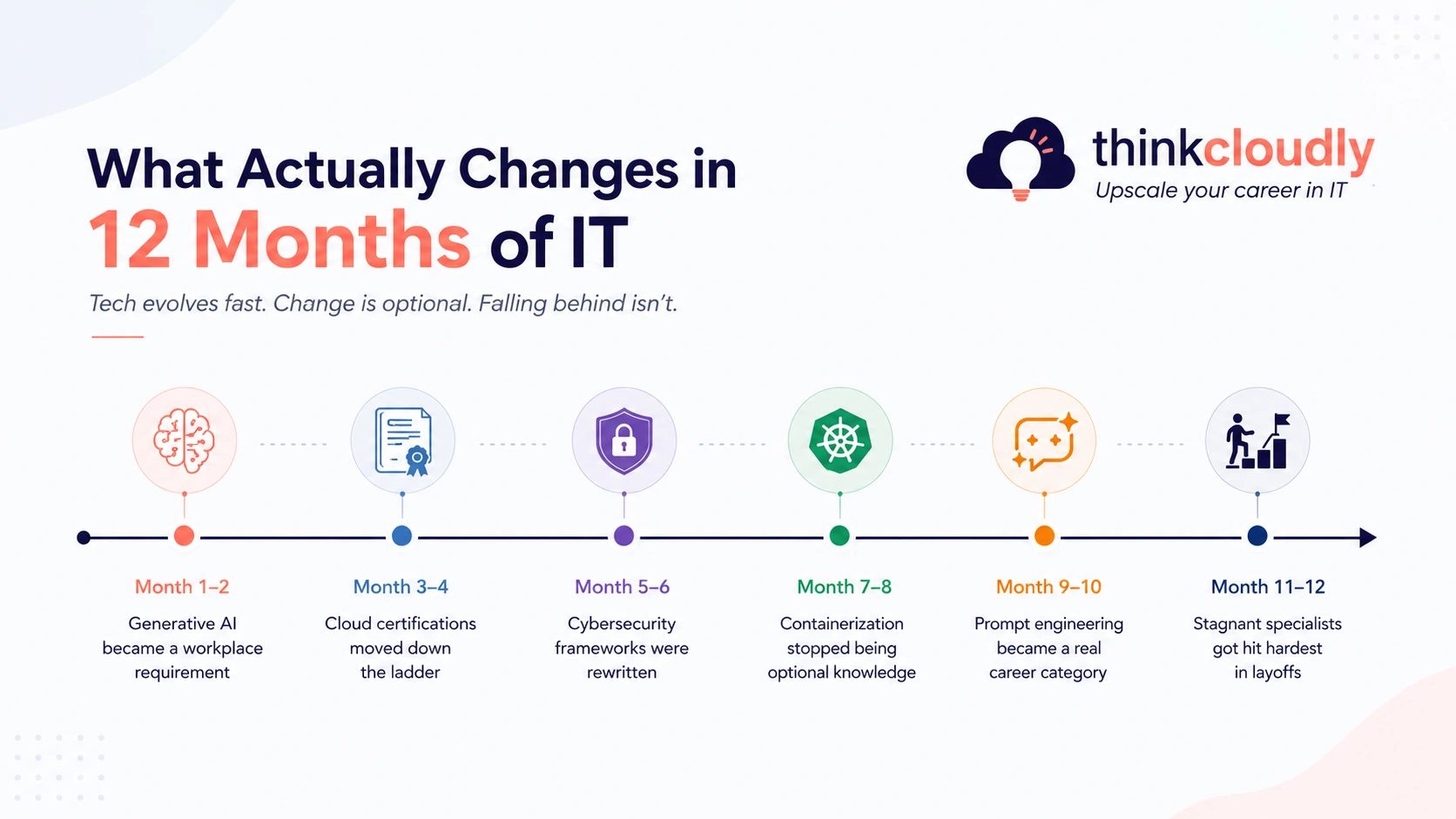
Generative AI became a workplace requirement
Twelve months ago, generative AI was still something most companies were experimenting with cautiously. Today employers are factoring AI tool proficiency directly into hiring decisions. Professionals who spent that year ignoring it are now scrambling to catch up on something that has quietly become a baseline expectation.
Cloud certifications moved down the ladder
Certifications that were considered advanced qualifications for senior roles not long ago have become standard expectations for mid-level positions. If you were not keeping pace, you did not just miss a bonus credential. You fell short of what the market now considers ordinary.
Cybersecurity frameworks were rewritten entirely
Threat landscapes shifted, and the frameworks built to defend against them shifted with them. Security professionals who stopped learning found themselves working from outdated playbooks in an environment where the attacks had already evolved past what they knew.
Containerization stopped being optional knowledge
Kubernetes and containerization moved firmly into the mainstream across development and operations teams. What was once a specialist skill became something teams simply expected engineers to understand without needing to be taught from scratch.
Prompt engineering became a real career category
Prompt engineering went from a phrase nobody used to a recognized skill category appearing on resumes and job descriptions within a single year. That kind of shift does not give anyone advance notice. It just happens, and you are either tracking it or you are not.
Stagnant specialists got hit hardest in layoffs
When the technology sector went through significant rounds of layoffs in recent years, a clear pattern emerged. The professionals most at risk were those whose skills had become narrow and had not been refreshed. The ones who recovered fastest and landed new roles quickest were those who had kept their knowledge both broad and current throughout.
The Salary Reality Nobody Wants to Talk About
Stagnation in IT does not just affect your job security. It hits your earning potential directly.
IT professionals who actively pursue new skills and certifications consistently earn more than those who do not. Cloud computing professionals with current certifications earn significantly above the average for their job category. Cybersecurity professionals with up-to-date credentials in areas like zero-trust architecture or cloud security earn considerably more than those holding only older qualifications.
The gap between a current IT professional and a stagnant one is not subtle. In many specialisms, the salary difference between someone with skills from two years ago and someone with skills from today can run into tens of thousands of dollars annually. Employers pay for current relevance, not for historical competence.
Here is what that looks like across a few common IT roles:
Salary Impact of Staying Current vs. Stagnating in IT (2026)
|
Role |
Current Skills Salary Range |
Stagnant Skills Salary Range |
Approximate Annual Gap |
|
Cloud Engineer |
$130,000 to $165,000 |
$95,000 to $115,000 |
Up to $50,000 |
|
Cybersecurity Analyst |
$115,000 to $145,000 |
$80,000 to $100,000 |
Up to $45,000 |
|
Software Developer |
$120,000 to $155,000 |
$90,000 to $110,000 |
Up to $45,000 |
|
Data Engineer |
$125,000 to $160,000 |
$85,000 to $105,000 |
Up to $55,000 |
|
IT Project Manager |
$110,000 to $140,000 |
$85,000 to $100,000 |
Up to $40,000 |
|
QA Automation Engineer |
$105,000 to $135,000 |
$75,000 to $95,000 |
Up to $40,000 |
|
DevOps Engineer |
$130,000 to $160,000 |
$95,000 to $115,000 |
Up to $45,000 |
The Confidence Problem Nobody Mentions
There is something that happens psychologically when you stop learning in a fast-moving field that does not get talked about enough.
At first, the gap feels manageable. You tell yourself you will catch up eventually. But as months pass and the distance grows, something shifts. You start avoiding conversations where your knowledge gap might show. You stop volunteering for new projects because they involve tools you are not confident in. You become quieter in meetings where newer technologies are being discussed.
This is not laziness. It is a very human response to feeling out of depth. But it creates a compounding problem. The less you engage, the further behind you fall. The further behind you fall, the harder it feels to start again. Many IT professionals who have experienced this describe it as one of the most professionally isolating feelings they have had in their careers.
The professionals who never let it get to that point are not necessarily smarter or more talented. They are simply the ones who treated learning as a non-negotiable part of the job rather than something optional to be done when time allowed.
How Employers Actually See It
Hiring managers in IT are experienced at reading between the lines of a resume. A gap in skill development is not always obvious from job titles and dates, but it shows up in interviews quickly.
When a candidate cannot speak confidently about tools and approaches that have become standard in the past year or two, it raises questions. Not necessarily about their ability to learn, but about their engagement with the field. IT is a profession where intellectual curiosity is expected to be ongoing. Candidates who demonstrate that they have kept up, even imperfectly, even through free resources and personal projects, stand out clearly from those who have not.
Recruiters report that candidates who can show evidence of continuous learning, whether through certifications, personal projects, contributions to open-source work, or even thoughtful posts about industry developments, are significantly easier to place and typically receive stronger offers.
The reverse is equally true. A resume that ends its professional development story two years ago, in a field that changes as rapidly as IT, is a red flag that experienced hiring managers notice immediately.
The Good News: 12 Months Can Also Go the Other Way
Everything described above is real, but here is the other side of it.
Twelve months of intentional, consistent learning in IT can do extraordinary things for a career. It can move someone from a mid-level position to a senior one. It can open doors to specializations that pay significantly more. It can make someone genuinely irreplaceable within their team because they understand both the established systems and the new ones.
The investment required is not as overwhelming as it sounds. Studies on professional development consistently show that even five to seven hours of focused learning per week, maintained consistently, is enough to develop meaningful new competencies within a year. That is less than an hour a day.
The IT professionals who are thriving right now are not the ones who work eighteen-hour days. They are the ones who built learning into their routine the same way they built in exercise or meal planning. Steady, consistent, and non-negotiable.
Where to Start If You Have Already Fallen Behind
If you are reading this and recognizing yourself in some of what has been described, the most important thing to know is that the gap is closeable. People recover from skill stagnation in IT all the time. The key is starting with honesty and a clear plan rather than trying to learn everything at once.
Start by auditing where you are against where the job market currently is. Look at ten job listings for roles you want in the next two to three years. Note every requirement you cannot currently meet. That list becomes your learning roadmap.
Next, pick one thing and go deep before going broad. A half-understood cloud certification is worth less than a genuine, applied understanding of one area of cloud infrastructure. Employers can tell the difference in conversation.
Use free and low-cost resources intelligently. AWS, Google Cloud, and Microsoft Azure all offer free learning tiers. Platforms like Coursera, Pluralsight, and LinkedIn Learning offer structured paths. YouTube has genuinely excellent technical content from practitioners who are in the industry right now.
And tell people about what you are learning. Post about it on LinkedIn. Talk about it with colleagues. Teaching and discussing what you are learning accelerates the internalization of it faster than passive consumption alone ever will.