
Two Scrum Masters, Same Job Title, $70,000 Apart—How Is That Possible?
Picture this: one Scrum Master facilitates standups for two teams at a 50-person SaaS startup and earns $95,000 a year. Another, with a similar job title, coordinates a SAFe release train across four enterprise squads and pulls in $165,000. Same title. Same certification on LinkedIn. Wildly different paycheck.
The discrepancy isn’t a typo—it’s a sign of how broad the range of Scrum Masters’ salaries has really become in 2026. Scrum masters in the United States earned between $99,000 and $162,000 in 2026, with the national average ranging from $108,000 to $126,000, depending on the salary database you choose. If you’re wondering why one job posting says $80K and another says $150K for what seems to be the same work, you’re not crazy — and this blog will explain exactly why.
If you’re thinking about becoming a Scrum Master, questioning if you’re making less than you should as a Scrum Master, or a hiring manager trying to budget in a realistic way, this blog post walks you through the real 2026 numbers—no rehashed 2022 numbers, no vague “competitive salary” language.
Why Do Scrum Master Salaries Vary So Much in 2026?
The role of a Scrum Master sits at an unusual intersection. It’s part facilitator, part coach, part process guardian—and depending on the company, it can mean anything from “junior project coordinator with a fancy title” to “senior agile transformation leader managing multiple scrum teams.” “That ambiguity is exactly why pay varies so dramatically.
According to data compiled in 2026, the typical pay range for a Scrum Master in the United States falls between $99,854 at the 25th percentile and $162,510 at the 75th percentile, based on over 10,000 salary submissions. That’s a massive spread for a single job title—and it tells you that experience, industry, and company size matter far more than the title itself.
The Real Numbers: Scrum Master Salaries by Source (2026)
Because so many salary platforms track this data differently, the numbers don’t always agree. Here’s a consolidated, source-by-source breakdown of average Scrum Master salaries in the United States as of 2026:
|
Source |
Average Annual Salary (2026) |
Typical Range |
|
Glassdoor |
$126,800 |
$99,854 – $162,510 |
|
ZipRecruiter |
$120,688 |
$103,000 – $137,500 |
|
Indeed |
$122,827 |
Varies by location |
|
PayScale (Certified ScrumMaster) |
$107,511 |
$74,000 – $146,000 |
|
ERI SalaryExpert |
$112,477 (+ $3,014 avg bonus) |
$81,356 (entry) – $138,340 (senior) |
|
KORE1 Staffing Guide |
$108,000 – $126,000 (national avg.) |
$99,000 – $162,000 |
Sources: Glassdoor 2026 salary data; ZipRecruiter 2026 compensation report; Indeed career salary index; PayScale CSM salary data; ERI SalaryExpert national averages; KORE1 2026 Scrum Master salary guide.
The takeaway? Don’t anchor your expectations to a single number you saw on one website. The honest range for 2026 is roughly $100,000 to $165,000, with most professionals landing in the $108,000–$135,000 band.
What Actually Moves the Needle on Your Pay?
If you want to understand Scrum Master salaries beyond a single average figure, you need to look at the four forces that actually determine where you land on that range.
1. Experience Level
Experience remains the single biggest predictor of pay. An entry-level Scrum Master with 1–3 years of experience earns an average of $81,356, while a senior-level Scrum Master with 8 or more years of experience earns an average of $138,340 — nearly a 70% jump. On PayScale’s more recent data, a Junior Scrum Master averages $92,546, with a typical range of $64,000 to $126,000, which shows just how much variability even exists within the “junior” bracket itself.
2. Certification
This is where things get genuinely interesting for anyone considering an agile scrum master certification. Certifications aren’t just a resume bullet point — they have a measurable dollar impact. Professionals holding a PSM II certification can earn up to $16,000 more annually than non-certified peers, and additional credentials like SCM, ICP-ACC, and PMI-ACP can boost salaries by as much as $35,000 per year. Separately, PMI’s own salary survey found that PMI-ACP certified professionals earn roughly 20% more than non-certified counterparts, with salaries in some surveys ranging from $122,554 to $163,339.
For those working specifically with scaled agile frameworks, a SAFe Scrum Master certification carries its own premium, particularly at large enterprises running multiple agile release trains—a topic we’ll come back to below.
3. Industry
Not all industries pay the same for identical responsibilities. The top five highest-paying industries for Scrum Masters in 2026 are Aerospace & Defense (median $140,238), Human Resources & Staffing ($138,844), Energy, Mining & Utilities ($137,313), Financial Services ($134,331), and Management & Consulting ($134,170). If you’re chasing the upper end of the salary band, the industry you work in often matters more than the company’s size.
4. Location
Geography still plays a major role, even with remote work normalized. Sixteen U.S. states pay above the national average, with Washington, the District of Columbia, and New York leading the list—New York beats the national average by 9.4%, and Washington exceeds it by 13.3%. At the city level, San Francisco Scrum Masters average $133,016, with a typical range of $97,000 to $160,000, reflecting the Bay Area’s broader tech salary premium.
Certifications That Actually Pay Off in 2026
If you’re deciding which agile scrum master certification to pursue, not all credentials carry equal weight in the market. Here’s where the data points in 2026:
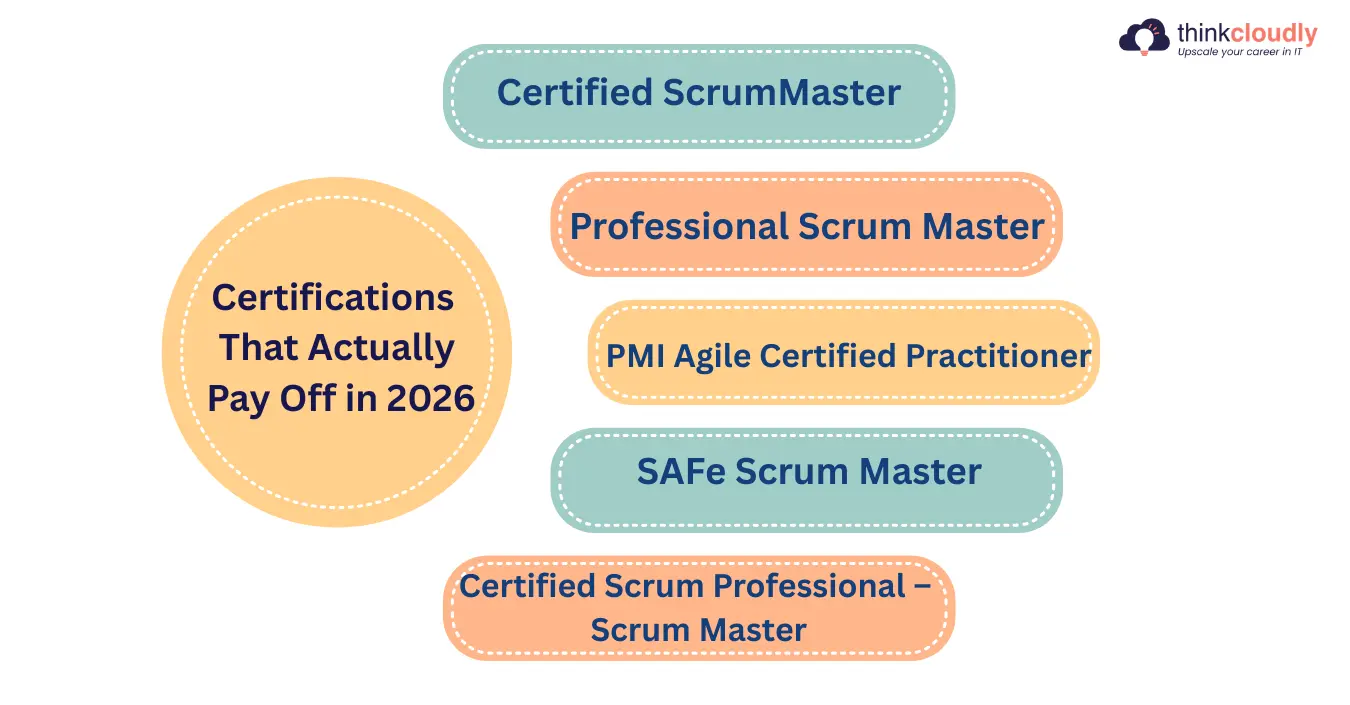
- CSM (Certified ScrumMaster): It is the most popular entry-level certification, with average pay of about $107,511 per PayScale’s 2026 data.
- PSM I/II (Professional Scrum Master): It is becoming increasingly popular with recruiting managers. The exam is tough, and PSM II holders can earn as much as $16,000 more a year than their non-certified counterparts.
- PMI-ACP (PMI Agile Certified Practitioner): It has one of the strongest wage premiums in the data, with average earnings about $123,000 per year and an approximately 20% pay raise above non-certified employment.
- SAFe Scrum Master (SSM) certifications are specifically valuable for professionals working inside large-scale Agile transformation programs, where coordinating multiple teams under the scaled agile framework is the core job requirement rather than a nice-to-have skill.
- Certified Scrum Professional – Scrum Master (CSP-SM): It is an advanced certification with an average salary of around $115,000 across the United States.
A practical note: certification alone won’t move your salary if you don’t pair it with real delivery experience. The data consistently shows that certifications amplify existing experience — they rarely substitute for it.
Why Does Demand for Scrum Masters Keep Climbing?
It’s worth understanding why this role continues to command strong pay, because the underlying market trend explains a lot about future salary trajectory.
Agile methodology adoption has moved well beyond software teams. According to industry tracking, the use of SAFe for large-scale agile transformations climbed from 37% in 2021 to an anticipated 53% by 2025—meaning more than half of enterprises running agile at scale now rely specifically on the framework that created the SAFe Scrum Master role in the first place.
“This isn’t a niche trend limited to tech. Market data validates this at scale: the global enterprise agile transformation services market is valued at $8.92 billion in 2026 and is expected to reach $21.21 billion by 2035, at a CAGR of 10.1%. A whopping 78% of companies with 1,000 or more workers have already implemented at least one formal agile framework in three or more business units—a clear signal that demand for skilled Scrum Masters isn’t going away anytime soon.
This growth connects directly to the broader concept of business agility—an organization’s capacity to sense market change and respond quickly without losing momentum. As more companies chase that capability, the professionals who facilitate it (Scrum Masters, agile coaches, and release train engineers) become correspondingly more valuable, which is part of why pay for the role has held steady rather than declined despite a broader tech hiring slowdown.
Four Practical Ways to Increase Your Scrum Master Earning Potential
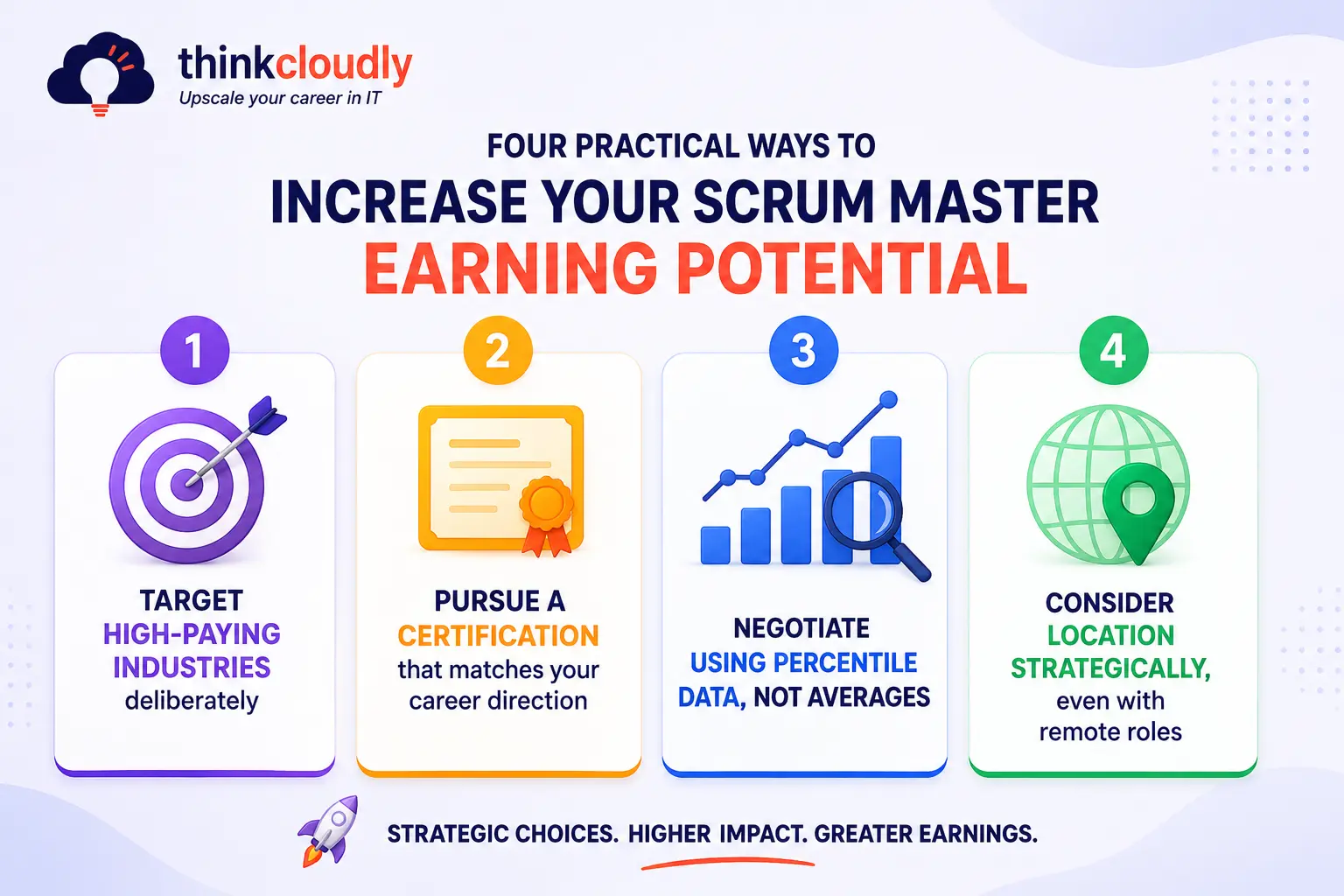
If you’re already in the role—or hoping to be—here are four specific, research-backed actions that impact where you’ll land on the Scrum Master salary spectrum:
- Target high-paying industries deliberately: Aerospace & Defense, Financial Services, and Energy & Utilities all pay above the national median, again and again. A lateral shift into one of these industries can be more valuable than a promotion within a lower-paying field.
- Pursue a certification that matches your career direction: If you are targeting enterprise-level responsibilities, a SAFe Scrum Master certification is designed to get you into large-scale transformation efforts. If you are looking for broader project leadership credibility, PMI-ACP has one of the strongest recognized salary premiums.
- Negotiate using percentile data, not averages: When negotiating salary, quote the 75th percentile salary statistics (about $137,500-$162,000)—not the national average—especially if you have 5+ years of experience or numerous certifications.
- Consider location strategically, even with remote roles: For remote jobs, companies in high-paying states (Washington, New York, California) sometimes still have location-based pay bands. If you know where a company is based, it helps you know how to negotiate.
A Quick Note on Global Perspective
While this guide is mostly focused on U.S. data (which accounts for most of the accessible wage data), it’s worth noting that the need for Scrum Masters is a global phenomenon. The U.S. market is pushing the same business agility goals that organizations everywhere are chasing, propelling Agile methodology and scaled Agile adoption across Europe, Asia-Pacific, and the Middle East. If you are considering prospects elsewhere in the world, you will see lower base numbers proportionally but typically similar percentage premiums for qualification and experience—the same underlying patterns tend to be there even when the baseline currency and cost of living are different.
Conclusion: What This Means for You
The honest answer to “how much can you really earn as a Scrum Master in 2026?” is not a number, but a range that depends on your experience level, your credentials, the industry you’re working in, and where you’re located. According to the research, Scrum Master salaries range from about $81,000 for entry-level experts to more than $160,000 for senior, certified Scrum Masters in high-paying industries or large metro areas.
If you’re starting out, the quickest lever you can pull is certification with actual delivery experience, not simply certification. If you are more senior, your best bet is probably to go into industries or SAFe Scrum Master roles that are associated with large-scale Agile transformation programs, where enterprise finances and complexity both drive remuneration upwards. Either way, the first step to negotiating what you’re genuinely worth is to know where you are on this range—not anchoring to one average.
Sources
- Glassdoor — Scrum Master: Average Salary & Pay Trends 2026 (June 2026)
- ZipRecruiter — Scrum Master Salary: Hourly Rate (June 2026)
- Indeed—Scrum Master Salary in United States (Updated 2026)
- ZipRecruiter — Entry-Level Scrum Master Salary (May 2026)
- ERI SalaryExpert — Scrum Master Salary in the United States (2026)
- PayScale — Certified ScrumMaster (CSM) Salary (Jan 2026)
- KORE1 — Scrum Master Salary Guide 2026: Pay by Experience
- PayScale — Average Junior Scrum Master Salary (2026)