


Here’s a number that stopped me mid-scroll: over 14,000 ServiceNow-related job openings were listed on LinkedIn in the United States alone this year, and the platform now runs mission-critical workflows inside 85% of the Fortune 500. So why do so many people still finish a course, print a certificate, and then sit through months of silence from recruiters?
The honest answer is that most people take the wrong kind of ServiceNow developer training—the kind built to sell seats, not to build hireable skills. I’ve watched this happen to friends, and I’ve made a few of the same mistakes myself. This blog walks through what actually works in 2026, backed by current salary data, real certification requirements, and one story from my own path into this field.
Why ServiceNow Developer Training Is Worth Your Time in 2026?
Let’s deal with the money question first, because it’s usually the real reason anyone considers a career in ServiceNow in the first place. According to 2026 data, the average ServiceNow developer in the United States earns $124,681 a year, with top earners crossing $185,000.
July 2026 figures put the national average slightly higher at $129,281, with senior professionals in cities like Berkeley and Sunnyvale earning well above that. Even junior developers, fresh out of training, are pulling in close to $89,000 a year according to the same source. That’s not a “someday” career. That’s a realistic outcome for people who finish the right ServiceNow developer training within a year.
Here’s a simple snapshot of what the current market looks like:
|
Role Level |
Average U.S. Salary (2026) |
Typical Certification Held |
|
Junior Developer (0–2 yrs) |
$85,000–$110,000 |
CSA |
|
Mid-Level Developer (3–5 yrs) |
$110,000–$145,000 |
CSA + CAD |
|
Senior Developer (5+ yrs) |
$145,000–$185,000 |
CAD + CIS |
|
Business Process Consultant |
$180,000–$250,000 |
CAD + domain specialism |
Becoming a certified developer isn’t just about the badge sitting on your LinkedIn profile—it’s proof that a company can hand you production work without hand-holding. The reason this matters is scale. Indeed’s 2026 wage data, drawn from job postings over the past three years, shows a national average of roughly $62.64 an hour for the role—and that’s before you factor in remote flexibility, which most ServiceNow roles offer.
Demand isn’t slowing down either. Hiring leaders at ServiceNow itself describe “double-digit growth” in demand across Europe alone, with the platform expanding well past its original IT roots into HR, CRM, and creator workflows. That expansion is exactly why the smartest ServiceNow developer training programs teach more than scripting—they teach the business logic behind it.
What Does Good ServiceNow Developer Training Actually Cover?
A lot of course marketing throws around the phrase “learn ServiceNow” without explaining what that even means. Real training, the kind that leads to a job offer, has to move you through four connected layers: the platform’s data model, its scripting environment, its automation tools, and its security architecture.
If your course skips any one of these, you’ll pass a quiz but freeze in an interview. Put simply, if you want to learn ServiceNow in a way that survives a real interview, video playback alone won’t cut it.
Here’s what a genuinely complete curriculum needs to include, broken into the skill areas employers actually test for:
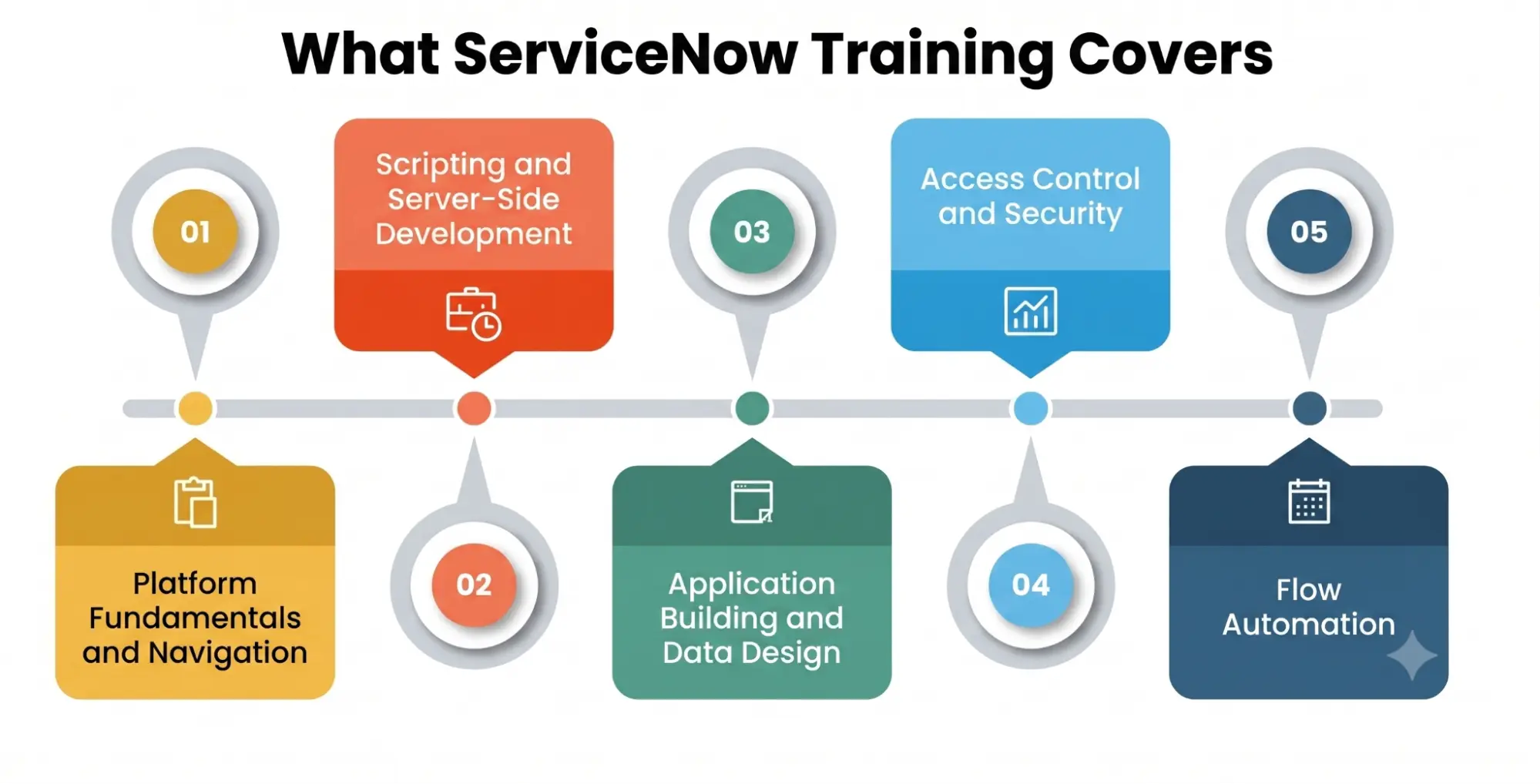
1. Platform Fundamentals and Navigation
- Understanding tables, records, and the Configuration Management Database (CMDB)
- Navigating scoped applications versus global scope
- Learning the difference between the various ServiceNow modules (ITSM, ITOM, HRSD)
2. Scripting and Server-Side Development
- GlideRecord and GlideSystem APIs
- Business Rules, Script Includes, and Scheduled Jobs
- Client Scripts and UI Policies using g_form and g_user
3. Application Building and Data Design
- Designing custom tables and relationships
- Building forms, lists, and UI Actions
- Import Sets, Transform Maps, and REST/SOAP integrations
4. Access Control and Security
- Access Control Lists (ACLs) and cross-scope security
- Application Access settings
- Testing fundamentals and debugging patterns
5. Flow Automation
- Flow Designer basics and advanced triggers
- Replacing legacy workflows with modern flow logic
- Connecting automations to external data sources
This is precisely the material tested on the ServiceNow (CAD) exam blueprint, which ServiceNow itself maintains and updates with every platform release. If your training doesn’t map to this structure, you’re studying the wrong material, no matter how polished the course looks, and it won’t turn you into a genuinely certified developer.
CSA vs. CAD: Choosing Your First Certification
Almost everyone starting a career in ServiceNow asks the same question: should I start with the CSA or go straight for CAD? The answer depends on where you’re standing today, but the general path is well established across the industry.
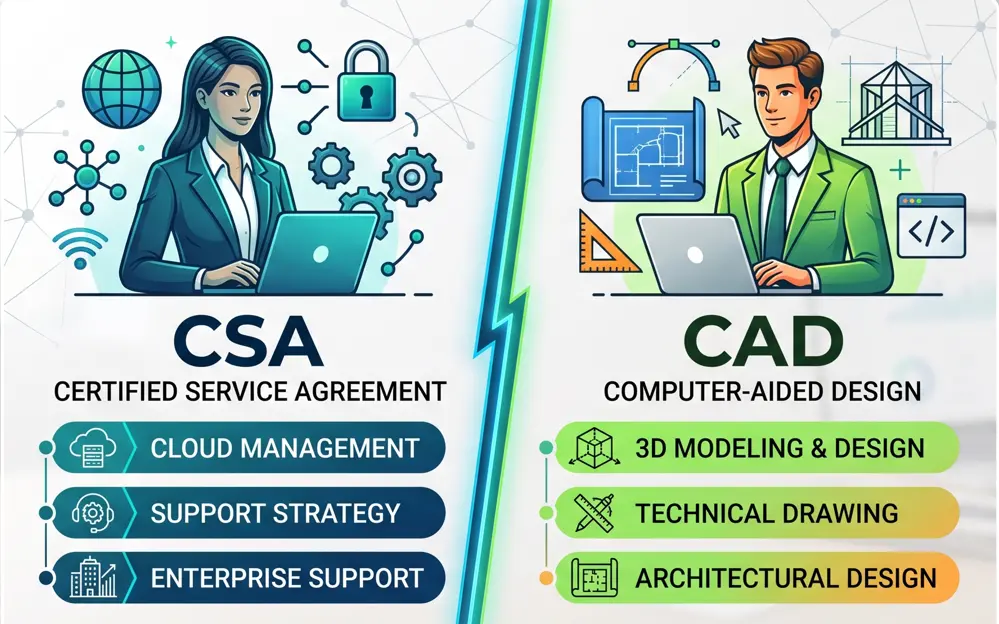
The Certified System Administrator (CSA) exam is the entry point. It tests your understanding of platform navigation, basic configuration, user administration, and core ITSM processes. Most training providers and recruiters treat CSA certification as the baseline credential—it proves you can operate inside the platform, even if you’re not yet writing complex code. Employers hiring junior staff for a career in ServiceNow frequently list CSA certification as a minimum requirement, even for roles that aren’t purely administrative.
The Certified Application Developer (CAD) exam is the harder, more technical step up. It consists of 60 questions across data modeling, scripting, security, and integrations, with a voucher currently priced around $300–$450 depending on your provider and region as per ServiceNow certification guides.
Passing the CAD certification is what separates someone who can configure ServiceNow from someone who can genuinely build on it. Most job listings for mid-level and senior developer roles now explicitly ask for CAD certification, and recruiters use it as a fast filter when a role has hundreds of applicants.
If you’re serious about becoming a certified developer, the practical order is almost always: learn the fundamentals, sit for the CSA, gain six months of hands-on scripting experience, and then attempt CAD. Skipping straight to CAD without hands-on practice is the single most common reason candidates fail on their first try—the exam is scenario-based, not memorization-based, and it punishes people who never actually built anything.
In short, no single ServiceNow certification guarantees a job on its own, but stacking CSA and CAD in the right order dramatically improves your odds.
A Personal Note: What My Own Training Path Looked Like
I’ll be honest about my own experience, because I think it’s more useful than another generic checklist. When I started, I picked a course purely because it was cheap and had a shiny “certified developer” badge in the thumbnail. Three weeks in, I realized it barely touched Flow Designer or ACLs—two things that came up in almost every interview I later sat for.
I switched to a program that forced me to actually learn ServiceNow through building, not watching, including a working approval workflow with GlideRecord scripting and a custom UI Action. That single project became the centerpiece of my portfolio and the first thing every interviewer asked me to walk through.
My CSA certification got me interviews. My hands-on project, not just my CAD certification, is what got me the offer. If there’s one lesson from that stretch of my career, it’s this: employers don’t hire your certificate; they hire what you can prove you built with it.
How to Learn ServiceNow the Smart Way in 2026?
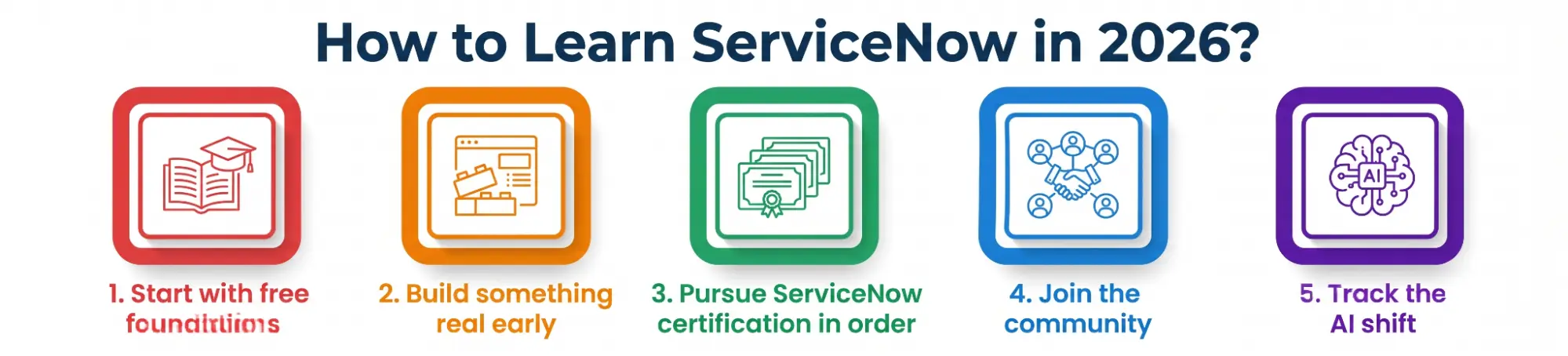
If you want to learn ServiceNow efficiently rather than slowly, structure matters more than course length, especially if your goal is to become a certified developer within a year. Here’s a realistic sequence:
-
Start with free foundations. ServiceNow’s own Now Learning platform offers free introductory courses that cover platform basics before you spend a cent.
-
Build something real early. Don’t wait until “you know “enough”—create a scoped application in a personal developer instance within your first two weeks.
-
Pursue ServiceNow certification in order. CSA first, then CAD, then a specialist CIS credential—employers view this sequence as the standard proof of a serious career in ServiceNow.
-
Join the community. ServiceNow’s developer forums and local user groups are where actual hiring managers often post roles before they hit job boards.
-
Track the AI shift. ServiceNow’s Now Assist and agentic AI tooling are increasingly part of technical interviews, so any current ServiceNow developer training should include at least an introduction to these features.
Common Mistakes That Keep People From Getting Hired
Even strong candidates hoping to build a lasting career in ServiceNow stall out for avoidable reasons, and it usually isn’t a lack of ServiceNow developer training—it’s how they used it. The most common ones I’ve seen, both in myself and in people I’ve mentored:
- Treating certification as the finish line instead of the starting line
- Never building a portfolio project outside of course exercises
- Ignoring the business side of the platform and focusing only on code
- Applying only to “ServiceNow Developer” titles instead of related roles like Platform Analyst or Application Support Engineer
- Letting a ServiceNow certification lapse without staying current on new platform releases
Conclusion
The data is fairly blunt: demand for skilled professionals is real, salaries are climbing, and the platform keeps expanding into new business areas every year. But none of that guarantees you a job by itself. What actually gets you hired is ServiceNow developer training that forces you to build, break, and fix real applications—not just memorize exam objectives.
Start with the fundamentals, earn your CSA certification, put in the hands-on hours, and let your CAD certification prove what you can already do. Treat every ServiceNow certification as a milestone, not the finish line. That combination, more than any single credential, is what turns a course completion into an actual offer letter.
Sources:
-
Glassdoor – ServiceNow Developer Salary 2026
-
ZipRecruiter – ServiceNow Developer Salary, July 2026
-
PayScale – ServiceNow Developer Salary 2026
-
Indeed – ServiceNow Developer Salaries
-
ServiceNow University – CAD Certification Learning Path
-
NowBen – Is ServiceNow Still a Good Career Choice in 2026?