
There is a particular kind of disorientation that comes with being laid off from a technology company in 2026 that did not exist in the same way five years ago.
Update your resume, lean on your network, apply to similar roles at competing companies, and wait out the cycle. The skills that got you hired before would get you hired again. The market would recover, and when it did, people who had done good work would find their way back without fundamentally changing what they did.
The people discovering that in real time, after receiving a layoff notification they did not see coming, are dealing with something more complicated than a temporary setback in a familiar market.
This is not just a story about job loss. It is a story about what happens when an industry restructures faster than individuals can adapt and what the people caught in that transition can realistically do about it.
Why Does This Layoff Wave Feel Different From Previous Ones?
Every technology downturn produces layoffs. The dot-com crash of 2001. The financial crisis of 2008. The post-pandemic correction of 2022 and 2023. Each of those cycles followed a recognizable pattern: companies over-hired, growth slowed, headcount was reduced, the market recovered, and hiring resumed.
The 2026 wave has a different character, and the difference matters for understanding what comes next.
Previous layoffs were primarily cyclical. They happened because companies had hired ahead of revenue and needed to bring costs in line with reality. The roles that were eliminated were largely the same roles that would be needed again when conditions improved. The people laid off were generally employable in the same function at a different company.
The 2026 cuts are partly cyclical and partly structural. The cyclical portion, over-hiring in consumer technology, digital advertising, and mid-management, follows the familiar pattern. But the structural portion is something else. Roles built around repetitive, predictable execution are being eliminated not because business slowed down but because AI tools have reduced the human labour required to perform them. Those roles are not coming back when the market recovers. They are being replaced by smaller teams using more capable tools.
According to Challenger, Grey and Christmas’s 2026 Job Cuts Report, the technology sector eliminated approximately 92,000 positions in the first half of 2026. Of those, an estimated 40 percent were in functions where automation had meaningfully reduced the workload, according to analysis by the McKinsey Global Institute. That is not a temporary reduction waiting for conditions to improve. It is a permanent reduction in the volume of human work required for those specific functions.
The Psychological Reality Nobody Talks About
With a cyclical layoff, the narrative you can tell yourself is relatively intact. The company overhired. The market corrected. It is not about your performance. You will find something similar and move forward.
With a structural layoff, that narrative has a complication built into it. The role is not waiting for you somewhere else. The market you trained for is not the market you are entering.
The American Psychological Association’s 2025 Workplace Stress Report identified technology sector layoffs as producing measurably higher levels of prolonged anxiety than layoffs in other sectors, partly because of this structural ambiguity. When people cannot identify a clear path back to what they were doing, the psychological recovery takes longer than when the path is clear.
Understanding that this experience is distinct is not an excuse to avoid moving forward. It is a prerequisite for moving forward in the right direction, which is different from the direction that got you to this point.
What the Market Looks Like From the Outside
The cruel irony of the 2026 technology job market is that it contains both record layoffs and a record number of unfilled positions simultaneously.
CompTIA’s State of the Tech Workforce 2026 report documents 275,000 open technology roles in the United States alone, sitting unfilled because the skills required are genuinely scarce relative to demand. Organizations are struggling to find qualified candidates in AI engineering, cybersecurity, cloud architecture, data privacy engineering, and AI governance. Salaries in these categories are rising even as overall technology employment contracts.
The people being laid off and the people being competed over are largely not the same people. The laid-off population is concentrated in roles where automation reduces workloads. The competing-over population has skills in areas where automation created new needs rather than reducing them.
That gap represents both the problem and the opportunity for someone navigating a technology layoff right now.
Where the Open Roles Actually Are?
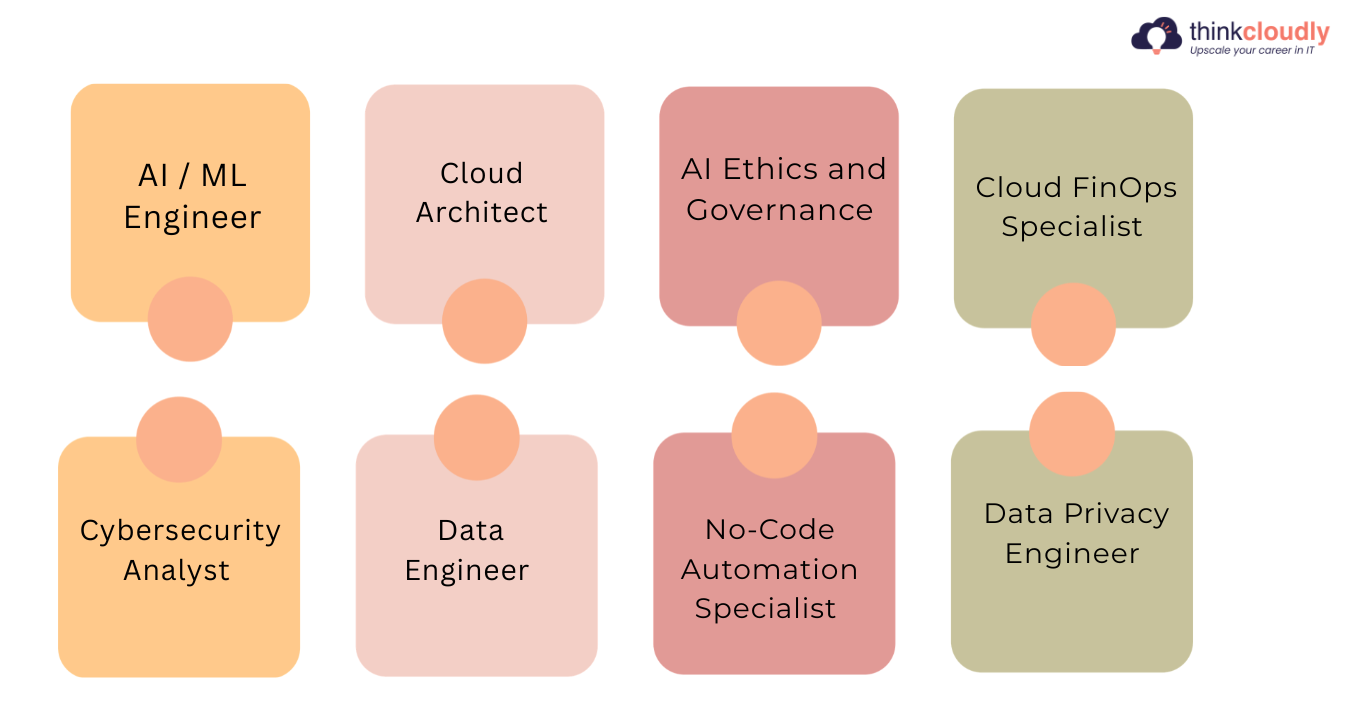
|
Role Category |
Open Positions (US) | Avg. Salary Range | Time to Qualify |
| AI / ML Engineer | 47,000+ | $115,000 – $160,000 |
12 – 18 months |
|
Cybersecurity Analyst |
38,000+ | $85,000 – $120,000 | 6 – 12 months |
|
Cloud Architect |
31,000+ | $120,000 – $165,000 |
9 – 15 months |
| Data Engineer | 29,000+ | $95,000 – $135,000 |
6 – 12 months |
|
AI Ethics and Governance |
18,000+ | $95,000 – $145,000 | 6 – 12 months |
|
No-Code Automation Specialist |
16,000+ | $70,000 – $100,000 | 3 – 6 months |
| Cloud FinOps Specialist | 14,000+ | $90,000 – $125,000 |
2 – 4 months |
| Data Privacy Engineer | 14,000+ | $90,000 – $130,000 |
9 – 15 months |
The time to qualify column is worth paying attention to. Several of the most accessible roles, Cloud FinOps Specialist and No-Code Automation Specialist, have realistic qualification timelines of two to six months for people coming from adjacent backgrounds. These are not roles that require starting from scratch. They require redirecting existing competencies toward a market that currently needs them.
The Practical Path Forward
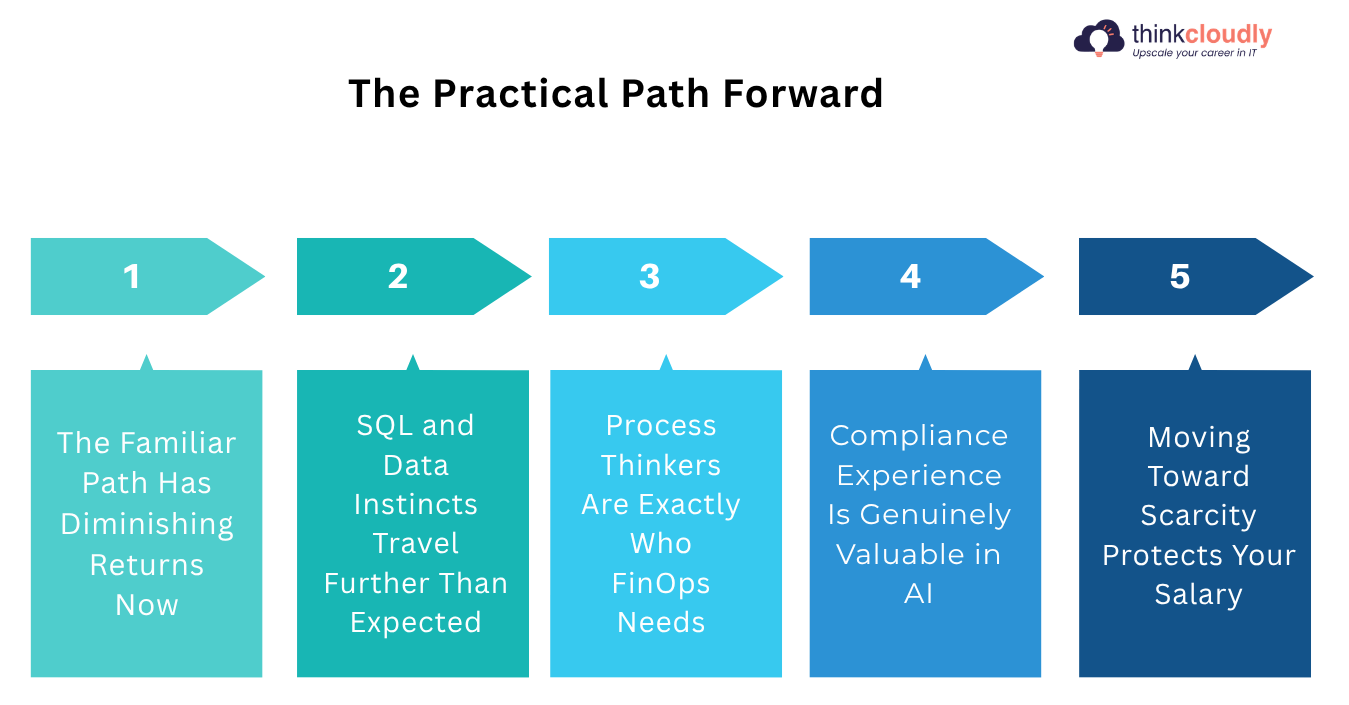
The Familiar Path Has Diminishing Returns Now
Most people leaving a technology role under pressure do the same thing first. They apply to similar roles at different companies, lean on their existing network, and try to replicate the career they had as quickly as possible. Sometimes that works. When the layoff is cyclical and the role category is healthy, it is often the right call. But when the shift is structural and the category itself is contracting, applying more aggressively to similar roles produces diminishing returns rather than faster results. The more useful starting point is an honest inventory of which existing skills transfer toward categories where the market is genuinely short of people.
SQL and Data Instincts Travel Further Than Expected
Data analysts sitting with a layoff notice often assume the jump to data engineering is larger than it is. It is not small, but it is manageable with the right focus. SQL proficiency is a genuine foundation. Familiarity with how datasets are structured and how data flows through systems is directly relevant. The gaps, pipeline design, BigQuery or Spark experience, and certification can be closed in six to twelve months of consistent effort. The skills built in a data analysis career are not starting over material. They are a foundation that the market is actively looking for people to build on.
Process Thinkers Are Exactly Who FinOps Needs
Cloud FinOps and No-Code Automation are two of the most accessible categories for people coming from project management and operations backgrounds. The FinOps Foundation’s Certified FinOps Practitioner credential takes six to eight weeks and opens real doors. No-code platforms like Make and Zapier are built for people who understand how work flows through an organization, which is precisely the skill that operations and project management careers develop. The technical requirement is lower than the category name implies.
Compliance Experience Is Genuinely Valuable in AI
AI Ethics and Governance is growing faster than the training pipeline can supply candidates for it, and the people being hired into these roles are not all coming from engineering backgrounds. They are coming from law firms, government agencies, compliance departments, and policy organizations. The World Economic Forum’s Future of Jobs Report 2025 is specific about this: AI governance values legal and regulatory expertise as much as technical knowledge. Someone who spent years working out how regulations apply to complex systems in finance or healthcare has already developed the core professional skill that this category needs. The technology context is learnable. The regulatory thinking is the hard part.
Moving Toward Scarcity Protects Your Salary
The financial anxiety that drives people toward familiar roles after a layoff is understandable, but the data suggests it may be pointing in the wrong direction. Robert Half’s 2026 Technology Salary Guide found that professionals who transition into growing categories within twelve months of a structural layoff typically land at compensation equal to or above what they were earning before. The mechanism is not complicated. Categories where demand exceeds supply pay more than categories where supply exceeds demand. Moving toward where the market is short of people, even with a transition period built in, produces better financial outcomes than competing for roles in categories where the market already has enough candidates.
What Nobody Tells You in the First Week
Updating LinkedIn to show “open to work.” Reaching out to former colleagues. Applying to roles that look similar to the one that was just eliminated.
None of that is wrong. Some of it is genuinely useful, particularly the network activation, which remains one of the most effective job search tools regardless of market conditions. LinkedIn’s own data suggests that approximately 70 percent of jobs are filled through networking rather than through direct applications.
But the thing that the first week rarely produces is the harder question: whether the role that was just eliminated is the role worth trying to get back to, or whether the layoff is an involuntary but potentially useful push toward a different direction.
The technology industry is not done restructuring. The skills that are scarce today will have more supply in two years as training programs catch up. The window for entering growing categories before competition increases is not permanent. Moving deliberately toward where the market is heading, rather than where it has been, is the most durable response to a structural disruption that most current job search advice is not yet accounting for.
Sources and References
- Challenger, Gray and Christmas: 2026 Job Cuts Report
- CompTIA: State of the Tech Workforce 2026
- LinkedIn Economic Graph: Jobs on the Rise 2026
- McKinsey Global Institute: The Future of Work After AI 2025
- American Psychological Association: Workplace Stress Report 2025
- World Economic Forum: Future of Jobs Report 2025
- Robert Half: 2026 Technology Salary Guide
- US Bureau of Labor Statistics: Computer and Information Technology Occupations
- FinOps Foundation: State of FinOps 2026
- Consumer Financial Protection Bureau: Financial Recovery After Job Loss
- Stanford Institute for Human-Centered AI: AI Index Report 2026
- ISC2: Cybersecurity Workforce Study 2024