

You search for help with a coding problem. You find a Stack Overflow answer. It has 800 upvotes. You follow the steps. Nothing works.
Sound familiar?
This happens to beginners and experienced developers every single day. The internet is packed with coding tutorials, YouTube videos, and forum answers — but a huge chunk of it was written for technologies that have changed, been updated, or simply don’t exist anymore in the same form.
In 2026, this is one of the biggest silent problems in learning to code. And most people don’t even realize it’s happening to them.
Why So Much Coding Advice Online Is Old
The web does not delete itself. A tutorial written in 2016 sits right next to one written last month. Search engines rank pages based on many things—relevance, backlinks, and traffic—but not always how recent or accurate the information is.
This means someone looking up “how to build a login page in React” might land on an article using React class components, a pattern the React team itself has moved away from in favour of functional components and hooks. The article might look professional, have great formatting, and still teach you something that React developers today would consider outdated.
The same thing happens across every language and framework. JavaScript guides from the early 2010s still circulate, teaching patterns that modern JavaScript has replaced with cleaner, safer ways of doing things.
The Stack Overflow Problem
Stack Overflow is one of the first places developers go when they’re stuck. It has been around since 2008 and has an enormous archive of questions and answers.
But here is the issue—many of the most upvoted answers are old. They were written for older versions of libraries, frameworks, or languages. The voting system tends to preserve those answers at the top because they collected thousands of votes years ago when the information was correct.
A developer today might follow a highly voted answer and spend hours confused about why their code won’t run, only to discover the method mentioned in the answer was deprecated two major versions ago.
Stack Overflow has made efforts to address this, but the volume of old content is simply massive. It cannot all be updated overnight.
Tutorials Written for Older Versions
This problem goes beyond forums. Many of the most popular coding tutorial websites and YouTube channels published their best content three to five years ago. Some of that content still ranks at the top of Google.
Framework updates happen fast. Node.js, Django, Laravel, Flutter — all of these release major updates regularly. A tutorial for “building a REST API with Express” from 2019 might skip important security practices that were introduced in later versions. A beginner following that tutorial has no way of knowing what’s missing.
Even official documentation sometimes lags. Libraries release updates faster than their docs can keep up. This creates a gap where the real behaviour of a tool and what is written about it are not the same thing.
AI Tools Are Changing Things — But Not Always for the Better
AI coding assistants have exploded in popularity. Tools like GitHub Copilot, ChatGPT, and others now help developers write code faster. But these tools are also trained on data that has a cutoff date.
That means an AI assistant might suggest code using an older API, a deprecated function, or a library that has since been replaced. The suggestion looks correct and confident, but it is based on training data that may not reflect how things work today.
Developers who are new to coding are especially vulnerable here. They don’t yet have the instinct to question whether a suggestion is current. They trust the AI, run the code, and then spend hours figuring out why nothing works.
This is not a reason to avoid AI tools — they are genuinely helpful. But it is a reason to understand their limits.
Old Advice vs. Current Practice
|
Topic |
What Old Tutorials Say |
What’s Current in 2026 |
|
React components |
Use class components |
Use functional components with hooks |
|
Python version |
Python 2 syntax is still common online |
Python 3 is standard; Python 2 is retired |
|
CSS layout |
Use floats for layout |
Use Flexbox or CSS Grid |
|
JavaScript async |
Use callbacks |
Use async/await |
|
Package security |
Install freely; check later |
Audit dependencies from the start |
Why This Slows Down Learners More Than Experts
An experienced developer who hits a wall usually knows to check the version number first. They’ll look at the docs, check the changelog, and figure out what changed.
A beginner doesn’t have that instinct yet. They follow instructions step by step. When something breaks because of outdated advice, they assume they are the problem. They think they made a mistake. They lose confidence.
This is one of the most damaging effects of outdated coding content—it makes people feel like they can’t code, when really they just followed instructions that no longer apply.
5 Ways to Spot Outdated Coding Advice
Before you spend hours following a tutorial or forum answer, run through these five checks:
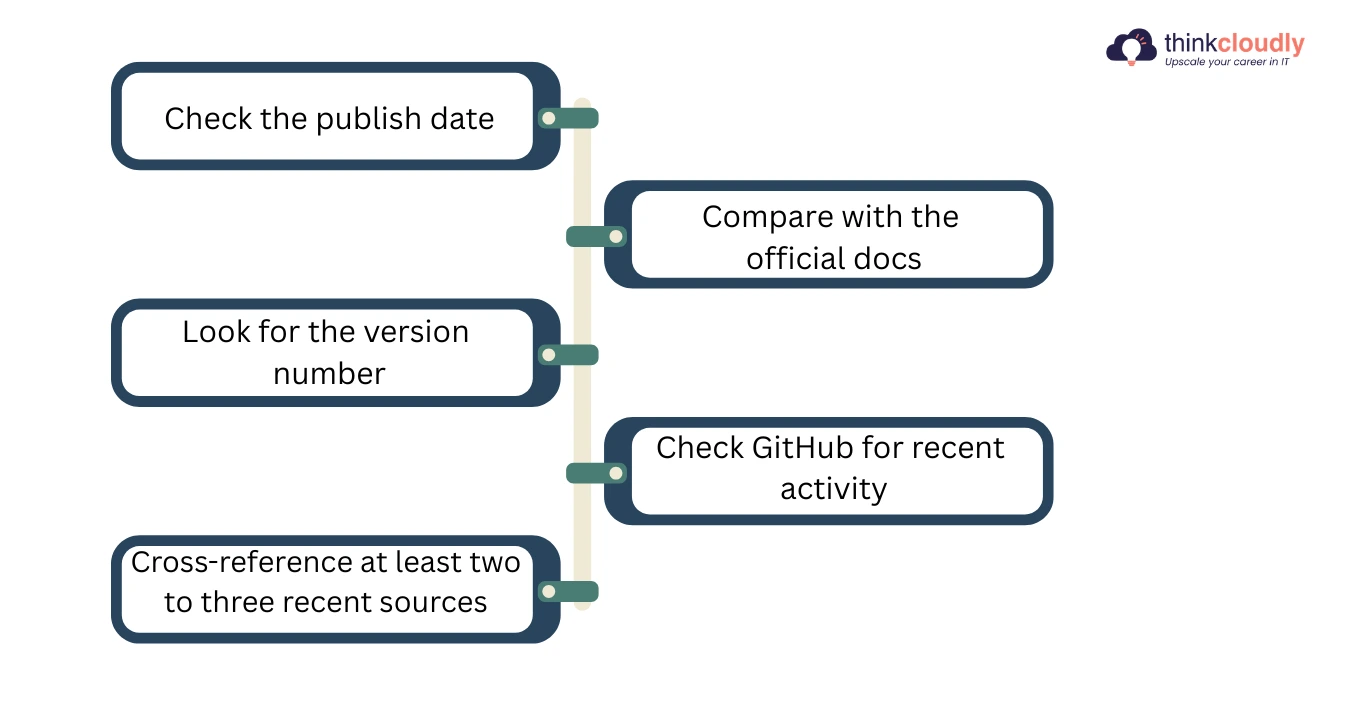
- Check the publish date—If the article is more than two years old and covers a fast-moving technology, treat it with caution before following any steps
- Look for the version number—If a tutorial mentions “Django 2.0” and the current version is Django 5.x, there are likely significant differences in how things work today
- Compare with the official docs—Open the official documentation for that technology and verify the method or syntax actually exists in the current version
- Check GitHub for recent activity—If the library or tool hasn’t had a commit or update in two years, it may no longer be actively maintained
- Cross-reference at least two to three recent sources—If multiple independent sources published recently say the same thing, you’re on solid ground
Where to Actually Learn Coding in 2026
Not all online resources age the same way. These are the ones that stay current:
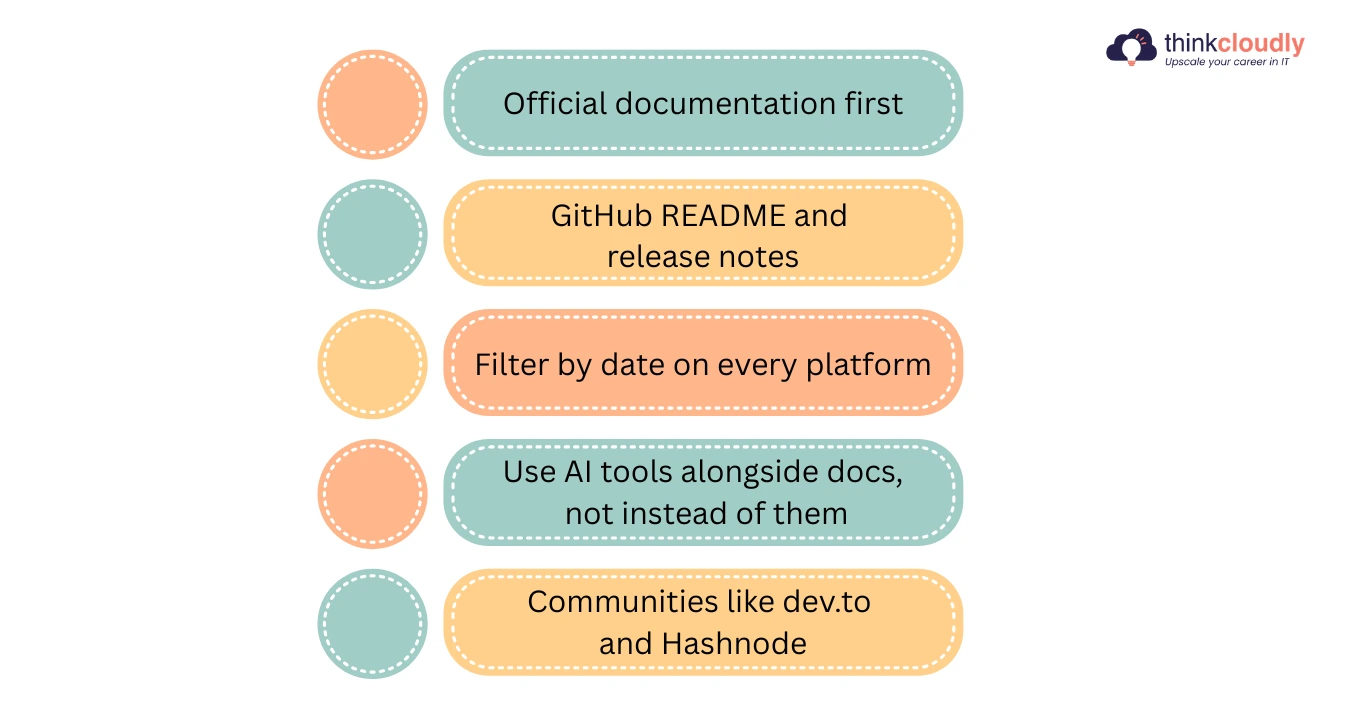
- Official documentation first—MDN Web Docs for JavaScript, Python.org for Python, React.dev for React—these are maintained alongside every release and are the most accurate source of truth
- GitHub README and release notes—The actual source code of a library tells you exactly how it works today, not how a tutorial from four years ago thought it worked
- Filter by date on every platform—Sort by newest, not most popular. A recent article with fewer views often beats a viral one from 2019
- Use AI tools alongside docs, not instead of them—AI coding assistants are useful, but always verify their suggestions against the current official documentation
- Communities like dev.to and Hashnode—These tend to publish fresher, more current content than older content farms that stopped updating years ago
What This Means for People Learning to Code in 2026
The cost of outdated advice is not just wasted time. It can set you back weeks, make you question your ability, and lead you to learn bad habits that take time to unlearn.
The problem is structural. The internet rewards popular content, not content that is accurate or current. Until that changes, the responsibility falls on the learner to be a little skeptical, to check dates, to verify versions, and to build the habit of going to primary sources.
That might sound like extra work at the start. But it saves enormous time down the line. Learning to question your sources is actually a core developer skill, not just a good habit.
The Bottom Line
Most online coding advice is not bad advice — it was just written for a different time. The internet is a snapshot of every era of software development stacked on top of itself. Learning to navigate that is part of what it means to become a developer today.
If you’re learning to code right now, don’t give up when something doesn’t work. Check the date. Check the version. Check the official docs. The problem is probably not you.
Sources & Further Reading
The data and statistics in this article are drawn from the following sources:
- React Official Documentation — Hooks Introduction — Basis for the claim that React has moved from class components to functional components with hooks.
- Python.org — Python 2 End of Life Announcement — Supporting reference for the claim that Python 2 has been officially retired.
- MDN Web Docs — CSS Flexbox — Supporting the claim that Flexbox and CSS Grid are the current standard for layout, replacing float-based approaches.
- Stack Overflow Blog — State of Developer Tools — General reference for Stack Overflow’s scale and the challenges of maintaining answer quality over time.
- GitHub Copilot Documentation — Understanding Suggestions — Reference for understanding how AI coding tools generate suggestions based on training data with a knowledge cutoff.
- MDN Web Docs — Async/Await — Reference for the shift from callback-based JavaScript to async/await patterns.
- Node.js Release Schedule — Supporting the broader point about how frequently major frameworks and runtimes release updates.
All sources are globally applicable and reflect the current state of web and software development practices as of 2026.