
Here’s a number that should stop you in your tracks: AWS cloud engineers in the United States now earn an average of $140,875 per year — and the top 10% cross $200,000. Cloud skills consistently rank as the #1 most in-demand technical capability in the global job market. If you’ve been sitting on the fence about a cloud career, 2026 may be the year you regret waiting.
Whether you’re a student, an IT professional ready to level up, or a career changer—this guide is built for you. We cover what an AWS cloud engineer does, what skills and certifications you need, what the job market looks like, and how to map a realistic path to your first role.
And if you already know you want to specialize in data pipelines and analytics, our AWS Data Engineering Training Course gives you a structured, job-focused path into one of the highest-paying corners of cloud engineering.
Let’s get into it.
What Is an AWS Cloud Engineer?
An AWS cloud engineer designs, deploys, secures, and optimizes cloud infrastructure on Amazon Web Services. They decide where and how applications live—keeping systems running reliably, securely, and cost-efficiently as businesses scale.
Think of it this way: if your company’s software is a city, cloud engineers are the urban planners. They don’t build the buildings — that’s the developers’ job. They design the roads, the power grid, and the zoning rules that make everything else possible.
The role sits at the intersection of systems administration, networking, DevOps, security, and software engineering. That breadth is exactly what makes AWS cloud engineers so valuable — and so well-compensated.
AWS holds approximately 30–32% of the global cloud infrastructure market (source: Statista), making it the dominant platform across nearly every industry. That dominance translates directly into hiring demand for AWS skills in cloud engineering, DevOps, security, data engineering, and ML roles.
What Does an AWS Cloud Engineer Do Day-to-Day?
This is the part most career guides get wrong. Knowing what a cloud engineer does on paper is different from understanding what the job looks like at 9am on a Tuesday.
Responsibilities vary by company and team, but these core activities appear consistently across roles:
Infrastructure Design and Deployment Cloud engineers architect environments from the ground up—selecting the right AWS services (EC2, S3, RDS, and Lambda), designing how they communicate, and deploying everything using Infrastructure as Code tools like CloudFormation or Terraform.
Security and Compliance: Security is built in from day one. Engineers configure IAM policies on the principle of least privilege, set up VPCs to isolate workloads, manage encryption via AWS KMS, and ensure compliance with SOC 2, HIPAA, or PCI-DSS depending on the industry.
Monitoring, Cost Management, and Optimization Engineers use AWS CloudWatch, Cost Explorer, and observability platforms to monitor performance and catch issues early. Cloud cost optimization has become its own discipline in 2026, with companies actively recruiting engineers who can reduce spend without sacrificing reliability.
Automation and CI/CD Pipelines: Cloud engineers build automated deployment pipelines using AWS CodePipeline, GitHub Actions, or Jenkins—enabling teams to ship code frequently and reliably.
Troubleshooting and Incident Response When production breaks — and it will — cloud engineers diagnose problems under pressure, restore service, and implement fixes to prevent recurrence.
Cross-Functional Collaboration Cloud engineers partner with developers, data engineers, security teams, and finance (for FinOps). Translating technical tradeoffs into business language is a skill that separates good engineers from great ones.
Core Skills Every AWS Cloud Engineer Needs in 2026
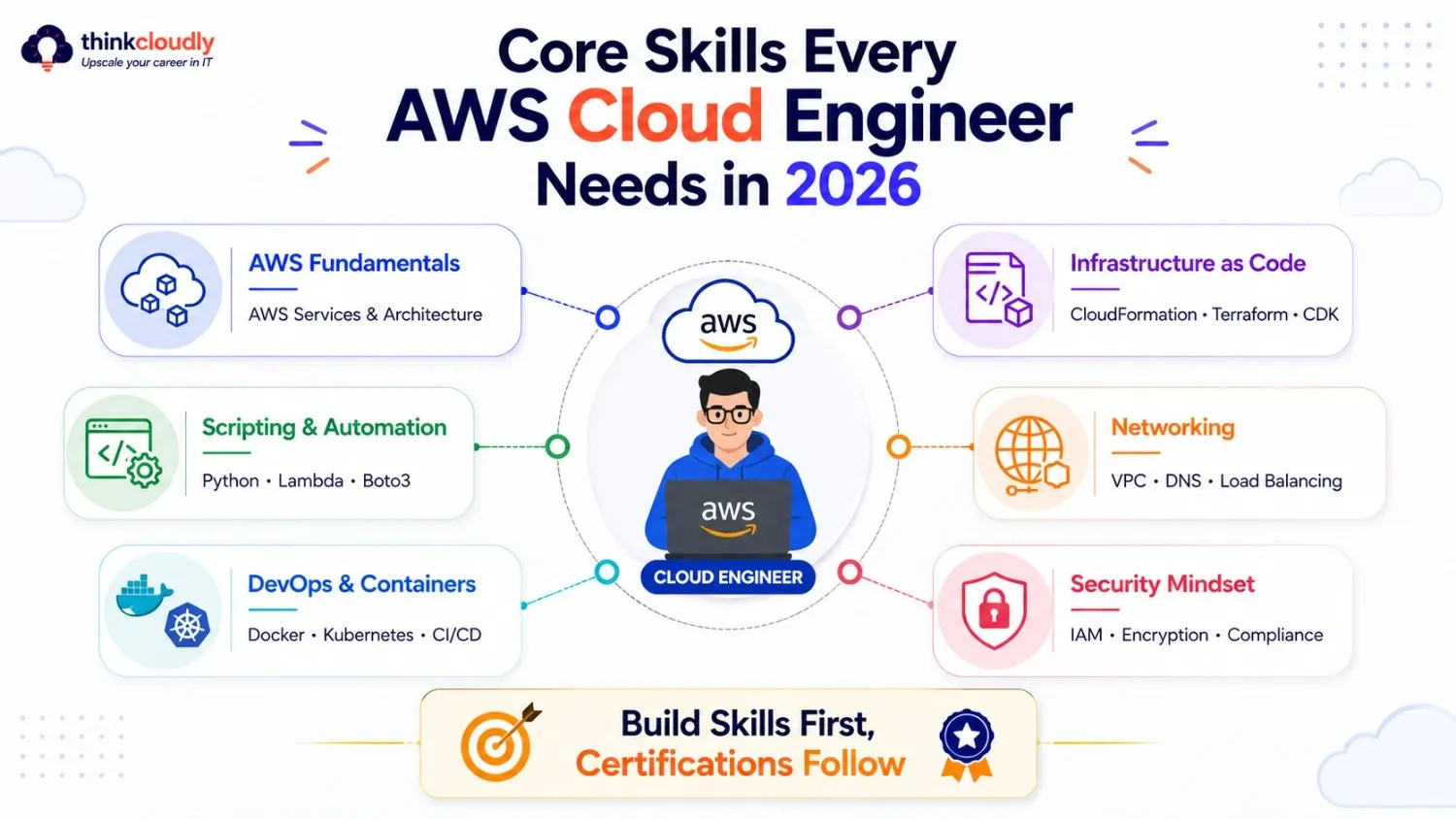
Here’s the uncomfortable truth: many aspiring cloud engineers chase certifications before building the underlying skills. Hiring managers notice. Here’s what actually needs to be in your toolkit.
AWS Fundamentals
Mastering AWS fundamentals is the non-negotiable foundation. You need to know core services deeply—not just what they are, but when to use them and where they fail:
- Compute: EC2, Lambda, Elastic Beanstalk, ECS, EKS
- Storage: S3, EBS, EFS, S3 Glacier
- Networking: VPC, Route 53, CloudFront, Direct Connect, Transit Gateway
- Databases: RDS, DynamoDB, Redshift, Aurora, ElastiCache
- Security: IAM, KMS, AWS Shield, AWS WAF, Secrets Manager
- Management & Monitoring: CloudWatch, CloudTrail, AWS Config, Systems Manager
Knowing when to choose DynamoDB over RDS, or when Lambda is the wrong tool—that judgment is what gets you through technical interviews.
Infrastructure as Code
Manual provisioning doesn’t scale. Proficiency with CloudFormation, Terraform, or AWS CDK is a baseline expectation in 2026, not a differentiator.
Scripting and Automation
Python is the de facto language of cloud engineering; Bash is a close second. Writing Lambda functions, automating tasks, and using Boto3 (the AWS Python SDK) meaningfully increases your value.
Networking
TCP/IP, DNS, load balancing, subnetting, VPNs — these fundamentals translate directly into correct AWS network configuration. Poor networking is one of the most common sources of both performance problems and security vulnerabilities.
DevOps and Containers
Familiarity with Docker, Kubernetes (Amazon EKS), Git, and CI/CD is increasingly expected at the entry level and mandatory mid-level and above.
Security Mindset
Engineers who genuinely understand the AWS shared responsibility model, identity federation, and encryption are in high demand — and command premium pay.
AWS Certifications: The Ones That Actually Pay Off
Not all AWS certifications are created equal. Some open doors. Others barely move the needle with hiring managers.
Here’s what the data shows:
According to Skillsoft’s IT Skills & Salary Report, AWS-certified professionals earn $10,000–$25,000 more than non-certified peers. But the specific certification matters.
|
Certification |
Level | Avg. Salary Lift | Best For |
| AWS Certified Cloud Practitioner | Foundational | Entry signal |
Career changers, beginners |
|
AWS Certified Solutions Architect – Associate |
Associate | High (~80% of job postings) | All cloud engineers |
| AWS Certified SysOps Administrator – Associate | Associate | Moderate |
Operations-focused engineers |
|
AWS Certified Developer – Associate |
Associate | Moderate | Engineers with dev background |
| AWS Certified DevOps Engineer – Professional | Professional | $142K avg. base salary |
DevOps specialists |
|
AWS Certified Solutions Architect – Professional |
Professional | $151K avg. base salary | Senior architects |
|
AWS Certified Security – Specialty |
Specialty | Premium in security roles |
Cloud security engineers |
| AWS Certified Data Analytics – Specialty | Specialty | Premium in data roles |
Data/analytics engineers |
Salary data from PayScale and Coursera’s AWS Certification Salary Guide.
The practical takeaway: Start with the Solutions Architect Associate; it appears in more job postings than any other AWS cert and is the closest thing to a universal entry requirement. Specialize from there.
How Much Do AWS Cloud Engineers Earn in 2026?
Let’s talk numbers—because this is often the question people are most hesitant to ask.
According to Glassdoor, the average AWS Cloud Engineer salary in the US is $140,875 per year, with the typical range between $115,597 and $173,471. Top earners at the 90th percentile exceed $200,000 annually.
ZipRecruiter’s 2026 data puts the average at $135,741, while Motion Recruitment’s 2026 Cloud Salary Guide reports senior engineers earning $139,000–$180,000+ nationally, with San Francisco mid-level roles reaching $184,000.
Key factors that determine where you land:
- Experience level: Entry-level starts at $85,000–$110,000; senior roles at $139,000+
- Certifications: Multiple AWS certs consistently correlate with higher pay
- Specialization: Security, data engineering, and AI infrastructure command premiums
- Industry: Finance, healthcare, and defense pay above market
- Location: Major tech hubs still pay significantly more, even with remote normalization
DataCamp’s 2026 analysis notes AWS cloud engineers earn a median of $140,000 — higher than Azure and Google Cloud counterparts, reflecting AWS’s market dominance.
Cloud Engineer Demand: Why 2026 Is a Pivotal Moment
The cloud job market has had its ups and downs. So why is 2026 different — and not just another hiring hype cycle?
Because the demand drivers aren’t cyclical. They’re structural.
AI Infrastructure Is Exploding The generative AI boom has created massive demand for the infrastructure that trains and runs AI models. AWS’s purpose-built AI services—SageMaker, Bedrock, and Trainium—are at the centre of this buildout, and companies need engineers to build and operate it.
Cloud Cost Optimization Is a C-Suite Priority Cloud budgets ballooned from 2020 to 2023. Now CFOs are demanding better ROI. Engineers who practice FinOps — reducing spend while maintaining reliability — are among the most actively recruited cloud professionals today.
Security Requirements Are Tightening The EU AI Act, GDPR enforcement, U.S. state privacy laws, and sector requirements (HIPAA, PCI-DSS) are all creating demand for security-fluent cloud engineers.
Multi-Cloud Is the New Default According to market research, 92% of enterprises now operate in multi-cloud environments. AWS engineers who understand Azure or Google Cloud basics have a meaningful hiring advantage.
Traditional Industries Are Still Catching Up Healthcare, manufacturing, financial services, and government are years behind pure tech companies in their cloud migrations—creating an enormous runway for cloud professionals outside the startup ecosystem.
How to Become an AWS Cloud Engineer: The Roadmap
Most “how to become a cloud engineer” guides give you a generic checklist. This one gives you a realistic timeline based on what actually works — including for complete career changers.
Here is a practical cloud engineer roadmap built around phases:
|
Phase |
Timeline | Focus Area | Key Milestone |
| Phase 1: Foundation | Months 1–3 | Networking basics, Linux CLI, Python fundamentals |
Comfortable using the terminal and writing simple scripts |
|
Phase 2: AWS Core Services |
Months 2–4 | EC2, S3, VPC, IAM, RDS, Lambda, CloudWatch | First working AWS architecture deployed from scratch |
| Phase 3: Certification | Months 4–6 | Solutions Architect Associate (or Cloud Practitioner first) |
Certified and able to explain AWS decisions in interviews |
|
Phase 4: Specialization + Portfolio |
Months 6–12 | DevOps, Security, Data Engineering, or AI infrastructure | 2–3 real projects on GitHub with documentation |
| Phase 5: Job Search + First Role | Months 10–14 | Resume, interviews, networking, negotiation |
First cloud engineer job offer |
Phase 1 is make-or-break for career changers. Linux and networking fundamentals aren’t glamorous, but they’re the scaffold everything else hangs on.
Hands-on practice is non-negotiable. Create a free-tier AWS account from day one. Engineers who build real things land jobs faster than those who only watch videos.
Phase 4 is where careers diverge. Some go toward DevOps, others into security. A growing number move into data engineering—pipelines, data lakes, and analytics infrastructure on AWS Glue, Kinesis, Redshift, and Athena.
If data engineering is your direction, the Thinkcloudly AWS Data Engineering Training Course gives you a structured, project-based path through the exact AWS services employers are hiring for.
AWS Cloud Engineer vs. Cloud Architect: The Full Comparison
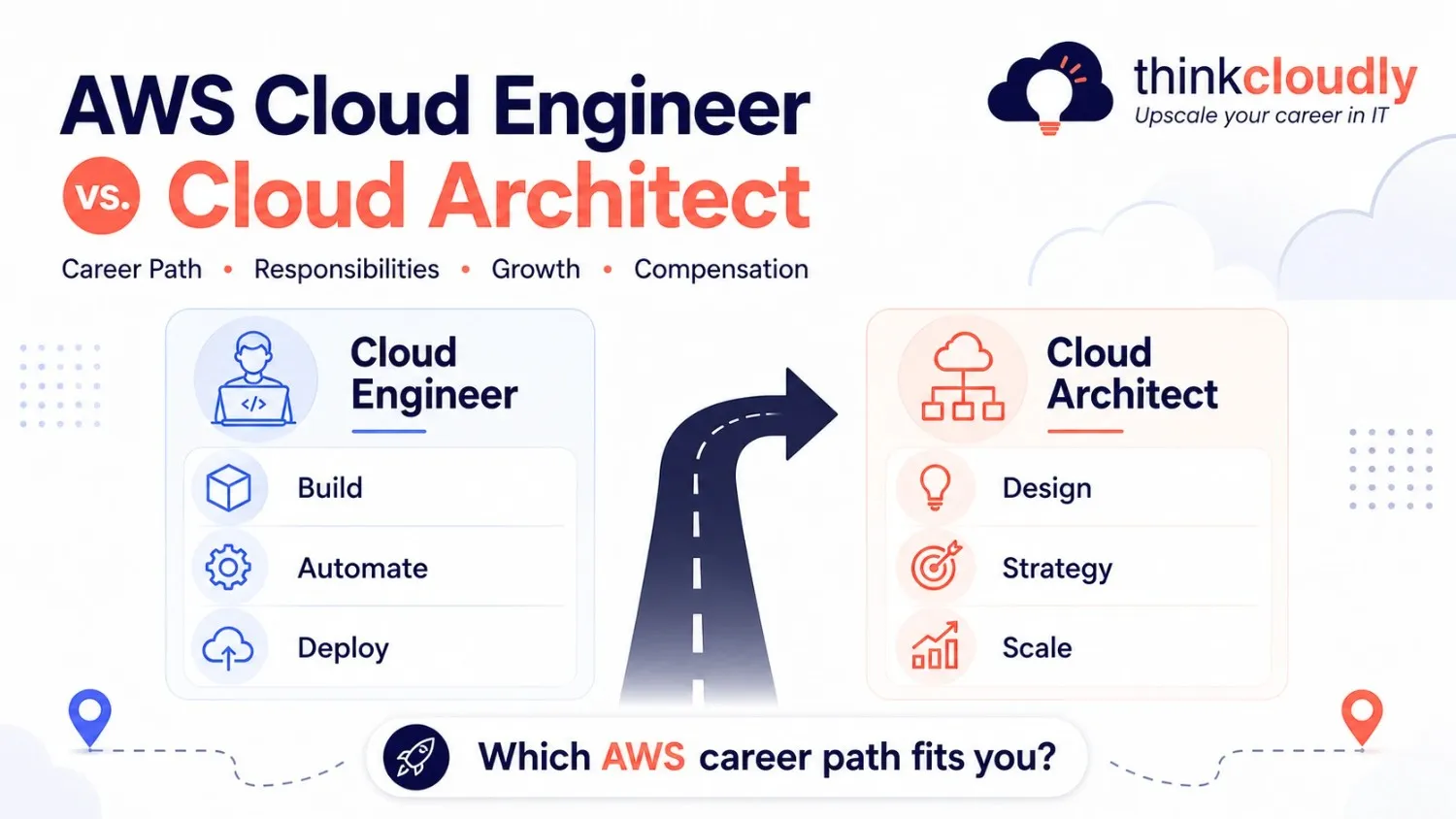
“AWS cloud engineer vs. cloud architect” is one of the most searched comparisons in cloud careers—and most articles answer it in two paragraphs. If you’re planning a multi-year career, this distinction matters.
Both roles work on AWS infrastructure and require deep technical knowledge. But in the job market, they represent meaningfully different realities—different day-to-day work, different seniority expectations, and different compensation.
|
Dimension |
AWS Cloud Engineer |
Cloud Architect |
|
Primary Focus |
Building, deploying, and operating infrastructure | Designing system-wide strategy and technical vision |
| Work Style | Deeply hands-on — in the console and CLI daily |
Higher abstraction — diagrams, docs, decisions |
|
Experience Required |
0–5+ years (broad range by level) | Typically 7–12+ years |
| Typical Responsibilities | IaC, CI/CD pipelines, monitoring, incident response |
Solution design, governance, vendor evaluation, alignment |
|
AWS Certifications |
Solutions Architect Associate, SysOps, DevOps Engineer | Solutions Architect Professional, specialty certs |
| Avg. US Salary (2026) | $115,000–$173,000 |
$150,000–$220,000+ |
|
Career Entry Point |
IT, DevOps, or self-taught background | Usually reached after 5–10 years as an engineer |
| Reports To | Engineering manager or DevOps lead |
CTO, VP Engineering, or Principal Architect |
|
Key Soft Skills |
Troubleshooting, automation mindset, documentation | Strategic thinking, executive communication, influence |
| Best For | Hands-on builders who love operational problems |
Systems thinkers who want to shape architecture at scale |
Salary Comparison: Engineer vs. Architect
|
Experience Level |
AWS Cloud Engineer |
Cloud Architect |
|
Entry / Junior |
$85,000 – $110,000 | Not typical at entry level |
| Mid-Level | $115,000 – $148,000 |
$140,000 – $175,000 |
|
Senior |
$139,000 – $180,000 | $175,000 – $220,000 |
| Principal / Staff | $175,000 – $200,000+ |
$200,000 – $250,000+ |
Ranges from Glassdoor, Motion Recruitment, and ZipRecruiter.
Which Role Should You Target?
For most people reading this: start as a cloud engineer. Cloud architecture is almost exclusively reached through engineering experience—there is no direct path from zero to architect. Hiring managers know this, which is why architect postings overwhelmingly require 7–10+ years of hands-on cloud work.
Cloud engineers are not a lesser version of architects. Senior cloud engineers at major tech companies earn as much or more than architects at mid-size firms. The career path for most looks like this:
Junior Cloud Engineer → Cloud Engineer → Senior Cloud Engineer → Lead/Principal → Cloud Architect (optional)
The Honest Reality: What Cloud Engineering Actually Feels Like
Cloud engineering is genuinely exciting—but realistic expectations serve you better than idealized ones.
The rewards are real: interesting problems, strong pay, constant learning, and flexibility across virtually every industry. The challenges are also real: incidents happen at inconvenient times, AWS releases updates constantly (your knowledge needs active maintenance), and debugging distributed systems under pressure is stressful even for experienced engineers.
For people who find technical problem-solving energizing—and who enjoy building and operating complex systems—cloud engineering is one of the most satisfying careers available in tech right now.
Ready to Start Your Cloud Engineering Journey?
AWS cloud engineer demand is structural, not cyclical. The forces driving hiring—AI infrastructure, security, cost optimization, and digital transformation—are not going away. You don’t need a CS degree or years of existing IT experience. You need a clear roadmap, hands-on practice, and the right training.
If you’re ready to move from thinking about it to actually building skills, explore the Thinkcloudly AWS Data Engineering Training Course—a practical, project-based program designed to take you from AWS fundamentals to job-ready expertise in one of the most in-demand cloud specializations of the decade.
The best time to start was yesterday. The second best time is today.
Thinkcloudly helps aspiring cloud professionals launch and advance their careers through practical, industry-aligned training. Salary and market data cited in this article reflects publicly available 2026 figures from Glassdoor, ZipRecruiter, Skillsoft, Coursera, DataCamp, and Motion Recruitment.