
The cloud job market has more open seats than qualified people to fill them. The only thing standing between most candidates and those seats is a story they keep telling themselves about not being ready yet.
There is a particular kind of waiting that feels responsible and disciplined but is actually just expensive. It shows up in the person who says they will start applying for cloud roles once they have finished one more course. Or once they have completed all twelve certification modules rather than the first three. Or once they feel more confident. Or once they understand everything a little better.
Meanwhile, the market does not wait. Companies posting cloud roles right now are not looking for people who know everything. They are looking for people who know enough, can learn the rest, and are willing to show up. The gap between those two standards is where most career delays live, and it is entirely manufactured.
Nobody gets a warning before the market moves on
The US Bureau of Labor Statistics projects that computer and information technology occupations will generate approximately 317,700 openings per year through 2034, growing at a rate more than three times faster than the average for all occupations. The information sector, specifically, is projected to be the third-fastest-growing sector of the entire US economy over that period, driven substantially by cloud computing, AI systems, and cybersecurity demand.
IDC’s research is even more direct about the supply side of the problem. More than 90 percent of organizations worldwide will face IT skills shortages by 2026, at an estimated cost of 5.5 trillion dollars in delayed projects, quality failures, and lost revenue. That figure is not a warning about a future problem. It describes conditions that are already in effect.
The global cloud computing market was valued at approximately 912 billion dollars in 2025 and is projected to reach nearly 5.9 trillion dollars by 2035, representing a compound annual growth rate above 20 percent. That is not a niche growing sector. That is the infrastructure of the modern economy expanding at a pace the training pipeline is not keeping up with.
The uncomfortable truth: organizations are not struggling to hire cloud professionals because the standards are too high. They are struggling because the number of people willing to start is too low. The gap is a supply problem, not a quality problem.
What “not ready” actually costs
The delay has a measurable price. Cloud-certified professionals earn between 25 and 40 percent more than non-certified counterparts doing equivalent work, according to analysis published in 2026 across multiple salary-tracking platforms. The AWS Certified Solutions Architect credential is associated with median salaries of 125,000 to 163,000 dollars annually in the United States.
Azure Solutions Architect roles sit in a comparable range. Google Cloud specialists command premium salaries partly because the certified talent pool is smaller: approximately 1.2 million engineers hold GCP certifications versus more than 4 million for AWS, which drives compensation upward through basic scarcity.
Every month spent waiting is a month of that salary differential not being earned. For someone sitting on the fence about starting a cloud certification for twelve months, the opportunity cost at a conservative 30 percent salary premium on a 70,000 dollar salary is roughly 21,000 dollars. That is what feeling not ready actually costs in concrete terms.
LinkedIn Economic Graph data from 2025 and 2026 shows that professionals certified across two cloud platforms, AWS and Azure, or AWS and Google Cloud, earn between 18 and 25 percent more than those certified in only one. The compounding effect of moving quickly and adding credentials over time is significant.
The people who will have the strongest multi-cloud profiles in 2028 are the ones who started in 2025 or 2026, not the ones who waited until they felt completely prepared to begin.
What employers are actually hiring for right now
Analysis of 500 cloud job postings from 2026 found employers have moved well past basic server management. What they are actively hiring for now is infrastructure design, security architecture, cloud cost management, and the ability to connect AI systems to cloud platforms. Demand for the AWS Certified Security Specialty credential grew 73 percent in 2025 alone. Kubernetes administration and Terraform skills now appear consistently across a large share of active postings.
None of this means entry points have disappeared. It means the most valuable entry points have become more specific. The Microsoft Azure Fundamentals AZ-900 covers equivalent ground. Neither requires a computer science degree, prior programming experience, or years of IT background. They require focused study and the willingness to sit an exam.
The certification timeline vs. the waiting timeline
|
Certification |
Time to complete | Avg salary range (US) | Difficulty level |
Entry point |
|
AWS Cloud Practitioner |
6 to 8 weeks | $85k to $110k | Beginner |
Yes |
|
Azure Fundamentals (AZ-900) |
4 to 6 weeks | $80k to $108k | Beginner |
Yes |
|
AWS Solutions Architect Associate |
8 to 12 weeks | $125k to $163k | Intermediate |
Yes |
|
Azure Administrator (AZ-104) |
8 to 12 weeks | $90k to $110k | Intermediate |
Yes |
|
FinOps Certified Practitioner |
6 to 8 weeks | $90k to $125k | Beginner |
Yes |
|
AWS Certified Security Specialty |
12 to 16 weeks | $140k to $165k | Advanced |
After associate |
|
Google Cloud Associate Engineer |
8 to 12 weeks | $110k to $145k | Intermediate |
Yes |
|
Certified Kubernetes Admin (CKA) |
10 to 14 weeks | $130k to $160k | Advanced |
After associate |
Where the “not ready” story comes from
Part of what sustains the waiting pattern is a misunderstanding of how cloud hiring actually works at the entry level. People assume that employers expect candidates to arrive with complete knowledge of a platform before they will consider hiring them.
In most cases this is not how it works. Employers in fields with genuine talent shortages, which could represent almost every sector, are routinely hiring candidates who have the foundational credential and demonstrated willingness to learn and training the rest on the job.
Gartner’s cloud market analysis for 2026 identifies AI workloads as the single largest new driver of cloud adoption across industries. This is creating demand for a newer profile: professionals who understand both cloud infrastructure and how AI systems sit on top of it. This combination did not exist as a job category at scale three years ago.
Nobody has complete experience in it. The people being hired into these roles right now are building that knowledge as they go, which means the playing field for new entrants is more level than it appears from the outside.
“The people who will have the strongest cloud profiles in 2028 are the ones who started in 2025, not the ones waiting until they felt completely prepared.”
The other thing sustaining the delay is the volume of available learning material. There are more cloud courses, tutorials, certification tracks, and YouTube explanations available right now than any person could consume in a decade. The abundance creates a paradox: the more material available, the easier it is to convince yourself that you need to work through more of it before you are ready to move.
The certification exam is a forcing function that cuts through that loop. It sets a defined standard, a defined endpoint, and a defined credential that the market recognizes.
What non-technical people often miss
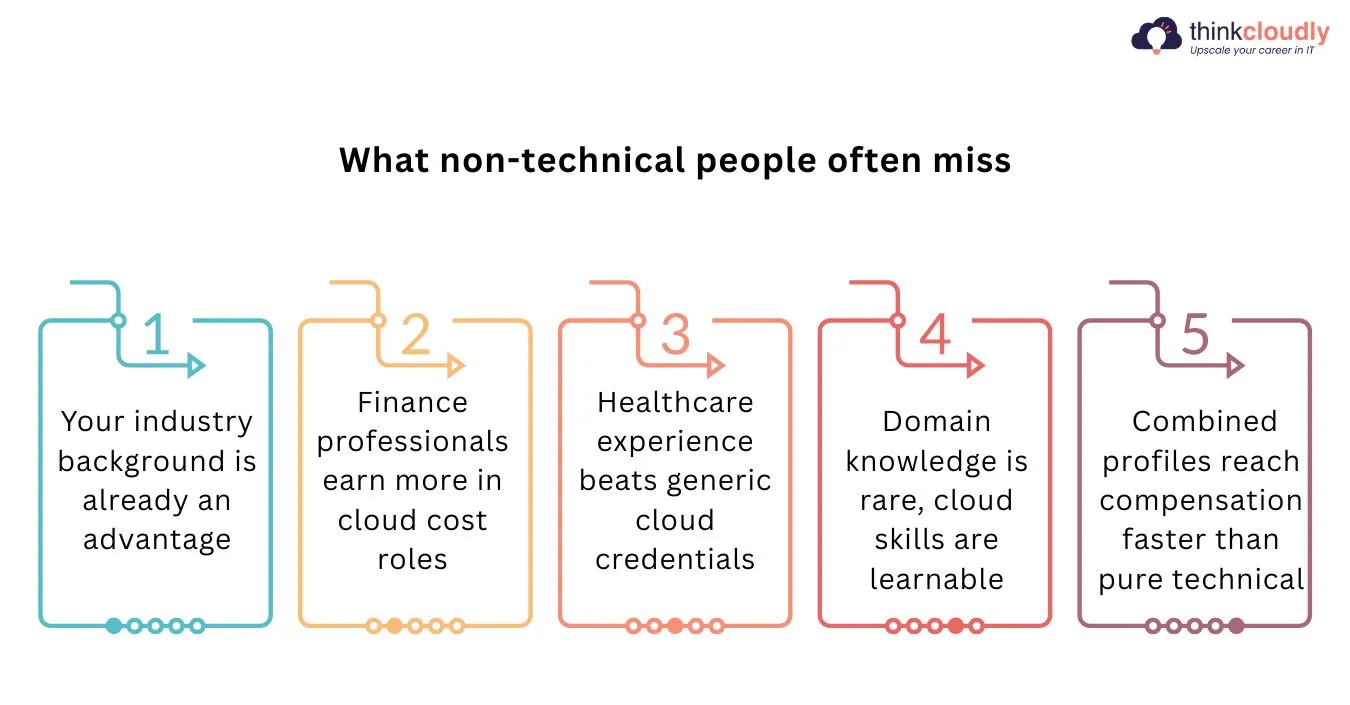
1. Your industry background is already an advantage
Most people switching into cloud from a different career assume their prior experience is irrelevant. The hiring data says the opposite. Professionals who develop cloud skills inside the industry they already know consistently outcompete pure technical candidates for roles in that same sector.
The person who understands how the organization works, what the real problems are, and how decisions get made is more useful than someone who only understands the technology sitting underneath it.
2. Finance professionals earn more in cloud cost roles
The FinOps Foundation’s State of FinOps 2026 found that cloud cost management specialists from finance backgrounds earn 22 percent more on average than those from purely technical backgrounds. The reason is straightforward. Managing cloud spend across an organization is fundamentally a financial problem, not a technical one.
Someone who already understands budgets, cost allocation, and how spending decisions get approved inside a real organization brings something to that role that no certification can replicate.
3. Healthcare experience beats generic cloud credentials
A healthcare administrator who develops AWS compliance expertise is more valuable to a healthcare cloud deployment than a generic cloud engineer who has never worked in a clinical environment. They already know how a hospital operates, where the regulatory pressure points sit, and what the people using the system actually need from it.
That operational context cannot be absorbed from documentation. It comes from years of working inside the environment, and it is exactly what healthcare organizations are struggling to find.
4. Domain knowledge is rare; cloud skills are learnable
The combination of deep domain expertise and cloud competence is what hiring managers consistently describe as the hardest profile to source. The reason is straightforward: technical skills can be taught relatively quickly through structured certification programs. The years of institutional knowledge, regulatory understanding, and operational fluency that come from working inside a specific industry cannot be replicated in six weeks.
Adding cloud skills on top of what you already know does not require starting over. It requires building one layer on top of a foundation that is already there.
5. Combined profiles reach compensation faster than pure technical ones.
The most direct path to both faster hiring and higher compensation in the cloud right now is not deep technical specialization in isolation. It is technical competence paired with genuine expertise in a domain the market needs to navigate. That combination is rarer than either element alone, and the salary data reflects it.
People who make this move do not need to compete on technical depth against candidates who have been in the field for years. They compete on a combination that most of those candidates simply do not have.
The actual first step
The honest practical answer for anyone who has been waiting is that the first step is narrower than it probably feels. It is not choosing a career, building a complete skill set, or becoming an expert. It is picking one entry-level certification, registering for the exam, and working backwards from the exam date to build a study schedule.
Six weeks for AWS Cloud Practitioner. Four weeks for Azure Fundamentals. Both are available through official provider training at low cost. Both are recognized immediately by hiring managers across every industry.
The cloud job market will not be this open indefinitely. Training programs are expanding, more people are entering the field, and the supply gap will eventually narrow. The professionals who move now are entering at a moment when employers are actively competing for qualified candidates rather than selecting from a comfortable pool. That window is worth taking seriously.
Sources & Further Reading
The data and statistics in this article are drawn from the following sources:
- US Bureau of Labor Statistics — Computer and IT Occupations Outlook 2024 to 2034 — Employment outlook and projected growth in computer and IT occupations
- US Bureau of Labor Statistics — Employment Projections 2024 to 2034 Summary — Long-term workforce and employment trend projections
- IDC — IT Skills Shortage Impact Report 2026 — IT skills gap analysis and business impact insights
- Gartner — Cloud Market Analysis and AI Workload Trends 2026 — Cloud market growth and AI workload adoption trends
- Electromech Cloud — Global Cloud Market Size and Projections 2025 to 2035—Global cloud market size forecasts and future projections
- Global Knowledge — IT Skills and Salary Report 2026 — IT certification demand and salary benchmarking data
- LinkedIn Economic Graph — Cloud Certification Salary Data 2025 to 2026 — Salary trends related to cloud certifications and job demand
- ThinkCloudly — 500 Cloud Job Postings Analysis 2026 — Analysis of cloud job market requirements and hiring patterns
- FinOps Foundation — State of FinOps 2026 — Cloud financial management and FinOps adoption insights
- Coursera — Cloud Computing Salary Guide 2025 — Cloud computing salary ranges and career guidance
- CompTIA — State of the Tech Workforce 2026 — Technology workforce statistics and industry outlook
- World Economic Forum — Future of Jobs Report 2025 — Future workforce trends, emerging roles, and skills demand
Data references primarily cover the United States and global technology workforce trends from 2024 to 2026.