

Did you know that organizations using a structured Agile team workflow report a 75% project success rate—compared to just 56% for teams still relying on traditional methods?
That gap is not a coincidence. It is the compounding result of smarter processes, faster feedback loops, and deliberate workflow management in agile that removes friction before it becomes failure.
Yet here is the uncomfortable truth: 94% of organisations claim to practice Agile, but only 11% have reached a high level of maturity in how they actually run it. Most teams have the language down. They hold standups. They use Kanban boards. But their agile project management is patchy—inconsistent sprint discipline, bloated product backlogs, and no real visibility into where work is stuck or why delivery keeps slipping.
This guide cuts through the noise. If you are a team lead, project manager, or anyone responsible for delivery, what follows is a practical, data-backed walkthrough of how Agile team workflow actually works in 2026—from the core process to the tools that make it run, the metrics that tell you the truth, and the best practices that separate high-performing teams from the rest.
What Is an Agile Team Workflow? A Clear Definition
An agile team workflow is the structured sequence of activities, ceremonies, and feedback cycles through which a team plans, builds, reviews, and improves its work—iteratively and continuously. It is not a single tool or a single framework. It is the living operating system of how a team moves from idea to delivered value.
Workflow management in Agile governs how work enters a team’s queue, how it is prioritized, how it flows through development stages, and how the team reflects and adjusts after each cycle. By 2026, agile project management has expanded well beyond software. Marketing teams, HR departments, finance functions, and operations units are running agile team workflows to manage campaigns, onboarding processes, and cross-departmental initiatives. The principles have proved universally applicable—and the numbers back it up.
The Core Process: How an Agile Team Workflow Is Structured
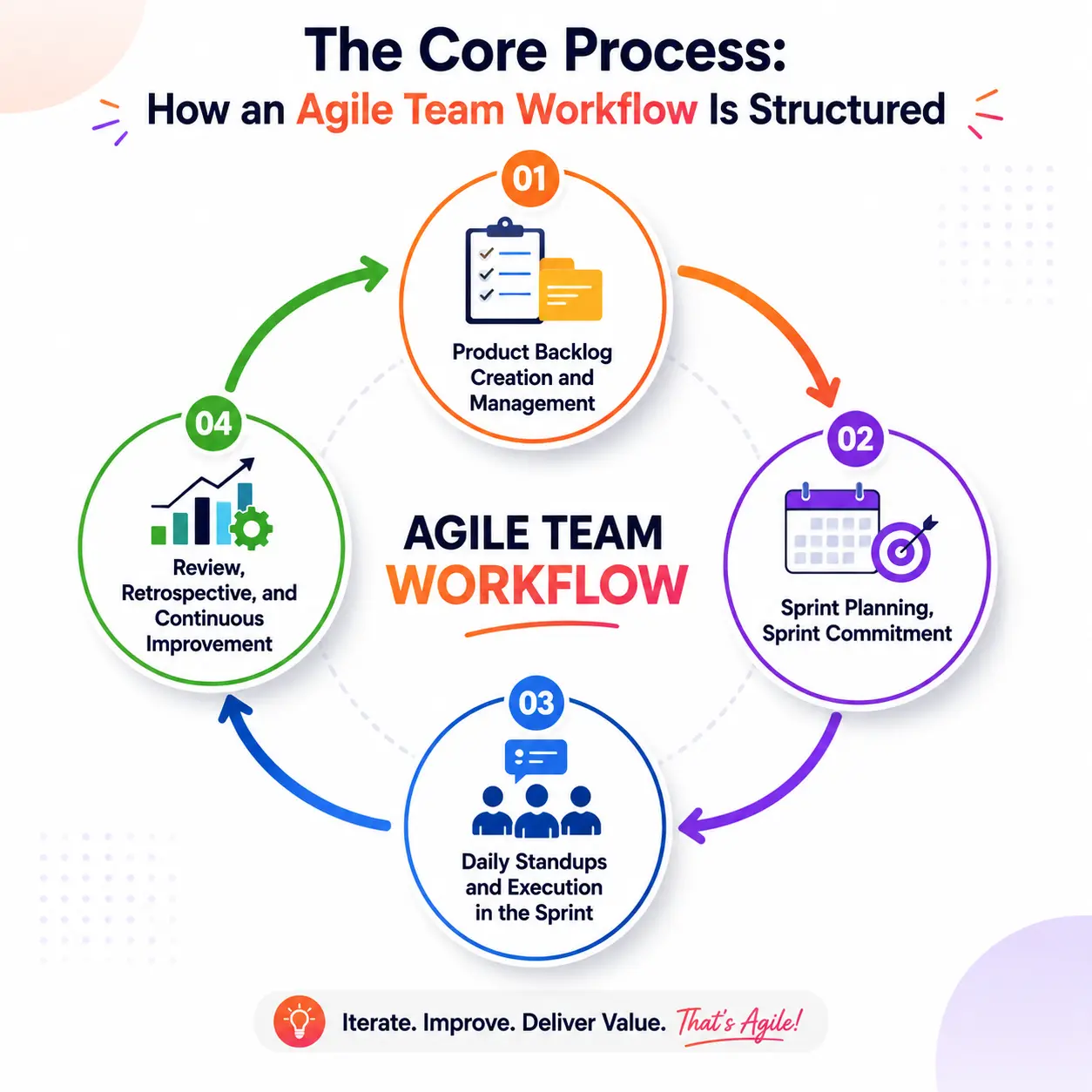
1. Product Backlog Creation and Management
At the heart of every good Agile team workflow is a well-managed product backlog—a ranked list of features, fixes, and enhancements that comprises the team’s complete queue of possible work. This list is owned by the product owner, but the complete team helps to maintain it clean, sized, and relevant.
Scrum workflow standards suggest that teams should do regular grooming or refinement sessions (usually once each sprint) to examine future backlog items, divide larger stories into smaller stories, and estimate effort. Without this discipline, product backlogs become graveyards of half-baked ideas that never get acted on. And in 2026, AI-assisted backlog technologies are speeding this up dramatically. Atlassian Intelligence is included in Jira and can automatically recommend story sizing, find duplicate items, and reveal priority conflicts—saving teams up to 40% of their grooming time.
2. Sprint Planning, Sprint Commitment
Then the team proceeds to sprint planning with a refined product backlog. This is a time-boxed session in a conventional Scrum workflow—usually two to four hours for a two-week sprint—where the team pulls the highest-priority items from the backlog, commits to a sprint goal, and assigns responsibility.
In agile project management, good sprint planning is about being honest about capacity. When teams over-promise and under-deliver, trust and morale break down. Based on the statistics from WifiTalents’ February 2026, 46% of Agile teams believe that making sure the entire team’s utilization during sprint planning is still a struggle. The cure is not working harder—it is planning more honestly, utilizing velocity data from past sprints as a guardrail.
3. Daily Standups and Execution in the Sprint
Once the sprint begins, workflow management in agile is a daily rhythm. The daily standup is the core ceremonial for 81% of Agile teams, making sure communication is tight and blockages are identified before they compound. The standup is for cooperation, not for status reporting to management. Team members answer three questions: What did I do yesterday? What am I working on today? What is in my way? This practice is kept to 15 minutes or less and greatly decreases the need for asynchronous back-and-forth that breaks up focus time throughout the day.
4. Review, Retrospective, and Continuous Improvement
At the end of each sprint, the team runs two critical ceremonies: the sprint review—where working software is demonstrated to stakeholders—and the sprint retrospective, where the team honestly examines how they worked, not just what they built.
Retrospectives are where flow efficiency improvements are born. Teams that consistently run them—and act on the action items they generate—compound small gains over dozens of sprints into measurably better delivery systems. Agile Metrics like cycle time and throughput should be reviewed here, not just qualitative feelings about the sprint.
Agile Workflow Automation: Removing the Invisible Tax on Delivery
One of the most underutilized levers in an Agile team workflow is workflow automation. Most teams still spend significant chunks of their week on tasks that a well-configured tool could handle in seconds — status updates, ticket routing, approval requests, notifications, and reporting. The enormity of this problem is staggering. 67% of knowledge workers said that they spend more than three hours every day on manual coordination chores, including data input, status updates, and report generation. In a two-week sprint, that’s almost 30 hours per person wasted on busywork with little customer value.
In agile project management, workflow automation usually aims at the following:
- Ticket status updates — automatically moving cards between columns as linked pull requests are merged
- Sprint reporting – no manual data entry for burndown and velocity charts
- Stakeholder notifications – alerts when blockages are raised or sprint goals are at risk
- Backlog grooming reminders—scheduling / pre-filling refinement sessions from templates
The global workflow automation market was valued at $23.77 billion and is forecasted to reach $37.45 billion by 2030—at a CAGR of 9.52%. The teams investing in Workflow Automation today are developing a structural advantage that compounds with every sprint cycle
Agile Metrics and Flow Efficiency: Measuring What Actually Matters
Most teams track the wrong things. Velocity is popular, but it measures estimated effort — not actual delivery quality or customer impact. The metrics that reveal the real health of your agile team workflow are flow-based. Flow efficiency is the percentage of time spent in active development versus sitting idle in a queue or waiting for review. For most teams, this number is surprisingly low—often below 20%, meaning work is actively being worked on for less than one-fifth of its total lifecycle.
Agile metrics worth tracking in 2026, according to monday.com’s April 2026 best practices guide:
- Cycle Time — how long it takes a work item to move from start to done
- Throughput — how many items the team completes per sprint
- Work in Progress (WIP) — how many items are simultaneously in progress (lower is almost always better)
- Flow Efficiency — active work time divided by total cycle time
- Escaped Defects — bugs that bypass testing and reach production
Agile metrics should be reviewed in retrospectives and shared transparently. One enterprise team that reduced WIP from 32 items to 12 cut their average cycle time from 27 days to 9 days — without changing a single engineering practice. That is the power of measuring flow.
Best Agile Tools for 2026: A Structured Comparison
The Agile Team Workflow is only as good as the tools supporting it. Below is a comparison of the leading tools in 2026, mapped to the workflow stage they serve best:
|
Tool |
Primary Use | Best For | Workflow Stage |
Standout Feature |
|
Jira (Atlassian) |
Agile Project Management | Scrum & Kanban teams | Backlog → Delivery |
AI-assisted backlog, advanced Agile Metrics |
|
Confluence |
Documentation | All teams | Planning & Review |
Living docs linked to Jira issues |
|
Trello |
Visual task tracking | Small teams, beginners | Sprint execution |
Drag-and-drop simplicity |
|
Monday.com |
Workflow management | Cross-functional teams | All stages |
Custom dashboards, Workflow Automation |
|
Asana |
Task & project tracking | Marketing, Ops, HR | Sprint execution |
Goal tracking, timeline views |
|
Miro |
Visual collaboration | Remote & distributed teams | Planning & Retro |
Digital whiteboard, templates |
|
Azure DevOps |
DevOps + Scrum Workflow | Engineering teams | Full SDLC |
CI/CD integration, test planning |
|
ClickUp |
All-in-one Agile Project Management | Versatile teams | All stages |
Flow Efficiency dashboards, time tracking |
|
Linear |
Engineering workflow | Product & engineering | Sprint execution |
Blazing fast UI, Workflow Automation |
|
Notion |
Docs + lightweight PM | Startups, small teams | Planning & Docs | Flexible databases, templates |
Sources: (Wrike Agile Tools Guide 2026), (StarAgile State of Agile 2026)
Four Best Practices for Agile Team Workflow to Achieve High Performance
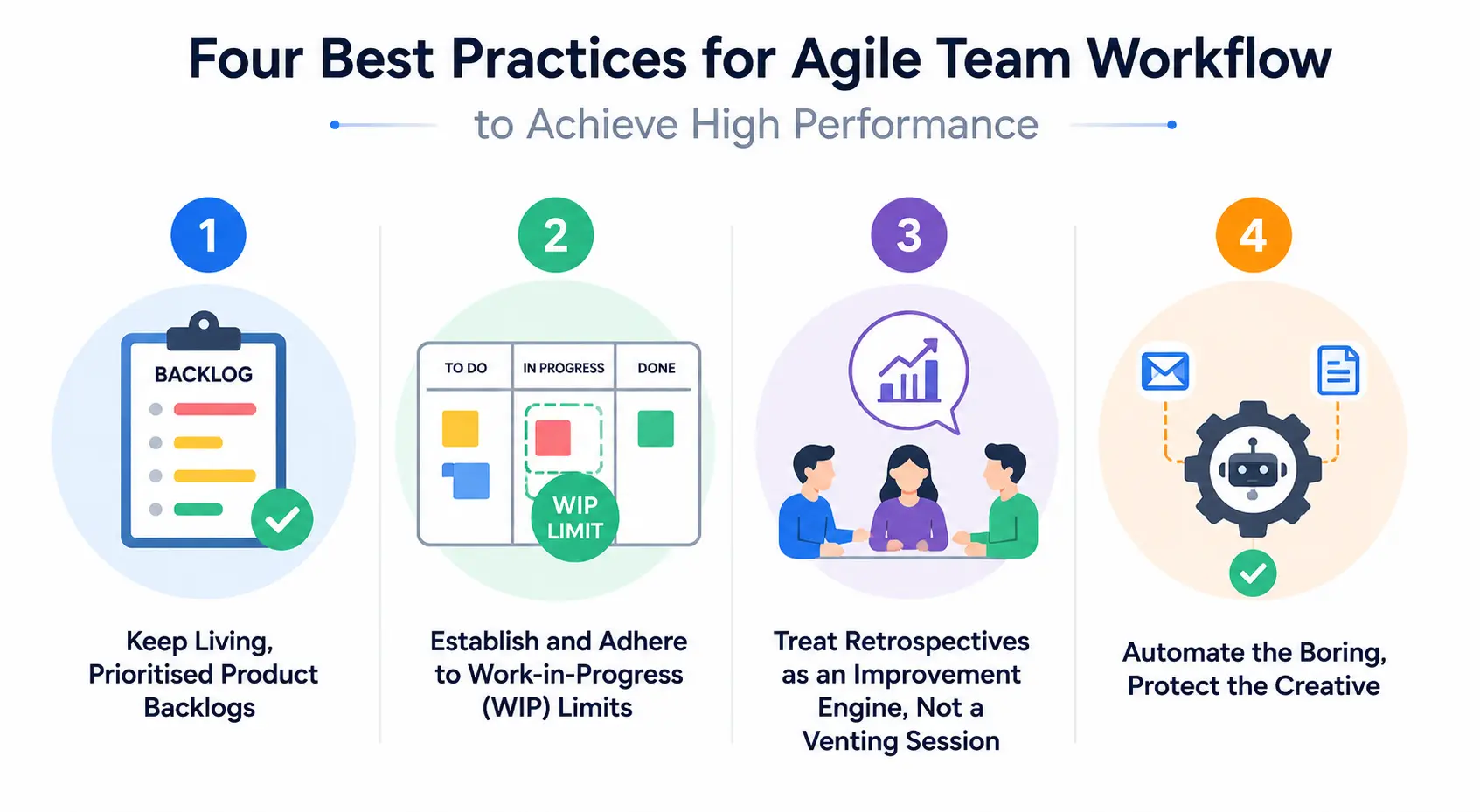
Getting the process and tools right is necessary—but not sufficient. The divide between successful agile team workflows and inferior ones is four disciplined habits:
1: Keep Living, Prioritised Product Backlogs
Product backlogs are not historical archives; they are living documents. Teams should evaluate and re-prioritize them every sprint, ruthlessly deleting items that have been languishing there for more than three cycles without being taken into development. A bloated Product Backlogs list indicates confused strategy, not thorough planning. Every item should have a clear ‘why’ that is related to a business outcome.
2. Establish and Adhere to Work-in-Progress (WIP) Limits
One of the most paradoxical truths in agile workflow management is that doing less at once makes teams quicker overall. WIP limits—a key aspect of Kanban—limit the amount of things in any given workflow stage, compelling teams to complete work before starting new items. 77% of Kanban users claim enhanced flow efficiency and workflow visibility when using WIP limitations. This is one of the most leveraged moves a team can make instantly.
3: Treat Retrospectives as an Improvement Engine, Not a Venting Session
The retrospective is the built-in learning mechanism of the agile team workflow. But far too many teams see it as an optional extra—a debrief with no follow-through. High-performing teams use Agile Metrics from the sprint (cycle time trends, escaped defects, and flow efficiency ratings) to base retrospective conversations in data. They assign owners to each action item and analyze outcomes during the next retrospective.
4: Automate the Boring, Protect the Creative
Workflow automation should never replace human judgment—but it should absolutely replace human effort on anything repetitive and rule-based. Teams that automate status updates, notifications, report generation, and test triggers free their people to focus on the genuinely complex: problem-solving, stakeholder alignment, architecture decisions, and creative feature design. Companies that fully deploy workflow automation tools report an average 30–40% productivity gain within the first year. Start with one workflow, prove the value, then scale.
Conclusion
The difference between a team that struggles and one that consistently delivers comes down to how deliberately they design and run their agile team workflow. Process clarity, tool discipline, honest Agile metrics, and systematic workflow automation are not optional extras—they are the operating infrastructure of delivery in 2026. With 97% of organizations now using Agile in some form and the global Agile tools market heading towards $9.2 billion by the end of 2026, the competitive pressure to get this right has never been higher. But most organizations are still leaving the majority of their agile potential untapped—stuck between adoption and mastery.
Start where you are. Tighten your Scrum workflow ceremonies. Groom your product backlogs consistently. Set WIP limits. Track cycle time. Automate one manual process this sprint. Each improvement compounds—and the teams that build this discipline now will be the ones setting the pace for everyone else in the years ahead.
Your agile team workflow is not a methodology you follow. It is a competitive advantage you build, sprint by sprint.