

Here’s a number that surprised even people who work inside the ServiceNow ecosystem every day: nearly two million people were actively training on the company’s official education platform by mid-2026, a jump of roughly 80 percent in a single year, according to ServiceNow’s own newsroom.
If you have ever wondered whether investing your time in ServiceNow Learning is worth it, that growth curve alone should answer the question. This guide breaks down what the platform actually offers in 2026, how the paths and certifications work, what things cost, and what I personally learned going through the process myself.
What Is ServiceNow Learning, Really?
ServiceNow Learning is the umbrella term people use for the official training ecosystem built around the ServiceNow platform—the courses, hands-on labs, guided paths, and certification exams that teach you how to configure, administer, build on, and support the software that runs IT service management, HR workflows, customer service, and increasingly, AI-driven automation for thousands of companies worldwide.
For years this ecosystem was simply called Now Learning. In 2026, the company rebranded and expanded it into something bigger, but the goal stayed the same: give anyone, whether they are a brand-new hire, a career switcher chasing an online certification, or a fifteen-year veteran, a structured way to learn ServiceNow from the ground up.
Whether your goal is to become a ServiceNow admin, move into development, or simply add an online certification to your resume, this is where that journey starts.
From Now Learning to ServiceNow University: The 2026 Rebrand
At Knowledge 2026, the company’s flagship customer event held in Las Vegas, ServiceNow formally renamed its education arm ServiceNow University and introduced two new tools inside it: an AI Learning Guide that acts like a personal coach recommending courses based on your role and SimStudio, a simulation environment where learners practice real tasks instead of just answering quiz questions, as detailed by Investing.com’s coverage of the announcement.
The old branding, Now Learning, still shows up across forums, job postings, and older course links, so don’t be confused if you see both names used interchangeably. Functionally, it’s the same home for every course, lab, and exam you need. The platform also expanded language access in 2026, adding Arabic support in March, with Brazilian Portuguese content reportedly in the works, based on the same newsroom release. If your goal is genuinely to learn ServiceNow at a global standard, that kind of localization matters more than it might seem at first glance.
Why ServiceNow Learning Matters More Than Ever in 2026
Numbers tend to convince skeptics faster than opinions do, so here are a few from this year worth sitting with. An IDC study sponsored by ServiceNow found that organizations completing structured training and certification programs saw a 536 percent return on investment within three years, driven mostly by staff efficiency gains and reduced support costs, per the ServiceNow University press release.
On top of that, customer-side learners grew 28 percent year-over-year, partner participation rose 17 percent, and employee participation climbed 24 percent. Separately, the World Economic Forum has projected a net gain of 78 million jobs globally by 2030, with AI and big data topping the list of fastest-growing skill categories—a trend ServiceNow has leaned into directly by weaving AI modules throughout its 2026 course catalog.
Put simply, the platform isn’t just a nice-to-have anymore. If you want to learn ServiceNow seriously in 2026, doing it through the official channel gives you access to the exact tools employers are now measuring ROI against.
Five ServiceNow Learning Paths to Choose From
One thing that trips up beginners is not knowing where to start. The platform organizes everything into role-based paths, and picking the right one early saves months of wasted effort. Here are the main routes people take:
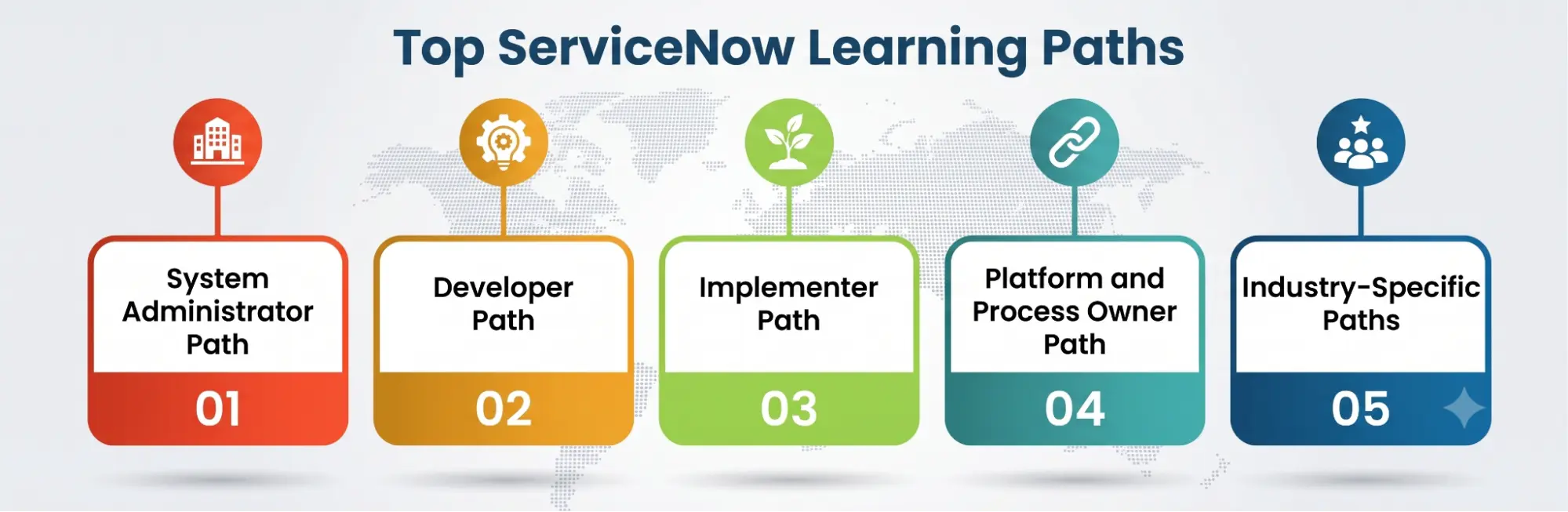
- System Administrator Path – This is the standard entry point for anyone wanting to become a ServiceNow admin. It covers navigation, workflow configuration, user administration, and platform basics, and it feeds directly into the Certified System Administrator exam.
- Developer Path – Built for people who want to script, build applications, and work with Flow Designer, IntegrationHub, and REST or SOAP APIs rather than just configure existing modules.
- Implementer Path—Focused on deploying ServiceNow for specific business functions like IT Service Management, HR Service Delivery, or Customer Service Management from the ground up.
- Platform and Process Owner Path – Aimed at people who own a business process (like change management or asset management) and need to understand governance and configuration without becoming full-time developers.
- Industry-Specific Paths—Newer tracks covering healthcare, telecommunications, public sector, and financial services operations, reflecting how broadly the platform has spread across industries.
Most learners still begin with the system administrator track because it builds the vocabulary and hands-on comfort every other path assumes you already have. It’s also the fastest way to start thinking and troubleshooting like a working ServiceNow admin, even before you touch a real production instance.
Certifications: CSA, CAD, and the Admin Certification Track
If courses are the classroom, certifications are the diploma. The most common admin certification people pursue is the Certified System Administrator, or CSA, and ServiceNow recommends at least six months of hands-on platform experience before attempting it, according to its own learning paths infographic.
As of 2026, the on-demand training itself is free, but the exam fee generally runs around $300, with a discounted $150 retake if you don’t pass the first time. That same source notes ServiceNow introduced a Certification Maintenance Program in 2026—a $200 annual fee that covers every mainline admin certification you hold, replacing the old system of paying separately for each one.
A second independent points out that pricing can vary slightly depending on your region and testing partner, so it’s worth confirming current numbers before you register. Either way, this is one credential that tends to pay for itself quickly once you’re employed on a ServiceNow-using team, and it’s still tracked under the Now Learning course catalog even after the university rebrand.
Instructor-Led Training vs Self-Paced Learning
This is the decision most people get stuck on. Self-paced, on-demand courses are free and let you learn ServiceNow on your own schedule, which works well if you’re disciplined and already comfortable with IT concepts. Instructor-led training, on the other hand, is paid—often somewhere between $1,900 and $2,700 depending on the course length—but gives you live access to a trainer, real-time Q&A, and a fixed schedule that keeps procrastination in check.
Neither option is objectively better. If you’re a hands-on learner who needs accountability, instructor-led sessions are usually worth the cost. If you’re self-motivated and just need structure, the free self-paced path covers the same material at zero cost, just without a live human guiding you through it. Many working ServiceNow admin professionals actually mix both, using free courses for the basics and paid sessions only for advanced modules.
ServiceNow Learning Costs and Options at a Glance
|
Option |
Format | Typical 2026 Cost |
Best For |
|
Self-paced courses |
On-demand, online certification track | Free |
Independent learners |
|
CSA exam |
Proctored, online | ~$300 (retake ~$150) |
First-time admin certification seekers |
|
CIS specialist exams |
Proctored, online | ~$450 |
Experienced admins going deeper |
|
Instructor-led classes |
Live, virtual or in-person | ~$1,900–$2,700 |
Learners who want structure |
|
Certification Maintenance Program |
Annual fee | ~$200/year |
Anyone holding multiple certifications |
A Personal Note From the Author
I’ll be honest—when I first tried to learn ServiceNow, I assumed it would feel like every other corporate LMS: dry videos, a quiz, and a certificate nobody checks. It wasn’t that. I went through the system administrator path myself over a few weekends, and what actually stuck with me were the hands-on labs where you configure a real instance instead of clicking through slides.
I failed my first CSA practice exam badly, mostly because I skipped the change management module thinking it was “boring admin stuff” that no working ServiceNow admin actually needs day-to-day. It wasn’t. That module came up repeatedly on the real exam. My honest advice, from someone who has been in your seat: don’t skip the modules that sound unglamorous, and don’t rush toward instructor-led classes before you’ve tried the free content first—you might not need to spend the money at all.
Final Thoughts
Whether you’re brand new to the platform or trying to formalize skills you’ve picked up on the job, ServiceNow Learning in 2026 gives you more structured, more current, and honestly more generous options than it did even a year or two ago.
Between free self-paced courses, optional live training, and a clear path toward certification, there’s a route that fits almost any schedule or budget. My own experience taught me that the free content alone can take you further than you’d expect—so before you spend a dollar, explore what ServiceNow Learning already offers at no cost, and decide from there whether the paid options are worth adding to your plan.