
Most people only think about risk after something has already gone wrong—a server goes down, a laptop gets stolen, or a company gets fined for missing a compliance deadline. A structured risk assessment flips that order. It forces an organization to look for weak points before they turn into headlines, so leadership is reacting to a plan instead of reacting to a crisis.
If you’re a student stepping into cybersecurity, IT, or business management, this guide breaks the process down in plain language: what it actually is, the steps professionals follow, the methods they use to score danger, the tools involved, and where beginners usually trip up.
By the end, you should be able to explain the whole cycle in an interview or apply it to a class project without leaning on jargon you don’t fully understand.
What Is Risk Assessment?
In simple terms, it is the structured process of spotting what could hurt an organization—its data, its people, its money, or its reputation—and figuring out how likely that harm is and how bad it would be.
It is not a single form filled out once a year. It’s a repeatable discipline, and international guidance such as ISO 31000 treats it as one part of a much larger risk management lifecycle that also includes treatment, communication, and ongoing review.
A useful way to picture it: every organization owns assets (systems, data, people, buildings); those assets face threats (hackers, natural disasters, human error); and those threats can exploit weaknesses. The whole exercise is about mapping those three things together so leadership can make informed decisions instead of educated guesses.
Risk Assessment vs. Risk Management
Students often mix these two up, so it’s worth separating them early. A structured evaluation produces the analysis—the list of dangers, their likelihood, and their potential damage. Risk management is the bigger umbrella: it takes that analysis and decides what to actually do about it, whether that’s buying insurance, changing a process, or accepting the exposure outright. In short, one is diagnostic and the other is the treatment plan built on top of it.
Why Does It Matter—Especially If You’re Just Learning This?
Every certification path in security, audit, or compliance—from entry-level IT support to a CISO role—eventually circles back to this one skill.
Here’s why it’s worth taking seriously early on:
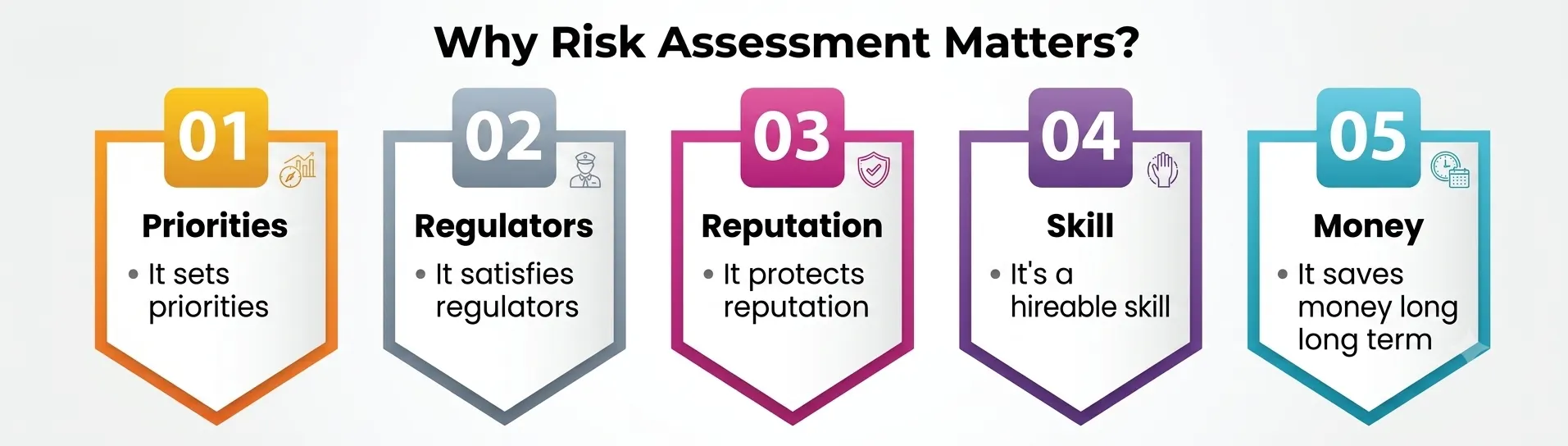
- It sets priorities. No organization has an unlimited budget, so this process tells teams which problems to fix first instead of chasing every alert equally.
- It satisfies regulators. Frameworks in healthcare, finance, and government all require documented proof that dangers were reviewed on a regular schedule.
- It protects reputation. A breach that could have been predicted looks far worse to customers and investors than one that came out of nowhere.
- It’s a hireable skill. Recruiters specifically look for candidates who can run a structured evaluation from start to finish, not just recite security theory from a textbook.
- It saves money long-term. Fixing a gap before it’s exploited is almost always cheaper than incident response, legal fees, and customer churn afterward.
The Core Steps in the Process
Every mature framework breaks the work into stages that build on each other. Here’s how they usually play out in practice and how they connect from one step to the next.
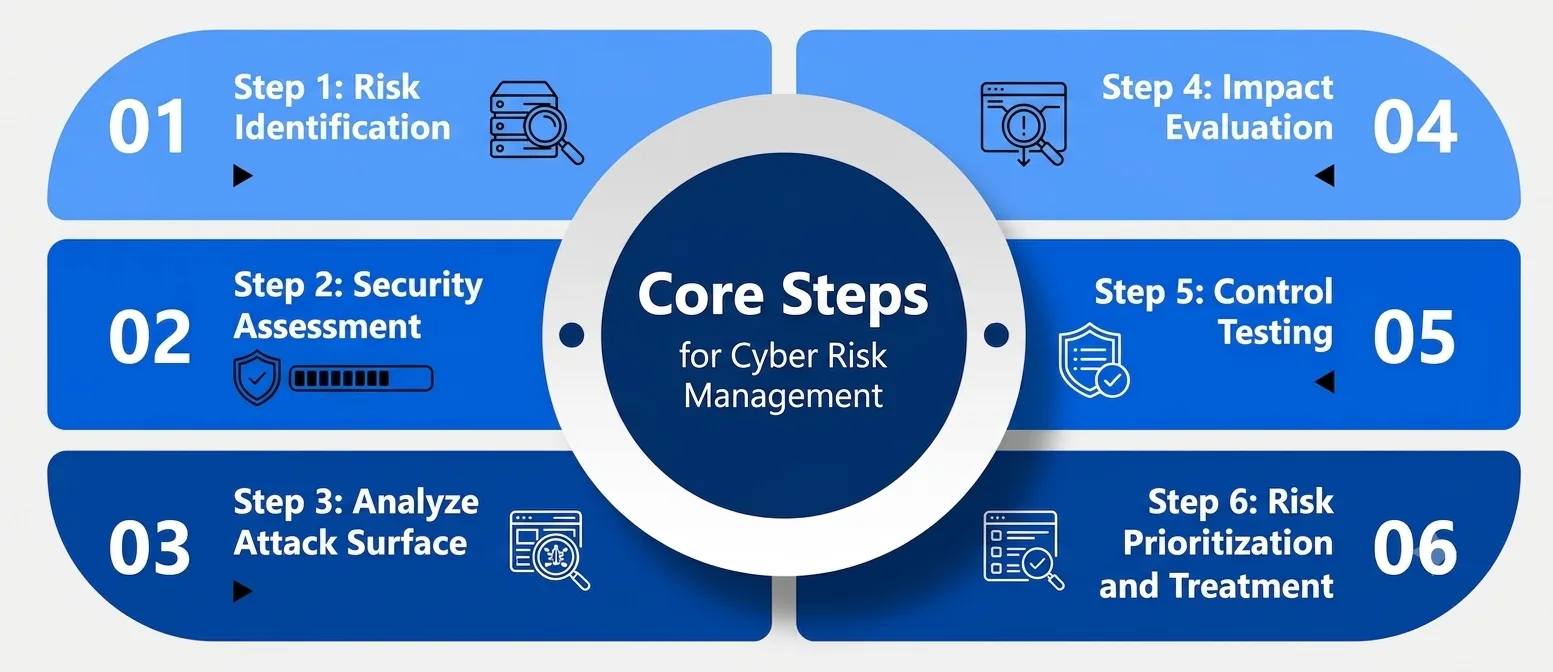
Step 1: Risk Identification
This is where the work begins. Risk identification means cataloguing everything of value—servers, source code, customer databases, physical facilities, and third-party vendors—and then listing every plausible threat and vulnerability tied to each one. Skipping this step is the single most common beginner mistake, because you can’t evaluate a danger you never wrote down. A thorough round of identification usually involves interviews with staff, asset inventories, and a review of past incidents, and it often surfaces “shadow” systems nobody remembered were still running.
Step 2: Security Assessment
After assets and threats are identified, a more in-depth security assessment examines how well current defenses actually hold up against them. That includes things like reviewing firewall rules, control of access, patch levels, and employee awareness. This phase is usually more technical than the last—it might include vulnerability scans, configuration reviews, or interviews with the IT team to learn what’s actually deployed versus what’s just sitting in an old policy binder.
Step 3: Analyze Attack Surface
Then a good look at all possible attacker entry points. In attack surface analysis, we map out open ports, exposed APIs, public-facing web forms, remote access tools, and even physical entry points such as an unlocked server room. The goal here is simple: the smaller and better-monitored the exposed surface, the fewer places a threat actor has to try. Many students underestimate this step because it’s easy to focus only on the “main” systems and forget about forgotten subdomains, retired staging servers, or vendor integrations nobody audits anymore.
Step 4: Impact Evaluation
Not every weakness deserves equal attention, which is why this next stage exists. Impact evaluation asks: if this specific threat actually happened, how bad would it be—financially, legally, operationally, and reputationally? A thoughtful evaluation usually ranks consequences on a scale (low, medium, high, or a numeric equivalent) so different risks can be compared on the same footing rather than argued about anecdotally in a meeting.
Step 5: Control Testing
Finding a gap is only half the job—you also need to confirm whether existing safeguards actually work. Control testing involves simulating attacks, running penetration tests, checking backup restoration, or auditing access logs to see if the protections written on paper hold up in practice. This stage frequently uncovers safeguards that exist only on a policy document but were never properly implemented, which is exactly the kind of gap the whole exercise is designed to catch. Good control testing is repeated on a schedule, not treated as a one-off box to check.
Step 6: Risk Prioritization and Treatment
With likelihood and impact scored, risks get ranked from most to least urgent. Leadership then chooses to accept, avoid, transfer (through insurance or outsourcing), or mitigate each one. This is the decision-making moment the entire earlier process was built to support, and it’s where technical findings get translated into business language executives can act on.
Step 7: Monitoring and Review
Threats evolve, so the picture built in the earlier steps can’t stay static. Scheduled reviews, new vulnerability scans, and updated asset lists keep everything current—this is also where a repeat technical review or a fresh look at exposed entry points often gets scheduled on the calendar.
Who Actually Performs This Work?
In larger organizations, this is rarely one person’s job. Risk analysts and compliance officers typically lead the identification and evaluation stages, security engineers or penetration testers handle the more technical testing, and department heads provide the business context needed to judge financial and reputational impact accurately.
In smaller companies, an IT manager or an outside consultant may run the entire cycle solo, which is exactly why checklists and established frameworks matter so much—they keep a one-person risk assessment from missing steps a full team would naturally cover.
Certifications also shape who ends up owning this work. Credentials like CRISC and CISSP test candidates on this exact skill set, which is why job postings for security analyst and IT auditor roles list it as a core requirement.
Even outside formal titles, project managers increasingly need a working knowledge of the cycle, since new features almost always introduce new exposure someone has to account for before launch.
Methods Used to Score Risk
Not every organization scores danger the same way. The three broad approaches are compared below.
|
Method |
How It Works | Best For |
Limitation |
|
Qualitative |
Uses descriptive scales like low/medium/high, often shown on a risk matrix | Fast, early-stage reviews with limited data |
Subjective—different reviewers can rate the same issue differently. |
|
Quantitative |
Assigns numeric values (probability × financial loss) to calculate expected loss | Budget decisions, insurance, board-level reporting |
Requires reliable historical data, which many teams don’t have |
|
Semi-Quantitative |
Blends scoring scales (e.g., 1–5) with rough numeric weighting | Teams that want more precision than qualitative but lack full quantitative data |
Scores can still feel arbitrary if the scale isn’t well defined. |
Standards bodies such as ISO/IEC 31010 catalogue dozens of specific techniques inside these three categories, including fault tree analysis, bow-tie analysis, and Delphi expert panels—but almost every method traces back to one of these three broad approaches. Most professionals mix them: qualitative scoring for a fast first pass, then quantitative modeling for the handful of issues serious enough to justify the extra time.
Choosing between them usually comes down to two questions: how much reliable data actually exists, and who the final report is for. A board of directors deciding on an insurance policy will want numbers they can plug into a budget line, while a small internal team triaging a long backlog often just needs a fast, defensible ranking to know where to start on Monday morning. Neither approach is inherently better—the mistake is picking one and never revisiting it as the organization and the data available to it mature.
Real-World Examples
A hospital rolling out a patient portal. During the identification stage, the team lists the portal server, the patient database, and a third-party billing API as key assets. The technical review reveals the server is missing a critical patch. Mapping the exposed entry points flags that the billing API is reachable from the public internet without IP restrictions. Scoring the consequences shows that a breach here would trigger regulatory fines and expose sensitive medical records—a high-impact, high-likelihood combination. Testing the existing controls then confirms the web application firewall isn’t actually configured to block the relevant attack pattern. The hospital patches the server, restricts the API, and reconfigures the firewall before the portal ever goes live.
A small retail business. A local shop adding online payments might run a lighter version of the same cycle: list the point-of-sale system and card processor as assets, check whether staff are using shared logins, confirm the payment page uses current encryption, and decide that losing card data would be catastrophic even though the odds seem low. That single conclusion is often enough to justify hiring a payment-compliant vendor instead of building checkout in-house.
A Quick Recap for Students
If you remember nothing else, remember the order. A complete risk assessment moves through five checkpoints: risk identification (know what you own), security assessment (know how well it’s defended), attack surface analysis (know where an attacker could get in), impact evaluation (know what it would cost you), and control testing (know whether your defenses actually hold up under pressure).
Miss a checkpoint and the whole risk assessment produces a distorted picture—skipping attack surface analysis often means an organization patches the systems it already knew about while an exposed API sits untouched, and skipping that verification step means a firewall rule that looks correct on paper never actually gets checked against real behavior.
Turning This Into a Class Project
Professors often assign a mini risk assessment as coursework, and grading rubrics usually reward students who show their work at every stage. Start small: pick one system (a school Wi-Fi network, a campus app, or even your own laptop), run a basic risk identification pass to list what’s connected to it, then do a lightweight attack surface analysis by noting every open service or login page.
Wrap up with a one-page summary that ranks your top three findings by impact and names which control testing step you’d run next to confirm them. That single exercise, done properly, demonstrates more real understanding than memorizing definitions ever will—and it’s exactly the kind of project that looks good attached to an internship application.
Common Mistakes Students and Beginners Make
- Treating risk identification as a one-time checklist instead of an ongoing cycle that needs revisiting every time the environment changes.
- Jumping straight to “fix everything” without properly scoring consequences first, which wastes limited time and budget on low-priority issues while real dangers wait.
- Confusing a vulnerability scan with a full technical review—a scan is one input, not the whole picture, and treating it as a finished report leaves gaps a reviewer would have caught.
- Ignoring physical and human factors while focusing only on software and code, even though social engineering and lost devices cause a large share of real incidents.
- Never revisiting the exposed entry points after new tools, cloud services, or vendors are added mid-year, which quietly grows the danger without anyone noticing.
- Writing findings only for technical readers, which makes it hard for non-technical executives to actually approve a budget for the fix.
Conclusion
Whether you’re studying for a certification, writing your first audit report, or just trying to understand why your company keeps running these reviews, the logic stays the same: identify what you have, test how exposed it is, weigh how bad things could get, confirm your defenses actually work, and repeat.
A disciplined risk assessment turns vague anxiety about “what could go wrong” into a ranked, fundable action list—and that shift is one of the most transferable skills in security, IT, and business today.
A Personal Note
I’ve sat through more than one meeting where a spreadsheet full of red and yellow cells got dismissed as “just paperwork”—until the exact issue near the top of that list turned into a 2 a.m. phone call. The frameworks and jargon can feel dry when you’re first learning them, but the habit underneath is simple and worth keeping for any career, technical or not: look for the worst-case scenario on purpose, before it finds you by accident.