
Audit Trail: How to Track and Monitor Data Changes
If you’ve ever wondered how a bank proves nobody quietly moved a decimal point in your account balance, or how a hospital can tell exactly who opened a patient’s file at 2 a.m., the answer almost always comes back to one unglamorous but essential idea: the audit trail. It isn’t flashy.
Nobody puts it on a resume as their favorite hobby. But once you understand what this record actually does, you start noticing it everywhere—in your college’s grading portal, in your bank’s mobile app, and in the software your future employer will expect you to use responsibly.
This guide breaks down what an audit trail is, why organizations build their entire compliance culture around it, and how it connects to related ideas like change tracking, database activity monitoring, data lineage tracking, digital evidence management, and regulatory reporting.
I’ve written it specifically with students in mind—whether you’re studying information systems, accounting, cybersecurity, or simply trying to make sense of a term you keep seeing in internship postings.
What Is an Audit Trail?
At its core, this concept refers to a chronological record that documents who did what, when, and how, inside a system. According to Wikipedia’s overview of the topic, it is a security-relevant, time-ordered set of records that provides documentary evidence of a sequence of activities affecting a specific operation, procedure, or device. Think of it as a diary that a system keeps about itself—except this diary can’t be torn out, edited, or conveniently “forgotten.”
A well-built audit trail generally captures a few consistent details:
- Who performed the action (a user ID, an application, or a service account)
- What was changed (the specific field, record, or transaction)
- When it happened (a precise timestamp)
- Where it happened (which system, module, or device)
- What it looked like before and after the change
This kind of documentation isn’t just a nice-to-have feature buried in system settings. In regulated industries, it’s often a legal requirement. Financial platforms like Zoho Books explain that maintaining this kind of transaction history is mandated in many countries specifically so auditors can trace fraud and confirm the accuracy of financial statements. Framed that way, this record-keeping habit stops sounding boring and starts sounding like the thing standing between a company and a very bad headline.
Why Change Tracking Matters More Than Ever
Every time a record in a database gets edited, deleted, or created, something needs to be noticed—that’s the essence of change tracking. Without this kind of discipline, a single unauthorized edit to a price list, a grade, or a medical prescription could go unnoticed for months. With it in place, that same edit gets logged, timestamped, and tied to a specific user the moment it happens.
Modern applications rarely rely on a single administrator remembering to “keep an eye on things.” Instead, they build this monitoring directly into the data layer, so every insert, update, or deletion triggers a corresponding log entry. This matters for three big reasons:
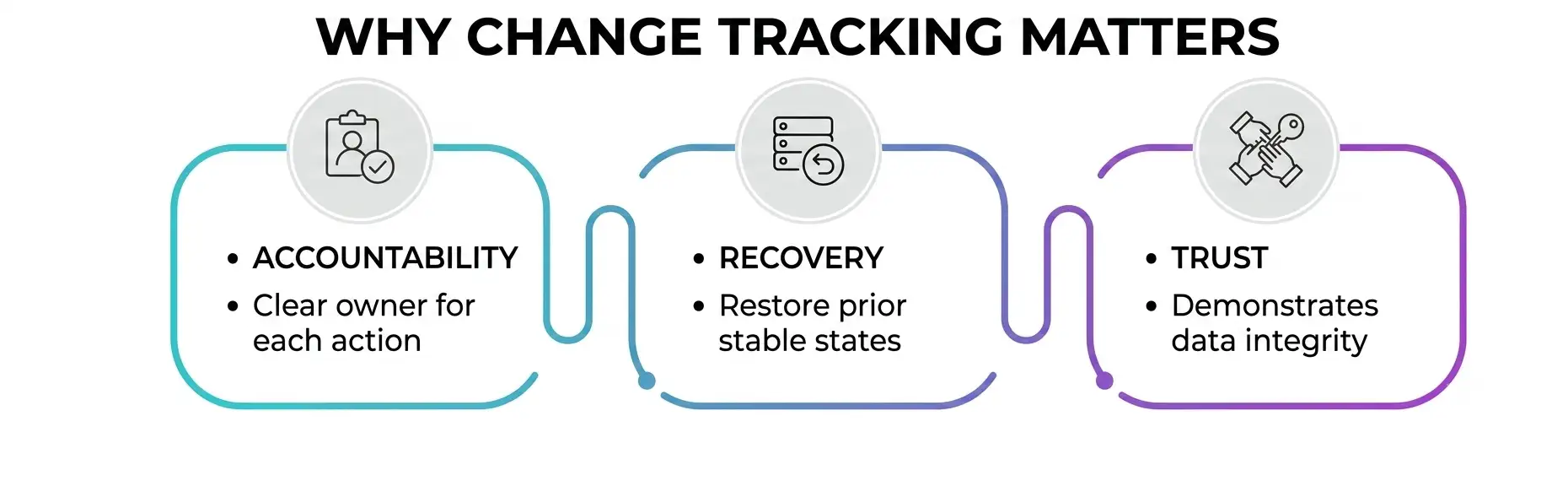
- Accountability—when something goes wrong, teams can pinpoint exactly who or what caused it, instead of guessing.
- Recovery—if bad data slips in, Change Tracking often lets teams roll back to the last known-good version.
- Trust—students, employees, customers, and regulators are far more willing to trust a system that can prove its own history.
A good version of this practice doesn’t just record that something happened; it records the full context around it, which is exactly what turns a simple log into genuine, defensible documentation.
The Building Blocks of a Reliable Record
Not every log file deserves to be treated as a trustworthy history. A proper one is structured, tamper-resistant, and searchable. The table below breaks down the core components most systems rely on.
|
Component |
What It Captures |
Why It Matters |
|
Event identifier |
A unique ID for each logged action |
Makes every entry traceable and non-repeatable |
|
User/actor identity |
Login ID, role, or system account |
Establishes who is accountable for the change |
|
Timestamp |
Exact date and time, often to the millisecond |
Creates a defensible, chronological sequence |
|
Before/after values |
The data state before and after the change. |
Shows precisely what was modified |
|
Source and location |
Device, IP address, or module involved |
Helps investigators reconstruct the full scenario |
|
Immutability controls |
Write-once storage, hashing, or append-only logs |
Prevents anyone from editing history after the fact |
NIST’s Guide to Computer Security Log Management (SP 800-92) lays out very similar principles for federal and enterprise systems, stressing that logs need to be generated consistently, protected from tampering, and retained long enough to be useful during an investigation. That last point trips up a lot of organizations—a history that gets wiped after thirty days isn’t much of an audit trail at all if the fraud only surfaces six months later.
Database Activity Monitoring: Watching the Data Layer in Real Time
While the record itself is the outcome, Database Activity Monitoring (DAM) is one of the main tools used to generate and enforce that record at the database level. DAM combines network-based monitoring with native database audit information to build a full picture of database activity, and it typically runs continuously and in real time.
Why does this matter so much? Because databases are usually the softest target in an organization—a single privileged user with the right credentials could, in theory, quietly read or alter sensitive records without anyone noticing. DAM closes that gap by:
- Flagging unusual queries or bulk data exports
- Alerting security teams to privilege escalation or off-hours access
- Feeding directly into the historical record so every flagged event has a permanent entry
Tools like IBM Guardium, Oracle Audit Vault, and Microsoft Defender for SQL are commonly deployed for exactly this purpose, and Database Activity Monitoring exists because relying purely on native database logs is often too resource-intensive and easy to bypass. In short, DAM puts a second, independent set of eyes on the same data.
Data Lineage Tracking: Following Data From Birth to Report
Here’s where things get genuinely interesting for anyone studying data science or analytics. Data lineage tracking answers a slightly different question than a standard history log. Instead of just asking “who changed this record,” it asks “where did this piece of data originally come from, and what happened to it on the way to this dashboard?”
IBM describes data lineage as the process of tracking the flow of data over time, documenting where it originated, how it was transformed, and where it ultimately ended up in the pipeline. Others add that effective data lineage tracking captures the source of the data, what other datasets contributed to it, who created it, how it has been transformed, and which downstream systems depend on it.
For students working with analytics tools, data lineage tracking is what lets a data scientist trust a report enough to make a decision based on it. If a number in a dashboard looks wrong, this same lineage view lets you walk backward through every transformation until you find the exact step that introduced the error—instead of re-checking the entire pipeline from scratch. Paired with solid day-to-day change monitoring, it turns “the numbers look off” into “here’s precisely where and why they went wrong.”
Digital Evidence Management: When History Has to Hold Up in Court
Sometimes a system’s internal record isn’t just a convenience—it has to survive legal scrutiny. That’s where digital evidence management comes in. This discipline focuses on preserving digital evidence (video, documents, logs, images) in a way that proves it hasn’t been altered since the moment it was collected.
A technical explainer on chain of custody in cybersecurity describes it as the documented process that ensures the integrity, security, and admissibility of digital evidence throughout its entire lifecycle, from collection to presentation in an investigation or legal proceeding.
Digital evidence management systems typically pair the actual evidence with a parallel audit trail recording every person who accessed, copied, or analyzed it—because a broken chain of custody can get otherwise solid evidence thrown out entirely.
For law enforcement, corporate investigations, and compliance teams, this is where that field and traditional record-keeping genuinely merge: both exist to answer the same underlying question—can we prove, beyond doubt, that this record is authentic and untampered?
Regulatory Reporting: Why Auditors Never Stop Asking for Logs
If you’ve ever wondered why so much of this infrastructure exists in the first place, a huge part of the answer is regulatory reporting. Organizations in finance, healthcare, and pharmaceuticals don’t maintain detailed change histories purely out of good discipline—they’re often legally required to in order to satisfy these compliance obligations.
Deloitte’s overview of regulatory reporting describes it as the process of submitting data to the appropriate authority to demonstrate compliance with relevant rules, noting that internal controls, data quality, and accountability can no longer be treated as separate concerns given how complex these compliance requirements have become. Frameworks like GDPR, HIPAA, SOX, and PCI-DSS all lean heavily on the existence of a verifiable record to prove that data was handled correctly.
In pharmaceutical and life sciences contexts specifically, data integrity guidance from regulatory bodies requires that raw data permit the full reconstruction of the activities that generated it—which is really just a formal way of saying: your documentation needs to be good enough that an outside inspector, with zero prior context, could reconstruct exactly what happened. That’s a genuinely high bar, and it’s exactly why these compliance obligations and sound record-keeping design are so tightly linked in practice.
Best Practices for Building an Audit Trail That Actually Works
A weak history log is almost worse than no log at all, because it creates a false sense of security. A few practices consistently separate the systems that hold up under scrutiny from the ones that fall apart:
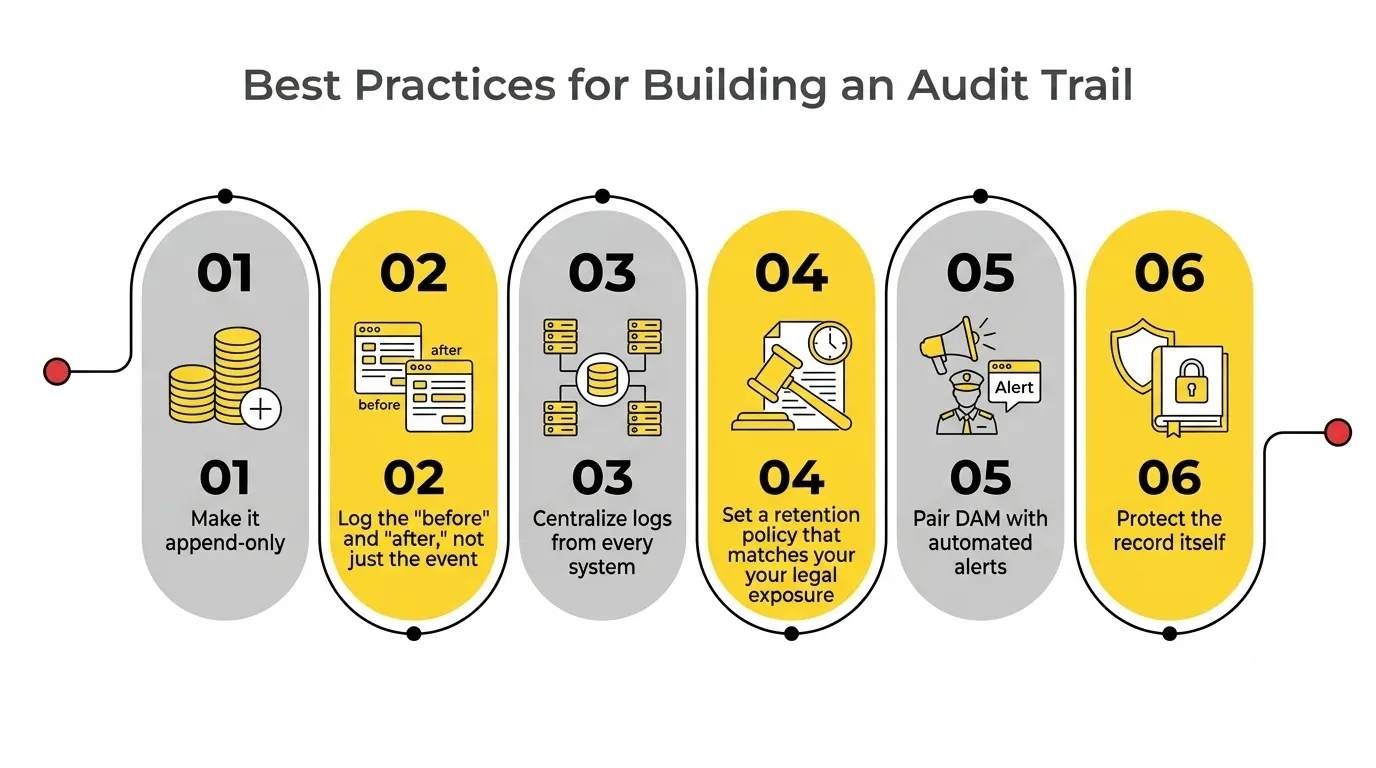
- Make it append-only. Once an entry is written, nobody — not even administrators — should be able to quietly edit or delete it.
- Log the “before” and “after,” not just the event. Knowing that a record “was updated” is nearly useless without knowing what it looked like before.
- Centralize logs from every system. Fragmented logs scattered across ten different tools make change tracking and investigation painfully slow.
- Set a retention policy that matches your legal exposure. If compliance obligations require seven years of history, thirty-day log rotation defeats the purpose.
- Pair DAM with automated alerts. A log nobody reads until something breaks isn’t really being monitored at all.
- Protect the record itself. If an attacker can modify the log, they can erase their own footprints—encryption and hashing help prevent this.
Common Challenges Organizations Run Into
Even well-intentioned teams stumble on a few recurring problems. Storage costs balloon quickly once every micro-change across dozens of systems gets logged in detail, which pushes some organizations to cut corners on retention.
Cross-system consistency is another headache—a data-lineage tool built for one data warehouse rarely talks cleanly to the change log from a separate legacy application, leaving gaps exactly where investigators need continuity the most.
And there’s a very human problem too: teams generate mountains of log data but never build the habit of actually reviewing it, so the record becomes a graveyard of information nobody looks at until it’s too late.
A Personal Note
I’ll be honest with you: the first time I encountered the phrase “audit trail” in a systems class, I filed it away as one of those compliance buzzwords that mattered to auditors and nobody else. It wasn’t until I watched a real investigation unfold—where a single timestamped log entry settled a dispute that could have dragged on for weeks—that I understood why this unglamorous record-keeping habit is treated as sacred in serious organizations.
If you’re a student reading this, my honest advice is: don’t skip the “boring” infrastructure topics like this one. They’re often the exact skills that make you the person a team trusts to investigate when something actually goes wrong.