
Picture this: a company’s main data center floods overnight, and by nine o’clock the next morning customers still can’t log in. Somewhere in a shared drive, there’s a business continuity plan describing exactly what should happen next.
The trouble is, nobody has ever actually tried to run it. This is precisely the gap that continuity testing exists to close. It is the process of rehearsing recovery, not just writing it down on paper, so that when a real disruption hits, the plan performs the way it was designed to.
For students studying risk management, IT operations, or business administration, this is becoming a fundamental topic—as essential to know as reading a balance sheet. Every industry—banking, healthcare, e-commerce, logistics—depends on systems staying available around the clock, and this discipline is what actually proves those systems can bounce back when something goes wrong, instead of just assuming they will.
A bank that can’t process payments for six hours, or a hospital that loses access to patient records during a shift change, isn’t facing an abstract IT problem—it’s facing a resilience failure with real consequences for real people.
In this guide, we’ll break down what this term means, how it works step by step, the different types you’ll come across, how it relates to disaster recovery testing, and the metrics—like recovery time objective—that make an exercise meaningful instead of symbolic.
What Is Continuity Testing?
Continuity testing is the practice of validating a business continuity plan (BCP) by simulating a disruption and observing whether people, processes, and technology respond the way the plan says they will. It’s the difference between owning a fire extinguisher and actually knowing, because you’ve used one before, that it works when it matters.
At a basic level, this kind of testing answers one question: if a disruption happened right now, would the organization keep functioning, or would the plan collapse the moment reality got involved? A plan that has never been tested is really just a hypothesis wearing a formal title.
This matters because continuity planning on paper and continuity planning in practice are two very different things. A document can look complete—contact lists, recovery steps, backup sites—and still fail the first time it’s used, because nobody accounted for a key manager being on leave, a vendor not answering the phone, or a backup site that was never actually provisioned.
NIST’s contingency planning guidance makes this point directly: a plan only becomes a real capability once it has been tested, trained on, and exercised—not simply written and filed away.
Why Does It Matter for Organizational Resilience?
Every organization likes to talk about resilience, but organizational resilience is not a mindset you declare—it’s something built through repetition and evidence. Regularly rehearsing recovery is one of the few disciplines that forces a business to prove, on a schedule, that it can absorb a shock and keep delivering for customers.
Regulators have started treating this as non-negotiable rather than optional. In the EU, central securities depositories are required under Article 79 of Regulation (EU) No 909/2014 to test their continuity and disaster recovery arrangements at least once a year, covering large-scale disaster scenarios and switchovers between primary and secondary sites. That’s a direct, legal expression of how seriously mature organizations take resilience.
The international standard ISO 22316 goes further, framing resilience as something built through leadership, culture, shared awareness of risk, and—crucially—continual practice. Testing is where that theory gets checked against reality. An organization that skips it is essentially claiming a level of resilience it has never actually demonstrated.
How Continuity Testing Works: Step by Step
So how does this actually work once you move past the theory?
-
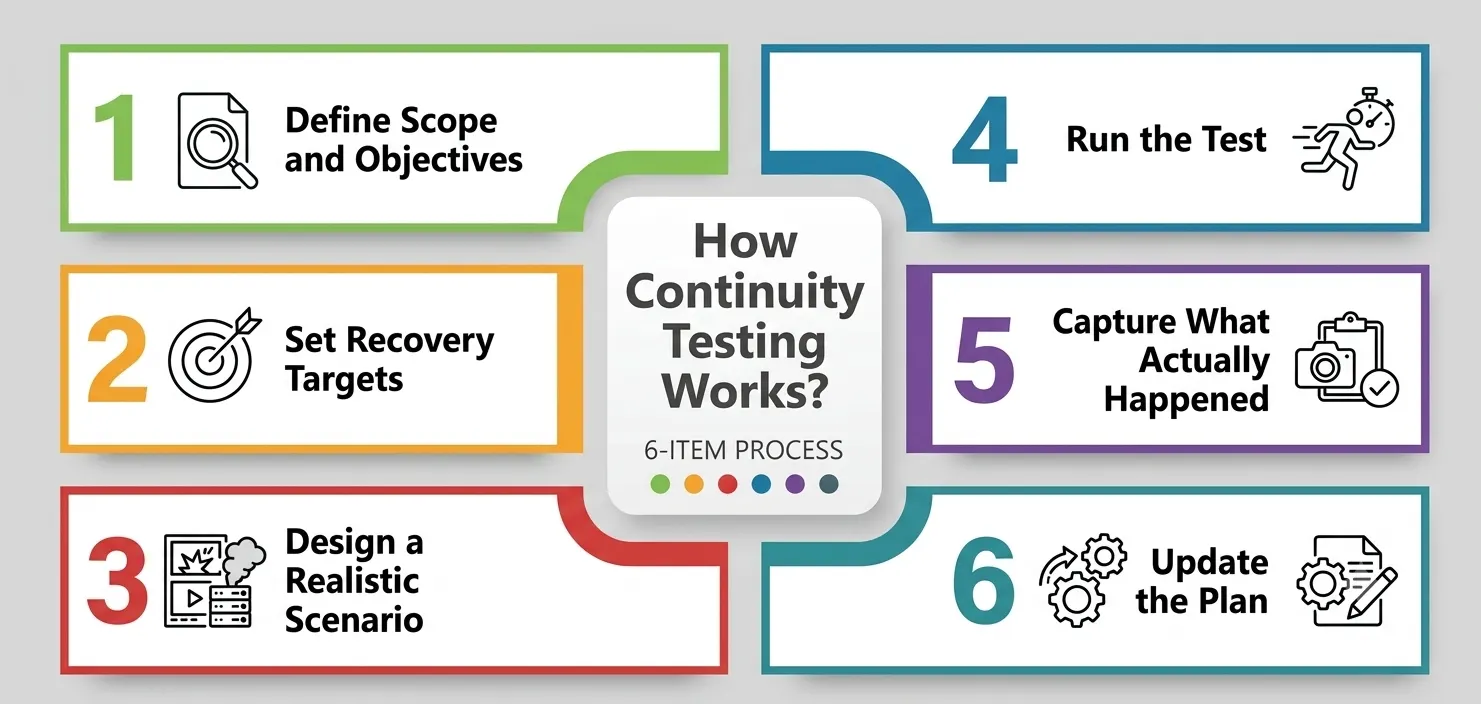
Define scope and objectives. Decide which processes, systems, or sites are being tested, and tie the exercise back to the organization’s continuity planning priorities—the functions that would hurt the most if they went down.
-
Set recovery targets. Every serious exercise starts with a clear recovery time objective for each critical process—the maximum time it can stay unavailable before the damage becomes unacceptable. The AWS Well-Architected Framework describes this as the maximum acceptable delay between an interruption and full restoration of service.
-
Design a realistic scenario. A regional power outage, a ransomware attack, a key supplier going dark—the more specific and plausible the scenario, the more useful the exercise.
-
Run the test. Depending on the type chosen, teams either talk through the plan, simulate parts of it, or actually fail over to a backup site.
-
Capture what actually happened. Record timings against the target, note where communication broke down, and log every improvisation the team had to make on the spot.
-
Update the plan. This is the step organizations skip most often, and it’s the one that matters most—an exercise that doesn’t change the plan was barely a test at all.
Types of Continuity Testing
Not every exercise needs to shut down live systems, and not every organization is ready for a full failover on day one. Programs typically follow a maturity curve, starting cheap and low-risk and building toward realistic, higher-stakes rehearsals.
|
Test Type |
What Happens |
Best Suited For |
|
Tabletop / Walkthrough |
The team discusses the plan step by step around a table; no systems are touched. |
Early-stage plans, new teams, tight budgets |
|
Simulation |
A mock incident runs in a controlled environment to test decision-making. |
Mid-maturity programs, cross-department coordination |
|
Parallel Test |
Backup systems run alongside live production without disrupting it. |
Validating a recovery site with zero customer risk |
|
Full Interruption Test |
Primary systems are deliberately taken offline, and recovery is executed for real. |
Mature programs confident in their continuity planning |
|
Disaster Recovery Testing |
Focused specifically on restoring IT infrastructure, applications, and data | Technical teams validating backups and failover independent of the wider business plan |
A well-known reference point here is the tabletop format used by many universities and public agencies, including UC Irvine’s continuity training program, which relies on low-cost, discussion-based exercises to check whether a plan is fit for purpose before committing to anything more disruptive.
Continuity Testing vs. Disaster Recovery Testing
Students often use the two terms as if they’re interchangeable, but they actually sit at different levels of the same problem, and mixing them up is one of the most common mistakes in exam answers and in real audit reports alike.
Disaster recovery testing is narrower and more technical. It focuses on IT: can servers, applications, and data actually be restored from backup within the target window? AWS’s guidance on disaster recovery frames disaster recovery as one component of a wider business continuity strategy, not a replacement for it.
The broader discipline covers whether the whole organization—people, suppliers, communication chains, physical workspace, and yes, IT—can keep functioning, not just whether a server comes back online. A useful way to separate the two: disaster recovery testing asks “can we restore the system?” while the broader exercise asks “can the business keep serving customers?”
Recovery Time Objective, Service Recovery, and the Metrics That Matter
Two numbers usually anchor a serious testing program: the recovery time objective and its close relative, the recovery point objective. Together, they set the boundaries of an acceptable outage—one measures how long a process can stay down, and the other measures how much data the organization can afford to lose, counted backward from the moment of disruption.
Hitting a recovery time objective on paper is easy. Hitting it in an actual exercise, with real people executing real steps under time pressure, is the entire point of continuity testing.
But hitting that time target alone doesn’t guarantee a good outcome for customers. That’s where service recovery comes in—the discipline of restoring the actual service experience, not just the underlying system.
A team can technically meet its recovery window and still deliver poor service recovery if customers can’t log in cleanly, transactions fail silently, or support queues collapse under the weight of everyone calling at once.
Mature programs track service recovery using customer-facing measures: transaction success rate, checkout completion, call center wait times, and app reviews in the days after a real incident.
Service recovery is ultimately the number that tells you whether the exercise—and the plan behind it—actually protected the business or just protected the servers. Getting this right feeds back into broader organizational resilience, since customers judge a company by how it behaves during a bad week, not a good one.
How This Plays Out Across Industries
The shape of a good exercise changes a lot depending on what an organization actually does.
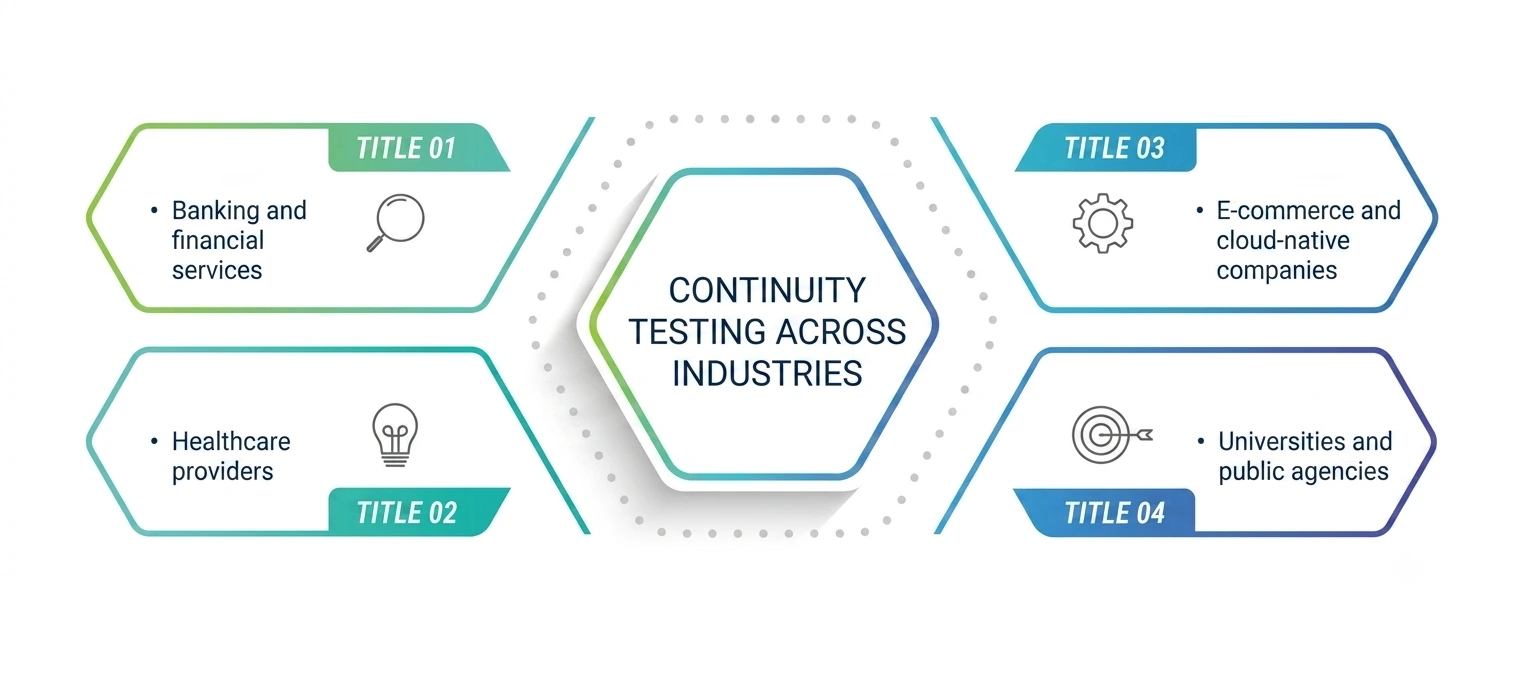
- Banking and financial services tend to have the strictest requirements, often set by regulators rather than choice. A payments processor might run a full failover to a secondary data center once a year while relying on smaller tabletop exercises for the months in between, because even a few hours of downtime on a payment rail affects thousands of unrelated businesses at once.
- Healthcare providers face a different kind of pressure: patient safety. A hospital that loses access to electronic health records isn’t just inconvenienced—clinicians may be forced back onto paper charts mid-shift. Exercises here usually focus heavily on communication chains and manual fallback procedures, not just server restoration.
- E-commerce and cloud-native companies typically lean on parallel testing and automated failover drills, since their infrastructure is built to run across multiple regions already. For them, the exercise is less about proving a backup site exists and more about proving the automated switch actually happens fast enough to avoid losing a shopping cart mid-checkout.
- Universities and public agencies, like the tabletop programs run by campus emergency management offices, often start smaller—discussion-based exercises that build a culture of preparedness and organizational resilience before committing budget to anything more elaborate. This is usually the right instinct: a school running its first exercise doesn’t need a full-scale simulation; it needs a realistic conversation about who calls whom and when.
Across every one of these sectors, the underlying goal is identical—narrow the gap between what the plan claims and what the organization can actually do under pressure.
Best Practices for Running Effective Continuity Testing
- Test on a schedule, not just after an incident. Annual testing is a common regulatory minimum, but critical systems—payment processing, patient records, core booking engines—often warrant more frequent exercises, sometimes quarterly, because the cost of a surprise outage rises faster than the cost of practicing for one.
- Involve the whole business, not just IT. Continuity planning fails when it’s treated as a purely technical exercise handed off to server administrators; finance, HR, legal, and customer service all need a seat at the table, because a real disruption never confines itself neatly to one department.
- Set a clear recovery target before you start, so success or failure is measurable rather than a matter of opinion. Writing down a specific number of hours, and holding the exercise to it, is what separates a genuine test from a demonstration.
- Debrief honestly. The real value of the exercise comes from what’s uncomfortable to admit—the missed phone call, the outdated contact list, the backup that silently stopped running weeks ago, and the manager who didn’t know they had a role in the plan at all.
- Close the loop. Update the plan, retest the fix, and treat organizational resilience as a habit rather than a certificate you earn once. A plan that was tested two years ago and never touched since is already out of date.
Common Mistakes Students and Organizations Make
A few patterns show up again and again, whether it’s a first-year student writing a case study or a real company running its first exercise.
The first is treating the written plan as proof by itself. A polished document with an impressive table of contents means nothing if nobody has actually walked through it under time pressure.
The second is testing only the easy parts—running a backup restore in a quiet office on a Tuesday afternoon isn’t the same as coordinating a response at 3 a.m. with half the usual staff unreachable.
The third is skipping the debrief. Teams that rush straight from “the exercise is over” to “back to normal work” lose almost all the value of having run it in the first place, because the gaps never get written down or fixed.
Finally, many organizations test once, declare success, and never repeat it—treating readiness as a one-time achievement instead of an ongoing habit that needs to keep pace with new systems, new staff, and new risks.
A Note From the Author
I’ve sat through plans that looked flawless on paper and fell apart in the first ten minutes of a real exercise—not because anyone was careless, but because nobody had actually pressure-tested the assumptions underneath it.
If you’re a student learning this material, the one thing worth remembering is that this work isn’t paperwork; it’s the closest thing most organizations have to a fire drill for their entire business. Treat it that way, and resilience stops being an abstract word in a textbook and starts being something you can actually plan, measure, and improve.