
A student in one of my workshops asked me something I still think about: “If encryption exists, why do companies keep getting hacked?” I get why she asked. On paper, the tools are mature—encryption, access control, and monitoring have all existed for decades, and none of them is secret knowledge anymore.
In practice, database security in 2026 is harder than it’s ever been, because attackers now move at machine speed while most defense teams are still stuck approving change requests in weekly meetings. The gap isn’t a knowledge problem. It’s a speed problem, and closing it is what this guide is really about.
The numbers back this up. According to IBM’s 2026 Report, one in four malicious breaches this year were AI-enabled, and those breaches cost an average of $6 million—roughly a million dollars more than the global average of $4.99 million. It isn’t a checkbox exercise anymore. It’s a discipline that has to be practiced continuously, and that’s exactly what this guide walks through, in plain language, for anyone starting to learn the field.
Why Database Security Still Fails in 2026?
For nineteen straight years, stolen credentials were the number one way attackers broke into systems. That changed this year. The 2026 Verizon Data Breach Investigations Report found that software vulnerability exploitation has overtaken stolen credentials as the leading entry point, now responsible for 31% of breaches, while credential abuse fell to 13%. AI is a big reason why—attacks that once took months to plan now happen in hours.
What makes this worse is how slowly organizations patch. The analysis found that only 26% of critical vulnerabilities were fully remediated last year, and the median time to full remediation stretched to 43 days. Third-party involvement in breaches jumped 60% year over year, now touching 48% of all incidents.
Meanwhile, on the encryption front, IBM found that only 37% of breached organizations encrypt sensitive data both at rest and in transit, and just 34% have real visibility into where their cryptographic assets even live. That gap between “we think we’re covered” and “we actually are” is where most database security incidents originate.
The Five Pillars of Database Security You Actually Need
Protecting a database isn’t one control—it’s five overlapping habits working together, each covering a blind spot the others can’t. Skip one, and the remaining four carry more weight than they were built to hold. Newcomers to this field often assume one strong tool, like a firewall or a single encryption policy, is enough. It never is, because attackers only need to find the one habit your team skipped. Here’s how each of the five pieces fits and why none of them can substitute for another.
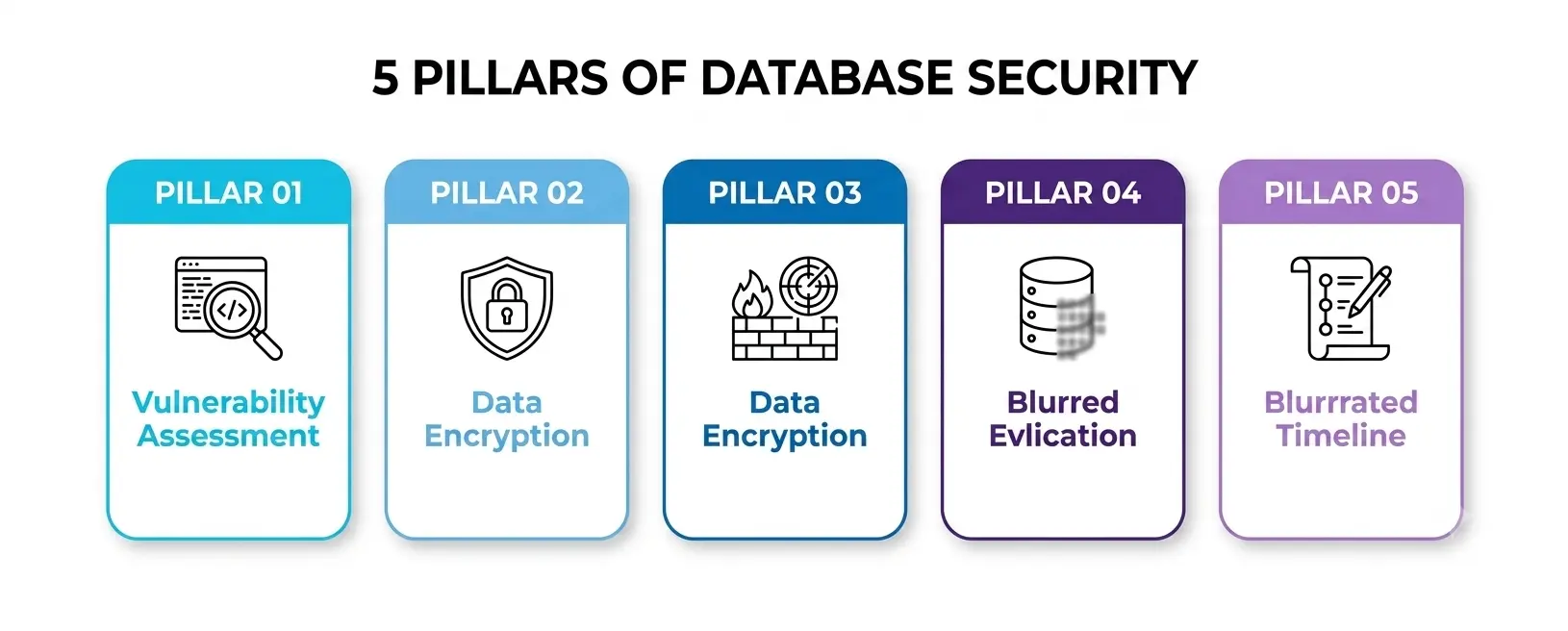
1. Vulnerability Assessment: Find the Cracks Before Someone Else Does
A vulnerability assessment is the routine scan of your database systems, configurations, and surrounding applications to find weaknesses before an attacker does. It’s not a one-time audit; it needs to run on a schedule, because new flaws surface constantly.
In April 2026 alone, researchers tracked fresh SQL injection vulnerabilities in production software, including a critical flaw in Fortinet FortiClient EMS that was already being actively exploited before it even appeared on official exploited-vulnerability lists.
SQL injection itself refuses to die. It has sat in OWASP’s top rankings for over two decades, and a proper vulnerability assessment routine—combined with parameterized queries and least-privilege database accounts—remains the most reliable way to catch it before it becomes a headline.
If your team isn’t scanning for these on at least a quarterly basis, treat that as your first fix, not your fifth. Even a modest, free scanner run consistently beats an expensive tool that only gets used once a year.
2. Data Encryption: The Last Line of Defense
Data encryption protects information even after every other control has failed—which is exactly why it matters so much. Encrypting data at rest and in transit means that a stolen database dump, on its own, is just noise to whoever took it. Yet IBM’s own numbers show most companies aren’t there yet: barely a third encrypt consistently across both states.
Good data encryption in 2026 also means treating key management as its own discipline. As one enterprise data security guide notes, key administrators shouldn’t be the same people who manage the databases those keys protect, and every key action—creation, rotation, access, deletion—should generate a log that routes to centralized monitoring. Encryption without disciplined key management is a lock with the key taped to the door.
3. Intrusion Detection: Catching the Intruder While It’s Still Happening
Intrusion detection is about noticing an attacker while they’re still inside, not three weeks later when a regulator calls. Database Activity Monitoring tools watch for the signals that matter—failed logins, unusual query volume, bulk data reads, access at odd hours—and flag them before they turn into an exfiltration event.
Speed matters more than ever here. The CitrixBleed 2 vulnerability showed how attackers can hijack an already-authenticated session and walk straight past multi-factor authentication, because MFA only protects the login event, not what happens after. Without real-time intrusion detection watching session behavior itself, a fully patched, fully encrypted system can still be wide open.
4. Data Masking: Protecting What People Don’t Need to See
Data masking replaces sensitive values with realistic but fake substitutes, so developers, testers, and analysts can do their jobs without ever touching real customer records. It’s one of the most underused controls in smaller teams, largely because it feels like extra work—until a leaked staging database turns out to contain full production data.
Data masking has taken on new urgency because of AI tools. Employees increasingly paste raw data into generative AI assistants without approval—what security teams now call “shadow AI.” IBM linked shadow AI to 20% of breaches this year, adding an average of $670,000 to the cost of each one.
Guidance on securing AI-integrated systems now explicitly recommends applying strict data masking before any text reaches an AI model, and that advice applies just as much to your database exports as it does to chatbots.
5. Audit Logging: Building the Trail You’ll Need Later
Audit logging is the record of who did what, when, and inside your database—and it’s often the only thing standing between “we think this happened” and “we can prove exactly what happened.”
A solid logging setup captures successful and failed logins, permission grants, schema changes, and data exports, then ships that record somewhere the database itself can’t touch or quietly overwrite.
That last part matters more than people assume. As one practical guide to logging strategy puts it, an attacker who reaches the database shouldn’t be able to erase the trail without detection—which is why audit logging should always write to storage separate from the system being watched. Set a quiet baseline first, then alert on real deviations, rather than drowning your team in noise from day one.
What 2026’s Breach Data Is Actually Telling Us?
|
Metric |
2026 Figure |
|
Global average cost of a data breach |
$4.99 million |
|
Average cost of an AI-enabled breach |
$6 million |
|
Average cost of a healthcare sector breach |
$10.93 million |
|
Breaches caused by vulnerability exploitation |
31% (up from 20%) |
|
Critical vulnerabilities fully remediated |
26% |
|
Organizations encrypting data at rest and in transit |
37% |
|
Breaches involving a third party |
48% |
Sources: IBM Cost of a Data Breach Report 2026, Verizon 2026 DBIR, IBM healthcare breach analysis.
The Business and Regulatory Stakes
None of this happens in a vacuum. Reported cybercrime losses jumped 33% in the FBI’s most recent accounting, from $12.5 billion to $16.6 billion—and that’s a single agency’s tally for a single year. Regulators have also stopped treating breaches as purely a technical problem for the IT department to sort out quietly.
Under the EU’s NIS2 directive, company leadership can now be held personally liable for failing to implement adequate risk management measures, with administrative fines reaching €10 million or 2% of global turnover, whichever is higher. In the most serious cases, regulators can suspend executives from their managerial roles entirely.
That shift matters if you’re building a career in this field. A well-run protection program used to be judged mainly on whether it stopped attacks. Increasingly, it’s also judged on whether an organization can prove, in writing, that reasonable care was taken—which is exactly why documented scans and clean activity trails carry as much weight with a regulator as they do with an incident responder.
If you’re learning this field, get comfortable writing things down clearly. The technical fix and the paper trail are no longer separate jobs; they’re the same job, done properly.
Common Mistakes I See Beginners Make
The biggest one is treating database security as a launch-day task instead of an ongoing habit. Teams harden a database once, move on, and never revisit it. PostgreSQL, for example, ships with sensible defaults, but production settings like TLS, restrictive access rules, and activity logging require explicit configuration—a default install left untouched is not a secure install, no matter how good the software is out of the box.
The second mistake is trusting patches alone to fix a breach in progress. In January 2025, attackers exploited an SQL injection flaw in PostgreSQL to breach a remote-support platform, and the intrusion chain ultimately reached the US Treasury Department.
Patching closes the door for new attackers, but it does nothing about a session an attacker already stole. That’s why intrusion detection and session invalidation matter just as much as the patch itself—closing the hole and evicting the intruder are two separate jobs.
A third, quieter mistake is trusting outside vendors with more access than they need and then never checking back. Third parties are now involved in roughly half of all breaches, often because a contractor or SaaS integration was granted broad access years ago and nobody ever revisited the grant. Treat vendor access the same way you’d treat an employee’s: time-limited, tracked, and reviewed on a fixed schedule, never granted once and forgotten about.
A Starter Checklist for Learning Database Security
If you’re a student trying to build real, job-ready skills, work through these in order:
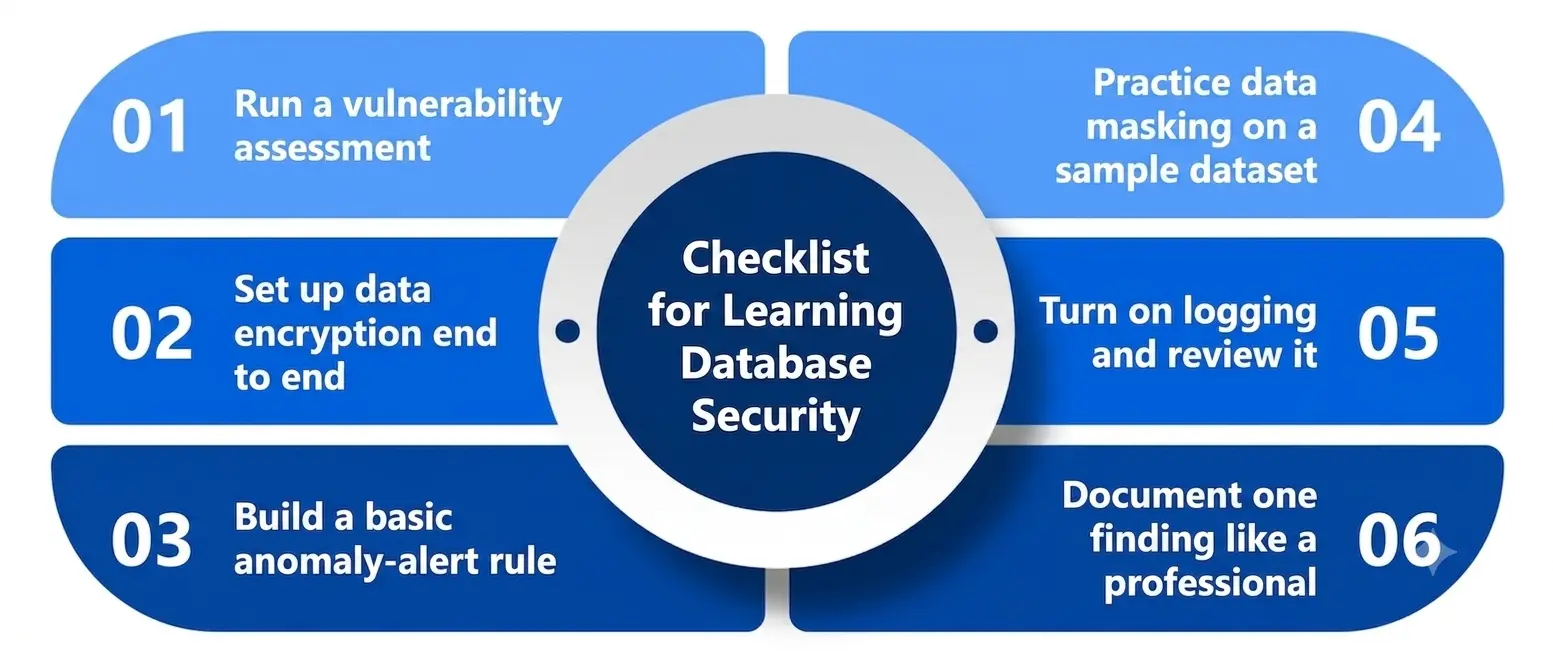
- Run a vulnerability assessment on a practice environment. Use a free scanner against a deliberately vulnerable app (never a live production system) to see what real findings look like.
- Set up data encryption end to end. Encrypt a test database at rest, enable TLS in transit, and practice rotating a key without downtime.
- Build a basic anomaly-alert rule. Configure an alert for failed logins or unusual query volume in a sandbox database, then deliberately trigger it yourself so you know what a real alert looks like before you’re staring at one during an incident.
- Practice data masking on a sample dataset. Take a public dataset with fake PII and mask it before “sharing” it with a mock analytics team.
- Turn on logging and actually review it weekly. Even a small home lab project benefits from the habit of reading logs rather than just collecting them; most teams only discover their logging was misconfigured after an incident, when it’s too late to matter.
- Document one finding like a professional would. Pick a single scan result and write it up the way you’d report it to a manager: what the risk is, how bad it could get, and what fix you’d recommend, with a realistic timeline attached.
A Personal Note
I’ve been teaching and writing about this field long enough to notice a pattern: the students who go furthest aren’t the ones who memorize every acronym. They’re the ones who get genuinely curious about why a breach happened, who read the postmortem instead of just the headline, and who ask, “What would have caught this earlier?” instead of just, “Who’s to blame?”
Database security rewards that kind of patience. It’s not glamorous work most days—it’s logs, patches, and reviewing access lists that nobody else wants to touch. Some weeks feel repetitive, and that’s normal; the repetition is the job, not a sign you’re doing something wrong.
But when you’re the reason a breach didn’t happen, nobody throws you a parade. Nobody even notices, because the story that doesn’t happen never makes the news. Honestly, that’s kind of the point, and it’s a strange thing to make peace with early in a career built on being invisible when things go right. Stay curious, keep your basics boring and consistent, and you’ll outlast most of the noise in this field.