

Every business, big or small, runs on data now—customer records, payment details, internal reports, all of it sitting on a server somewhere. That convenience comes with a price tag most people don’t think about until it’s too late: a single cyberattack can undo years of trust in one bad afternoon.
This is exactly where cybersecurity risk management earns its place at the center of any serious business strategy. It isn’t a buzzword thrown around in boardrooms—it’s the practical discipline of finding your weak points before someone else does and deciding what to do about them.
In this blog, I’ll walk you through what this discipline actually means, why it matters more in 2026 than it ever has, and how students and early-career professionals can start building a real foundation in this field. No jargon-heavy lecture—just a clear, honest breakdown you can actually use.
What Is Cybersecurity Risk Management?
At its core, it’s the ongoing process of identifying, evaluating, and reducing the digital threats an organization faces—then deciding how much risk is acceptable to carry forward. It’s not about eliminating every possible threat (that’s impossible); it’s about knowing which threats matter most and putting resources where they’ll actually make a difference.
The NIST Cybersecurity Framework is one of the most widely referenced models for this. Its 2.0 version organizes the process around six functions: govern, identify, protect, detect, respond, and recover. Think of it as a loop, not a checklist—because threats evolve, your approach to managing that risk has to evolve with them.
For students studying information security, this is the concept everything else hangs on. Firewalls, encryption, and access controls—they’re all tools used inside a bigger risk management framework, not replacements for one.
Why Cybersecurity Risk Management Matters for Businesses Today
Numbers make this real. According to IBM’s Cost of a Data Breach Report, the global average cost of a data breach sits at $4.4 million, and healthcare organizations—which carry especially sensitive records—face the steepest average losses of any sector.
The same research found it still takes organizations well over 200 days on average just to identify and contain a breach. That’s more than six months of exposure, and every extra day adds to the final bill.
Small and mid-sized businesses often assume attackers only target large corporations. That assumption is exactly what makes them attractive targets—smaller companies frequently have weaker defenses and less budget for dedicated security staff, which makes them easier entry points.
A structured, disciplined approach to managing that risk levels the playing field. It doesn’t require a massive budget; it requires discipline, documentation, and a willingness to treat security as an ongoing responsibility rather than a one-time project.
The Growing Attack Surface: Remote Work and Third-Party Risk
Part of why this field has become so central to business strategy is that the attack surface itself has quietly expanded. A decade ago, most sensitive systems sat behind a single office network with one clear perimeter to defend.
Today, employees log in from home routers, personal laptops, and coffee-shop Wi-Fi, and companies routinely hand data access to outside vendors, contractors, and cloud providers who each carry their own security gaps.
This shift matters because a chain is only as strong as its weakest link. A well-defended company can still be compromised through a poorly secured vendor, a misconfigured cloud bucket, or an employee’s personal device that was never properly secured.
Any serious risk strategy today has to look beyond the company’s own walls and account for every third party that touches sensitive systems, because attackers routinely go after the easiest entry point rather than the strongest target.
Regulatory and Compliance Pressure
There’s also a legal dimension businesses can’t afford to ignore. Organizations worldwide are being forced to demonstrate they’re proactively managing digital risk, not merely reacting to incidents after the fact, with regulations like the GDPR in Europe, HIPAA for healthcare data in the US, and a patchwork of privacy laws at the state level.
Missing it is no longer just a technical failure; it can mean real fines, lawsuits, and mandatory public disclosures that can damage a brand for years.
For many organizations this pressure has formalized what used to be informal or ad hoc practices. Having policies documented, reviewed regularly, and a clear paper trail proving due diligence is becoming the norm, not a nice-to-have.
For students entering the field, understanding this compliance layer is just as important as understanding the technical tools, since a lot of real-world security work involves translating legal requirements into practical, everyday controls.
Common Tools and Technologies in a Risk Management Program
No single product solves security by itself, but a few categories of tools appear over and over again in mature programs. Firewalls and intrusion detection systems monitor the network edge for suspicious activity.
Security information and event management (SIEM) platforms gather logs from across an organization into one location, which helps to detect weird patterns before they become major incidents. Endpoint protection software watches individual devices—laptops, phones, servers—for malware and unexpected behavior.
Encryption tools protect sensitive files at rest on a hard drive or in transit across a network, and automated patch management systems ensure that known software flaws are patched on a predictable schedule rather than when someone thinks about it. None of these tools work in isolation—they’re only as good as the strategy that connects them, which is exactly what a well-run risk program does.
The Core Steps of Cybersecurity Risk Management
Most frameworks, no matter the industry they are built for, follow a similar sequence. This is how it usually works in practice:
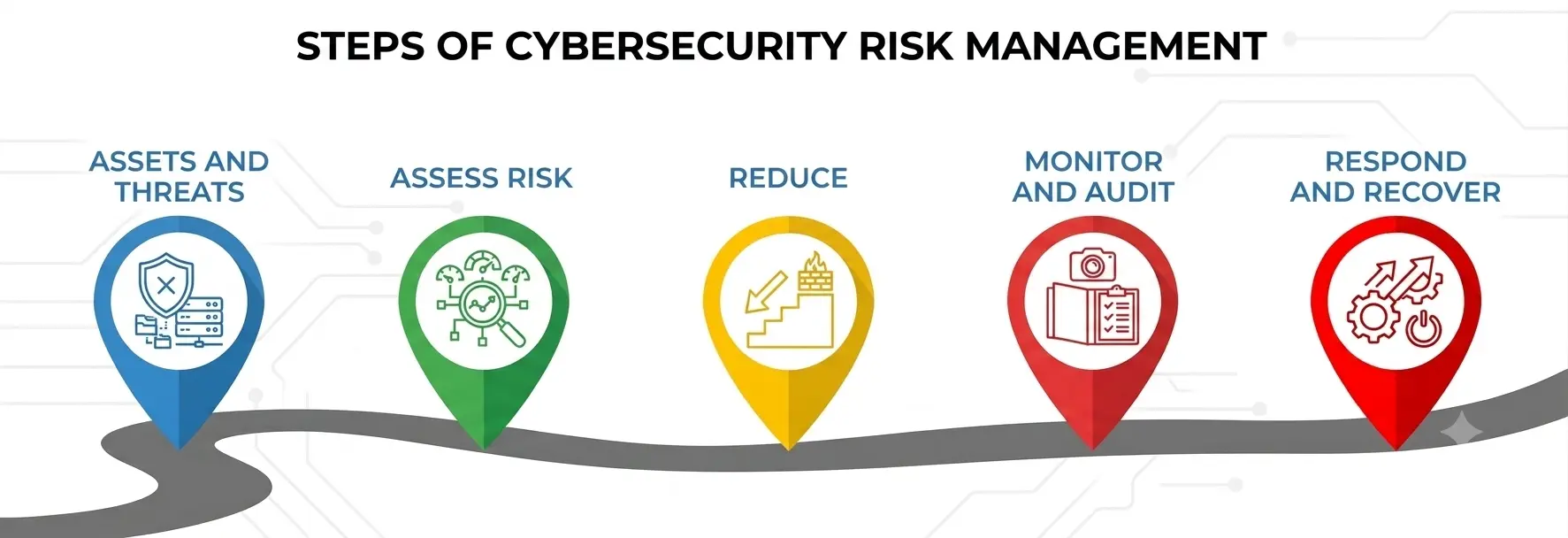
- Assets and Threats – List what you are protecting (data, systems, devices) and what can go wrong.
- Assess risk—Estimate the probability of each threat and the potential damage.
- Reduce—Use controls: encryption, limiting access, training employees, and scanning systems regularly to find weaknesses before attackers do.
- Monitor and audit—Keep watching. This is where a routine IT security audit earns its value, since threats and systems both change constantly.
- Respond and recover—Have a plan ready for when something does go wrong, because eventually, something will.
This cycle is what separates a business that reacts to incidents from one that’s genuinely prepared for them. Skipping any single step weakens the whole chain—mitigation without monitoring is just guesswork, and monitoring without a response plan just tells you how badly things went.
A Quick Look: Key Elements of Cybersecurity Risk Management
|
Element |
What It Involves |
Why It Matters |
|
Risk Identification |
Mapping assets, data flows, and possible threats |
You can’t protect what you haven’t accounted for. |
|
Vulnerability Scanning |
Automated checks for known weaknesses in systems and software |
Catches exploitable gaps before attackers find them |
|
IT Security Audit |
Independent review of policies, access controls, and configurations |
Confirms controls are actually working as intended |
|
Data Protection |
Encryption, backups, and access management for sensitive information |
Limits damage if a breach does occur |
|
Cyber Resilience Planning |
Incident response and recovery procedures |
Keeps operations running when, not if, something fails |
Building Cyber Resilience Through Proactive Planning
The term “cyber resilience” is used loosely but has a specific meaning: it’s your organization’s ability to keep operating—or bounce back quickly—during and after a cyberattack. Prevention is important, but there is no perfect defense, so it is this ability that determines if an incident is a minor disruption or a company-ending event.
The first step to building this kind of resilience is redundancy—backup systems, offline copies of data, and straightforward communication plans so that when one part of the system fails, the rest can keep on running. It also means training staff to recognize phishing attempts and social engineering, since human error remains one of the most common entry points for attackers. A business that treats recovery planning as an afterthought usually discovers the gap in the worst possible moment—during an actual incident.
Data Breach Prevention: Practical Steps That Actually Work
Data breach prevention isn’t about a single silver-bullet tool; it’s a layered approach. Some of the most effective, low-cost measures include:
- Enforcing multi-factor authentication across all accounts, not just admin logins.
- Applying the principle of least privilege, so employees only access what their role requires.
- Patching software and systems on a predictable schedule instead of waiting for a crisis.
- Encrypting sensitive data both at rest and in transit as a core part of data protection.
- Running regular employee awareness training, since phishing remains one of the most common attack vectors, according to industry breach research.
None of these steps are exotic or expensive. What actually stops most data breach prevention programs from working isn’t lack of knowledge—it’s inconsistency. A policy that exists on paper but isn’t enforced day to day offers almost no real protection.
The Role of an IT Security Audit in Risk Management
An IT security audit is the reality check every cybersecurity risk management strategy needs. It’s a structured review—sometimes done internally, sometimes by an outside firm—that checks whether your stated policies match what’s actually happening on your network. Are old employee accounts still active? Are backups actually being tested, not just scheduled? Is data protection applied consistently, or only on paper?
The CISA Cyber Essentials guide is a solid, free starting point for organizations that want a structured way to evaluate their current posture without hiring a large consultancy right away. Running these audits at least once a year—more often for organizations handling sensitive data—keeps assumptions from quietly turning into blind spots.
Vulnerability Scanning: Your First Line of Defense
Vulnerability scanning is one of the more technical pieces of the puzzle, but it doesn’t have to be intimidating. In simple terms, it uses automated tools to check systems, networks, and applications for known weaknesses—outdated software versions, misconfigured settings, and exposed ports—before an attacker finds them first.
Resources like OWASP publish free, widely respected guidance on common application vulnerabilities, which is a great starting point for students who want hands-on exposure to this side of security work.
Doing this regularly, and pairing it with a clear process for actually fixing what’s found, closes a gap that too many organizations leave wide open simply because scanning without follow-up action changes nothing.
Common Mistakes Businesses Make
A few patterns show up again and again in organizations that get hit hard by cyber incidents:
- Treating security as a one-time setup instead of an ongoing responsibility.
- Skipping employee training because it feels like a “soft” investment compared to technical tools.
- Assuming compliance checklists alone equal real security.
- Ignoring smaller vendors and third parties, who often have access to sensitive systems but weaker defenses.
- Failing to test incident response plans until an actual incident forces the test.
Every one of these is fixable with attention and a modest budget—the barrier is usually awareness, not resources.
How Can Students Build a Career in Cybersecurity Risk Management?
If you’re a student trying to break into this field, start with the fundamentals rather than chasing every trending certification. Understand how networks work, get comfortable with basic scripting, and study frameworks like NIST CSF so you understand the language professionals actually use. Free resources from CISA, OWASP, and SANS offer real, practical material without requiring a paid course upfront.
Hands-on practice matters more than memorized theory here. Set up a home lab, try scanning tools such as Nmap or OpenVAS to hunt for exposed weaknesses in a safe, isolated environment, and get familiar with how a basic security review is structured.
Employers in this space consistently value people who can explain risk in plain language to non-technical stakeholders—that communication skill is just as valuable as the technical one.
Conclusion
Cybersecurity risk management isn’t a project you finish and move on from—it’s a habit an organization builds over time. The businesses that handle it well aren’t necessarily the ones with the biggest security budgets; they’re the ones that treat data protection, regular audits, and resilience planning as part of how they operate, not an emergency response.
Whether you’re running a business or studying to enter this field, the principle stays the same: find your weak points before someone else does.
A personal note
I’ve written a lot about cybersecurity over the years, and the one thing that keeps surprising me is how few incidents actually come down to some brilliant, unstoppable hacker. Most of the time, it’s a missed patch, a reused password, or a warning that got ignored for months.
That’s honestly good news—it means the fixes are within reach for almost any business willing to put in consistent effort. I hope this piece gave you a clearer, less intimidating picture of where to start.