
If you ask five people in an organization what an IT audit actually does, you’ll probably get five different answers—”checking passwords,” “making sure we pass ISO,” “something the compliance team does once a year.”
None of that is wrong, exactly, but none of it captures what the work is really for. An IT audit exists to answer one uncomfortable question: if something in your technology environment failed right now—a breach, a bad deployment, a fraudulent transaction pushed through a broken approval workflow—would anyone have caught it before it caused real damage?
This guide walks through what an IT audit actually involves, how the process runs from planning to reporting, the standards that shape it, and the skills you’d need if you’re a student considering it as a career.
It’s just a straightforward look at a discipline that quietly keeps a lot of modern business from falling apart, whether that business is a five-person startup running everything on a single cloud account or a bank with decades of legacy systems bolted together.
What Is an IT Audit?
An IT audit is an independent examination of an organization’s technology environment—its systems, applications, infrastructure, and the processes around them—to determine whether they’re reliable, secure, and compliant with relevant laws, contracts, and internal policy. It’s not the same as a general business audit, and it’s not the same as a penetration test. A pen test tries to break in.
An IT audit asks whether the controls meant to prevent, detect, and correct problems are actually designed properly and working as intended, including the information security controls that protect data confidentiality, integrity, and availability.
Auditors don’t usually fix anything themselves. Their job is to test, document, and report—objectively enough that management, the board, and sometimes regulators can trust the conclusion. That independence is the whole point. An audit performed by the same team that built the system isn’t really an audit; it’s a self-assessment.
Why IT Audits Matter for Modern Organizations
Three forces make this work more important than it was a decade ago: regulation, interconnected systems, and the sheer cost of getting it wrong.
Most industries now sit under some kind of mandatory oversight—data protection law, financial reporting rules, sector-specific regulation—and a large share of that oversight runs through IT. That’s distinct from a pure IT compliance audit, which checks adherence to a specific law or standard, though the two overlap heavily in practice; a general IT audit almost always touches compliance obligations along the way.
Then there’s the interconnection problem. A single vulnerable vendor integration, a misconfigured cloud bucket, or a forgotten admin account can expose an entire enterprise. And security governance—the policies, ownership, and decision-making structure that sits above day-to-day security work—often breaks down exactly at these connection points, because no single team feels fully responsible for them.
Finally, the cost math has changed. A breach, an outage, or a failed regulatory exam is no longer a line item; it’s the kind of event that ends careers and, occasionally, companies.
Regulators have also grown less forgiving of “we didn’t know” as an excuse, which means an undocumented gap is no longer just a technical problem—it’s a legal and reputational one too. An IT audit is one of the few mechanisms that catches these gaps while they’re still cheap to fix, long before a regulator, a customer, or an attacker finds them first.
Types of IT Audits
Not every engagement looks the same. The scope and depth shift depending on what’s being examined:
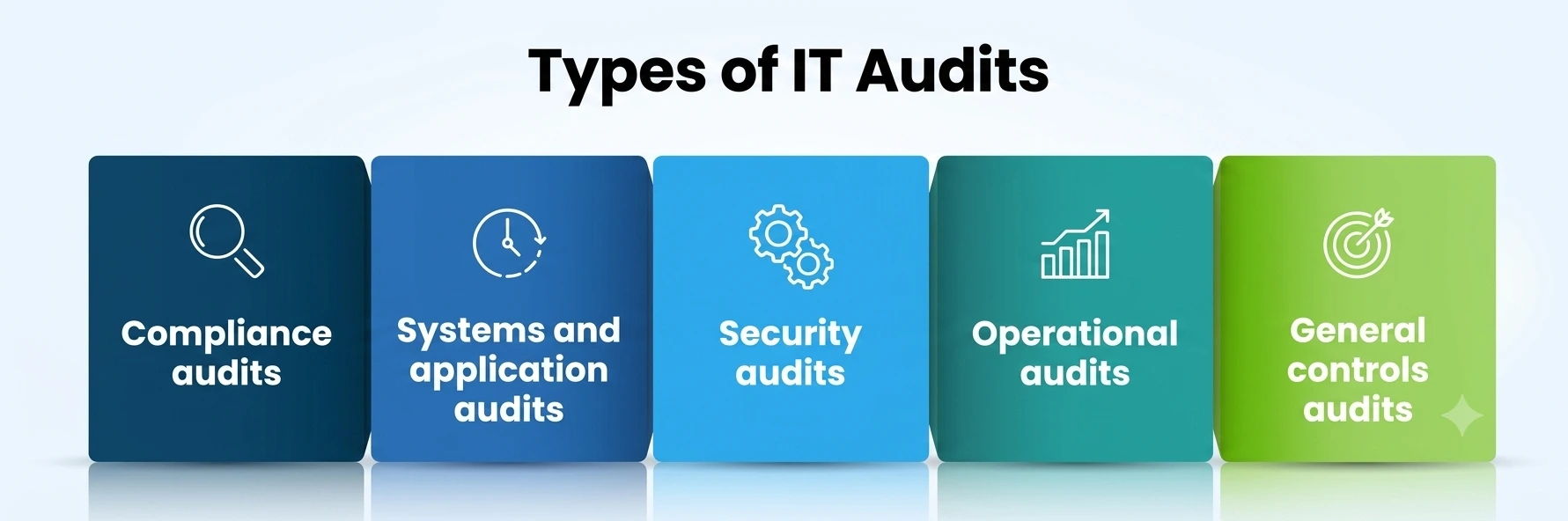
- Compliance audits—verifying adherence to a specific law, standard, or contract. This is where an IT compliance audit lives: PCI DSS, HIPAA, SOX, GDPR, and similar frameworks each have their own checklist.
- Systems and application audits—testing whether individual applications process data correctly, which is where application controls come under the microscope.
- Security audits—assessing information security controls: access management, encryption, monitoring, and incident response.
- Operational audits—looking at IT operations and infrastructure management for efficiency and reliability, not just security.
- General controls audits—reviewing the broader environment (change management, physical access, backup, and recovery) that underpins everything else.
Few organizations have every one of these skill sets sitting in-house, which is exactly why many companies bring in specialized IT audit services rather than trying to build the full bench internally.
The IT Audit Process: Step by Step
Every well-run IT audit follows a similar arc, regardless of scope. The names vary by firm, but the phases don’t:
|
Phase |
Objective |
Key Activities |
|
Planning & Scoping |
Define what’s in scope and why it matters. |
Risk assessment, stakeholder interviews, setting audit objectives and criteria |
|
Fieldwork & Testing |
Gather evidence on whether controls actually work. |
Control walkthroughs, sampling, configuration reviews, evidence collection |
|
Analysis & Evaluation |
Turn raw evidence into findings. |
Comparing results against the control framework, rating severity, identifying root causes |
|
Reporting |
Communicate findings to decision-makers. |
Draft report, management response, final report with recommendations |
|
Follow-Up |
Confirm issues actually got fixed. |
Remediation tracking, retesting, closing, or escalating open items |
The part students underestimate most is planning. A poorly scoped audit either wastes weeks testing things that don’t matter or—worse—misses the one control that actually mattered. Good auditors spend real time understanding the business before they touch a single system.
Core Areas Every IT Audit Should Cover
A handful of areas show up in almost every engagement, because they’re where most real-world failures originate:
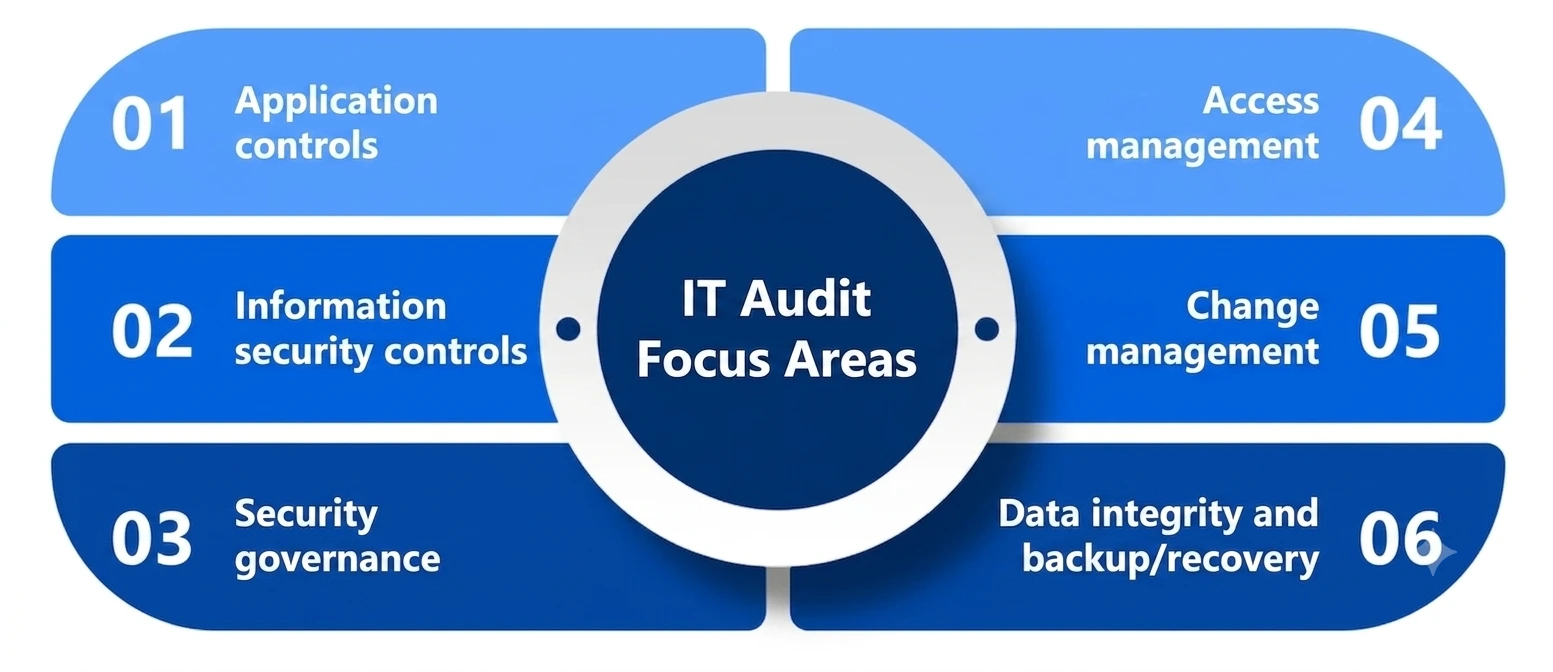
- Application controls. These are the input, processing, and output checks built into a specific application—validation rules, calculation logic, approval workflows, and error handling. Weak application controls are how a single typo or a bypassed approval step turns into a six-figure loss.
- Information security controls. Access provisioning and de-provisioning, encryption standards, logging and monitoring, and vulnerability management. These controls protect data at rest and in motion, and they’re usually the first thing regulators ask about.
- Security governance. Who owns security decisions? Is there a documented risk appetite? Do policies actually get enforced, or do they sit in a shared drive nobody reads? Strong security governance is what keeps the other controls from decaying the moment the person who built them changes jobs.
- Access management. The classic “who can touch what” question—least privilege, segregation of duties, periodic access reviews.
- Change management. How code and configuration changes move from development to production, and whether anyone can push a change without review.
- Data integrity and backup/recovery. Whether data can be trusted and whether the organization can actually recover it after something goes wrong.
Standards and Frameworks That Guide IT Audit
Auditors don’t invent criteria from scratch—they test against recognized frameworks, which gives an IT audit a shared, defensible vocabulary instead of one person’s opinion of “good security.”
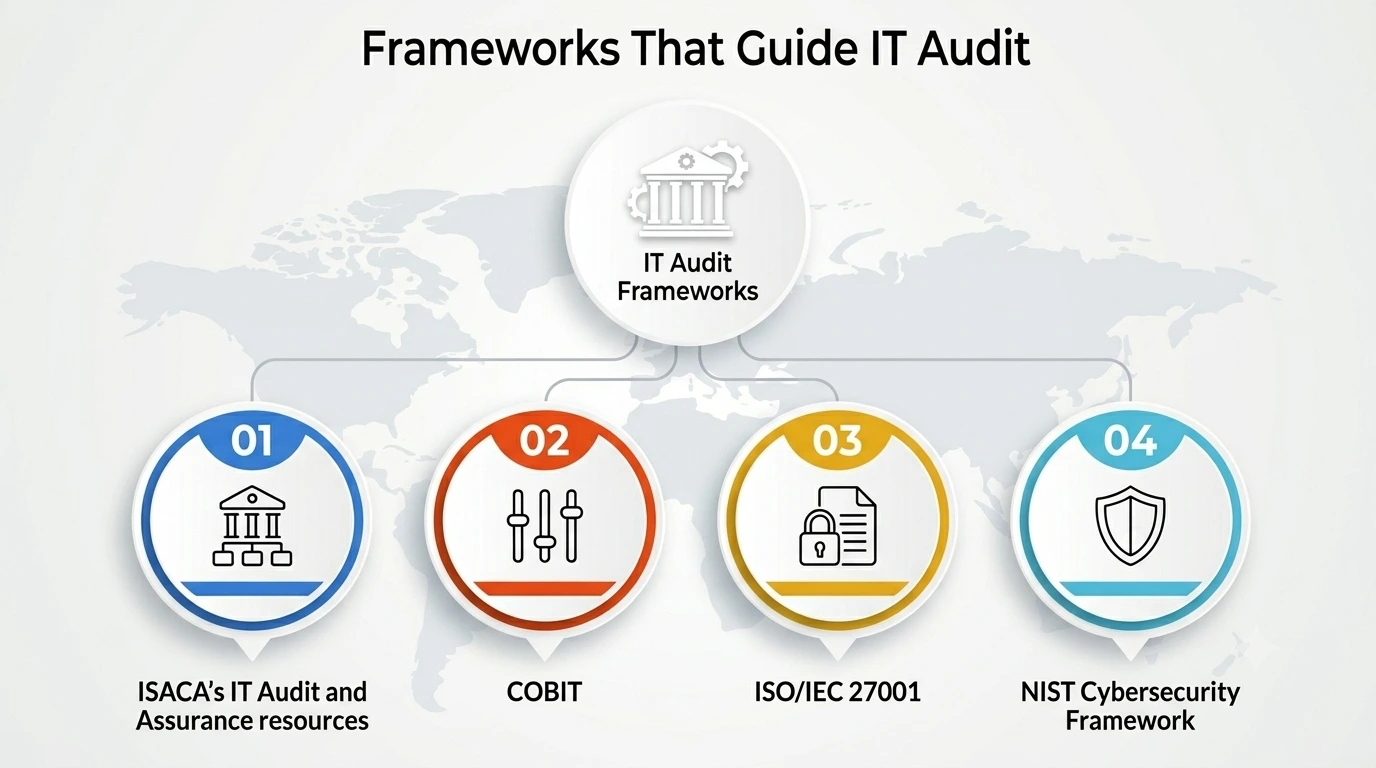
- ISACA’s IT Audit and Assurance resources, including its ITAF standards, define professional practice for IT audit and assurance engagements—roles, ethics, and methodology.
- COBIT, also from ISACA, is the dominant framework for enterprise IT governance and management, organizing control objectives across governance domains.
- ISO/IEC 27001 is the most widely recognized international standard for information security management systems, and it’s frequently the backbone auditors use to evaluate information security controls.
- The NIST Cybersecurity Framework organizes security activity into five functions—Identify, Protect, Detect, Respond, and Recover—and is heavily used in both private-sector and regulatory contexts in the US.
An IT compliance audit built entirely around a checklist from one of these frameworks, without adapting it to the actual business, tends to miss the operational risk that doesn’t fit neatly into a control number. Frameworks are a starting point, not a substitute for judgment.
Common Challenges in IT Audit and Compliance
Ask any working auditor and you’ll hear versions of the same complaints:
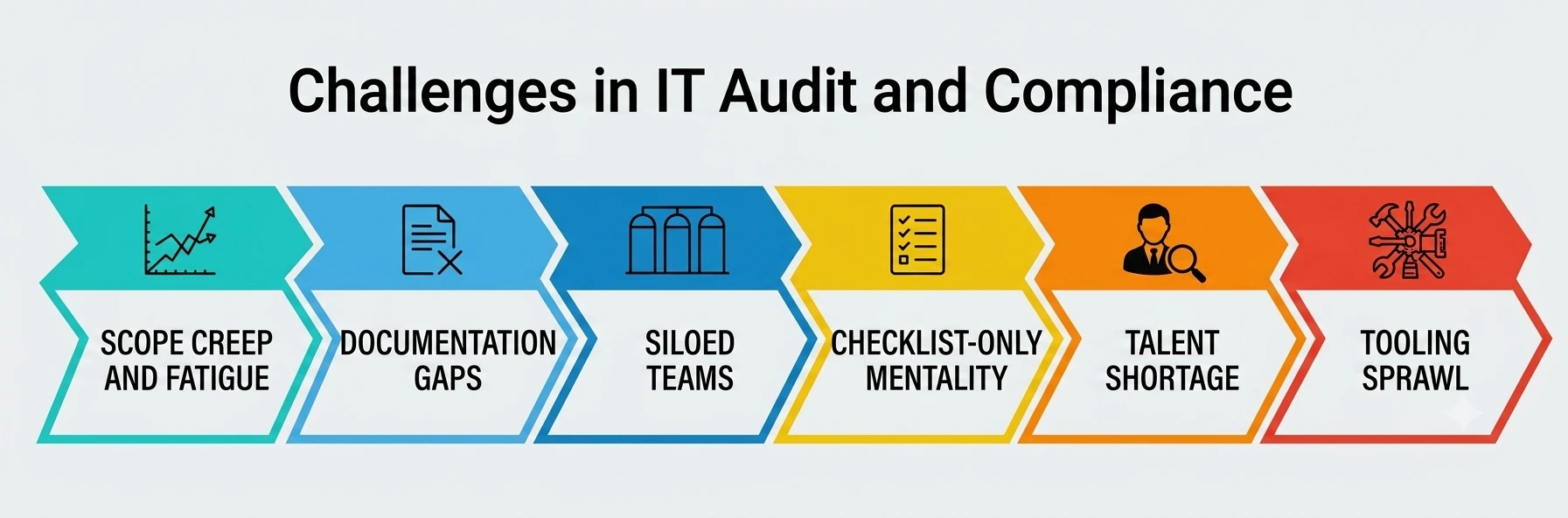
- Scope creep and fatigue. Systems change faster than audit cycles do, so scope agreed upon in week one can be outdated by week six.
- Documentation gaps. Controls that exist in practice but were never written down are almost impossible to audit—and almost impossible to defend to a regulator.
- Siloed teams. Security, IT operations, and compliance often use different terminology for the same control, which slows fieldwork and creates false findings.
- Checklist-only mentality. An IT compliance audit can quietly turn into a box-ticking exercise if nobody asks whether the control actually reduces risk versus just satisfying a clause.
- Talent shortage. Skilled IT audit professionals are genuinely hard to find, which is part of why demand for outside IT audit services keeps climbing.
- Tooling sprawl. Larger organizations often run dozens of overlapping security and monitoring tools, and reconciling what each one actually reports can eat up more fieldwork time than the testing itself.
None of these challenges are unique to any one industry, and none of them have a purely technical fix—most come back to communication and ownership more than to software.
Best Practices for an Effective IT Audit Program
None of this is complicated in concept—it’s just consistently hard to execute:
- Start with risk, not with a checklist. Scope the IT audit around what could actually hurt the business, not around what’s easiest to test.
- Involve business owners early. Controls designed without the people who use them daily rarely survive contact with reality.
- Test information security controls continuously, not just at audit time. Point-in-time testing misses issues that appear for three weeks and then get quietly fixed before the auditor shows up.
- Invest in security governance before technology. A well-governed organization with average tools usually outperforms a poorly governed one with excellent tools.
- Automate evidence collection where possible. Manual screenshots and spreadsheets don’t scale, and they’re where most audit fatigue comes from.
- Track remediation like a project, not a formality. An open finding that never gets closed is worse than no audit at all—it creates a false sense of security.
- Revisit application controls after every major system change. A control that worked before a migration or upgrade cannot be assumed to still work afterward.
The Role of IT Audit Services in a Modern Compliance Strategy
Not every organization needs—or can justify—a full in-house audit function. This is where external IT audit services fit in. They range from single-engagement compliance reviews to co-sourced arrangements where an outside firm supplements an internal team’s capacity during peak periods.
Engaging IT audit services makes particular sense when a company needs specialized expertise it doesn’t have internally (cloud security, a specific regulatory framework, forensic work), when independence requirements mean the work legally can’t be done in-house, or when internal audit staff are stretched too thin to cover the full risk landscape.
The trade-off is cost and a learning curve each time a new firm comes in—which is why many mature organizations run a hybrid model: a lean internal team that understands the business, supported by external specialists for depth.
Getting Started: IT Audit as a Career Path for Students
If you’re a student weighing whether IT audit is a viable career, here’s the honest pitch: it sits at the intersection of technology, business, and risk, which means it ages well. You won’t be replaced by the next framework update, because frameworks are tools, not the job itself.
A reasonable path looks like this: build a foundation in either accounting/business or computer science, get exposure to at least one control framework (COBIT or ISO 27001 are good starting points), and pursue a recognized credential once you have some work experience.
The Certified Information Systems Auditor (CISA) certification from ISACA is the most widely recognized entry point in this field and is worth researching early, even before you’re eligible to sit the exam, so you can plan your experience requirements around it.
Internships in internal audit, risk, or IT compliance are the fastest way in—the work is genuinely learnable on the job in a way that a lot of technology careers aren’t.
A Personal Note
I’ve sat through audits from both sides of the table—as the person being questioned and, later, as the person asking the questions—and the thing that surprised me most wasn’t the technical complexity. It was how often the biggest gaps had nothing to do with technology at all.
They came from a policy nobody updated after a reorganization or a control that made sense three systems ago and never got revisited. If you take one thing from this guide, let it be that an IT audit is ultimately a check on whether an organization’s intentions and its actual behavior still match. Everything else is a method.