If you’re studying business, law, computer science, or risk management right now, there’s a good chance you’ve heard people throw around compliance jargon in lectures without anyone quite defining it.
That’s not an accident — this field is moving faster than the textbooks. Regulators are still writing the rules, companies are hiring for roles that didn’t exist three years ago, and students are expected to understand a discipline that barely has settled vocabulary yet.
This guide is my attempt to fix that gap. We’ll walk through what the term actually means, why it has become one of the fastest-growing career paths in tech policy, and how five connected ideas — model governance, information governance, regulatory change management, audit readiness, and technology audit — fit together into one practical picture.
By the end, you should be able to explain AI compliance to a classmate, a recruiter, or a professor without reaching for jargon you don’t fully understand.
What Is AI Compliance?
AI compliance is the set of policies, controls, and review processes an organization uses to make sure its artificial intelligence systems follow the law, industry standards, and its own internal ethical commitments.
It sits at the intersection of legal obligation and technical reality — a compliance officer who doesn’t understand how a model was trained is just as stuck as an engineer who doesn’t understand what a regulator actually requires.
Unlike traditional IT compliance, this discipline has to account for systems that behave probabilistically, that can drift in accuracy over time, and that are frequently built on data nobody in the room fully controls.
That’s why it can’t be treated as a one-time checklist. It has to be a continuous habit, built into how a system is designed, deployed, monitored, and eventually retired.
Why Is AI Compliance No Longer Optional?
Three years ago, this was mostly a research topic. Today it’s a board-level agenda item, and the shift has a clear regulatory backbone.
The EU AI Act is the clearest example. It’s the world’s first comprehensive AI law, and it classifies AI systems by risk level — banning some practices outright and imposing strict obligations on “high-risk” systems used in areas like hiring, credit scoring, and law enforcement. Organizations that ignore it aren’t just risking reputational damage; they’re risking fines that scale with global revenue.
In the United States, the NIST AI Risk Management Framework plays a similar role without the force of binding law. It’s voluntary, but it has become the reference point auditors and regulators point to when they ask, “did you manage this responsibly?” The framework organizes work around four functions — Govern, Map, Measure, and Manage — and any student building a career in this field should be able to name and explain all four.
Then there’s ISO/IEC 42001, the world’s first certifiable AI management system standard. It gives companies a structured way to prove — to clients, regulators, and auditors — that their program isn’t just a slide deck but an operating system.
And underneath all of it sits data protection law. GDPR predates the current AI wave, but nearly every compliance program still has to answer to it, because most AI systems run on personal data somewhere in their pipeline.
Analysts are watching the money follow the mandate. Gartner’s research on 2026 internal audit priorities places data governance and regulatory compliance among the top risk areas audit committees are planning for this year, driven directly by the speed at which AI is being adopted inside organizations.
The Five Pillars of an AI Compliance Program
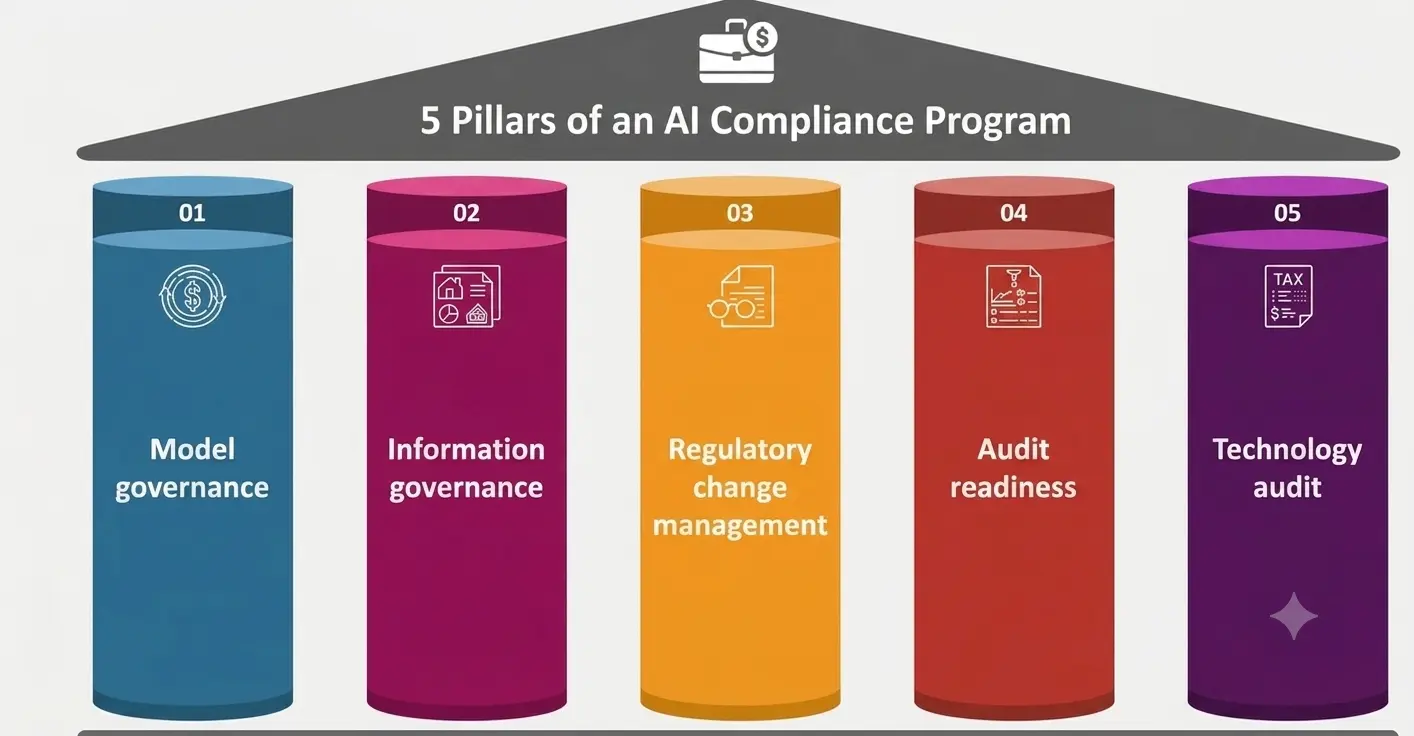
Most compliance programs, once you strip away the vendor marketing language, are built from the same five components. Here’s how they relate to each other.
|
Pillar |
What It Covers |
Why It Matters |
|
Model governance |
Approval, documentation, testing, and monitoring of every AI model in production |
Without it, nobody can prove a model was validated before deployment |
|
Information governance |
Data lineage, classification, retention, and access control feeding the models |
Poor data practices mean the model’s inputs are already a legal liability |
|
Regulatory change management |
Tracking new laws and standards and updating policy before deadlines hit |
It keeps the compliance program current instead of permanently outdated |
|
Audit readiness |
Evidence, logs, and documentation kept ready for external review at any time |
It turns a stressful audit into a routine one |
|
Technology audit |
Independent technical review of systems, code, and controls |
This is where governance claims either get verified or exposed as gaps |
Let’s take each one further, because a table only gets you so far in an exam or an interview.
Model Governance: The Engine Room of the Program
Model governance is the practice of tracking every model an organization builds or buys, from the moment it’s proposed to the moment it’s decommissioned. That includes documenting training data sources, recording performance metrics, defining who can approve a model for production use, and setting rules for how often it gets re-tested.
Strong model governance answers questions like: Who signed off on this model? What data was it trained on? How do we know it still performs correctly six months after launch? When a compliance team can’t answer these questions quickly, that’s usually the first sign that something has broken down somewhere in the pipeline.
In regulated industries — banking, healthcare, insurance — governance failures at the model level are frequently what trigger regulatory penalties, because auditors assume that if you can’t document a decision, you didn’t actually control it.
Good practice here also means version control. Models get retrained, fine-tuned, and swapped out constantly, and every version needs its own audit trail. A company that can’t tell you which version of a model made a specific decision six months ago has a governance gap that no amount of policy language will paper over.
Information Governance: Where Compliance Actually Starts
If model governance is about the engine, information governance is about the fuel. Every AI model is only as trustworthy as the data feeding it, which means this layer of work — classifying data by sensitivity, defining who can access it, setting retention limits, and tracing where it came from — is arguably the more foundational discipline of the two.
Weak information governance shows up as AI systems trained on data nobody can source, retained far longer than any policy justifies, or accessed by teams who never should have had permission in the first place.
Regulators increasingly treat these failures as compliance failures in their own right, independent of whatever the model does downstream, because GDPR and similar frameworks regulate personal data regardless of what technology touches it.
For students, the practical takeaway is this: information governance isn’t a “data team problem” that AI compliance teams can ignore. The two are inseparable. Any compliance strategy that treats it as someone else’s job is building on a foundation it doesn’t control.
Regulatory Change Management: Staying Current on Purpose
Here’s the part most students underestimate. AI law isn’t static — it’s one of the fastest-moving regulatory areas in the world right now, with new guidance, codes of practice, and national implementations arriving on a near-monthly basis.
Regulatory change management is the discipline of tracking those changes, assessing their impact, and updating internal policy before a deadline becomes a crisis.
Without active regulatory change management, a compliance program quietly becomes obsolete. A policy written to satisfy an earlier version of a law can be dangerously incomplete two years later, and “we didn’t know the rule had changed” is not something defense regulators tend to accept.
Effective regulatory change management usually means someone — often a compliance analyst, sometimes an entire regulatory affairs team — is assigned to monitor specific jurisdictions and specific laws, with a defined process for escalating changes to legal and engineering teams.
This is also where career opportunities are opening up fastest. Organizations that operate across the EU, US, UK, and Asia now need regulatory change management specialists who can track divergent AI rules across all of those jurisdictions at once, because a single global AI compliance policy rarely satisfies every regulator by itself.
Audit Readiness and Technology Audit: Proving It, Not Just Claiming It
Audit readiness is the practice of maintaining documentation, logs, and evidence continuously, so that when an auditor — internal or external — asks for proof, the answer is already sitting in a folder rather than being assembled in a panic.
Organizations with strong audit readiness treat every governance decision as something that will eventually be reviewed by someone outside the team that made it.
A technology audit is where that discipline gets tested. It’s an independent, often technical, review of the actual systems — the code, the model pipelines, the access controls, the logging — rather than just the policy documents describing them.
This is the step where a well-written governance policy either holds up or falls apart, because a technology audit doesn’t care what the policy says; it checks what the system actually does.
Strong audit readiness makes a technology audit faster and less disruptive. Weak preparation turns every review into a fire drill, with teams scrambling to reconstruct decisions that should have been documented months earlier.
Students heading into compliance, audit, or risk roles should understand that being ready isn’t a separate task bolted onto the end of a project — it’s a habit built into daily documentation from day one.
Common Mistakes Students and Early-Career Professionals Make
A few patterns show up again and again in how people misunderstand AI compliance early in their careers. The most common is treating it as a legal-only discipline, when in practice it requires fluency in both regulation and technical systems.
Another is assuming compliance is a one-time sign-off rather than continuous monitoring — models drift, laws change, and data sources evolve, so a program that isn’t built to update itself will fail quietly rather than loudly.
A third mistake is underestimating information governance, treating it as background infrastructure rather than a core requirement in its own right.
What Happens When It Actually Breaks Down?
It helps to picture the failure mode, because the abstract version of this topic can feel low-stakes until you see how it plays out. A lender deploys a credit-scoring model without documenting which data trained it.
Regulators later find the model disproportionately denies applicants from certain postcodes. Because model governance records don’t exist, the company can’t show when the bias was introduced, who approved the model, or whether anyone tested for it before launch.
The fine follows, but so does something harder to fix: every future audit now starts from a position of distrust. Or picture a healthcare provider that retains patient data used to train a diagnostic tool for years past its stated retention window, because nobody owned that decision.
That’s not a model problem — it’s an information governance failure, and under frameworks like GDPR, it’s punishable on its own, independent of how well the diagnostic tool actually performs.
These aren’t hypothetical edge cases. They’re the ordinary, unglamorous ways organizations get into trouble: not through some dramatic AI failure, but through the quiet absence of documentation, ownership, and review.
That’s precisely why audit readiness and a properly resourced technology audit function matter so much — they’re what stands between an organization and exactly this kind of scenario. A compliance program that only exists on paper won’t catch any of it in time.
The Road Ahead for AI Compliance
Spending on AI governance platforms is projected to grow sharply through the rest of this decade as regulation spreads to a larger share of the world’s economies, and organizations are shifting from manual, spreadsheet-based tracking toward dedicated software that can automate parts of model governance and regulatory change management.
That doesn’t mean human judgment disappears — if anything, it means the people who understand both the regulatory logic and the technical reality become more valuable, not less.
For students entering this field, the opportunity is straightforward: it sits at a rare intersection where legal reasoning, data literacy, and technical curiosity all matter at once. Few other emerging careers ask for that particular combination, and fewer still are growing this quickly.
A Personal Note
I’ve written a lot of technical explainers over the years, and this is a topic where I keep noticing the same gap: students are taught either the law or the technology, rarely both at the same time.
If there’s one thing I’d want a reader to take from this piece, it’s that AI compliance stops being intimidating the moment you stop treating it as a legal subject or a technical subject and start treating it as both, at once. That shift in framing is worth more than memorizing any single regulation.