
I get asked this question at least once a month, usually by someone standing at a career crossroads with a half-finished OSCP lab and a nagging worry: “Is this actually worth it?” So let’s talk numbers, honestly, without the recruiter spin.
If you’re weighing a move into offensive security, or you’re already in it and wondering whether you’re being paid fairly, the penetration tester salary conversation is really a conversation about three things—where you are in your career, what you can prove, and where you’re willing to work. Let’s break it all down.
This isn’t just another listicle scraped together from old data. I’ve pulled together the most current figures available in 2026 from across the major salary platforms, because among all the cybersecurity careers out there, few generate as much confusion around pay as this one does.
Why Is Penetration Tester Salary All Over the Map?
Here’s the first honest thing I’ll tell you: there is no single “correct” number for penetration tester salary. Ask five different sources, and you’ll get five different averages, and that’s not because anyone’s lying—it’s because the job itself spans such a wide range of skills and responsibilities.
According to Indeed’s 2026 data, the average salary for a penetration tester is $122,309 per year in the United States, based on 241 salaries taken from job postings over the past 36 months. Meanwhile, others reported a lower figure — an average salary of $103,782 in 2026. On the other hand, pegs the broader average penetration tester salary at $119,895 a year or roughly $57.64 an hour, with salaries ranging as high as $168,000 and as low as $22,500.
Why the spread? A few real reasons:
- Certifications matter more than years in this field. As 2026 recruiting notes put it, most hiring managers now want the OSCP on the resume before the first call because it proves the candidate can actually exploit a box under a clock instead of just reading about it.
- The job title itself isn’t standardized. In fact, the U.S. Bureau of Labor Statistics does not track “penetration tester” as its own occupation, so every salary site is essentially self-reporting from job boards and surveys, not a government census.
- Sector and clearance change everything. Defense contractors, in particular, will pay a premium for people who already hold a clearance, since an entry-level cleared role often outpays an uncleared senior one three time zones away.
So instead of chasing one “true” number, it’s more useful to look at pay by experience level—which is where things actually start making sense.
Penetration Tester Salary by Experience Level
Let’s go level by level, because this is where the real story is.
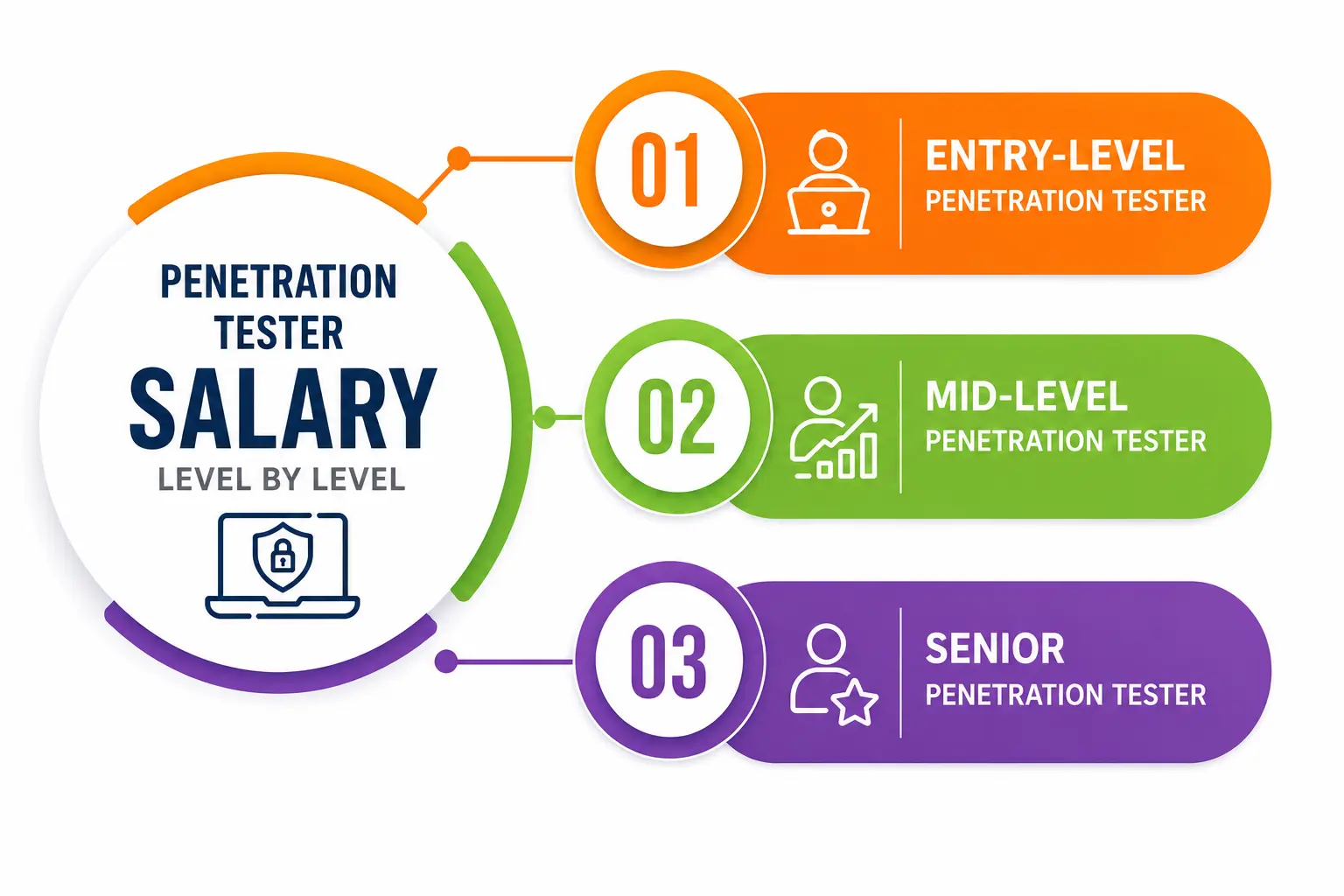
1. Entry-Level Penetration Tester Salary
Breaking in is the hardest part of any offensive security career, and pay reflects that. ZipRecruiter’s July 2026 data shows the average entry-level penetration tester salary in the United States is $119,895 per year, with the majority of salaries ranging between $96,000 and $141,000. That’s higher than what most other sources report for entry-level, and it likely reflects postings that blend “entry-level” with roles that already expect a year or two of hands-on hacking experience.
A more conservative estimate places an entry-level penetration tester salary (0–1 year) at approximately $90,500, while others found an entry-level penetration tester with less than one year of experience earns an average total compensation of $72,823, based on 67 reported salaries. KORE1 adds useful color here too, noting junior penetration testers typically run $80,000 to $105,000 in base pay.
Realistically, if you’re brand new to pentesting jobs with a certification or two and a home lab full of solved boxes, expect somewhere between $75,000 and $100,000 depending on location and employer. It’s not glamorous money at first, but it’s a solid foundation compared to many other entry points into cyber jobs, and it climbs quickly once you have a track record of real engagements behind you.
2. Mid-Level Penetration Tester Salary
This is where the curve starts to bend upward and where a strong grasp of vulnerability assessment and real client engagements starts to pay off. Data reports a mid-level penetration tester salary (4–6 years) of around $114,000. HackerDNA’s 2026 breakdown agrees closely, putting mid-career testers with 3–5 years of experience in the $110,000 to $140,000 range.
At this stage, you’re no longer just running scans—you’re chaining vulnerabilities, writing reports clients actually act on, and probably starting to mentor juniors. That expertise shows up in the paycheck.
3. Senior Penetration Tester Salary
By the time you’re senior, you’re not just testing systems—you’re often shaping how an organization approaches network security and offensive security strategy as a whole. ZipRecruiter’s June 2026 figures show the average senior penetration tester salary sitting at $119,895 nationally, with top earners in the 90th percentile making $158,500 annually.
Other sources put the ceiling considerably higher. Sources note a senior-level penetration tester salary (7–9 years) at around $123,000, while other reports show that seniors with deep specialization pass $150,000, sometimes reaching $200,000 or more. Salary.com‘s leveled breakdown backs this up, listing a Penetration Tester V position at $174,290 and a Penetration and Vulnerability Director role at $208,300.
The takeaway: a senior penetration tester’s salary isn’t capped at a low-end six figures—it stretches well past $150,000 once you specialize in red teaming or cloud security or lead a testing practice. At this level, you’re also more likely to be advising on hiring for other pentesting jobs on your team, which adds a layer of leadership responsibility that further justifies the higher pay band.
Penetration Tester Salary Table
|
Experience Level |
Years of Experience |
Typical Salary Range (USD) |
|
Entry-Level |
0–1 year |
$72,800 – $119,900 |
|
Junior |
1–3 years |
$80,000 – $105,000 |
|
Mid-Level |
3–6 years |
$110,000 – $140,000 |
|
Senior |
7–9 years |
$123,000 – $175,000 |
|
Lead/Director-Level |
10+ years |
$175,000 – $208,000+ |
Keep in mind these ranges reflect base pay in the U.S. market as of mid-2026 and don’t always include bonuses, on-call pay, or contract premiums, which can push actual take-home noticeably higher for consultants.
What Actually Moves the Needle on Penetration Tester Salary?
If you want to earn more, here’s what genuinely correlates with higher pay, based on the sources above and general patterns across cybersecurity careers:
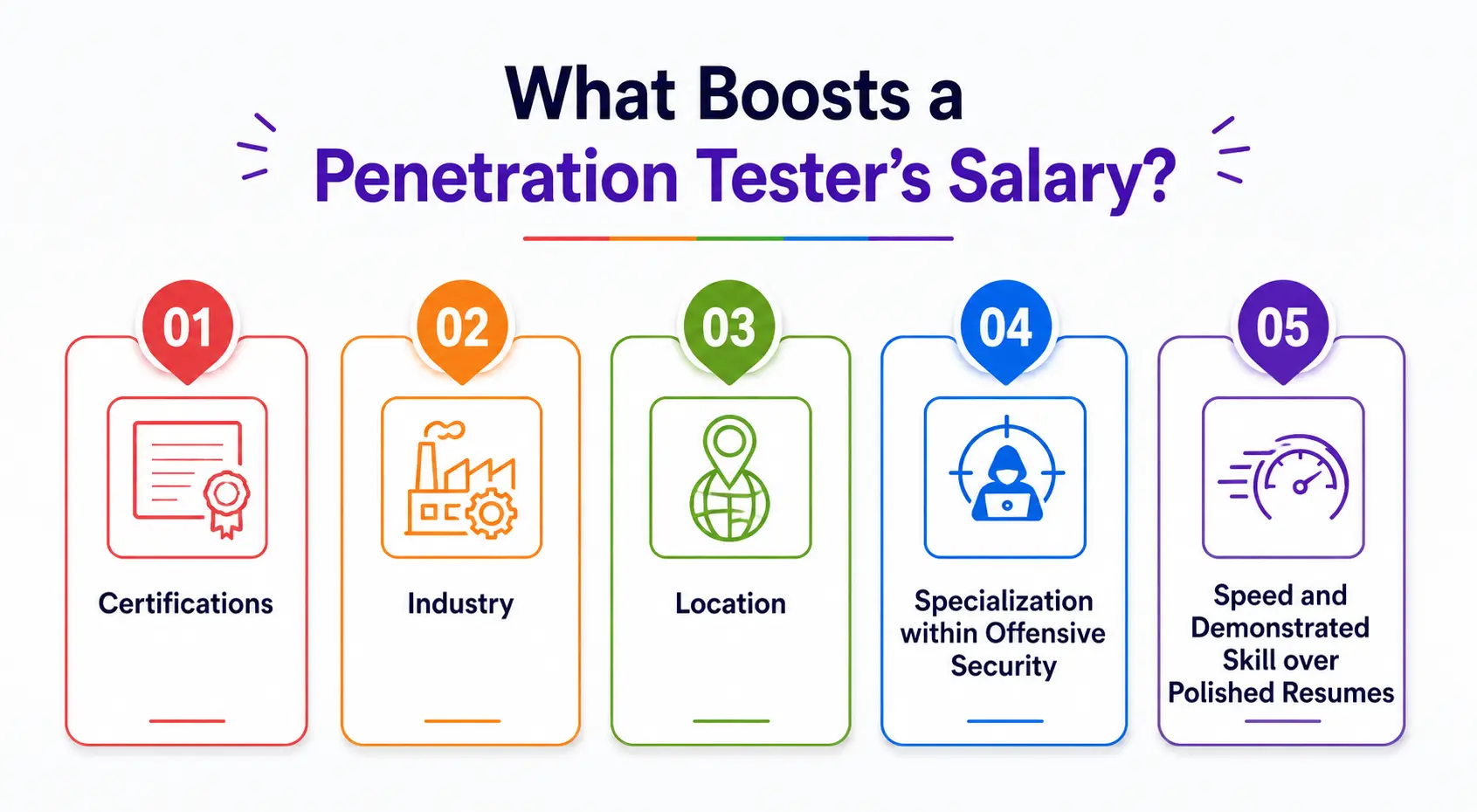
1. Certifications, especially offensive ones
The OSCP remains the single biggest lever. Data notes that penetration tester pay is positively impacted by qualifications such as CISSP, OSCP, and CEH, since certificates authenticate past performance and increase reputations, leading to greater chances of landing high-paying cyber jobs.
2. Industry
Not all sectors pay equally for information security talent. Some point out that government, technology, and finance sectors are often more lucrative because cybersecurity plays a major role there, with companies like Google and Microsoft and financial institutions offering premium rates.
3. Location
Geography still matters a lot, even with remote work being common. Sources found ten U.S. cities where entry-level pay beats the national average, with Felton, CA, topping the list at 27.1% above the $119,895 baseline.
4. Specialization within offensive security
Not every pentesting role pays the same. Some comparison shows SOC analysts earning $65,000–$95,000, general penetration testers at $90,000–$150,000, and red team operators reaching $120,000–$200,000+, showing that adversary simulation and red teaming sit near the top of the technical security pay scale.
5. Speed and demonstrated skill over polished resumes
KORE1’s recruiters note something counterintuitive: in a tight hiring market, speed wins more offers than money does, and companies unsure how senior a role needs to be often start with a short contract engagement to see real work before committing to a full hire.
How Does Penetration Tester Salary Compare to Other Cyber Jobs?
It helps to zoom out and see where this role sits relative to the rest of the cyber jobs landscape. Penetration testing is a specialized offshoot of information security, and it tends to sit above general IT security roles but below highly niche specialties like security architecture at the executive level.
If you’re coming from a background in vulnerability assessment work—running automated scans, triaging findings, writing basic remediation notes—moving into full penetration testing usually means a meaningful pay bump, because manual exploitation and reporting depth are valued more highly than scanner-driven output.
Similarly, professionals coming from broader network security roles often find that offensive security pays a premium for the same underlying knowledge, simply because fewer people are willing or able to do it under real-time pressure with a client watching the clock.
This is also why so many people treat pentesting as a mid-career pivot rather than a first job. A few years in a SOC or as a systems administrator gives you the network security fundamentals that make penetration testing engagements far more effective—and recruiters know it, which is reflected in the pay.
Is a Career in Penetration Testing Still Worth It?
Given the numbers above, yes — this remains one of the more rewarding paths within cybersecurity careers, both financially and intellectually. You’re paid to think like an attacker, and organizations are willing to pay well for that mindset, especially as they face constantly evolving threats.
Whether you’re doing network security audits, web app testing, or full-scope red team engagements, the demand for skilled offensive security professionals isn’t slowing down. That said, don’t expect it to be an easy six-figure shortcut.
The entry point is genuinely competitive, certifications take real study time, and the “junior” rung of the ladder is thinner than people expect. But once you’re through it, the pay trajectory for a penetration tester’s salary is one of the more generous ones in tech.
It’s also worth remembering that pentesting jobs aren’t a monolith. Some roles are consulting-heavy, bouncing between client engagements every few weeks; others are embedded within a single large organization’s internal security team, doing continuous testing on the same systems.
Both pay well, but the consulting route often has a higher ceiling because firms bill clients a premium for specialized offensive talent, and a share of that premium tends to flow back to the tester in the form of bonuses or higher base pay.
If you’re deciding between an in-house role and a consultancy, factor in not just the base penetration tester salary but the bonus structure, travel expectations, and how much variety you actually want in your day-to-day work.
A Personal Note
I’ve spent enough time around this industry to say this plainly: don’t chase the highest number on a salary chart and call it a career plan. I’ve seen people rush toward “senior penetration tester” titles without the underlying skill to back it up, and it catches up with them in the first real engagement.
Build the fundamentals; get comfortable being wrong in a lab before you’re ever wrong in front of a client, and the penetration tester salary numbers above will follow naturally—not the other way around. This field rewards patience and genuine curiosity far more than it rewards a rushed resume.