

Here’s a number worth sitting with for a second: the global cybersecurity workforce is still short by roughly 4.8 million people. That gap isn’t shrinking, and it isn’t reserved for people with computer science degrees either. A growing share of it is being filled by former teachers, retail managers, accountants, and military veterans who picked the right cybersecurity training program and stuck with it.
If someone reading this is currently stuck in a job that no longer fits, feels replaceable, or simply wants steadier long-term demand, cybersecurity is one of the few fields where a career switch is genuinely realistic without starting over from zero, and it remains one of the more accessible cyber careers for people without a technical background.
This piece walks through what 2026 data actually says about pay, which skills matter most, how to evaluate a training option before paying for one, and what the first year on the job tends to look like.
Why Switch to Cybersecurity Today?
Career switching always comes with risk, so it’s fair to ask whether cybersecurity is worth that risk in 2026 specifically. A few things point toward yes.
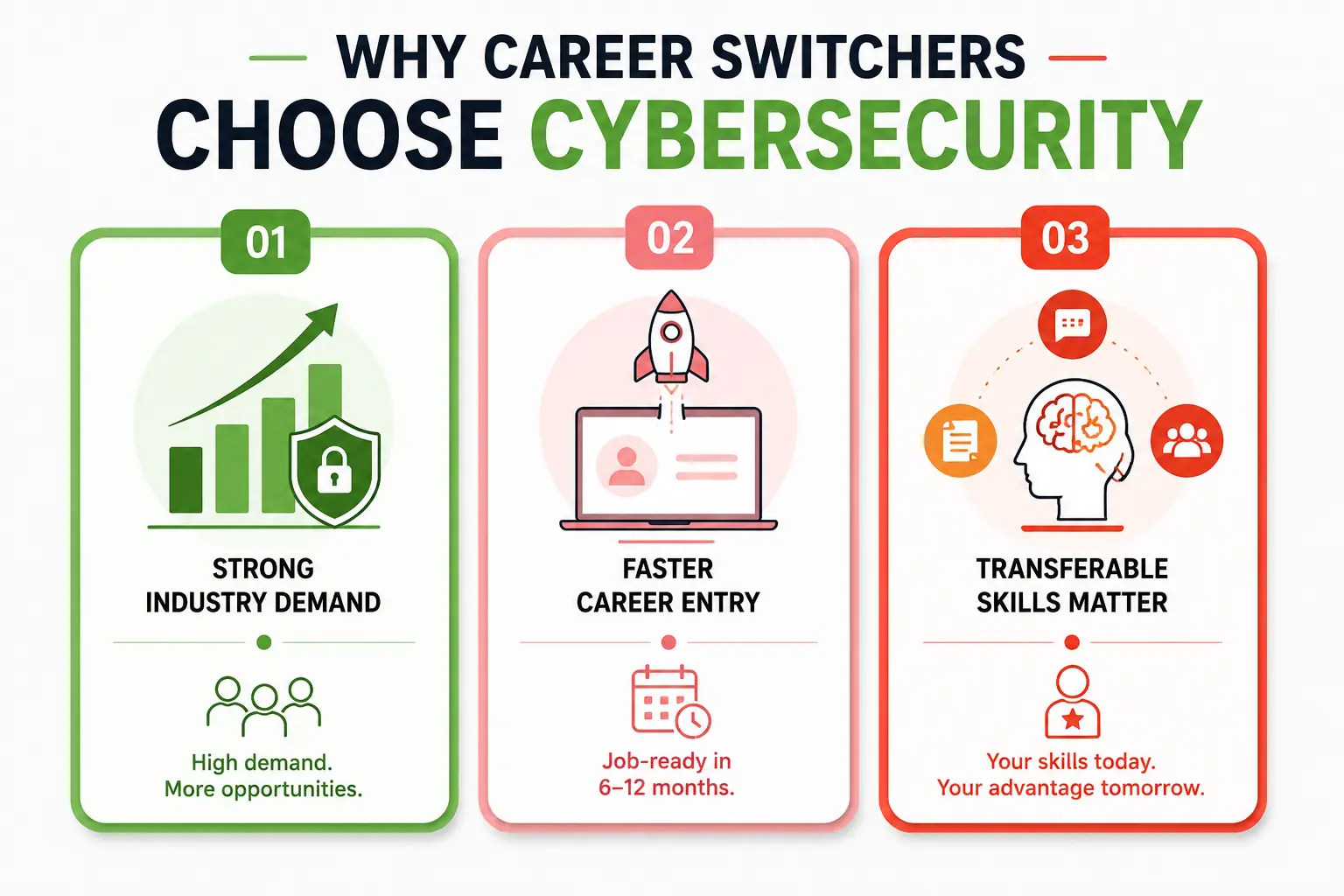
- First, demand has not cooled off. Global information security spending is projected to reach roughly $244.2 billion this year, based on Axis Intelligence’s 2026 breakdown, and that spending translates directly into open cyber jobs at companies of every size, not just large tech firms.
- Second, unlike software engineering, cybersecurity does not require years of coding fluency before someone becomes employable; a solid entry-level cybersecurity training program can realistically prepare a motivated beginner for a junior role within six to twelve months.
- Third, the field rewards people who already bring soft skills from other careers, like attention to detail, documentation habits, or customer-facing communication, all of which matter more in security operations than most beginners expect.
None of that means the switch is effortless. Employers still want proof of applied skill, not just a certificate on a resume, which is exactly why the choice of training matters so much more than people assume going in.
What 2026 Salary Data Actually Shows for Career Switchers?
Every career switcher wants to know one thing before committing months of study: what does the money actually look like? The honest answer is that it depends heavily on role and location, but the ranges are still strong compared to most other entry points into tech.
According to TripleTen’s 2026 cybersecurity guide, the median annual wage for information security analysts sits at $124,910, though that figure represents the midpoint across all experience levels, not an entry-level starting point.
Most first jobs land considerably lower, and that gap matters for anyone setting expectations. 2026 pay data for cybersecurity analysts puts the national average at $127,928 annually, with the bottom quarter of earners closer to $99,735, a useful reminder that averages hide real variation by city and employer type.
|
Career Stage |
Typical Salary Range (USD, 2026) |
Notes |
|
Entry-Level (0–1 year) |
$62,000 – $85,000 |
Junior SOC analyst, associate cyber analyst, IT security specialist |
|
Early Career (1–4 years) |
$85,000 – $115,000 |
Security analyst, incident response associate |
|
Mid-Career (5+ years) |
$120,000 – $180,000+ |
Senior analysts, security engineers, and CISSP-holding specialists |
A career switch entering the field around $72,000 can realistically reach the $120,000 range within four to six years, according to Coding Temple’s 2026, particularly for people who pick up a relevant certification and change employers once or twice along the way.
That trajectory is one of the clearer arguments for cyber careers over staying in a stagnant field: pay tends to climb quickly once someone has even a year or two of hands-on, documented experience.
What a Strong Security Training Course Should Actually Teach
Not every course marketed as security training is built the same way, and career switchers lose real time and money picking the wrong one. A genuinely useful cybersecurity training program tends to share a few features:
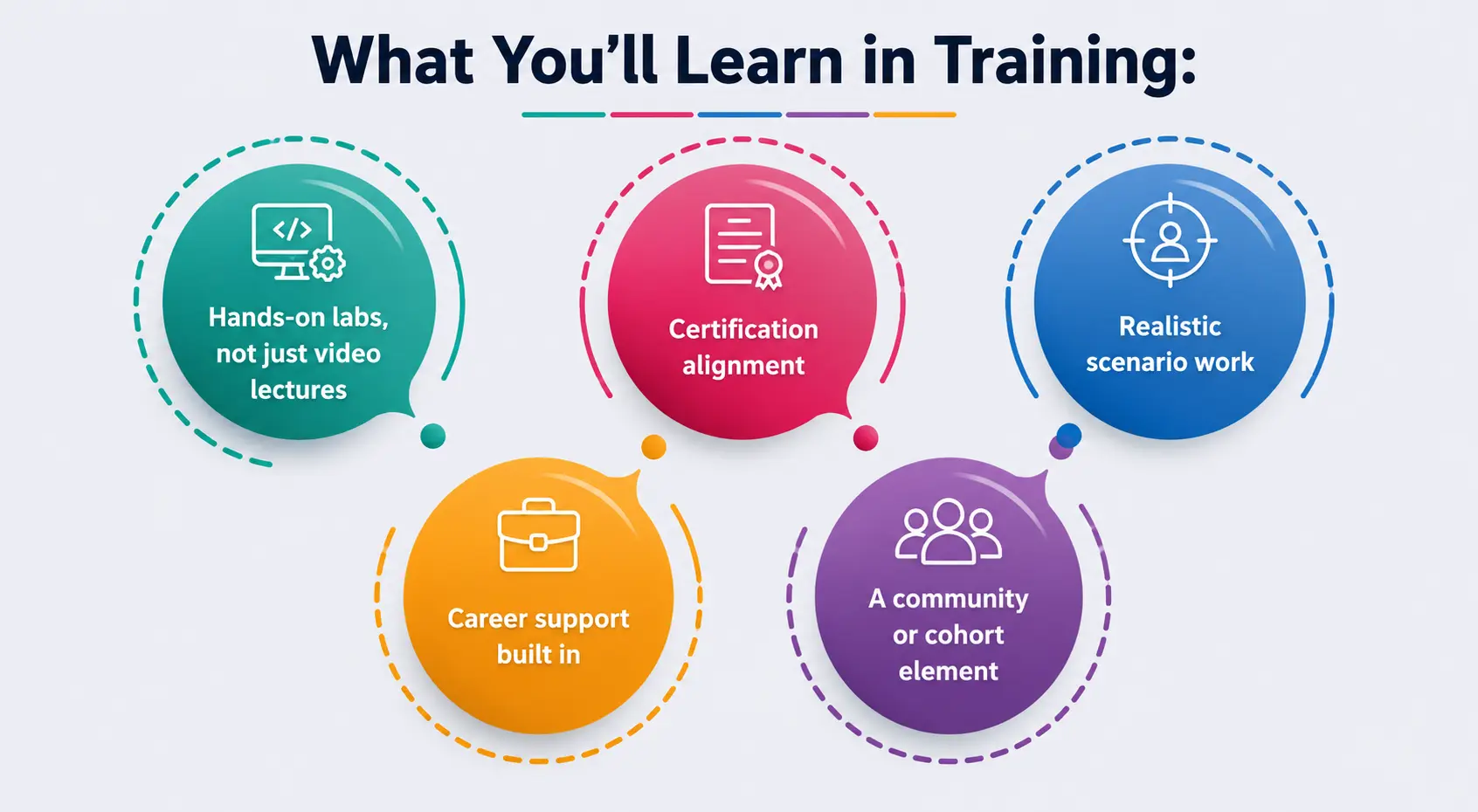
- Hands-on labs, not just video lectures. Reading about firewalls is not the same as configuring one; a program built around practice, not passive watching, is what actually builds job-ready skills.
- Certification alignment. The strongest programs map directly to recognized credentials like CompTIA Security+, since data shows Security+ appears in over 70% of cybersecurity job postings and functions as a resume filter for HR teams screening applicants.
- Realistic scenario work. Simulated incident response, log analysis, and phishing investigation exercises mirror what a junior security analyst actually does day to day, rather than testing pure memorization.
- Career support built in. Resume review, mock interviews, and introductions to hiring partners matter enormously for someone with no prior network in the industry.
- A community or cohort element. Career switchers who study alongside peers tend to stick with the material longer than people studying entirely alone.
Choosing Between Self-Study, Bootcamps, and Formal Degrees
This is where most career switchers get stuck, so it helps to be blunt about trade-offs. Self-paced online training is the cheapest route and works well for people who already have some IT background and strong self-discipline.
Structured security training, whether delivered through bootcamps or instructor-led courses, costs more but produces meaningfully better outcomes for total beginners; pass rates on certification exams average 80 to 90 percent for people in structured training compared to 60 to 65 percent for self-study alone.
Formal four-year degrees remain useful for people aiming at government roles or long-term leadership tracks within cyber careers, but they are rarely necessary for someone simply trying to land a first job in the field.
The practical takeaway: a focused, cert-aligned cybersecurity training program with built-in accountability tends to beat pure self-study for anyone making a genuine career switch, mainly because it shortens the time between starting and becoming employable.
Certifications Worth Prioritizing in 2026
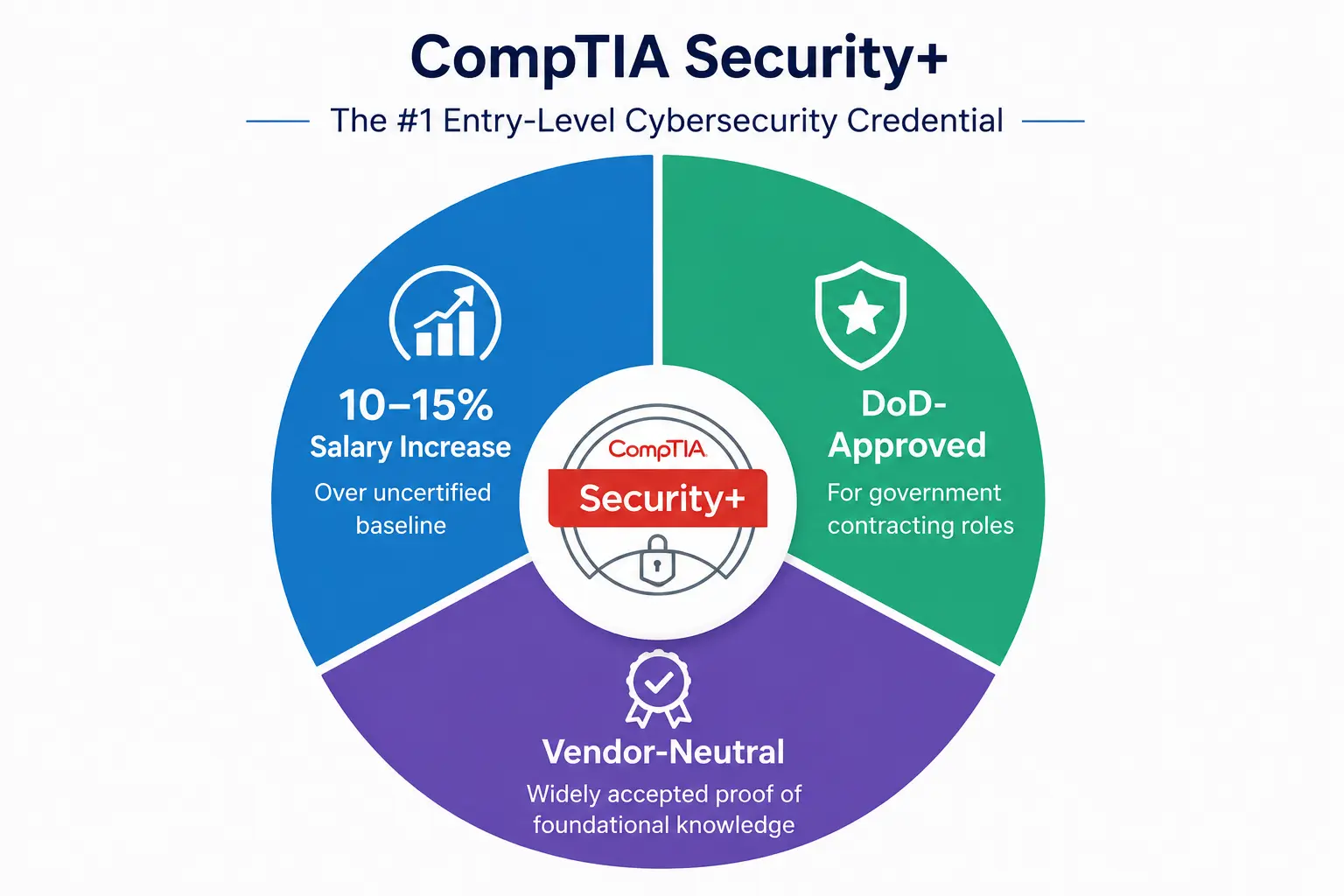
CompTIA Security+ remains the single most requested entry-level credential and typically delivers a 10 to 15 percent salary increase over an uncertified baseline, according to DiviTrain’s 2026 ROI analysis of the certification. It is vendor-neutral, DoD-approved for government contracting roles, and widely accepted as proof of foundational knowledge.
Beyond Security+, CompTIA CySA+ targets analyst-specific skills more directly and suits people aiming squarely at SOC roles rather than general IT security. Further down the road, once someone has several years of experience, CISSP becomes worth pursuing; it carries the largest salary bump of any single credential for senior-level cyber jobs, though it requires five years of relevant experience before the certification can be fully awarded.
Building Real Experience Before the First Job Offer
Certifications open doors, but hands-on proof of skill is what actually gets interviews converted into offers. Home labs, built using free or low-cost virtual machines, let career switchers practice network segmentation, log analysis, and basic penetration testing without needing employer access to real systems.
Platforms built around capture-the-flag challenges give structured, gamified practice that doubles as talking points in interviews. Volunteering to help a small business or nonprofit tighten up its basic security posture, even informally, creates a genuine story to tell rather than a hypothetical one.
None of this replaces a solid cybersecurity training program, but it turns theoretical coursework into evidence an employer can actually evaluate.
What Does the First Year on the Job Actually Look Like?
Most people picturing their first cybersecurity role imagine something closer to a spy movie than the reality, so it helps to set expectations early. A typical first year is heavy on monitoring: watching dashboards for unusual login activity, triaging alerts flagged by automated detection tools, and documenting findings clearly enough that a more senior analyst can act on them quickly.
It is repetitive work at times, and that repetition is exactly what builds the pattern recognition that separates a strong analyst from a mediocre one two years later. Shift work is common in larger security operations centers, since threats do not stop at 5 p.m., so it is worth asking about scheduling during any interview process rather than being surprised by it after accepting an offer.
Feedback loops also tend to be faster than in many other office jobs. A missed alert or a misclassified incident gets noticed quickly, which can feel intense for someone used to slower-paced roles, but it also means skill growth is easy to track.
Most people who stick with it for the first six months report the steepest part of the learning curve happening early, followed by a noticeable jump in confidence once they’ve handled a handful of real incidents rather than only simulated ones.
Managers in this field also tend to value someone who asks clarifying questions over someone who guesses and gets it wrong, which works in favor of career switchers coming from customer service or administrative backgrounds where that instinct is already second nature.
Conclusion
Switching into cybersecurity in 2026 is not a long shot; it is one of the more realistic career pivots available for someone willing to put in focused, structured effort over six to twelve months. The data backs this up: real demand, real salary growth, and a workforce gap that shows no sign of closing on its own.
The single biggest factor in how smoothly that switch goes is the quality of the cybersecurity training program chosen at the start, since it shapes everything from certification readiness to whether a resume actually gets a callback.
Pairing that training with a recognized certification, a bit of hands-on lab practice, and honest patience through the first few months of job searching gives most career switchers a genuinely fair shot at building a long, stable career in security.
A Personal Note
I’ve spent a fair amount of time around people mid-career switching into this field, and the pattern that separates the ones who make it from the ones who quietly give up isn’t talent. It’s whether they treated the first few months like a job search project with weekly goals rather than an open-ended hobby they’d get to eventually.
If you’re on the fence about starting a cybersecurity training program, my honest advice is to pick one, commit to a hard deadline for your first certification exam, and let that deadline create the urgency that motivation alone rarely does. It’s a genuinely good field to land in, but only for the people who treat the learning phase with the same seriousness they’ll need once they’re on the job.