
Ask five security professionals to define “framework” and you’ll get five overlapping but slightly different answers. That’s usually where students get stuck when they first study cybersecurity frameworks—not because the material is technically hard, but because nobody explains how the major names relate to one another before throwing acronyms at you.
NIST, ISO 27001, and the CIS framework show up in almost every job posting, textbook, and audit report in this field, and once you see how they connect instead of compete, the whole subject stops feeling like memorization and starts feeling like a shared language security team already speaks.
This guide breaks down what each of these cybersecurity frameworks actually does, how they map onto one another, and where terms like security compliance, an ISO audit, and a governance framework fit into the picture.
It’s written for students and early-career professionals who want a working understanding, not just a glossary of terms, and it ends with a personal note on what actually made this material click for me.
What Is a Cybersecurity Framework, and Why Do We Need Three of Them?
A framework, in plain terms, is a structured set of practices, policies, and security controls that an organization follows to manage risk instead of reinventing its approach to security from scratch every time.
Cybersecurity frameworks exist because every organization—a hospital, a bank, a five-person startup—faces the same basic questions: what are we protecting, what could go wrong, and how do we prove we’re handling it responsibly?
The reason there isn’t just one universal standard comes down to origin and purpose. NIST was built by a U.S. government agency to guide federal systems and later opened up to private industry. ISO 27001 came out of an international standards body and was designed from day one for global certification.
CIS grew out of a community of practitioners trying to answer a simpler question: out of everything we could do, what actually stops the most common attacks? Different starting points, different flavors, but a lot of shared DNA underneath.
It also helps to know that none of these three are laws. They’re voluntary standards an organization chooses to adopt, which is different from a regulation like HIPAA or GDPR that carries a legal mandate.
A company can be fully compliant with a regulation and still have a weak security posture, or it can follow a framework closely and still need to separately track legal obligations. Frameworks describe good practice; regulations describe legal requirements—and in a lot of real jobs, you’ll end up mapping one to the other.
NIST Cybersecurity Framework: The Risk-Management Playbook
The NIST Cybersecurity Framework (CSF) is maintained by the U.S. National Institute of Standards and Technology and is one of the most widely referenced cybersecurity frameworks in the world, even outside the United States.
The current version, CSF 2.0, was finalized in February 2024 and expanded the original five functions to six: Govern, Identify, Protect, Detect, Respond, and Recover.
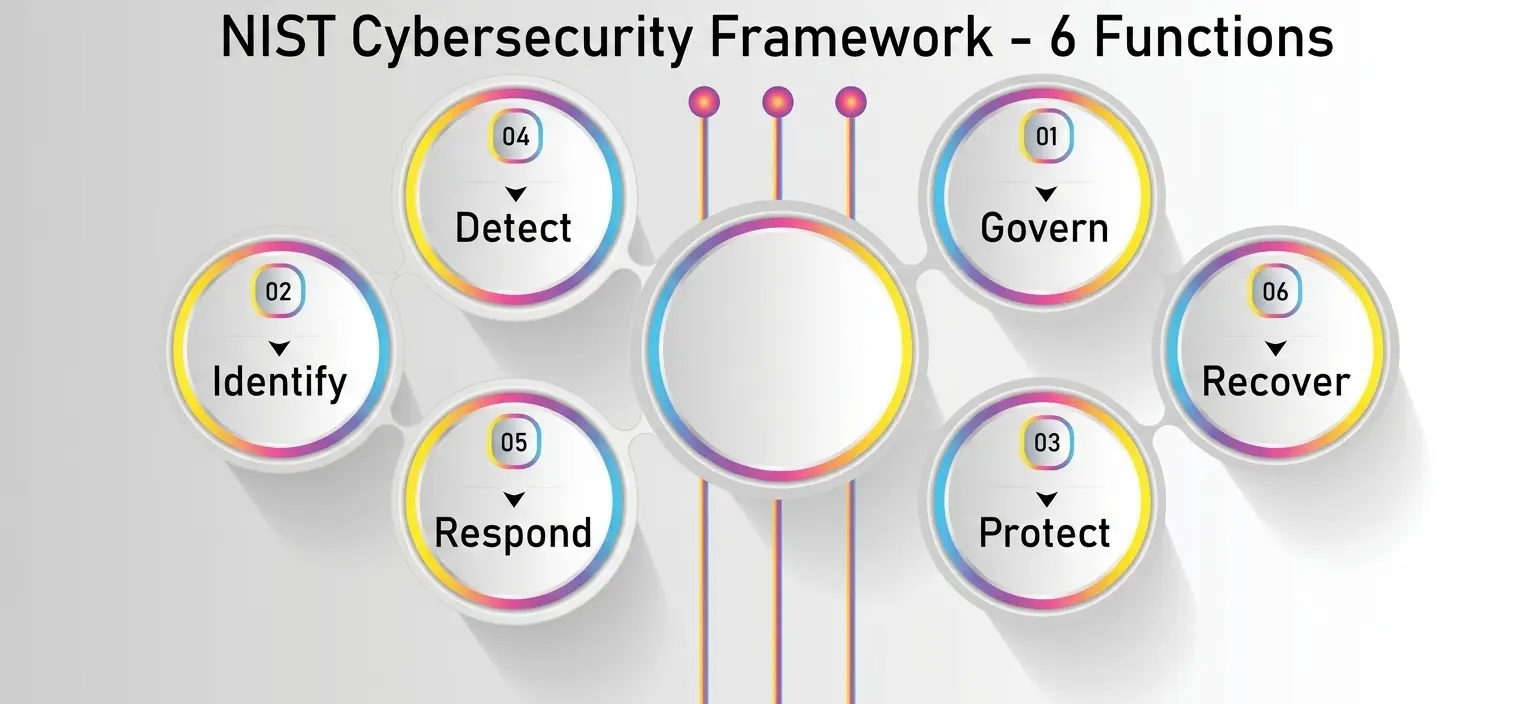
That new “Govern” function matters more than it sounds. It formally recognizes that a governance framework—the policies, roles, and oversight structures that decide who is accountable for security decisions—has to sit above the technical controls, not alongside them as an afterthought.
NIST doesn’t tell you exactly which controls to implement; instead, it gives you outcomes to aim for and lets you choose the tools and processes that fit your organization’s size and risk appetite.
That flexibility is why so many industries—healthcare, finance, education, and manufacturing—adapt CSF profiles to their own needs instead of using a single rigid checklist. It’s less a rulebook and more a shared vocabulary for talking about risk across a whole organization, from the server room to the boardroom.
ISO 27001: The Certifiable Standard and the ISO Audit Process
Where NIST gives you guidance, ISO/IEC 27001 gives you a certification you can actually hang on your wall. It’s part of the broader ISO/IEC 27000 family of standards and defines requirements for building an Information Security Management System, or ISMS — a formal, documented way of identifying risks and applying security controls to manage them.
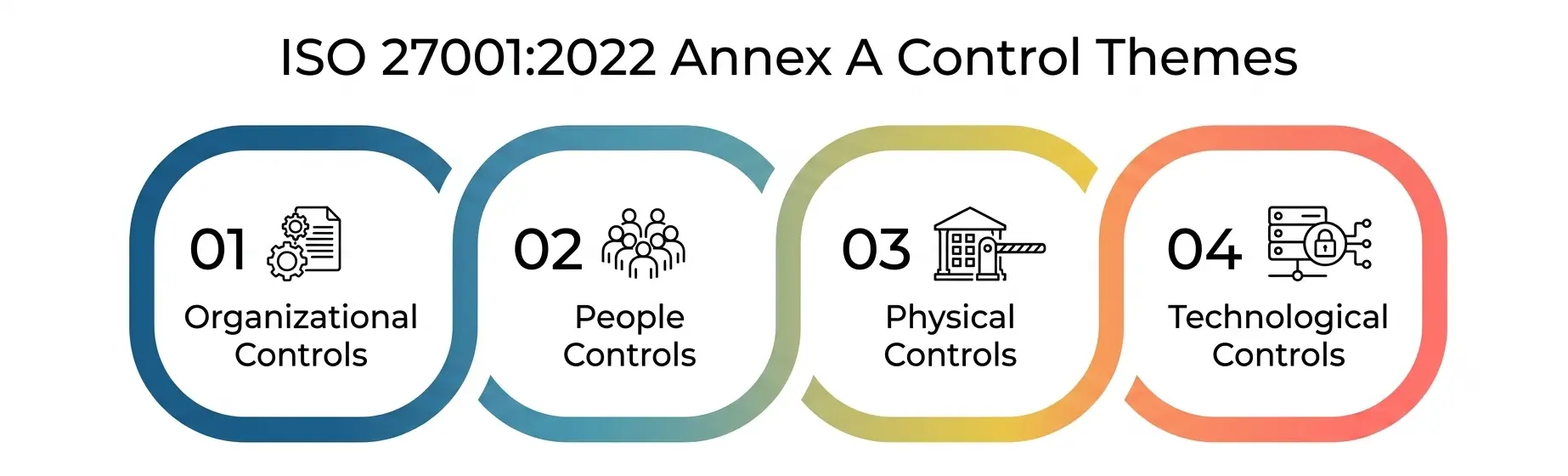
The 2022 revision reorganized Annex A from 114 controls across 14 domains down to 93 controls grouped into four themes: organizational, people, physical, and technological. If your organization was certified under the 2013 version, the transition deadline to move to ISO 27001:2022 was October 31, 2025—certificates that weren’t updated by then lapsed, a detail a lot of compliance teams learned the hard way.
Getting certified means going through an ISO audit, usually done in two stages. Stage one checks whether your documentation—policies, risk assessments, your Statement of Applicability—actually meets the standard’s requirements. Stage two is where an accredited auditor tests whether you’re actually doing what your documents claim.
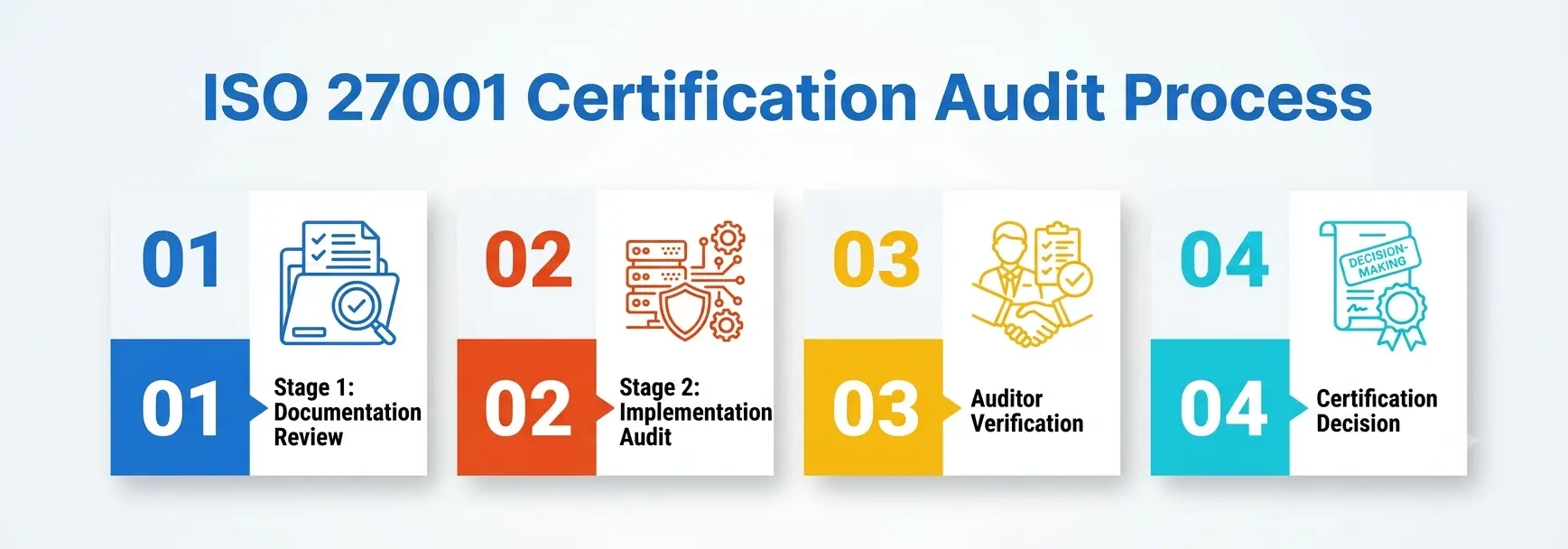
After certification, surveillance audits happen annually, and a full recertification audit repeats roughly every three years to keep the certificate valid. For students heading into GRC or compliance roles, understanding what this audit process actually examines — evidence, not intentions — is often more useful than memorizing clause numbers.
CIS Controls: The Practical, Prioritized Starting Point
If NIST is the philosophy and ISO 27001 is the certification, CIS is the “start here” list. Published by the Center for Internet Security, CIS Controls version 8.1 organizes 18 control groups into prioritized, actionable safeguards rather than abstract goals.
The update to v8.1, released in mid-2024, added its own governance function and realigned its mappings to match NIST CSF 2.0, which shows how closely these standards are expected to work together in practice.
What makes this framework different is the Implementation Groups (IG1, IG2, IG3) system. IG1 defines a baseline of essential security controls that almost any organization—even one with no dedicated security staff—should be able to implement.
IG2 and IG3 add layers for organizations with more resources and higher risk exposure. This is often the most approachable entry point for students because it answers a very concrete question: if you could only do ten things to reduce risk, what would they be?
A lot of introductory security courses actually start here for exactly that reason, before circling back to the broader theory in NIST or the formal documentation demands of ISO 27001.
Comparing the Three Approaches Side by Side
Laying these cybersecurity frameworks out side by side makes the differences easier to spot than reading about them one at a time:
|
Aspect |
NIST CSF 2.0 | ISO 27001 |
CIS Controls v8.1 |
|
Origin |
U.S. government (NIST) | International Standards Body (ISO/IEC) |
Community-driven (Center for Internet Security) |
|
Structure |
6 functions: Govern, Identify, Protect, Detect, Respond, Recover | Clauses 4–10 plus 93 Annex A controls in 4 themes |
18 control groups, prioritized by Implementation Group |
|
Certifiable? |
No formal certification | Yes, through an accredited audit |
No, but self-assessment tools exist. |
|
Best for |
Building a risk-based governance structure | Proving compliance to customers and regulators |
Fast, prioritized implementation |
|
Flexibility |
High—outcome-based | Moderate—requirements-based |
Moderate—prescriptive but scalable |
How These Cybersecurity Frameworks Actually Work Together?
Here’s the part that trips people up: organizations rarely pick just one. It’s common to see a company use NIST CSF for high-level governance and risk communication with leadership, ISO 27001 to prove security compliance to customers and win an audit-backed certificate, and CIS’s safeguards as the technical to-do list that engineers actually implement day to day.
CIS has published mappings from its controls directly to NIST CSF functions, and crosswalk documents exist mapping CIS Safeguards to ISO 27001 Annex A controls, which makes it possible to satisfy overlapping requirements without duplicating work.
Think of it like three different views of the same building. NIST shows you the blueprint and the reasoning behind it. ISO 27001 is the inspector’s certificate confirming it was built to code and verified through a proper audit process.
CIS’s Controls are the actual construction checklist the crew works from every day. None of them is “better” in isolation — they answer different questions, and a mature security program usually ends up drawing from all three at once.
Picture a mid-sized healthcare company preparing for its first big enterprise contract. Leadership adopts NIST CSF to structure its overall risk conversation and satisfy the new contract’s due-diligence questionnaire.
The compliance team pursues ISO 27001 certification because the client explicitly asks for a certificate, not just a policy document, as proof of compliance. Meanwhile, the IT team implements CIS’s Implementation Group 1 controls first, because it’s the fastest way to close obvious gaps — unpatched systems, missing multi-factor authentication, weak password policies — before the certification audit even begins.
None of these three efforts is optional or redundant; each one is answering a different question a different audience is asking, and the healthcare company ends up with three overlapping projects that reinforce rather than duplicate each other.
Choosing the Right Governance Framework for Your Organization
Picking among these approaches depends less on which one is “best” and more on what you need to prove and to whom.
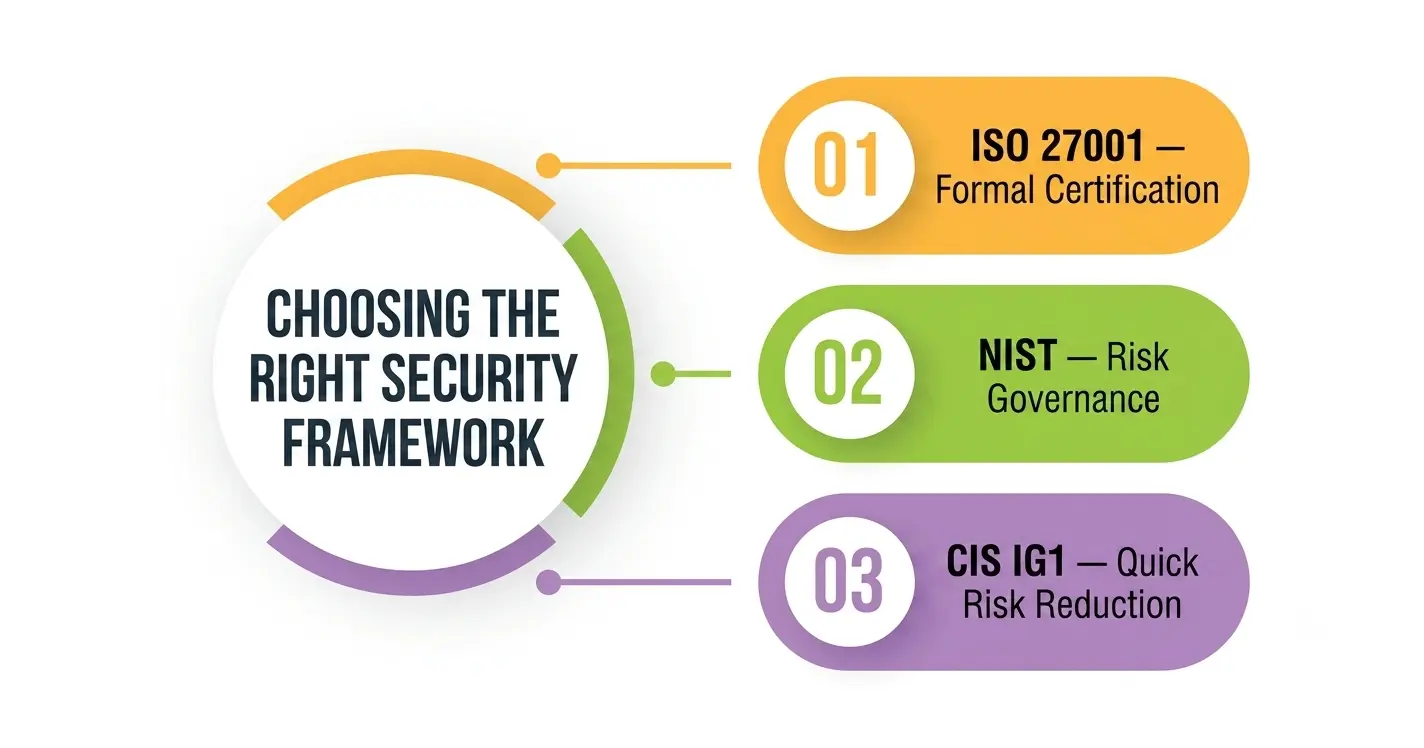
- If regulators or enterprise customers require formal certification, ISO 27001 and its audit process are usually non-negotiable for demonstrating security compliance.
- If leadership needs a shared language to discuss risk across departments, NIST’s governance structure communicates well to non-technical stakeholders.
- If your team is small and needs to reduce risk fast without a large compliance program, starting with CIS’s Implementation Group 1 gives the most immediate return on effort.
Many mature organizations end up blending all three: a governance framework built on NIST’s functions, security compliance backed by ISO 27001 certification, and day-to-day technical safeguards drawn from CIS’s list. There’s no rule against combining them—that overlap is the whole point of having crosswalks between the standards.
In fact, job postings for GRC analysts and security engineers increasingly expect at least working familiarity with all three, since most mid-sized and large organizations are managing more than one at a time.
Where Do These Frameworks Show Up in a Cybersecurity Career?
If you’re a student wondering why this matters beyond an exam, the honest answer is that these three names follow you into the job market. Entry-level certifications like CompTIA Security+ reference NIST terminology throughout their exam objectives.
GRC and compliance analyst roles almost always list ISO 27001 experience, sometimes phrased as “audit support” or “ISMS maintenance,” as a preferred qualification. Security engineering and SOC analyst roles frequently reference CIS’s Controls or Implementation Groups when describing baseline hardening work.
Even if your first job title has nothing to do with “compliance,” you’ll likely touch at least one of these standards indirectly—patching systems to meet a control, writing a policy that satisfies an audit requirement, or building a dashboard that reports progress against a framework to leadership.
Recognizing the names early, and understanding roughly what each one is for, saves you from relearning the same material three separate times under three different labels.
Common Mistakes Students and New Practitioners Make
A few patterns show up again and again when people are new to these cybersecurity frameworks.
- First, treating a framework like a checklist to complete once rather than a cycle to repeat—risk assessments and control reviews are ongoing, not one-time projects.
- Second, assuming compliance with one framework automatically satisfies another; crosswalks help, but gaps still need direct attention.
- Third, underestimating the governance piece—the policies and accountability structures—because it feels less “technical” than firewalls and encryption, when in reality most audit failures trace back to weak governance, not weak technology.
- And finally, walking into the certification audit without evidence, not just documentation; auditors want to see that controls are actually operating, not just written down somewhere.
A Personal Note
I’ll be honest about something most guides skip: the first time I tried to learn these three frameworks side by side, I made the mistake of memorizing them like separate subjects for an exam. It didn’t click until I stopped treating NIST, ISO 27001, and the CIS framework as competitors and started treating them as three lenses pointed at the same problem—risk.
Once I understood that a governance framework, a set of security controls, and an audit process are just different layers of the same conversation, everything else—the acronyms, the control numbers, the audit cycles—became a lot easier to hold onto.
If you’re a student reading this before an exam or an interview, that shift in mindset will serve you better than memorizing any single control list.