
If you have ever sat in a college seminar and heard a guest speaker say “compliance is a full-time job now,” you were not being fed a cliché. It is genuinely true. Regulations pile up faster than most legal and IT teams can read them, and the businesses that survive are the ones that stop treating compliance as a once-a-year scramble.
That is exactly where compliance management tools come in, and that is exactly what this guide is about. I am writing this as someone who has spent time researching, comparing, and reading through real user reviews of these platforms, not just skimming marketing pages.
My goal is simple: give students, early-career professionals, and small business owners a clear, honest, and practical look at the top platforms available right now, without the jargon overload that usually comes with this topic. By the end, you should be able to hold your own in a conversation about compliance software with someone twice your experience level.
What Are Compliance Management Tools, Really?
At the simplest level, compliance management tools are software platforms that help organizations track, manage, and prove that they are following laws, industry standards, and internal policies.
Instead of managing spreadsheets, sticky notes, and email chains, teams use a centralized dashboard to see exactly where they stand against a given regulatory framework, whether that is GDPR, HIPAA, SOC 2, ISO 27001, or PCI DSS.
Modern platforms go far beyond simple checklists. They combine compliance automation with continuous monitoring, so instead of scrambling before an audit, the system quietly checks controls in the background all year long.
Many also fold in audit tools, policy templates, risk registers, and vendor management modules so that one platform can handle several connected jobs instead of forcing teams to stitch together five different tools.
You will also see these platforms marketed under a slightly different label—regulatory compliance software—especially when a vendor wants to emphasize mapping to one specific law rather than general operational compliance.
In practice, the two phrases describe the same category of product, and most vendors happily use both terms on the same page.
How the Automation Actually Works, Day to Day
It helps to picture what happens behind the screen. Once a platform is connected to a company’s cloud accounts, identity provider, and code repository, it starts pulling small, verifiable facts on a schedule: Is multi-factor authentication enabled for every admin account? Are backups running on time? Has every employee acknowledged the security policy this quarter?
Each of those facts maps to a specific control required by a given law or standard, and the platform quietly stacks up evidence so nobody has to chase it down manually the week before an auditor arrives.
Why Businesses (and Students Studying Them) Should Care
Here is a number worth sitting with: according to Vanta’s own research, organizations now spend roughly 11 working weeks a year on compliance-related tasks, up from 10 the year before. That trend line is not slowing down. Every new privacy law, every new AI regulation, and every new industry standard adds another layer of work.
This is precisely why compliance automation has moved from “nice to have” to “business-critical” in a few short years. A single missed control, an expired vendor questionnaire, or an out-of-date policy document can turn into a failed audit, a lost customer contract, or in worse cases, a regulatory fine.
For students studying business, cybersecurity, or information systems, understanding how regulatory compliance software actually works in practice is quickly becoming as important as understanding the regulations themselves.
Good platforms also strengthen third-party oversight through built-in vendor risk modules, since a company’s compliance posture is only as strong as the weakest supplier or partner touching its data.
Top 5 Compliance Management Tools Worth Knowing in 2027
I picked these five platforms because they consistently show up across independent comparisons, they serve genuinely different use cases, and they each represent a distinct approach to solving the same underlying problem: reducing manual compliance work.
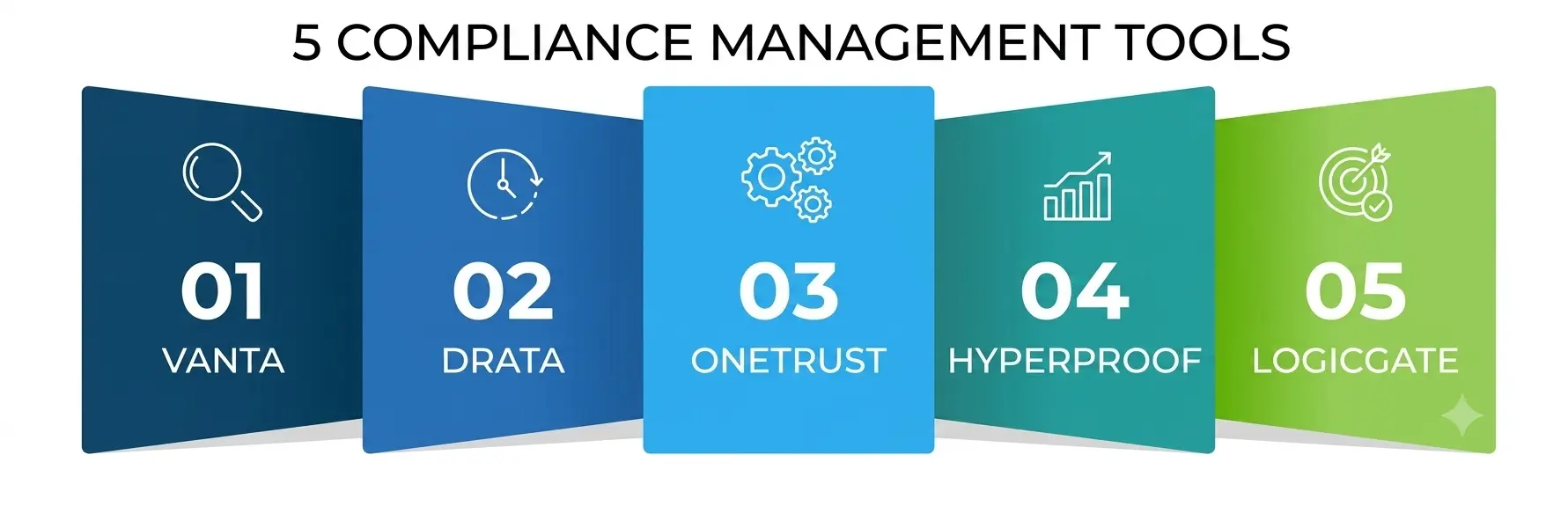
1. Vanta — Best for Quick, Automated Evidence Collection
Vanta is one of the most widely used platforms among SaaS startups and mid-sized companies and was named a leader in the IDC MarketScape for governance, risk, and compliance software. The platform hooks into a company’s existing cloud services, code repositories, and HR systems and automatically pulls the evidence needed for frameworks like SOC 2, ISO 27001, HIPAA, and GDPR.
What makes Vanta stand out is its emphasis on continuous monitoring rather than point-in-time checks. Instead of scrambling for screenshots before an audit, security teams get hourly automated tests that flag drift the moment a control slips out of line.
It also includes trust center features, letting companies publicly showcase their compliance posture to prospective customers—a genuinely clever use of compliance automation as a sales enabler, not just a defensive tool.
Good for: startups and growth-stage companies pursuing their first SOC 2 or ISO 27001 certification.
2. Drata—Best for Continuous Control Monitoring and Vendor Oversight
Drata plays in the same space as Vanta but has built a strong reputation for the depth of its continuous control monitoring and its structured approach to vendor management. It connects with a wide range of integrations to automatically gather compliance evidence, cutting out the manual data-pulling that used to eat entire weeks of a compliance officer’s calendar.
Drata’s policy management module offers editable, auditor-approved templates, while its built-in risk assessment tools let teams self-report on how effective their controls actually are, rather than assuming a checkbox equals real security.
For companies juggling multiple vendors and multiple frameworks at once, Drata’s centralized location for sending, tracking, and reviewing vendor security questionnaires is a genuine time-saver.
Good for: growing companies that need to manage several compliance frameworks and a long vendor list simultaneously.
3. OneTrust—Best for Privacy and Regulatory Framework Coverage
OneTrust takes a broader view than most compliance management tools on this list. Rather than focusing narrowly on security certifications, it covers privacy, data governance, third-party risk, and ethics programs under one roof, serving thousands of enterprise customers, including a large share of the Fortune Global 500.
Where OneTrust really shines is in privacy-specific regulatory framework coverage. Its assessment automation handles Privacy Impact Assessments and Data Protection Impact Assessments, its data mapping tools support GDPR Article 30 recordkeeping, and its cookie consent and preference management modules are practically an industry standard for websites operating across multiple jurisdictions. Its Vendorpedia module also folds vendor management directly into privacy and third-party risk workflows.
Good for: larger organizations with heavy privacy obligations across multiple countries and jurisdictions.
4. Hyperproof — Best for Centralizing Compliance Operations at Scale
Hyperproof is built for compliance teams that are done juggling five frameworks in five different spreadsheets. It centralizes controls, policies, evidence, and risk monitoring into a single system of record, and it is one of the more capable audit tools on the market for organizations running multiple certifications at once.
Reviewers consistently point to Hyperproof’s ability to map controls once and reuse them across several frameworks, which meaningfully cuts down duplicate work during audit season.
Its “freshness tracking” feature flags evidence that is getting stale before an auditor ever asks for it, and its reusable audit history means teams are not rebuilding their compliance story from scratch every single year.
Good for: mid-market to enterprise compliance teams managing five or more frameworks in parallel.
5. LogicGate — Best for Configurable, No-Code GRC Workflows
LogicGate takes a different approach from the rest of this list. Its Risk Cloud platform is a no-code system that lets risk and compliance teams build their own workflows, applications, and reporting structures instead of working inside a rigid, pre-set template.
With more than 40 purpose-built applications available out of the box, it is one of the more flexible regulatory compliance software options for organizations with unusual or highly specific processes.
LogicGate leans heavily into connecting risk data across the business, so a control gap identified in one department can automatically trigger a related risk review somewhere else.
This interconnected view is part of why it is frequently chosen by larger enterprises that have outgrown simpler, single-purpose automation tools and need a genuinely configurable GRC platform instead.
Good for: enterprises with complex, custom risk and compliance workflows that off-the-shelf platforms cannot easily accommodate.
Quick Comparison Table
|
Tool |
Best For | Standout Feature |
Ideal Company Size |
|
Vanta |
Fast SOC 2 / ISO 27001 readiness | Hourly automated control testing |
Startups & growth stage |
|
Drata |
Continuous monitoring + vendor oversight | Auditor-approved policy templates |
Growing multi-framework teams |
|
OneTrust |
Privacy and regulatory framework coverage | GDPR-ready data mapping (Article 30) |
Large enterprises |
|
Hyperproof |
Centralizing multi-framework operations | Evidence of “freshness” tracking |
Mid-market to enterprise |
|
LogicGate |
Configurable, no-code GRC workflows | 40+ purpose-built applications |
Enterprises with custom needs |
How to Choose the Right Compliance Management Tool?
There is no single “best” answer here, and honestly, anyone who tells you otherwise is probably selling something. The right choice depends on a few practical questions:
- Which regulation or standard matters most to you right now? A startup chasing its first SOC 2 report has very different needs than a multinational managing GDPR and CCPA at the same time.
- How many vendors do you rely on? If vendor management is a daily headache, prioritize platforms with strong third-party risk modules.
- Do you need audit tools for one framework or five? Centralization matters more as the number of frameworks grows.
- How technical is your team? No-code platforms like LogicGate suit teams that want to build custom workflows without engineering support, while automation-first tools like Vanta and Drata suit teams that would rather work inside a pre-built structure.
- What is your budget and team size? Some of these compliance management tools are priced for lean startups; others are built for enterprise procurement cycles.
None of these questions have a universally right answer, which is exactly why the shortlist above includes five genuinely different platforms rather than five versions of the same idea.
Talking to current users on review platforms like G2 and requesting live demos rather than relying only on marketing pages remains the most reliable way to validate a fit before signing a contract. It is also worth asking each vendor directly how their pricing scales as you add frameworks, since that is where costs can quietly balloon.
A Personal Note
I will be honest with you: when I first started digging into this topic, I expected compliance software to be dry, box-ticking stuff. It is not. What struck me while going through actual user reviews was how much time and stress these platforms genuinely save real compliance teams—people who used to spend entire weekends before an audit hunting for screenshots and old emails.
If you are a student heading into cybersecurity, IT governance, or business compliance, I would genuinely encourage you to create a free trial account on one of these platforms and click around.
Reading about compliance automation in a textbook is one thing; watching a dashboard flag a real control gap in real time is what actually makes the concept click. It changed how I personally think about “compliance”—less as paperwork, more as an ongoing engineering discipline.