
Walk into almost any mid-sized company today and ask the compliance officer how many spreadsheets they’re juggling. The answer is usually “too many.” Regulations pile up faster than teams can track them, audit requests arrive with no warning, and one missed control can turn into a six-figure fine.
This is the exact gap that GRC compliance software was built to close, and it’s why the category has grown from a niche IT purchase into a boardroom priority in just a few years.
If you’re a student trying to understand this space or a working professional evaluating your first platform, this guide breaks down what these platforms actually do, the features that separate a strong tool from a mediocre one, and the real business benefits behind the marketing language. By the end, you should be able to walk into a vendor demo and ask sharper questions than most first-time buyers do.
What Is GRC Compliance Software?
GRC stands for Governance, Risk, and Compliance. According to ISACA, GRC is an operational strategy that helps organizations align their activities with business objectives, manage risk effectively, and stay in compliance with government and industry regulations.
GRC compliance software is the technology layer that makes this strategy executable—instead of managing policies, risks, and audit evidence across email threads and disconnected spreadsheets, everything lives inside one connected system.
At its core, a strong GRC platform gives an organization a single governance framework to define who is accountable for what, a working control structure to enforce how risks are managed day to day, and a repeatable process for proving compliance to regulators, customers, and auditors.
The discipline exists to help organizations reliably achieve objectives, address uncertainty, and act with integrity—the software simply operationalizes that idea at scale, across every department instead of one.
Why Are Businesses Investing in GRC Compliance Software?
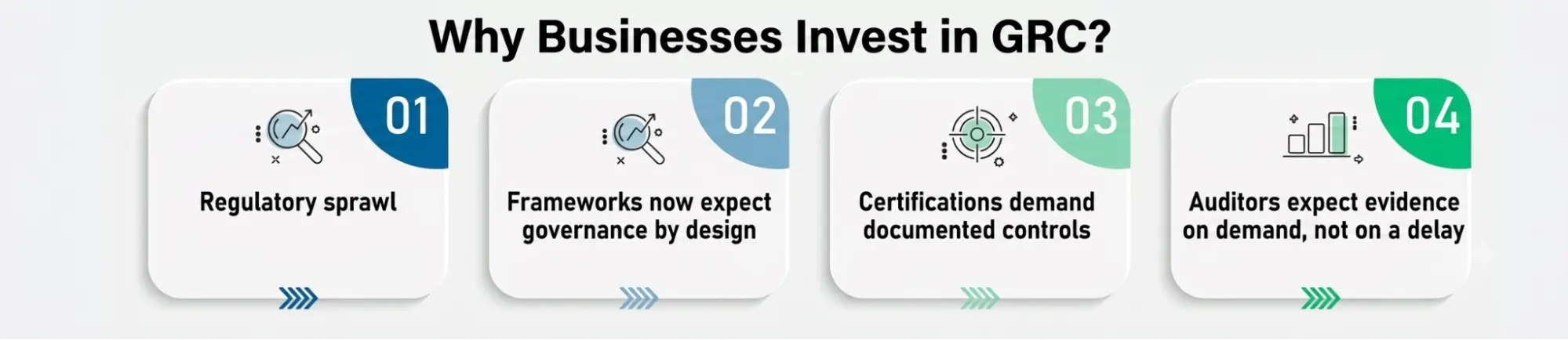
Manual compliance management doesn’t break all at once—it breaks quietly, one missed deadline or undocumented control at a time. A few forces are pushing organizations toward dedicated platforms instead of homegrown spreadsheets:
- Regulatory sprawl. Laws like GDPR, HIPAA, and dozens of industry-specific mandates keep expanding, and tracking them by hand simply doesn’t scale past a handful of frameworks.
- Frameworks now expect governance by design. The NIST Cybersecurity Framework added a dedicated “Govern” function in its 2.0 update, formally recognizing that governance has to be built into risk management rather than bolted on afterward.
- Certifications demand documented controls. Standards such as ISO/IEC 27001 require organizations to show, in writing, exactly how information security risks are identified, treated, and monitored — something a spreadsheet struggles to maintain consistently over time.
- Auditors expect evidence on demand, not on a delay. Ad hoc compliance reporting during audit season creates weeks of scrambling; a proper system keeps evidence current all year round.
Taken together, these pressures explain why so many risk and audit teams eventually outgrow manual tracking and start shopping for a dedicated GRC platform.
Top Features of a Strong GRC Platform
Not every tool in this market is built the same way, but the strongest platforms share a common set of capabilities.
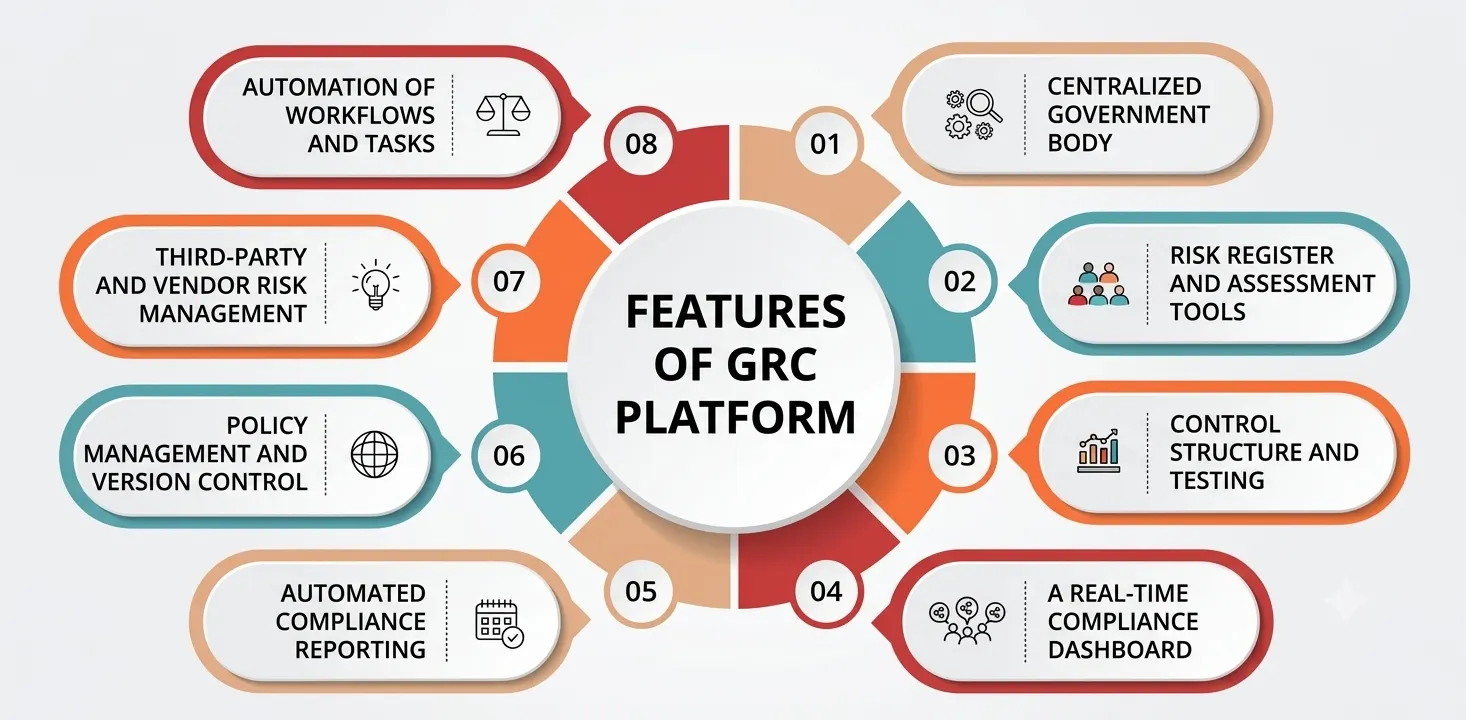
1. Centralised Government Body
A good GRC platform gives you a single place to document policies, assign ownership, and map responsibilities across departments. It becomes a living structure—constantly updated, versioned, and directly tied to the risks and controls it governs—not a governance framework that lives on a PDF nobody reads. That single source of truth is often the difference between a mature compliance program and one that’s still playing catch-up.
2. Risk Register and Assessment Tools
Every platform needs a way to identify risks, score their likelihood and impact, and track how they evolve over time. This is where governance connects to daily operations — risks get flagged, owners get assigned, and remediation gets tracked all the way to closure.
3. Control Structure and Testing
Every compliance program needs a working set of controls—the specific safeguards, technical, administrative, and physical, that reduce a given risk to an acceptable level. Mature GRC platforms let teams map one control to multiple regulatory requirements at once, so a single access-review control might satisfy SOC 2, ISO 27001, and an internal policy simultaneously, cutting duplicate audit work significantly.
4. A Real-Time Compliance Dashboard
A well-designed compliance dashboard is often the single feature executives care about most. It turns hundreds of underlying data points—open risks, overdue tasks, control test results, and audit findings—into a visual snapshot leadership can read in under a minute. A strong dashboard like this doesn’t just show status; it highlights what’s trending in the wrong direction before it becomes a formal finding.
5. Automated Compliance Reporting
Manually assembling reporting packages for auditors, regulators, or the board eats enormous amounts of staff time. A modern GRC platform automates compliance reporting by pulling live data—control status, risk scores, and remediation history—into pre-built or customizable templates, cutting reporting cycles from weeks down to days in many cases.
6. Policy Management and Version Control
Policies change constantly, and a good platform tracks every revision, who approved it, and when employees acknowledged it—which matters enormously the moment an auditor asks, “Prove employees agreed to this policy back in March.”
7. Third-Party and Vendor Risk Management
Your compliance posture is only as strong as your weakest vendor. Leading platforms extend the same governance structure and control environment to third parties, tracking vendor risk assessments, contracts, and ongoing monitoring in one place instead of a separate spreadsheet nobody updates.
8. Automation of Workflows and Distribution of Tasks
A modern GRC platform will automatically route tasks—a control to be retested, a policy to be re-approved—to the right owner, with reminders and escalation built in from day one, rather than chasing people over email.
Features vs. Benefits at a Glance
|
Feature |
What It Does |
Business Benefit |
|
Governance framework hub |
Centralizes policies, roles, and accountability |
Clear ownership; fewer gaps between departments |
|
Risk register |
Tracks and scores risks continuously |
Faster identification of emerging threats |
|
Control structure mapping |
Links one control to multiple regulations |
Less duplicated audit work, lower cost |
|
Compliance dashboard |
Visualizes real-time compliance posture |
Faster, better-informed executive decisions |
|
Automated reporting engine |
Generates audit-ready reports from live data |
Shorter audit cycles, less manual effort |
|
Policy version control |
Logs every policy change and acknowledgment |
Defensible audit trail during regulatory review |
|
Vendor risk management |
Extends oversight to third parties |
Reduced supply-chain and vendor exposure |
|
Workflow automation |
Assigns and tracks remediation tasks |
Fewer missed deadlines, better accountability |
Core Benefits of GRC Compliance Software
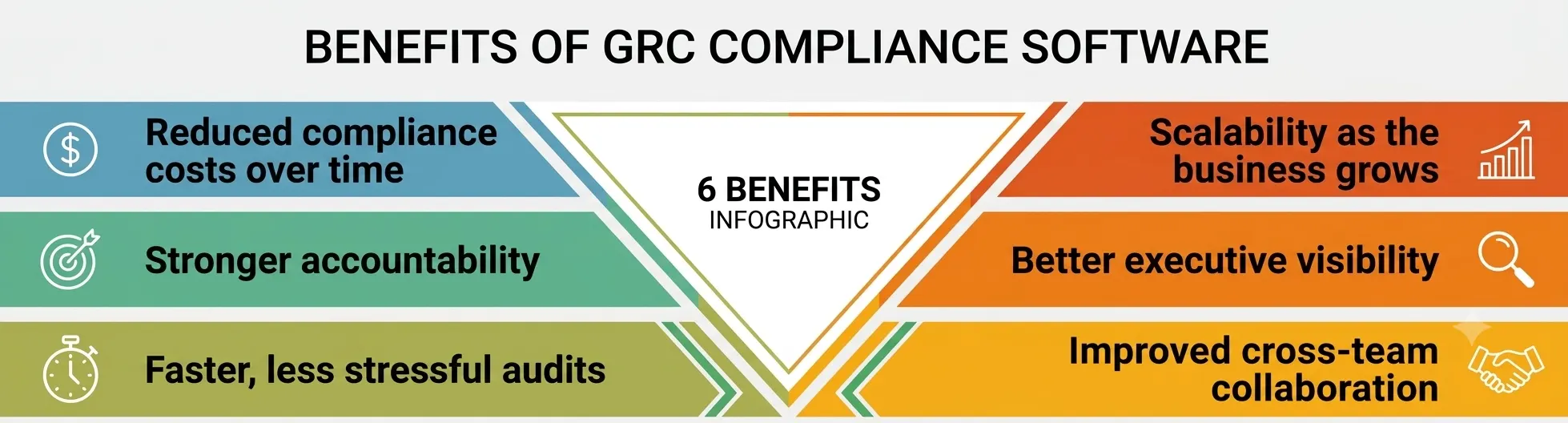
- Reduced compliance costs over time. Once your policies and controls are digitized, the incremental cost of adding a new regulation or certification drops sharply, since existing work can often be reused rather than rebuilt.
- Faster, less stressful audits. With reporting generated directly from live system data instead of assembled by hand, compliance reporting shifts from a weeks-long fire drill to something closer to a routine export.
- Better executive visibility. A live dashboard means leadership doesn’t have to wait for a quarterly report to understand organizational risk exposure—they can check a compliance dashboard whenever they actually need to.
- Stronger accountability. Because every control, policy, and risk has a named owner inside the system, this kind of software closes the “I thought someone else was handling that” gap that causes so many compliance failures in the first place.
- Scalability as the business grows. A control structure built for one regulation can typically be extended to cover new frameworks with far less duplicated effort than starting from scratch each time a new law arrives.
- Improved cross-team collaboration. Legal, IT, security, and operations teams often manage overlapping risks without realizing it; a shared governance framework gives everyone the same source of truth instead of five conflicting spreadsheets.
How to Choose the Right GRC Compliance Software?
For students and early-career professionals evaluating this market, a few criteria consistently separate a good fit from a bad one:
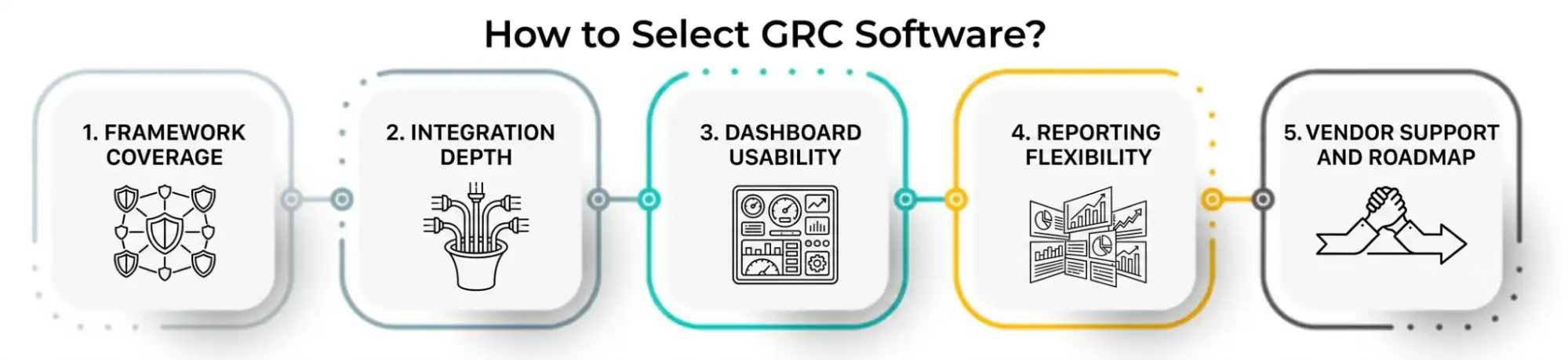
- Framework coverage — does it support the regulations and standards relevant to your industry, such as GDPR, HIPAA, ISO 27001, or SOX?
- Integration depth – does it pull data automatically from cloud, HR, and IT systems rather than manual uploads?
- Dashboard Usability – can a non-technical executive understand the compliance dashboard without any training?
- Flexibility in reporting—Is compliance reporting flexible to adapt to different auditors’ formats, or is it rigid and difficult to customize?
- Vendor support and roadmap — is the vendor actively investing in the product, including newer AI-assisted risk scoring capabilities?
According to Gartner’s coverage of the GRC tools market, these platforms increasingly incorporate AI for tasks like risk score validation and control recommendations — a trend worth weighing heavily if you’re choosing something meant to last more than a couple of years.
Common Challenges When Implementing These Platforms
No platform fixes a broken process by itself. Common early-stage challenges include:
- Data migration fatigue — moving years of spreadsheet history into a structured, centralized system takes genuine project time and planning.
- Change resistance — teams accustomed to email-based workflows often resist new controls and workflows until they personally see time saved.
- Over-customization — configuring every possible field before going live delays adoption; most teams do better starting simple and expanding gradually.
- Dashboard fatigue—a dashboard packed with every possible metric becomes as unreadable as no dashboard at all; less is often genuinely more.
Where Is the Category Heading?
GRC compliance software is moving toward continuous, automated assurance rather than periodic check-ins. AI-assisted control testing, real-time third-party risk scoring, and predictive risk modeling are becoming standard features rather than premium add-ons.
For students entering this field, understanding both the governance fundamentals and the automation layer will matter more with every passing year, since the manual, spreadsheet-driven version of compliance work is steadily disappearing from job descriptions across nearly every regulated industry.
It’s also worth noting that this shift changes what “compliance skills” even mean. A decade ago, being good at compliance meant being meticulous with documents. Today, it increasingly means knowing how to configure a system, interpret a dashboard, and trust automated evidence collection enough to sign off on it—a genuinely different skill set that most compliance training still hasn’t fully caught up with.
Final Thoughts
GRC compliance software isn’t just a tool for checking regulatory boxes — it’s what turns governance, risk, and compliance from three disconnected chores into one coordinated system.
Whether you’re a student mapping out a future in this field or a professional comparing platforms, understanding the governance framework, control structure, dashboard, and reporting capabilities behind the marketing pitch will help you tell a genuinely useful platform from a good-looking demo.
A Personal Note
I’ve watched compliance teams go from dreading audit season to treating it as a non-event, purely because the underlying system finally matched the complexity of the work they were already doing. If you’re studying this field, don’t just memorize the acronyms — spend time in an actual product demo.
Watching a live dashboard update in real time, or seeing one control satisfy three different frameworks at once, teaches you more about why this discipline matters than any textbook definition ever will.