

Every organization, from a college fest committee handling a few thousand rupees to a multinational bank moving billions across borders, runs on the same fragile currency: trust. Someone has to believe that the numbers being reported are real, that the money collected went where it was supposed to go, and that no single person quietly bent the rules along the way. That trust does not happen by accident. It is built, transaction by transaction, through financial controls.
If you are a student trying to make sense of why terms like internal controls, audit trail, and segregation of duties keep showing up in your accounting, auditing, or corporate governance textbook, this guide breaks it all down in plain language, with real examples, so the concepts actually stick instead of being memorized the night before an exam.
What Are Financial Controls?
Financial controls are the policies, procedures, and checks that an organization puts in place to manage how money moves in, through, and out of the business. They cover everything from who is allowed to approve a purchase order to how expenses get recorded in the books to what happens the moment the numbers stop adding up.
According to Pathlock’s breakdown of preventive, detective, and corrective safeguards, these fall into three broad categories:
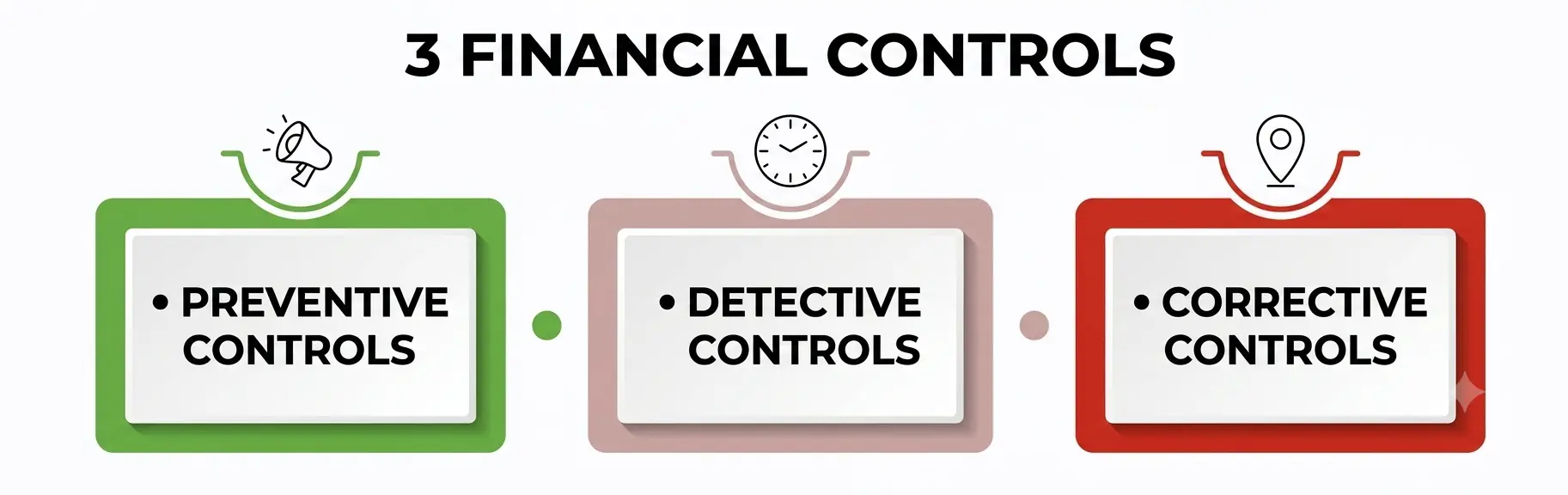
- Preventive controls—stop errors or fraud before they happen (for example, requiring two signatures on any payment above a set limit)
- Detective controls—catch problems after they have already occurred (for example, a monthly bank reconciliation)
- Corrective controls—fix what detective controls uncover and make sure it does not happen again
Together, these three categories form a loop: prevent, detect, and correct. That loop is what keeps an organization’s financial statements honest, and it is exactly why this system sits at the center of both governance and risk management, rather than being treated as a side task left entirely to the accounts department.
Why Financial Controls Matter for Governance
Governance, at its core, is about accountability—who is responsible for what, and how do we actually know they did it properly? Without financial controls, governance is just good intentions typed into a policy document that nobody ever checks.
Boards and senior management rely on these safeguards to get an honest, current picture of the organization’s financial health. When financial controls are weak or missing, three things tend to go wrong at the same time: financial statements become unreliable, fraud becomes easier to hide, and regulators start asking uncomfortable questions.
This is exactly why the Sarbanes-Oxley Act’s Section 404 in the United States requires publicly listed companies to formally assess and report on the effectiveness of their internal reporting safeguards, a requirement explained well in Cherry Bekaert’s guide to SOX 404 compliance. A company that cannot demonstrate this kind of discipline risks losing investor confidence long before it loses any actual money.
Good governance also depends on active compliance monitoring—the ongoing process of checking whether an organization is actually following its own policies and external regulations, not simply writing them down and forgetting about them.
As an overview of governance, risk, and compliance explains, these three functions work together to help an organization reliably achieve its objectives, manage uncertainty, and act with integrity. This ongoing check is the piece that turns a governance policy from a document into a living practice.
Internal Controls: The Building Blocks
If financial controls are the overall system, internal controls are the individual bricks that the system is built from. They include every policy, procedure, and safeguard a company uses to protect its assets, ensure accurate record-keeping, and promote operational efficiency—not just controls over money, but over processes, data, and people too.
The most widely used reference point for internal controls worldwide is the COSO Internal Control–Integrated Framework, developed by the Committee of Sponsoring Organizations of the Treadway Commission.
As the Government Finance Officers Association explains in its internal control framework guidance, the COSO model organizes them around five components: control environment, risk assessment, control activities, information and communication, and monitoring activities.
For a student, the easiest way to remember this is that internal controls are not one single rule—they are a system of interlocking safeguards. A single strong control, like requiring manager approval on expenses, can still fail if the surrounding checks, like proper documentation or independent review, are weak. That is why auditors evaluate the whole system rather than judging individual rules in isolation.
Segregation of Duties: The First Line of Defense
Of all the internal controls a company can put in place, segregation of duties is arguably the simplest to understand and one of the hardest to get right in practice.
The idea behind this principle is straightforward: no single person should be able to both carry out a transaction and cover up a mistake or fraud connected to it. As AccountingTools explains in its guide on this internal control, no one person should control authorization, record-keeping, and custody of assets for the same transaction. Split those three responsibilities across different people, and it becomes far harder for either an honest mistake or a deliberate fraud to slip through unnoticed.
A classic classroom example makes this easy to picture. Imagine one employee who can both create a new vendor in the accounting system and approve payments to that vendor. Nothing stops them from inventing a fake vendor and paying themselves.
Now split those two tasks between two different employees, and suddenly a fake vendor requires two people to agree to commit fraud together, which is a much harder thing to pull off quietly.
Segregation of duties does not mean every small business needs a huge finance team. Where headcount is limited, compensating controls—like a supervisor’s sign-off, an external accountant’s periodic review, or rotating duties between staff—can achieve a similar effect. The underlying goal never changes: make sure no single individual has unchecked authority over an entire financial process.
Audit Trail: Proof That the Controls Are Actually Working
These controls are useful only if you can later prove they were followed, and that is where the audit trail comes in.
An audit trail is a chronological, time-stamped record of a transaction from the original source document (an invoice, a receipt, or a contract) to its final entry in the general ledger and financial statements.
As Tipalti explains in its resource on this topic, the purpose is to reduce errors and fraudulent activity, strengthen internal controls, and ensure that the transactions flowing into financial statements are accurate.
Think of an audit trail as a detailed diary that the accounting system keeps automatically. Every approval, every edit, every reversal is logged with who did it, when, and why. When an external auditor shows up to review a company’s books, they are not just checking whether the final numbers look reasonable—they are following that record backward to confirm every number can be traced to a genuine, properly authorized source document.
A clean, complete audit trail also makes internal investigations far faster. Instead of asking employees to reconstruct events from memory, investigators can simply pull up the record and see exactly what happened, in what order, and who was involved.
That is why regulators like the SEC place so much weight on this kind of documentation when assessing whether a company’s controls over financial reporting are genuinely effective.
Compliance Monitoring: Keeping Controls Alive Over Time
Designing good safeguards once is not enough—regulations change, teams change, and systems change. Compliance monitoring is the discipline of continuously checking whether controls are still being followed and are still fit for purpose.
Compliance monitoring typically includes periodic control testing, spot checks on transactions, employee training refreshers, and formal reporting to the board or audit committee.
Done well, it catches control breakdowns early, before they turn into a full-blown scandal or regulatory penalty. Done poorly—or skipped altogether—even a well-designed system of controls will quietly decay as staff cut corners under deadline pressure.
This is also where technology has changed the game. Many organizations now run automated compliance monitoring tools that flag unusual transactions, duplicate payments, or policy violations in near real time, rather than waiting for a quarterly or annual audit to catch them.
For students entering the accounting or finance profession, understanding this discipline is quickly becoming as important as understanding double-entry bookkeeping, simply because so much of modern control testing now happens through software rather than manual review.
Where Financial Controls and Risk Management Meet?
Risk management asks a simple question: what could go wrong, and how bad would it be if it did? These safeguards are the practical answer to that question when the risk in question involves money, reporting, or compliance.
Consider how the pieces connect. A risk assessment might flag that a company’s accounts payable process is vulnerable to fraudulent vendor payments. The response is not just “be more careful”—it is to design specific financial controls: segregation of duties between vendor setup and payment approval, an audit trail that logs every change to vendor bank details, and compliance monitoring that flags payments to newly added vendors for extra review. Each control directly addresses a specific risk identified earlier in the process.
This is precisely why these safeguards cannot be designed in isolation from risk management. A control that looks strong on paper but does not map to an actual identified risk is wasted effort, and a real risk with no matching control is a problem waiting to surface. Mature organizations build a risk and control matrix that pairs every significant financial risk with the specific control (or controls) meant to manage it, then tests that pairing on a regular schedule.
A Quick Comparison: Types of Financial Controls
|
Control Type |
When It Acts | Example |
Primary Goal |
|
Preventive |
Before a transaction is completed | Dual approval on large payments |
Stop errors or fraud before they happen. |
|
Detective |
After a transaction is recorded | Monthly bank reconciliation |
Identify errors or irregularities quickly. |
|
Corrective |
After an issue is confirmed | Reversing an incorrect entry and retraining staff |
Fix the problem and prevent recurrence. |
|
Segregation of Duties |
Built into process design | Separate staff for invoice entry and payment approval. |
Prevent one person from controlling an entire process. |
|
Compliance Monitoring |
Ongoing, continuous | Automated flags on unusual vendor payments |
Confirm controls are still being followed. |
Common Mistakes Organizations (and Students) Make Get Wrong
A few misunderstandings come up again and again, both in the classroom and in the real world:
- Treating financial controls as a one-time project. Controls need periodic review, not a single rollout followed by years of silence.
- Confusing a policy with a control. Writing “employees must not approve their own expenses” in a handbook is a policy. Building a system that technically blocks self-approval is a control.
- Assuming segregation of duties is only relevant to large companies. Even a two-person startup can apply the principle through compensating controls.
- Ignoring the audit trail until something goes wrong. By then, gaps in the record are far harder to fill retroactively.
- Treating compliance monitoring as the auditor’s job alone. Ongoing monitoring works best when it is embedded in daily operations, not outsourced entirely to an annual external review.
Conclusion
Financial controls are not paperwork for its own sake. They are the mechanism that turns good governance from a stated value into a demonstrable, testable reality, and they are the practical toolkit that risk management uses to actually manage the risks it identifies.
Internal controls give the system its structure, segregation of duties keeps single points of failure out of critical processes, the audit trail provides the proof, and compliance monitoring keeps the whole system honest over time.
Understanding how these pieces connect is one of the most useful things a student of accounting, finance, or governance can take away—because in the real world, it is rarely the absence of rules that causes a scandal. It is the quiet failure to follow the ones already in place.
A Personal Note
I have sat through enough audit committee discussions and late-night reconciliation sessions to say this plainly: financial controls rarely fail because nobody knew the rules. They fail because the rules were quietly skipped under deadline pressure, and nobody was watching closely enough to notice until it was too late.
If you take one idea away from this piece, let it be that a control is only as good as the discipline behind following it—the framework on paper matters far less than the culture that actually enforces it day to day. That is the part textbooks tend to underplay, and that is the part that actually protects an organization when things get messy.