Ask any small-business owner what keeps them up at night, and you’ll hear about cash flow, hiring, or a competitor undercutting prices. Data protection rarely makes that list—until the day it becomes the only thing that matters. That day usually arrives after an attacker has already been sitting inside the network for weeks, quietly collecting information.
Business data security isn’t a box for the IT department to check once a year. It’s the ongoing practice of protecting the customer records, financial data, trade secrets, and internal communications that keep a company running. And the numbers back up why this deserves real attention.
The global average cost of a data breach reached $4.44 million, according to IBM breach-cost research—the first year-over-year decline in five years, driven mainly by faster detection rather than fewer attacks overall.
For students entering the workforce, understanding this topic isn’t optional background reading anymore. It’s a core professional skill, on par with knowing how to read a balance sheet.
What Is Business Data Security, Really?
Business data security refers to the policies, tools, and daily habits an organization uses to protect its digital and physical information assets from unauthorized access, corruption, or theft. That covers a lot of ground: customer databases, employee records, payment systems, product designs, and even the internal chat messages nobody thinks twice about.
Most people picture hackers in hoodies when they think about this topic, but the reality is far less cinematic. A large share of incidents start with something mundane—an employee reusing a password, a vendor with weak defenses, or a piece of software nobody remembered to update.
Verizon’s DBIR analyzed more than 22,000 security incidents and found that credential abuse and exploited vulnerabilities remain the two leading ways attackers get in, and that third-party involvement in breaches has doubled to 30 percent.
That last point matters. A company’s defenses are only as strong as the weakest vendor connected to it. Solid security thinking treats the entire supply chain as part of the attack surface, not just internal servers.
Why Does This Matter More Than Ever in 2026?
It’s tempting to think of security spending as insurance you hope never to use. That framing undersells the problem. Cyber threats aren’t a distant, hypothetical risk reserved for large corporations anymore—small and mid-sized businesses are now a preferred target, precisely because they tend to have thinner defenses and less capacity to recover.
A small-business snapshot found that extortion-style ransomware showed up in 88 percent of breaches at small and mid-sized businesses, compared with 39 percent at larger organizations. Attackers know a five-person accounting firm is less likely to have a dedicated security team than a national bank is, and they act accordingly.
There’s also a widening cost gap by region. In the United States specifically, the average data breach now costs a record $10.22 million, driven by regulatory fines and longer investigations, even as the global average declined.
That divergence says something important: breach cost isn’t only about attacker skill. It’s about how quickly a company detects the intrusion, how prepared its response plan is, and how exposed it is to fines for handling data carelessly in the first place.
Then there’s the AI variable. IBM’s research found that one in six breaches now involves AI-driven attacks—mostly used to scale phishing campaigns and deepfake impersonation—while 63 percent of organizations still have no governance policy covering how their own staff use AI tools.
Attackers are automating faster than most companies are adapting, which is exactly why business data security has to be treated as a continuous practice rather than a project with a finish line.
Common Cyber Threats Businesses Face Today
Understanding the shape of the threat helps prioritize limited time and budget. A few patterns show up again and again:
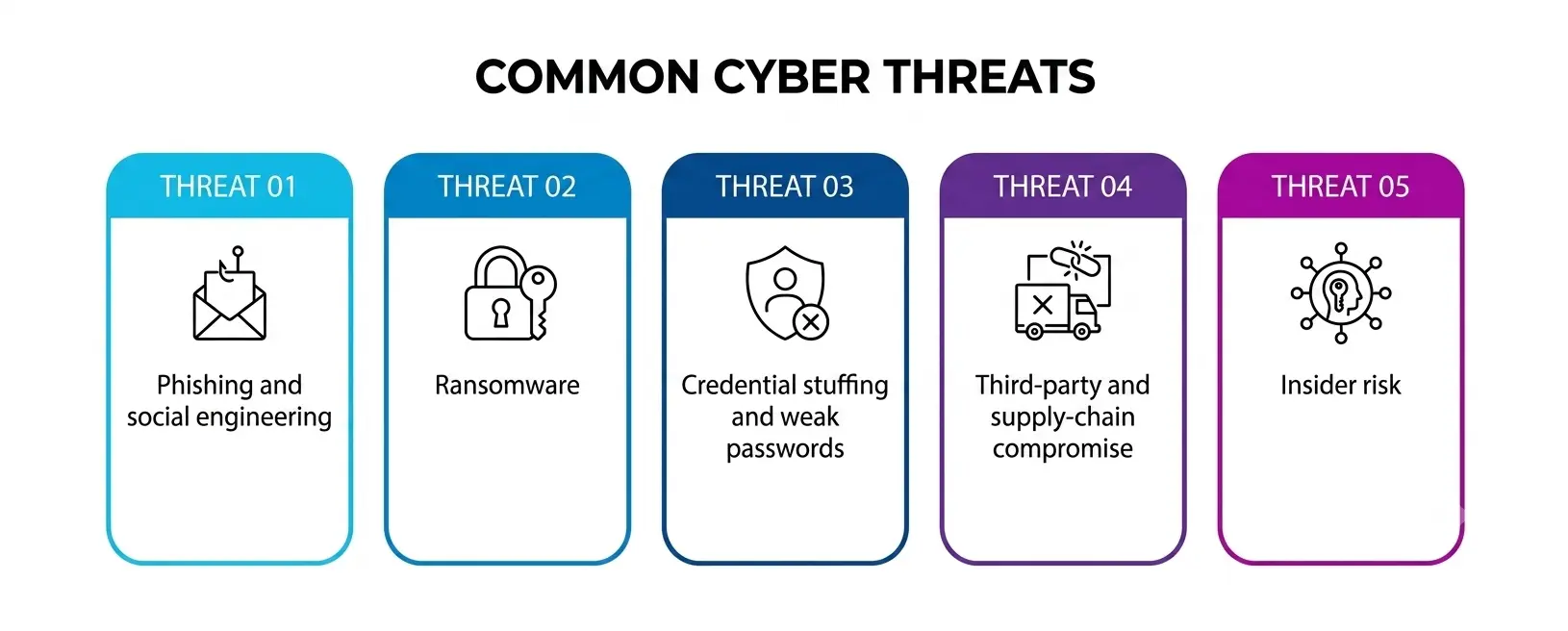
- Phishing and social engineering—still the most common way attackers get a foothold, because it targets people rather than code.
- Ransomware—attackers encrypt files and demand payment to unlock them, often paired with a second threat to leak stolen data even if the ransom is paid.
- Credential stuffing and weak passwords—reused logins from an unrelated breach elsewhere frequently unlock accounts on unrelated systems too.
- Third-party and supply-chain compromise—a vendor’s weak security becomes an organization’s problem the moment their systems connect.
- Insider risk—not always malicious; often just an employee misconfiguring a cloud storage folder or sending the wrong attachment.
Each of these threats calls for a different kind of defense, which is why a single antivirus tool was never going to be enough on its own. Layered protection—strong authentication, monitoring, employee training, and a tested incident-response plan—is what actually limits damage when, not if, something goes wrong.
Students studying business, computer science, or even communications should recognize this list. It’s less about memorizing attack names and more about understanding that most incidents exploit a gap between what a policy says on paper and what people actually do day to day.
The Role of Data Encryption
If there’s one control that consistently reduces both the likelihood and cost of a breach, it’s encryption. Encryption scrambles information so that even if an attacker steals it, the stolen files stay unreadable without the correct key.
Two versions of this matter in practice. Encryption “at rest” protects data sitting in a database or on a hard drive. Encryption “in transit” protects data as it moves between a browser and a server, or between two internal systems. A company can have excellent data encryption for customer payment details and still leave internal emails or backup files completely exposed—attackers look for exactly that kind of gap.
The NIST Cybersecurity Framework, a free resource built specifically with smaller organizations in mind, lists data encryption alongside access control and regular backups as a baseline protection every business should have, regardless of size or budget.
It’s written in plain language rather than government jargon, which makes it a genuinely useful starting point for students who want to see what real-world security guidance actually looks like.
Security Compliance: The Rules Businesses Can’t Ignore
Even companies with strong technical defenses can land in serious trouble if they mishandle data in ways that violate the law. That’s where security compliance comes in—the set of legal and industry standards dictating how organizations must collect, store, and protect personal information.
The General Data Protection Regulation (GDPR) is the best-known example. It applies to any organization handling the personal data of EU residents, regardless of where the company itself is based, and violations can carry fines of up to 4 percent of annual global revenue. Healthcare organizations in the US face HIPAA; payment processors face PCI-DSS; publicly traded companies face disclosure rules around breach-reporting timelines.
Meeting these standards isn’t a legal hurdle to clear once and forget. Regulators increasingly expect ongoing evidence—audit logs, documented policies, proof that employees were trained—rather than a one-time certificate on the wall.
For students heading into finance, healthcare, or law, understanding these obligations is genuinely useful career knowledge, since almost every industry now has some data-handling regulation attached to it.
The overlap between security compliance and good day-to-day practice isn’t a coincidence—most frameworks were written by studying real incidents and asking what would have prevented them.
Building Cyber Resilience, Not Just Cyber Defense
Here’s an uncomfortable truth worth sitting with: no company, no matter how well-funded its security team, can guarantee it will never be breached. That’s why the more useful goal isn’t perfect prevention—it’s cyber resilience, the ability to detect an incident quickly, contain it, and keep operating while recovering.
IBM’s research backs this up directly. Organizations with extensive AI-assisted detection and automation saved an average of $1.9 million per breach compared to those without it, largely because they identified and contained incidents faster. Speed of response, not the absence of incidents, is what separates a costly headline from a manageable disruption.
Practical resilience looks like this: regular, tested backups stored separately from the main network; a written incident-response plan naming who does what in the first 24 hours; and periodic drills so that plan isn’t being read for the first time during an actual crisis.
This kind of resilience also has a people dimension that’s easy to overlook. A team that can report a suspicious email without fear of blame will surface problems faster than one where employees quietly hope nobody notices their mistake. Building that culture is arguably cheaper than any software license, and it compounds over time in a way that a single security tool never will.
Security Best Practices at a Glance
For students trying to hold all of this together at once, here’s a simplified breakdown of where the core ideas fit:
|
Practice |
What It Protects Against |
Who Should Prioritize It |
|
Data encryption |
Data theft during storage or transfer |
Any business handling customer or payment data |
|
Multi-factor authentication |
Credential theft and phishing follow-through |
Teams using cloud accounts or shared logins |
|
Regular software patching |
Exploited vulnerabilities and zero-day attacks |
IT teams and remote-work-heavy organizations |
|
Employee security training |
Social engineering and insider mistakes |
All staff, not just technical teams |
| Breach duration and total recovery cost |
Businesses of any size, especially SMBs |
|
|
Compliance audits |
Legal and regulatory penalties |
Companies handling EU, healthcare, or payment data |
This isn’t an exhaustive list, but it covers the areas that show up most often in real breach reports—which tells you where attackers actually find success, not just where security vendors want their budget spent.
Good business data security usually looks boring from the outside: patched systems, trained staff, and tested backups. It’s the absence of drama, not the presence of it, that signals things are working.
What Students and Early-Career Professionals Should Actually Do?
If you’re studying business, IT, or any discipline that touches customer data, here’s where to start rather than trying to absorb everything at once.
First, learn how these fundamentals apply to your specific field—a marketing student should understand how customer email lists get protected; a finance student should understand how transaction data is handled and stored.
Second, practice recognizing phishing attempts. This sounds obvious, but most people have never actually seen a real phishing email placed side-by-side with a legitimate one.
Third, if you’re doing an internship or starting a first job, ask what encryption standards the company uses and whether you’re expected to complete security compliance training. Asking these questions early signals to employers that the responsibility is being taken seriously—and it’s genuinely rare, since most new hires never ask.
Finally, follow one credible source instead of doomscrolling security news. The IBM and Verizon annual reports referenced throughout this piece are free, published yearly, and written to be readable by non-specialists—a better use of study time than a dozen scattered blog posts.
Conclusion
None of this requires turning a company into a fortress overnight. Business data security is built incrementally—encrypt what matters most first, train people continuously rather than annually, and treat security compliance requirements as a floor, not a ceiling.
The organizations hurt worst by a data breach are rarely the ones without any defenses; they’re the ones whose defenses existed on paper but were never tested, updated, or actually followed.
The threat landscape will keep shifting—cyber threats powered by AI are already reshaping how phishing and impersonation work, and that trend isn’t reversing. What stays constant is the value of fundamentals: encryption, access control, a documented response plan, and a culture where reporting a mistake is safer than hiding it.
Whether you’re running a company or about to enter the workforce, business data security and cyber resilience aren’t separate specialties reserved for IT departments anymore. They’re baseline literacy for anyone who will ever touch a customer record, a company laptop, or a shared drive.
A Personal Note
I’ve sat through enough post-breach conversations to notice a pattern: almost nobody says “we didn’t know this could happen.” What they usually say is “We knew, and we kept meaning to fix it.” That gap between knowing and doing is where most damage actually happens.
If this piece leaves you with one takeaway, let it be this—pick one weak spot in your own digital habits this week, whether that’s a reused password or an unencrypted backup, and actually fix it. Security isn’t built in a single overhaul; it’s built in a series of small, unglamorous decisions that nobody notices until the day they matter enormously.