
If you’re stepping into the world of cybersecurity, you’ve probably heard people throw around the term “maturity” like it’s obvious what it means. It isn’t. Most students assume security is something an organization either “has” or “doesn’t have.” In reality, security exists on a spectrum, and the tool professionals use to figure out where an organization sits on that spectrum is called a security maturity assessment.
Recruiters mention it in interviews, professors reference it in lecture slides, and yet very few people ever explain what actually gets measured or why it carries so much weight in the industry. Once you understand this one concept, half the confusing jargon in cybersecurity job postings, frameworks, and audit reports suddenly makes sense.
This guide breaks down what this process actually involves, why it forms the backbone of almost every serious cybersecurity program, and how you can start thinking like an assessor even before you land your first internship or job.
What Is a Security Maturity Assessment?
A Security Maturity Assessment is a structured evaluation of how well an organization’s people, processes, and technology work together to manage cyber risk. It doesn’t just ask “do you have a firewall?” It asks deeper questions: Is your incident response tested? Are your policies actually followed, or just written down somewhere and forgotten? Do your employees understand their role in protecting data? Taken together, the answers to these questions paint a far more honest picture of an organization’s security posture than any single tool inventory ever could.
Unlike a simple checklist, this kind of review measures depth. An organization might have antivirus software everywhere and still score low, because maturity is about consistency, repeatability, and improvement over time, not just the presence of tools.
This is exactly what the NIST Cybersecurity Framework captures through its tiers, which describe how well cybersecurity risk management practices are integrated into an organization’s broader operations.
For students, this distinction matters. You’re not just learning to spot missing controls. You’re learning to judge how reliably an organization can sustain good security practices under pressure.
Why Should Students Care About This Early?
Most cybersecurity courses teach tools first: firewalls, SIEMs, penetration testing platforms. Fewer teach the thinking behind a Security Maturity Assessment, even though it’s one of the most commonly requested skills in junior GRC (Governance, Risk, and Compliance) and security analyst roles.
That gap in the curriculum is exactly why so many new graduates struggle in their first few months on the job, even when their technical exam scores were excellent.
Here’s the uncomfortable part: technical skills alone won’t get you far if you can’t explain why a control matters to a non-technical manager. Assessment work forces you to translate technical gaps into business risk, a skill that separates entry-level hires from people who get promoted quickly. Learning how this process is structured, scored, and reported gives you a head start that most of your peers won’t have.
The Building Blocks: Gap Analysis and Beyond
At the center of every review sits a gap analysis. This comparison looks at an organization’s current security practices against a defined standard or benchmark, then documents exactly where the shortfalls are. Think of it as the diagnostic step before treatment: you can’t fix what you haven’t measured.
A good version of this exercise doesn’t stop at spotting weaknesses. It prioritizes them. Not every gap carries the same risk, so part of the analyst’s job is ranking issues by likelihood and potential impact.
Programs like the Cyber Resilience Review run by CISA are built almost entirely around this idea, evaluating an organization across multiple operational domains and producing a gap analysis that highlights where resilience is weakest.
Students often skip straight to recommending fixes without doing the diagnostic groundwork first. Resist that urge. Assessors who jump to solutions before fully mapping the current state tend to produce reports that miss the real problem.
How a Security Maturity Assessment Works, Step by Step?
In most organizations, this is a simplified version of what actually happens during this kind of review:
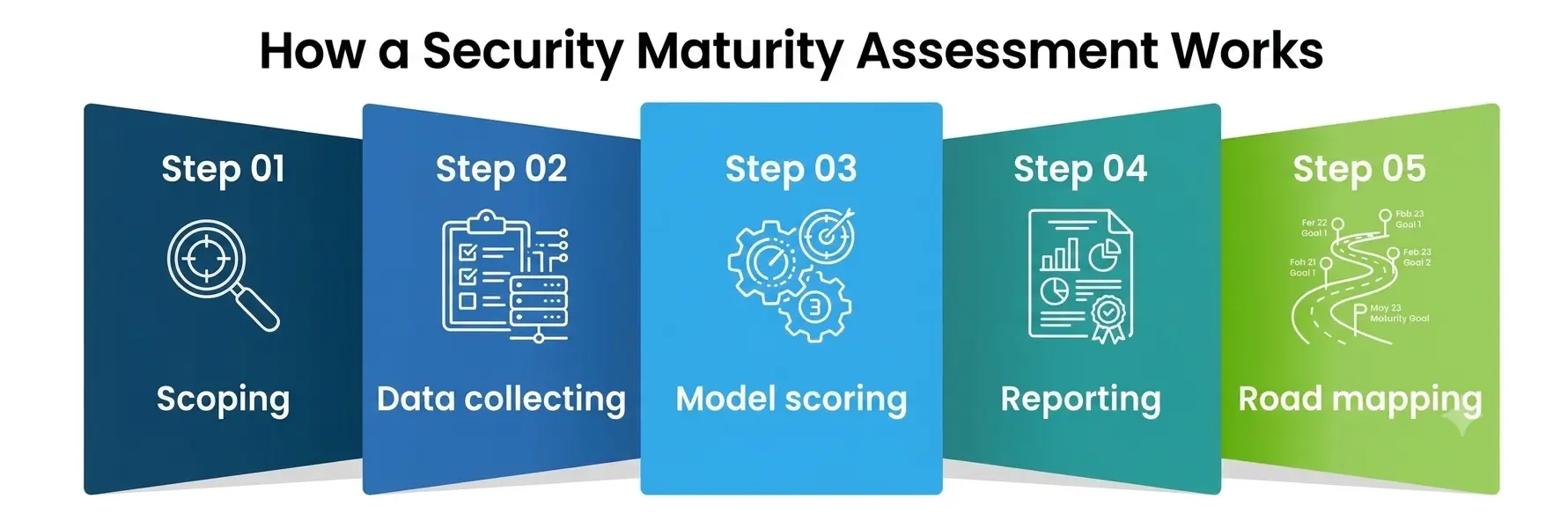
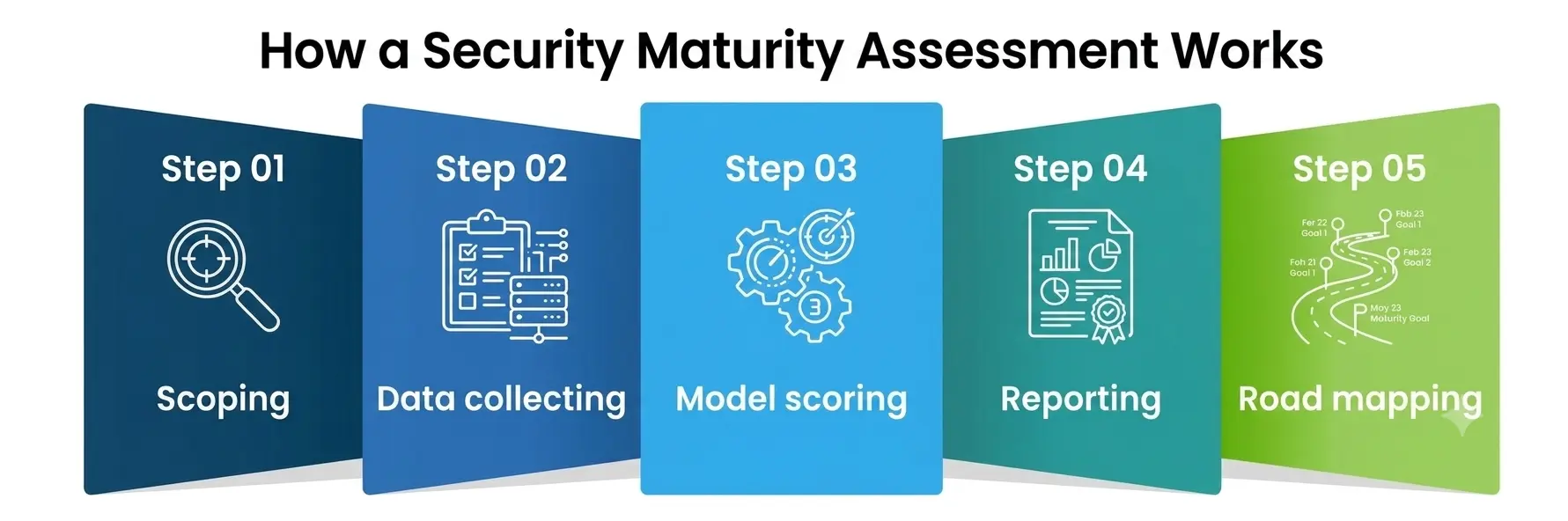
- Scoping. Identify the systems, departments, or business units to be audited.
- Data collecting. Review documentation, interview staff, and review technical configurations.
- Model scoring. Compare the results to a maturity model and rate each domain.
- Reporting. Deliver a summary of strengths, weaknesses, and overall security posture in a format that leadership can act on.
- Road mapping. Turn findings into a prioritized plan for improvement.
Notice that scoring is always scored against something. Assessors do not create their own criteria but map their findings to a defined cybersecurity framework or maturity model, providing consistent and comparable results across audits. Here a standard such as ISO/IEC 27001 can help, as it offers assessors a recognized framework to decide if an information security management system is working as it ought.
A Simple Look at Maturity Levels
Most maturity models use a five-level structure, even though the exact wording varies between frameworks. Here’s a simplified version that’s common across many assessment methodologies:
|
Maturity Level |
What It Looks Like |
Typical Organizational Behavior |
|
Initial |
Ad hoc, undocumented, reactive | Fixes happen after incidents, not before |
|
Developing |
Some processes exist but are inconsistent |
Depends heavily on specific individuals |
|
Defined |
Documented, standardized processes |
Policies exist and are mostly followed |
|
Managed |
Measured and monitored regularly |
Metrics guide decisions, not guesswork |
| Optimized | Continuously improved |
Lessons from incidents feed back into policy |
Knowing where an organization sits on this scale isn’t about assigning blame. It’s about setting realistic next steps. Jumping from Level 1 to Level 5 overnight isn’t possible, and pretending otherwise wastes budget and credibility.
Aligning Your Review With a Recognized Cybersecurity Framework
A security maturity assessment only carries weight if it’s anchored to something recognized outside the organization doing it. That’s why most assessors map their findings to an established cybersecurity framework rather than inventing their own criteria from scratch.
The Department of Energy’s C2M2 model is a good example: it defines specific practices across ten domains and measures how consistently an organization performs them, giving assessors a shared cybersecurity framework that regulators and auditors already understand.
Using a recognized framework also makes your gap analysis defensible. If a client or employer questions your findings, you can point to an established methodology rather than personal opinion. That credibility matters more than most students realize until they’re sitting across from a skeptical CISO.
From Assessment to Resilience Planning
Finding gaps is only half the job. The other half is resilience planning: turning results into a realistic plan for withstanding and recovering from cyber incidents. Good planning at this stage doesn’t just patch today’s weaknesses; it builds the organization’s capacity to absorb tomorrow’s unknown threats.
This is where a security maturity assessment earns its value. Instead of a one-time report that gathers dust, it becomes the foundation for a living roadmap. Resilience planning driven by real evaluation data tends to survive budget cuts and leadership changes better than plans built on assumptions, because it’s backed by evidence rather than guesswork about the organization’s security posture.
Students entering the field should practice this translation skill specifically: take a list of findings and turn it into a phased recovery roadmap with realistic timelines, not just a wish list of fixes.
Why Does Cybersecurity Governance Tie It All Together?
None of this works without cybersecurity governance, the structure of policies, roles, and accountability that decides who actually acts on assessment findings. A brilliant set of findings means nothing if no one has the authority, budget, or responsibility to fix what it uncovers.
Strong cybersecurity governance ensures that a security maturity assessment doesn’t just sit in a shared drive somewhere. It assigns ownership to specific findings, sets deadlines, and creates reporting lines up to leadership or the board.
Organizations like ISACA have spent years documenting why cybersecurity governance, not just technology, determines whether security investments actually pay off. For students aiming at GRC roles specifically, this is worth remembering: governance is not the boring paperwork side of security. It’s the mechanism that turns findings into real change.
Common Mistakes to Avoid
A few patterns show up again and again in weaker reviews, and they’re worth knowing before you write your first report:
- Treating this diagnostic step as a one-time event instead of a recurring practice.
- Focusing only on technical controls while ignoring people and process failures.
- Presenting findings without context, so leadership can’t judge urgency or the true security posture at stake.
- Skipping stakeholder interviews and relying purely on automated scans.
- Failing to revisit resilience planning after major organizational changes, like mergers or new technology rollouts.
Avoiding these mistakes won’t make you an expert overnight, but it will make your early work noticeably more credible than reviews built on shortcuts, and credibility is what gets you invited back for the follow-up engagement.
Tools and Skills That Support This Work
You don’t need an expensive toolkit to start practicing this kind of thinking. A spreadsheet is often enough to build your first maturity scoring matrix, and free versions of established frameworks give you real criteria to score against instead of inventing your own. What matters more than the software is the habit of asking “compared to what standard?” before declaring anything secure or insecure.
Interviewing skills matter just as much as technical ones. Much of the raw material for a review comes from conversations with IT staff, department heads, and sometimes finance or HR, not from automated scanners.
Practicing how to ask open-ended questions without leading the person you’re interviewing is worth developing early, ideally with classmates or a mentor willing to role-play a skeptical department head.
Writing matters too. A report that buries the real risk under ten pages of technical detail won’t get read by the people who control the budget. Improving an organization’s security posture in the eyes of leadership often has less to do with finding more vulnerabilities and more to do with explaining the ones you already found in language a board member can act on. Practice summarizing a finding in two sentences: what’s wrong, and what happens if it stays that way?
Where Does This Fit in Your Cybersecurity Career?
Whether you’re aiming for a SOC analyst role, a GRC position, or eventually a CISO seat, understanding how a security maturity assessment is built gives you a vocabulary that connects technical work to business decisions.
It’s one of the few skills that stays relevant whether you specialize in cloud security, application security, or risk management, because every specialty eventually gets measured against some kind of maturity model.
If policy work appeals to you more than packet captures, roles centered on cybersecurity governance can be just as viable a long-term path as a purely technical track, and they tend to open up once you have a few real reviews on your resume.
Start small. Practice mapping a fictional company’s controls to a public framework, write a mock shortfall analysis, and try drafting a one-page recovery roadmap. These exercises mirror real consulting and internal audit work far more closely than most classroom labs do.
A Personal Note
I’ve read a lot of security reports over the years, and the ones that stood out were never the longest or most technical. They were the ones written by people who clearly understood that this process isn’t paperwork; it’s a conversation between the technical team and the people who control the budget.
Early in my own learning, I made the mistake of thinking a longer report meant a more thorough one. It usually meant the opposite: a report nobody had the discipline to edit down to what actually mattered. If you’re a student reading this, don’t just memorize frameworks. Practice explaining a gap in plain language to someone who has never touched a terminal. That skill will outlast every specific tool you learn in school.